
A $500 Thank-You for the Spouse Who Grieved Your Ferret: A Keepsake to Share
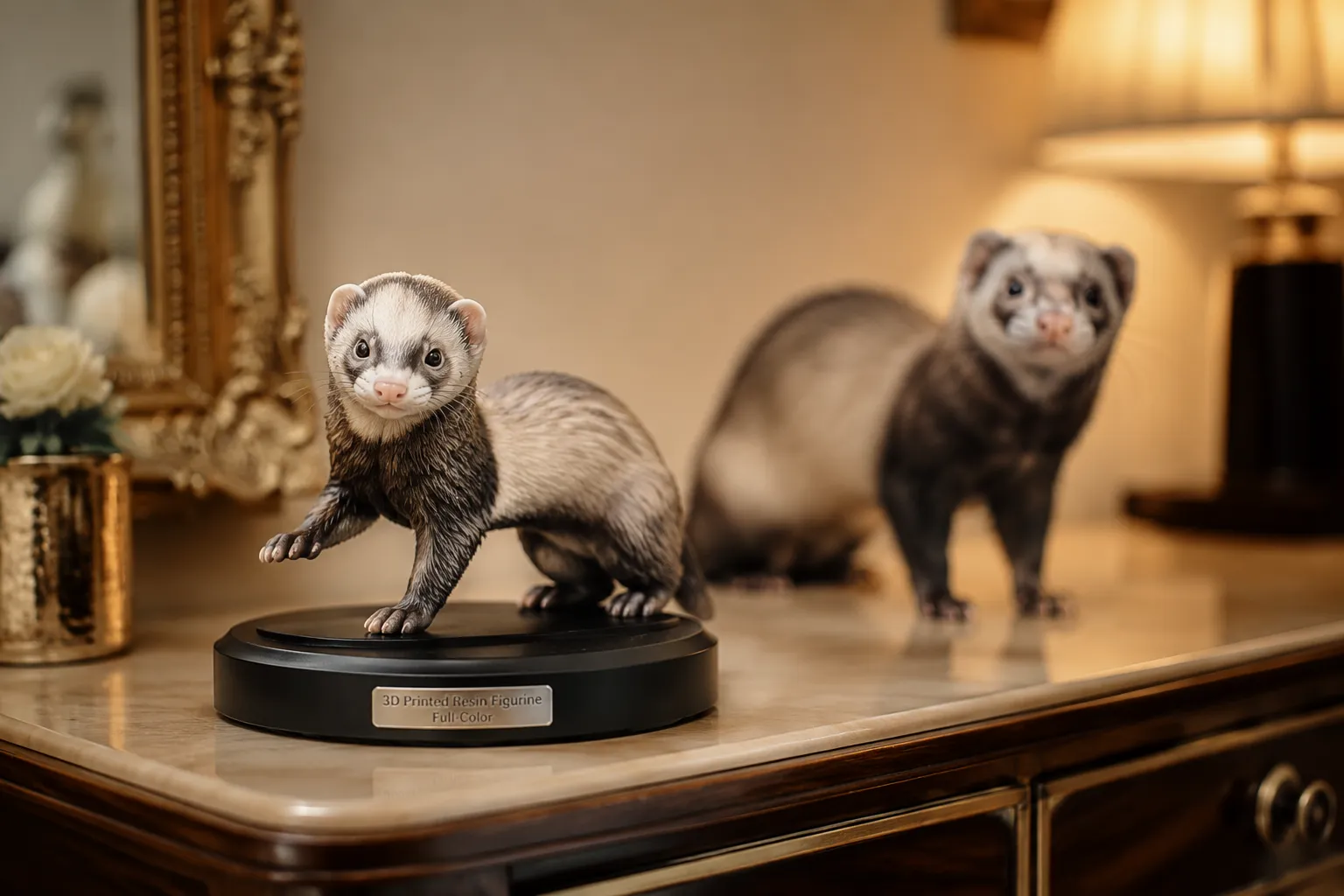
The screen door on the front porch slapped shut the way it always did, but this time you turned to the person beside you and realized the best thank you gift for spouse isn't flowers or a watch. It's something shaped like the ferret who used to nap in the crook of their elbow on this exact porch.
Quick Takeaways
- Grief is rarely shared equally — naming your spouse's quiet loss often matters more than the gift itself.
- A $500 splurge signals "I saw you" — the price tag communicates effort when words run dry.
- Choose a gift you can both touch — shareable keepsakes outperform private ones in long-term comfort.
- A full-color custom ferret figurine captures markings photos eventually fade from memory, so a 3D likeness anchors the details.
- Presentation beats price — how you hand it over shapes the memory more than the dollar amount.
The Grief Nobody Sent a Card For
Here is the part most gift guides skip entirely. When a ferret dies, the cards and casseroles (if they come at all) get addressed to the person who picked the pet out, fed it, named it. The spouse who grew to love that weasel-shaped chaos machine second-hand? They grieve in the margins.
We've worked with thousands of pet families, and a pattern shows up again and again. One partner carries the "official" grief. The other carries a quieter version, the kind that has no socially approved outlet. They were the one who started leaving the bathroom door open so the ferret could explore. They were the one who learned to check inside their shoes before putting them on.
"Secondhand grief is still grief. It just never gets its own funeral."
That's the angle nobody talks about. A thank-you gift for a grieving spouse isn't really about the ferret. It's about acknowledging a loss that the rest of the world didn't bother to notice.
Why the brain treats this loss as real
Attachment theory isn't only for people. Your spouse's nervous system bonded to that animal through repetition, proximity, and routine. The technical term is co-regulation — two beings whose stress hormones settle when they're near each other.
When the ferret darted across the floor and your spouse laughed, their cortisol (the body's main stress hormone) dropped a notch. Do that a few thousand times over several years and the brain wires a genuine relationship. The death of that animal removes a daily source of calm.
So when your spouse seems "fine" but a little flat, a little distant, that's not them being dramatic. That's a real neurological absence. The corner where the cage sat now reads as wrong to their visual system, the way a missing tooth feels wrong to your tongue.

Why a $500 Gift Actually Makes Psychological Sense
Most people flinch at spending real money on a memorial. It feels indulgent. Here's the counterintuitive part: the price isn't the point, but it isn't meaningless either.
Researchers who study gift-giving have found that perceived effort drives how loved a recipient feels, more than the item itself. And in long marriages, where partners often default to practical gifts (a new coffee maker, socks, a gas card), a deliberate splurge breaks the pattern. It says: this one is different. This one I thought about.
A splurge pet gift in the $400 to $600 range hits a specific sweet spot. It's expensive enough to signal seriousness, but not so extravagant that it creates discomfort or obligation. Go too cheap and it reads as an afterthought. Go to $2,000 and your spouse spends the next month worrying about the budget instead of feeling comforted.
"The right gift removes guilt. The wrong gift adds a new worry on top of the old grief."
Think of the $500 figure less as a price and more as a message. It's the cost of saying "your grief was worth my full attention" in a language money happens to speak fluently.
The "shared object" advantage
Here's something we learned the slow way. The most comforting memorials aren't the ones tucked into a drawer. They're the ones that live in shared space.
A locket holds memory for one person. A figurine on the mantel holds it for the whole household. When you choose a shareable memorial gift, you're not just giving your spouse a private comfort. You're creating a small ritual you can both participate in, a fixed point in the room you both walk through.
This matters more than it sounds. Grief that gets to be communal heals differently than grief that stays sealed off. The object becomes permission to keep talking about the ferret instead of pretending the loss already closed.
The Best Splurge Gifts for a Spouse Who Grieved
Let's get specific. Below are gift options that work for this exact situation — honoring a spouse's quiet grief over a lost ferret. We've ranked them by how well they function as something you can share, not just something to own.
First, a quick comparison to orient you:
| Gift Option | Budget Range | Best For | Shareable? |
|---|---|---|---|
| Custom full-color figurine | $300–$600 | Capturing exact markings & pose | Yes — lives in shared space |
| Commissioned portrait illustration | $150–$500 | Wall-art lovers | Yes — but flat, less tactile |
| Engraved jewelry / locket | $200–$800 | Private daily comfort | No — worn by one person |
| Memorial garden installation | $250–$700 | Outdoor-focused families | Yes — but seasonal |
| Custom storybook of the pet | $80–$250 | Families with kids | Yes — but reads as "done" |
| Star/tree dedication | $50–$150 | Symbolic gesture | Low — abstract, no object |
Now the detailed picks.
The Custom Full-Color Figurine
Who it's for: The spouse who keeps scrolling through old phone videos because they're scared of forgetting exactly what the ferret looked like.
Budget: $300–$600 depending on size and detail.
A figurine wins for one reason most people don't anticipate: it's three-dimensional, which means it engages the part of memory that flat photos can't reach. Your spouse can hold it. They can see the curve of the back, the specific way the mask marked the face, the proportions that made your ferret your ferret and not a generic one.
PawSculpt builds these through full-color resin 3D printing, where the color is printed directly into the material rather than added on top. The result captures the actual markings — the sable saddle, the cream bib, the dark stockings — instead of an approximation. There's a natural fine texture to the finish, sealed with a clear protective coat, so it reads as something real and held, not factory-glossy.
Pro tip: Send a photo where the ferret is in a recognizable pose — mid-bottlebrush tail, or curled in their sleep-sack. Personality lives in posture, not just coloring.
A Commissioned Portrait Illustration
Who it's for: Spouses who already think in terms of "what goes on the wall."
Budget: $150–$500 for a quality custom piece.
A good illustrated portrait turns the ferret into a small piece of art that fits the home's existing style. The strength here is aesthetic flexibility — you can match the frame, the palette, the room.
The limitation, honestly, is that it stays flat and stays on the wall. It becomes part of the décor, which is lovely, but over months it can fade into the background the way wall art does. You stop seeing it.
Pro tip: Pair the illustration with a short handwritten note tucked into the frame's back. The note ages into a treasure.
Engraved Memorial Jewelry
Who it's for: A spouse who wants comfort they can carry, privately, all day.
Budget: $200–$800, climbing fast with precious metals or ash inclusion.
Jewelry is intimate. A pendant that holds a tiny bit of fur or a paw-print engraving stays against the body, which some grieving people find profoundly grounding.
But it fails our shareable test. Only one person wears it. If your goal is to create a comfort you both return to, jewelry pulls in the opposite direction — it's personal, not communal. That's not wrong, it just depends on what your spouse needs.
Pro tip: If you go this route, get something your spouse would genuinely wear, not just keep in a box. Match their actual style, not the "memorial jewelry" aesthetic.
A Memorial Garden Corner
Who it's for: Outdoorsy couples with a porch, patio, or yard the ferret never actually used but the family loves.
Budget: $250–$700 for a designed installation with a marker.
There's a real psychological benefit to a living memorial. Tending something growing gives grief a forward motion — you're caring for life in the name of a life that ended.
The catch is seasonality and effort. It's beautiful in spring and a bit bleak in February. And not everyone has the space or the gardening interest to keep it from becoming a sad, weedy reminder.
Pro tip: Plant something hardy and low-maintenance. Grief shouldn't come with a chore list.
A Custom Storybook of Their Life
Who it's for: Families with children who also loved the ferret.
Budget: $80–$250.
For households with kids, a small printed book that tells the ferret's story does double duty — it helps children process loss while giving your spouse a keepsake to read aloud.
The downside is subtle. A book has an ending. Once you've read it, it can feel "complete," which is the opposite of what ongoing grief needs.
Pro tip: Leave a few blank pages at the back for the family to add memories over time. It keeps the story open.
What We Wish We Knew Sooner
A candid sidebar from our team, the stuff we figured out only after thousands of orders.
- We wish we'd known that the spouse who "didn't pick out the pet" often grieves hardest. The gift you're shopping for may be more needed than you realize.
- We wish more people sent photos of the pet awake and being weird. The sleeping-angel shots are sweet, but the goofy ones capture who the animal actually was.
- We wish we'd told people sooner: don't wait for the "right time." There isn't one. The gift lands harder three weeks after the loss than at some imagined perfect anniversary.
- We wish folks knew the small details matter most. A spouse will gasp at a correctly captured ear-notch or a kinked tail long before they notice the overall size.
- We wish we'd learned earlier that men, especially, grieve pets in near-total silence. A tangible object gives that silent grief somewhere to go.
"We've watched a grown man go quiet, pick up a figurine of his wife's ferret, and finally let himself cry. Grief needs an anchor."
— The PawSculpt Team
How to Choose the Right Gift for Your Spouse
Skip the guessing. Match the gift to how your spouse actually processes loss. We've found grieving partners tend to fall into a few patterns, and the right gift differs for each.
| If your spouse... | They likely need... | Best gift match |
|---|---|---|
| Keeps rewatching old videos | A way to "see" the pet in 3D | Custom figurine |
| Wants comfort all day, privately | Something on their body | Memorial jewelry |
| Talks about the pet constantly | A shared conversation piece | Figurine on the mantel |
| Has gone very quiet | A non-verbal outlet for grief | Tactile keepsake to hold |
| Loves the garden/outdoors | Forward-motion, living ritual | Memorial garden |
Here's the "if-then" logic that helps most. If your spouse is the silent type, then prioritize something they can hold without having to explain why. Tactile objects let grief move through the hands when it can't move through words.
If your spouse is a talker, then prioritize visibility. A keepsake displayed in a shared room becomes an invitation to keep telling the stories, which is exactly the processing they need.
"The best memorial isn't the one that says goodbye. It's the one that keeps the conversation going."
The detail that changes everything: get the markings right
This is the insider knowledge piece. With ferrets specifically, the markings are wildly individual — sables, albinos, pandas, blazes, mitts. A generic "ferret-shaped" anything will quietly disappoint, even if your spouse smiles politely.
The reason a custom pet figurine outperforms an off-the-shelf memorial is precision. When PawSculpt's digital sculptors model the piece, they're working from your photos to reproduce your ferret's exact coat pattern and proportions, then printing it in full color directly into the resin. Your spouse's brain will recognize it instantly, and that flash of recognition is the whole point.
If you want to understand how grief and the human-animal bond actually work at a deeper level, the Association for Pet Loss and Bereavement offers genuinely useful resources. We're not grief counselors, so for a spouse who's really struggling, that kind of support matters more than any object we can make.
Timing and Presentation: The Part That Multiplies the Value
You can buy the perfect gift and still fumble the moment. Here's how to land it.
1. Don't ambush them in a crowd. Grief-related gifts hit hardest in private. Choose a quiet evening, the two of you, no audience. The front porch at dusk works beautifully if that's where your ferret memories live.
2. Say the quiet part out loud. Before you hand it over, name what you're thanking them for. "You loved Pip too, and I don't think anyone ever acknowledged that. This is me acknowledging it." That sentence does more work than the gift.
3. Let them have the reaction they have. Some people cry. Some go quiet. Some laugh from relief. Don't manage their response or rush to fill the silence. Just be present.
4. Place it together. If it's a figurine, decide as a couple where it goes. The act of choosing the spot, that corner of the bookshelf, the windowsill where the afternoon light hits, turns the object into a shared ritual instead of a one-time present.
"A gift handed over with the right words becomes a memory. Handed over silently, it's just an object."
There's a small body of research on the human-animal bond suggesting that continuing bonds — staying connected to a pet's memory rather than "moving on" — actually supports healthier grief. A displayed keepsake is a continuing bond made physical. You're not telling your spouse to get over it. You're telling them it's okay to keep loving Pip out loud.
A timeline that tends to work
For those who like a concrete sequence, here's the rhythm we've seen land well:
- Week 1–2 after the loss: Hold off. The shock is too fresh, and a gift can feel like pressure to perform gratitude.
- Week 3–6: The sweet spot. The casseroles have stopped, the world has moved on, and your spouse is entering the lonely stretch where a thank-you means the most.
- Anniversaries and "would-have-been" dates: Strong secondary windows if you missed the early one.
The mistake most people make is waiting for a milestone — the one-year mark, a birthday. By then your spouse has weathered the hardest part alone. The gift comforts more when it arrives during the quiet, unmarked grief, not the publicly acknowledged kind.
Making It Last: Caring for a Keepsake Figurine
A splurge gift should outlive the grief that prompted it. Quick practical notes if you choose a resin figurine:
- Keep it out of harsh, constant direct sunlight if possible, though quality pieces use UV-resistant materials. Filtered light is fine and honestly shows the color best.
- Dust with a soft, dry cloth. No harsh cleaners on the protective coat.
- Give it a stable spot. A shelf where it won't get knocked by a door swing or a curious current pet.
The point of durability is emotional, not just practical. Your spouse should be able to look at this thing in twenty years and still see Pip clearly, long after the phone photos have migrated to some forgotten cloud account nobody remembers the password to.
Bringing It Back to the Porch
Picture that front porch again. The screen door, the creak in the same spot, the empty patch of floor where a ferret used to do that ridiculous war dance.
Now picture a small full-color figurine on the windowsill catching the last of the evening light, and your spouse glancing at it the way you glance at someone you love across a room. Not with fresh pain. With a kind of settled tenderness, because someone finally said out loud: your grief counted too.
The best thank you gift for spouse isn't a transaction. It's a translation — turning the loss they carried quietly into something the two of you can hold together. Spend the $500 if you can. Not because the figurine is worth exactly that, but because your spouse's unspoken grief was worth your full, deliberate attention.
Go sit on the porch tonight. Tell them you noticed. Then give them something to hold while you do.
Frequently Asked Questions
How much should I spend on a thank-you gift for a grieving spouse?
Somewhere in the $300 to $600 range works for most couples. It's enough to signal that you put real thought and effort in, but not so much that your spouse spends the next month worrying about the budget instead of feeling comforted. The exact number matters less than the intention behind it.
Is a custom figurine a good ferret memorial keepsake?
It's one of the strongest options, especially for ferrets, because their markings are so individual. A full-color 3D figurine reproduces the actual coat pattern and proportions, and because it's three-dimensional, it engages memory in a way flat photos can't. It also lives in shared space, so it becomes a comfort you both return to.
When is the best time to give a memorial gift after a pet dies?
The three-to-six-week window tends to be ideal. The initial shock has eased, but the rest of the world has moved on, which is exactly when grief gets lonely. Giving the gift during that quiet stretch — rather than waiting for the one-year anniversary — usually lands with more impact.
Why should I thank my spouse for grieving a pet they didn't even pick out?
Because the partner who didn't choose the pet often grieves the hardest and the most silently. There's no card, no casserole, no acknowledgment for their loss. Naming it and thanking them validates a real attachment and can strengthen your relationship more than you'd expect.
What's the difference between a shareable gift and a private one?
A shareable memorial gift lives in common space — a figurine on the mantel, a portrait in the hallway — so both of you return to it and keep the memory alive together. Private gifts like jewelry comfort one person. Neither is wrong, but if you want a shared ritual, choose something the whole household can see and touch.
Will a custom figurine really look like our specific ferret?
When it's built from clear photos, yes. The detail comes down to the source images — send a shot that shows your ferret's markings and a recognizable pose. The more personality and pattern visible in the photo, the more your spouse will recognize their companion instantly.
Ready to Celebrate Your Pet?
Every pet has a story worth preserving. Whether you're honoring a beloved companion who's crossed the rainbow bridge or searching for the right thank you gift for spouse to acknowledge the grief they carried quietly, a custom PawSculpt figurine captures the markings, the pose, and the personality that made your ferret one-of-a-kind.
Visit pawsculpt.com to learn more about our full-color 3D printing process, flexible revisions, and quality guarantee