
College Student Grief: Losing Your Childhood Golden Retriever From Afar
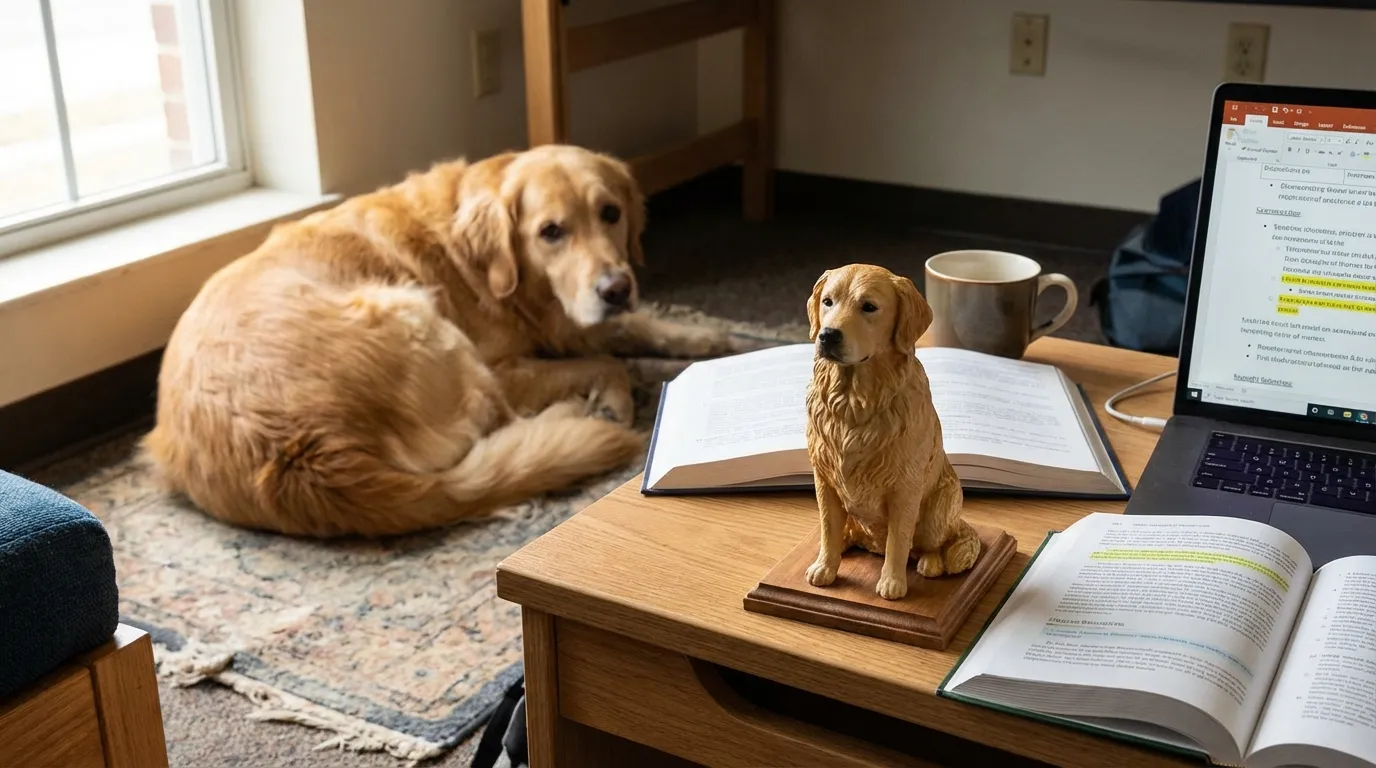
Does the grass in your parents' backyard still look the same where he used to lay, flattening the blades into a golden, dog-shaped nest near the oak tree? You can probably close your eyes right now and see the exact spot where the sun hit the lawn, the place where you spent hours tossing a tennis ball until your arm ached and his tongue lolled out in a goofy, satisfied grin.
But you aren't in that backyard. You’re hundreds of miles away, staring at a textbook or a laptop screen in a dorm room that smells like stale coffee and laundry detergent, trying to process a phone call that just shattered your childhood. Being away at college when the family dog passes away is a specific, disorienting kind of heartbreak that nobody really prepares you for. You don't get the closure of a final goodbye, and you don't have the comfort of a shared family cry in the living room. You are stuck in a strange limbo, grieving a loss that feels both devastatingly real and strangely theoretical because your immediate surroundings haven't changed—only your world has.
Quick Takeaways:
- Distance distorts grief: Not being present for the daily decline can make the loss feel surreal, leading to a "time capsule" effect where you only remember them as young and healthy.
- The "Study Guilt" is a lie: Regretting that you didn't go home for that random weekend three months ago is a common torture tactic of the brain, but it doesn't reflect the years of love you gave.
- Create a portable memorial: Since you can't visit the backyard grave, having a tangible connection—like a framed photo or a custom figurine on your desk—can help ground your grief in a new space.
- Communicate with professors: You don't need to overshare, but letting them know you've had a "family loss" can buy you necessary grace periods for assignments.
The "Time Capsule" Effect: Why Distance Makes It Harder
Here is the angle most people miss when talking about long-distance pet loss: You are likely grieving a different dog than your parents are.
For your parents, the grief has been a slow burn. They watched the muzzle turn white. They managed the medications, cleaned up the accidents, and helped your Golden Retriever up the stairs when his hips started to fail. They had months, maybe years, of "anticipatory grief"—the slow, painful acceptance that the end was coming.
You didn't see that.
When you picture your dog, you likely still see the vibrant, energetic animal you left behind after summer break or the holidays. Even if you knew he was "slowing down," you weren't confronted with the daily reality of his aging. This creates a cognitive dissonance known as the "Time Capsule Effect." Your memory of him is frozen in his prime, which makes the news of his death feel sudden and shocking, even if your parents say, "It was time."
This disconnect can create friction. You might feel angry that they "gave up too soon," while they might feel exhausted and misunderstood because they carried the burden of his care. It’s crucial to recognize that your shock is valid, but so is their relief that his suffering is over. You are mourning the end of an era; they are mourning the end of a struggle. Both forms of grief are heavy, but they weigh differently.
The Silent Scream in the Dorm Room
There is a profound isolation in grieving a pet while at university. If you lose a grandparent or a sibling, society understands. Professors grant extensions; roommates tread lightly. But when you lose a dog—especially a childhood dog who saw you through middle school angst, high school heartbreaks, and the terrifying transition to college—the world around you often keeps spinning with cruel indifference.
You might walk across the quad and see someone playing fetch with a campus therapy dog, and suddenly you’re weeping behind your sunglasses. You might be sitting in a lecture hall, surrounding by 200 people, feeling entirely alone because none of them knew him. To your roommate, he’s just a picture on your desk. To you, he was the only living being who listened to you without judgment for 15 years.
We’ve heard from students who felt they had to "perform normalcy." They go to parties, finish papers, and laugh at jokes, all while carrying a stone in their chest. This is "disenfranchised grief"—grief that isn't acknowledged or validated by the social environment.
The Counterintuitive Move: Stop looking for validation from people who didn't know the dog. It sounds harsh, but trying to explain the depth of your bond to a casual friend who just says, "Aww, that sucks," will only make you feel lonelier. Instead, lean heavily on the people from "home base"—your siblings, high school friends, or neighbors who actually knew the dog. They are the keepers of the memory. Text them. Share the ugly-cry selfies with them. Save your vulnerability for the people who earned it.
Confronting the "I Should Have Gone Home" Guilt
Let's talk about the 3 a.m. thoughts. The ones that whisper, I should have gone home last weekend instead of going to that football game. Or, I chose to study for midterms instead of spending his last birthday with him.
This guilt is corrosive. It eats away at the good memories.
Here is a hard truth we’ve learned from working with thousands of grieving families: Animals do not measure time in missed weekends. They measure it in the intensity of the connection when you were there.
Your Golden Retriever didn't spend his last months resenting you for being at college. Dogs live entirely in the present tense. When you came home for Thanksgiving, the explosion of joy he felt wasn't dampened by the fact that you were gone for September and October. It was pure, unadulterated happiness.
The "Relief" Nuance:
There is another, darker layer to this that few students admit: Relief.
You might feel a secret, shameful sense of relief that you weren't there for the very end. You didn't have to hear the final breath or see the light go out of his eyes. You get to keep the memory of him alive and well.
And then, immediately after feeling that relief, you feel like a monster for feeling it.
Please hear this: That relief doesn't make you a bad owner. It makes you human. It is a biological protection mechanism. It is okay to be grateful that your last memory of him was a tail wag, not a seizure or a syringe. Do not let guilt over your own self-preservation taint the love you had for him.
Managing the "Empty House" Visit
The hardest moment isn't necessarily the phone call. It’s the first time you go home for break after it happens.
You are used to the ritual: You unlock the front door, drop your bags, and brace yourself for the tackle—the click-clack of nails on hardwood, the "woo-woo" greeting, the fur flying everywhere.
Walking into a silent house is a physical blow. The absence of noise is deafening. You will instinctively look at the spot where his water bowl used to be. You will step over the place on the rug where he used to sleep.
How to prepare for the First Return:
- Ask for a "Warning Shot": Before you go home, ask your parents specifically what has changed. Did they put the bed away? Are the bowls gone? Is the leash still hanging by the door? Knowing what the physical space looks like beforehand can reduce the shock.
- Reclaim the Space: It might feel wrong to sit on "his" sofa cushion or walk in the backyard without him. But avoiding those spaces gives the grief more power. Go to his favorite spot in the yard. Sit there. Cry there. It’s a way of reclaiming the memory rather than running from the emptiness.
- The "Phantom" Senses: Be prepared for auditory hallucinations. You will swear you hear his collar jingle. This is your brain trying to fill in a pattern it has recognized for a decade. It’s not crazy; it’s neurology.
Rituals for the Long-Distance Griever
Since you cannot visit the grave or keep the urn on your dorm shelf, you need to create your own rituals to process the loss. Rituals act as containers for our emotions—they give the grief a shape and a place to go.
The Digital Wake
Gather your siblings or high school friends on a Zoom call specifically to tell stories. Not to catch up on life, but to focus entirely on the dog. Share the "greatest hits": the time he ate the Thanksgiving turkey, the time he knocked over the Christmas tree, the specific way he smelled after rain. Laughing at these stories releases the same endorphins as hugging him used to.The "Proxy" Memorial
You need something physical. We are tactile creatures. When we lose a pet, we lose the sense of touch—petting the soft ears, feeling the weight of their head on our lap.Some students keep a specific collar or tag on their keychain. Others print a high-quality photo for their bedside table. And increasingly, we see students looking for three-dimensional tributes.
This is where we often step in. At PawSculpt, we’ve worked with countless college students who send us photos of their childhood dogs. Our team of sculptors uses those images to create a custom, museum-quality figurine that captures not just the breed, but the individual dog—the gray muzzle, the lopsided ear, the specific pattern of the fur.
Having a custom figurine on your dorm desk gives you a physical focal point for your grief. It’s something you can touch when you’re stressed during finals, a small presence that reminds you: He existed. He mattered. He is still with me. It bridges the gap between the home you left and the life you’re building.
The Letter of Release
Write a letter to your dog. It sounds cheesy, but handwriting engages a different part of the brain than typing. Tell him about your classes. Tell him about the person you are dating. Tell him you’re sorry you weren't there. Then, burn it or bury it in a local park. It’s a way of sending a message across the divide.When Grief Affects Your Grades
This is the practical side of loss that nobody likes to discuss. Grief causes "brain fog." It affects memory retention and focus—two things you desperately need as a student.
If you are staring at a textbook and reading the same paragraph six times without absorbing it, stop. Your brain is in survival mode.
- The "Family Emergency" Clause: You do not need to tell your chemistry professor the intimate details of your heartbreak. A simple email stating, "I have experienced a death in the family and am struggling to focus this week. Is it possible to get a 48-hour extension?" is usually sufficient. Most educators are human beings first.
- The 20-Minute Rule: When studying feels impossible, commit to just 20 minutes. Set a timer. Tell yourself you can grieve as soon as the timer goes off. Usually, once you start, you can keep going, but giving yourself a "grief appointment" later can help clear your mind for the task at hand.
Moving Forward Without Forgetting
There is a fear that if you stop crying, or if you get really involved in campus life again, you are betraying his memory. You might feel guilty the first time you laugh really hard at a party, thinking, How can I be happy when he’s gone?
But your dog’s life mission was your happiness. That was his entire job description. He watched you grow from a clumsy child into an independent adult. He didn't guard you and love you for all those years so that you would crumble; he did it so you would fly.
The backyard will eventually look just like grass again. The indentation where he slept will rise with the rain. But the shape he left in your life—the compassion, the responsibility, the understanding of unconditional love—that is permanent. That is the one thing distance cannot touch.
Frequently Asked Questions
How do I focus on schoolwork after my dog died?
Grief physically affects the brain, causing "brain fog" and difficulty concentrating. Don't try to force marathon study sessions. Use the Pomodoro technique: 20 minutes of work followed by a 5-minute break. It is also completely acceptable to email your professors. You don't need to overshare; simply stating you have had a "death in the family" (which is true) is often enough to secure a short extension on assignments.Is it normal to feel guilty for not being home when my pet passed?
Yes, "distance guilt" is one of the most common emotions for college students. You may feel like you abandoned them. It is important to reframe this: You were building the life they watched you grow into. Dogs do not experience time or resentment the way humans do. They knew they were loved, regardless of your physical location on that specific day.Should I go home immediately after my pet dies?
This depends on your academic schedule and mental health. If you are in the middle of finals, your dog would not want you to jeopardize your semester. If you can afford the trip and have the time, the closure of being with family can be healing. However, be prepared that the house will feel very different. If you cannot go home, schedule a long video call with your family to share stories and cry together.How can I memorialize my pet in a dorm room?
Dorm rooms have strict rules (usually no candles) and limited space. Look for small, meaningful tributes. A digital photo frame loaded with pictures is a great option. Many students also find comfort in small, tactile objects, such as a custom figurine or a shadow box with the dog's collar and tags, which can sit on a desk without taking up too much room.Why do I feel relief after my pet died?
This is a complex emotion that often brings shame, but it is entirely normal. If your pet was suffering, or if your parents were stressed by the demands of caretaking, feeling relief that the struggle is over is a sign of empathy, not a lack of love. You are relieved that the pain has stopped, which is a valid and compassionate response.Honor Their Memory Forever
Your pet's story deserves to be preserved in a way that captures their unique spirit. A custom PawSculpt figurine transforms your cherished memories into a timeless keepsake—every whisker, every marking, every detail that made them irreplaceable.
Free instant AI preview • 3D artist preview within 7 days • 5 free revisions