
Donating Your Late Poodle's Belongings: When is the Right Time?
Three months ago, this front porch was a staging ground for chaos. It was the designated "shake-off zone" where wet Poodle curls sprayed mud across the white siding, and where the clack-clack-clack of anxious nails announced the mailman’s arrival before he even stepped out of his truck. Today, the siding is spotless. The air is still, broken only by the gentle chime of the wind catchers. But the hardest part isn't the quiet—it’s the wicker basket of tennis balls sitting by the door, untouched, their neon fuzz slowly fading in the afternoon sun, waiting for a game that isn't going to happen.
That basket has become a monument. Every time you walk past it, you feel a sharp pang in your chest, but the thought of moving it feels like a betrayal. It feels like admitting, with finality, that the game is over.
Quick Takeaways:
- The "Erasure" Fear: Keeping items often stems from a fear that removing them erases the pet's existence. It doesn't.
- The Purgatory Box: If you aren't ready to donate, seal items in an opaque box and date it for 6 months in the future.
- Grooming Gear: For Poodles specifically, high-value grooming equipment is desperately needed by breed-specific rescues.
- Memorializing: Keep 1-2 "totems" (a collar, a specific toy) to display alongside a custom figurine rather than keeping everything.
- Guilt vs. Relief: Feeling relief at a cleaner home is a normal physiological response to caretaking ending; it is not a lack of love.
The Psychology of "Stuff": Why We Hold On
We need to talk about the half-empty bag of kibble.
In our years working with grieving pet owners, we’ve noticed a pattern that few people talk about. It’s not just about the sentimental items like a collar or a favorite plushie. It’s the mundane, functional items that paralyze us. The half-bottle of shampoo. The prescription diet food. The poop bags in the coat pocket.
Why is it so hard to throw away a half-eaten bag of dog food?
Because throwing it away is an admission that they aren't coming back to finish it. As long as the bowl is on the floor, the brain can maintain a subconscious, low-level expectation of their presence. Removing these items disrupts the "shrine" we’ve unintentionally built.
One family we worked with kept a water bowl filled for six weeks. They watched the water level slowly evaporate, feeling that the water line was a clock ticking down how long their dog had been gone. When they finally poured it out, they felt they were pouring out the last physical trace of their dog's life.
This is the "Erasure Panic." It’s the terrifying, irrational thought that if you remove the evidence of their life, you will lose the memory of it. But here is the truth we have to learn the hard way: Your dog’s life was not in the kibble. It was in the love. The stuff is just plastic and grain. The love is in you.
The Standard Poodle Factor: It’s Not Just a Leash
If you are grieving a Standard Poodle, or any high-maintenance breed, the volume of "stuff" is significantly different than with a low-maintenance dog. You aren't just dealing with a bed and a bowl. You likely have a grooming table, high-velocity dryers, specialized slicker brushes, banding supplies for topknots, and perhaps a wardrobe of raincoats to protect that coat.
This adds a layer of complexity. This gear represents hours of bonding (and let’s be honest, sometimes wrestling) on the grooming table. It represents the labor of love you put into maintaining them.
However, this also presents a unique opportunity for healing.
Poodle-specific rescues are constantly overwhelmed. The cost of grooming a neglected rescue Poodle can be astronomical. A high-quality slicker brush or a working dryer is gold to these organizations.
We remember a customer, Sarah, who lost her Standard, Barnaby. She couldn't bear to look at the grooming table in the garage—it reminded her too much of his last months when he could no longer stand for trims. But she also couldn't trash it; it was expensive equipment. When she finally donated it to a local Poodle rescue, she received a photo two weeks later of a matted, terrified rescue dog being groomed on her table, revealing the beautiful dog beneath.
"I thought I was giving away his things," she told us. "But I was actually giving another dog his dignity back."
The Emotion We Don't Admit: Relief (and the Guilt that Follows)
Here is the section you won't find in most grief guides, but we need to be real about it.
There is a moment, perhaps a week or a month after the loss, where you look at your floor and realize it’s clean. There are no muddy paw prints. There is no hair tumbleweed under the sofa. You sleep through the night without listening for the click of nails or a whimper to go out.
And for a split second, you feel relief.
Immediately following that relief is a crushing wave of guilt. You think, “How can I be relieved? Do I not miss him? Am I a monster?”
You are not a monster. You are a caregiver who has been relieved of duty.
If your Poodle had a long illness, you have been running on cortisol and adrenaline for months, maybe years. You have been hyper-vigilant. The relief you feel is your nervous system finally unclenchng. It is physical, not emotional. You can miss your dog with every fiber of your soul and still appreciate not having to wake up at 3 AM to clean up an accident.
Cleaning up the house and donating the supplies often triggers this cycle. You remove the crate, the room looks bigger, and you feel "lighter." Then you hate yourself for feeling lighter.
Please hear us on this: You are allowed to reclaim your space. Your dog wanted you to be happy, not to live in a museum of sorrow. Clearing the clutter doesn't mean you are evicting their spirit; it means you are making room for your own healing.
The "Not Ready" Box Strategy
So, how do you actually do it? How do you go from a house full of memories to a clean slate without feeling like you've been gutted?
We strongly advise against the "rip off the band-aid" approach of doing it all at once, unless you are moving house. Instead, we recommend the Purgatory Box Method.
Get a large, opaque plastic bin. Go through the house and gather the items that are painful to look at but impossible to part with right now.
- The half-chewed Nylabone.
- The raincoat.
- The extra leash.
- The shampoo.
Put them in the bin. Seal it with tape. Write a date on it—six months from today. Put the bin in a closet, attic, or garage.
- It clears your visual field. You stop being triggered by the sight of the unused items 50 times a day.
- It removes the finality. You haven't "thrown them away." You have simply pressed pause.
When you open that box in six months, the raw agony will likely have softened into a duller ache. You will be able to look at that Nylabone and decide, with a clearer head, "Okay, I don't need to keep this." Or, you might find that one specific item brings a smile instead of tears.
Building a Deliberate Memorial
Once you have cleared the functional clutter—the crates, the bowls, the half-used bags of treats—you are left with the question of what to keep.
We believe in the power of curated memory.
A house full of scattered dog toys is a reminder of absence. A dedicated, beautiful memorial shelf is a reminder of presence.
Choose 1-3 physical "totems." Maybe it’s their collar, a lock of hair (common with Poodles), and their absolute favorite toy.
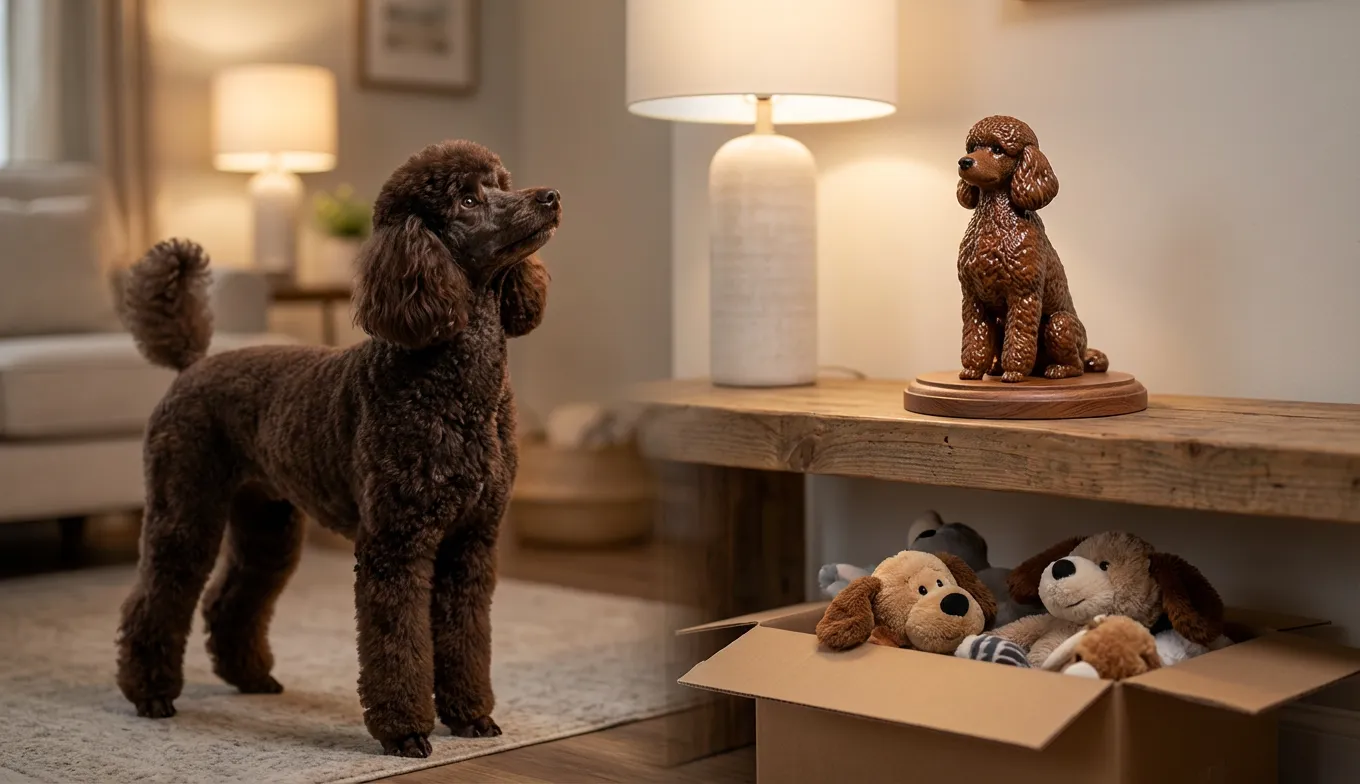
This is where many of our clients find solace in commissioning a custom piece. While a photograph captures a moment, a three-dimensional representation captures a presence. We’ve seen beautiful memorial shelves where a custom figurine stands watch over the dog's actual collar, turning a sad collection of "leftover items" into a dignified tribute. It shifts the energy from "this is what they left behind" to "this is how we honor them."
Having a tangible representation of your pet allows you to direct your grief toward something beautiful, rather than having it snag on every empty corner of the room.
Practical Guide: Where to Donate What
When you are ready—truly ready—here is a guide on where your Poodle’s belongings can do the most good.
1. The Vet's Office
- Best for: Prescription medications, prescription food, unopened fluids/syringes.
- Why: Many vets have a "compassion fund" or know elderly clients on fixed incomes who struggle to afford expensive meds. Handing these back to your vet can directly save another client from having to make a financial decision about their pet's health.
2. Wildlife Rehabilitators
- Best for: Mascara wands (for cleaning tiny larvae), heating pads, flat sheets, heating lamps.
- Why: It sounds odd, but old mascara wands (cleaned) are used to remove pests from wild birds and mammals. Heating pads are vital for orphaned squirrels and raccoons.
3. Animal Shelters (Municipal)
- Best for: Towels (even stained ones), blankets, cleaning supplies, bleach, paper towels.
- Why: Shelters go through laundry at an industrial rate. They don't care if the towel has a bleach stain; they care that it’s warm.
4. Breed-Specific Rescues
- Best for: High-end grooming gear, coats, sweaters, expensive orthopedic beds.
- Why: As mentioned, Poodle rescues have specific needs. A generic shelter might toss a slicker brush, but a Poodle rescue knows its value.
5. The "Neighbor" Dilemma
- The Situation: Your neighbor has a dog who used to play with yours. Should you give them the toys?
The Verdict: Proceed with caution. For some, seeing the neighbor's dog playing with their* dog's favorite ball is a beautiful continuity of life. For others, it is a knife in the heart. Be honest with yourself about which one you are before you offer.
When You Still Can't Let Go
There is a counterintuitive insight we want to leave you with: If you aren't ready, you aren't ready.
There is no statute of limitations on grief. If that basket of tennis balls on the porch needs to stay there for another year because moving it makes you feel unsafe, let it stay.
We live in a culture that rushes "closure." We are told to declutter, to move on, to "spark joy." But grief is messy. It doesn't fold neatly into a drawer.
However, pay attention to the difference between comfort and pain.
Does keeping the bed in the living room bring you comfort, or does it make you cry every time you walk past it?
Does the smell of the shampoo bottle make you smile, or does it ruin your morning?
If the items are causing you pain, they are not honoring your dog. Your dog’s legacy should be one of love, not daily torture.
Closing Thoughts
Eventually, the porch will be cleared. The mud will be washed away for good. The silence will stop feeling like an intruder and start feeling like peace.
When you finally donate that last box of supplies, you might cry in the car on the way home. That’s okay. You aren't crying for the stuff. You’re crying because you are closing a chapter of a book you never wanted to end.
But remember this: The dog who made the mess, who chased the balls, who needed the grooming and the care—they aren't in the box you dropped at the shelter. They are woven into the person you became because you loved them. You can’t donate that. You get to keep that forever.
Frequently Asked Questions
How soon should I donate my deceased pet's belongings?
There is no "correct" timeline for grief. Some pet parents find it healing to clear the space immediately (within 48 hours) because the visual reminders are too painful. Others need to keep things exactly as they were for months. Both reactions are valid. If you are unsure, use the "box method"—pack items away but don't donate them yet. This clears your visual space without making a permanent decision.Is it bad luck to keep a deceased dog's collar?
Absolutely not. This is an old superstition that has no place in modern grief. The collar is often the most sentimental item a pet owner possesses. Keeping it, displaying it in a shadow box, or draping it over a custom figurine is a beautiful way to honor their memory. It serves as a tangible connection to the walks and adventures you shared.Where can I donate open bags of dog food?
This can be tricky, as many large municipal shelters cannot accept open food due to safety and health regulations. However, your best bets are:- Smaller, private rescue groups: They often have less red tape and are desperate for food.
- Wildlife rehabilitators: They often need kibble for raccoons, opossums, or birds.
- Homeless outreach programs: People experiencing homelessness with pets are often in dire need of food and are grateful for any donation.
Why do I feel guilty for cleaning my house after my pet dies?
You are experiencing a conflict between your emotional brain (which wants to hold on) and your logical brain (which knows the caretaking is over). Cleaning feels like "erasing" them. Furthermore, if you feel any relief at the lack of mess (no more muddy paws, no more shedding), you may feel guilty about that relief. Please know that feeling relief from the labor of caretaking does not mean you don't miss the soul of the animal.What items should I definitely keep?
We recommend keeping items that trigger specific, happy memories rather than functional items.- Keep: The collar, their favorite durable toy, a lock of hair, their tag.
- Donate: Bowls, beds, leashes (unless sentimental), grooming supplies, leftover food. Keeping everything can create a "shrine" effect that keeps you stuck in the moment of loss, whereas keeping a few curated items helps you move toward remembering the joy.
Honor Their Memory Forever
Your pet's story deserves to be preserved in a way that captures their unique spirit. A custom PawSculpt figurine transforms your cherished memories into a timeless keepsake—every whisker, every marking, every detail that made them irreplaceable.
Free instant AI preview • 3D artist preview within 7 days • 5 free revisions