
First Christmas Without Your Black Lab: Keeping Their Stocking Up
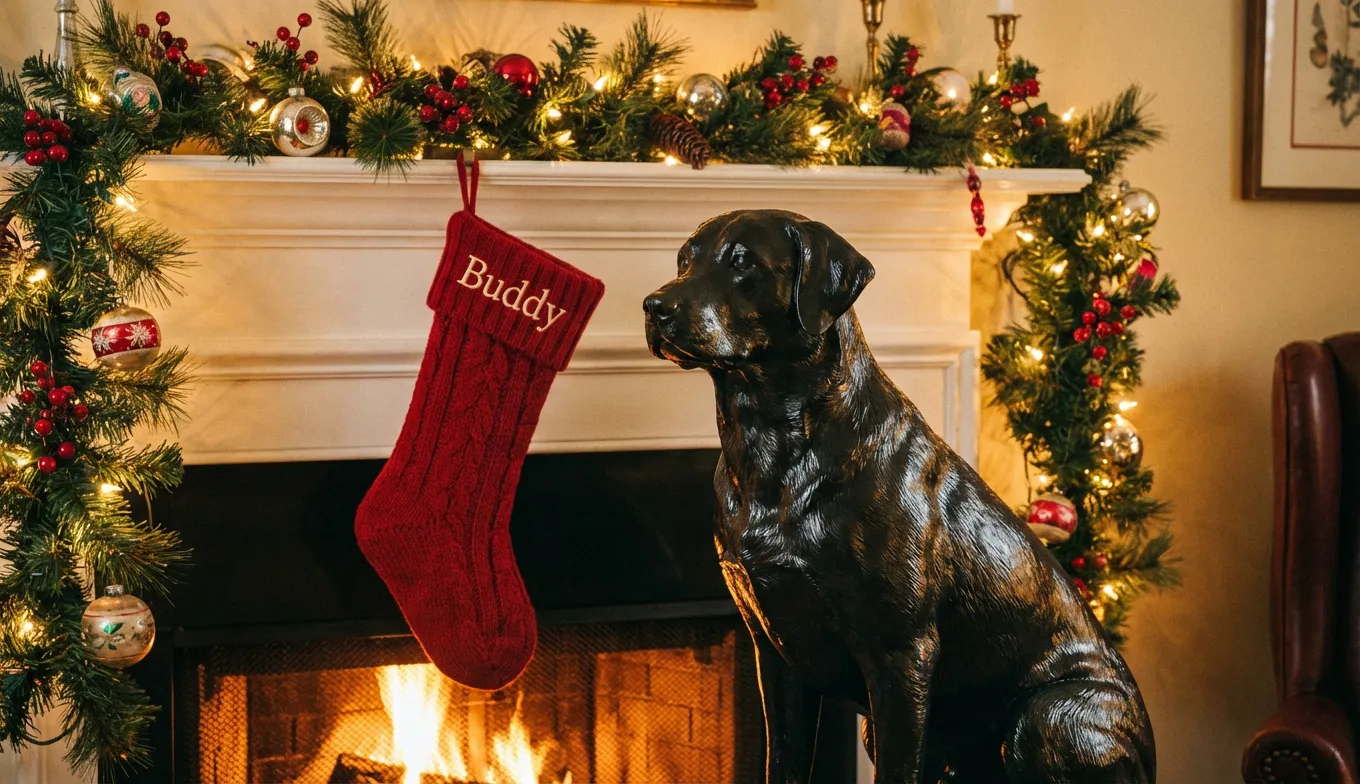
The wind off the ocean bit through your heavy coat, stinging your cheeks, but you kept walking toward the waterline anyway. Your hand instinctively reached into your right pocket for the tennis ball that used to live there, fingers brushing against nothing but lint and a forgotten receipt. For a split second, the crash of the waves sounded exactly like his heavy, rhythmic panting after a sprint across the sand—that joyous, full-body shake that used to spray salt water all over your jeans. Then the cold reality settled back in. The leash hanging by the door is gathering dust, and the spot on the rug where he dried off is clean. Too clean.
Quick Takeaways:
- The "Black Hole" Effect: Losing a Black Lab leaves a specific visual void in a room; acknowledge that your eyes are still looking for him in the shadows.
- The Stocking Strategy: Keeping the stocking up isn't "holding on" too tight—it’s honoring a family member. Consider filling it with letters or donations instead of treats.
- Memorial Options: From custom figurines to donation drives, tangible tributes help ground your grief.
- Guilt is a Liar: Feeling a moment of relief that you don't have to worry about the tree getting knocked over doesn't mean you love him less.
The Specific Weight of a Black Lab's Absence
We need to talk about the physics of this loss because it’s something people rarely articulate. When you lose a Black Lab, you aren't just losing a dog; you are losing a gravitational center in your home. These aren't small dogs. They are seventy, eighty, maybe ninety pounds of solid, loving muscle.
Our team has heard this from countless families: you walk into the living room, and your eyes automatically scan the dark corners. Black Labs have a way of blending into the shadows, becoming a part of the room's architecture. When that presence is gone, the room feels chemically different. It feels lighter in a way that makes your stomach heavy.
One customer told us she kept tripping over "nothing" in the kitchen for three weeks. Her muscle memory was so programmed to step over her sleeping Lab while cooking Christmas dinner that she couldn't stop doing the "Lab shuffle."
The counterintuitive truth: Don't rush to rearrange the furniture to "fill the space." Your brain is mapping the room based on where he used to be. If you move the armchair to cover his favorite nap spot too quickly, it can actually trigger more anxiety because your mental map of "home" is being rewritten too fast. Let the empty space be empty for a moment. It’s a testament to how much space he took up in your life.
To Hang or Not to Hang: The Stocking Dilemma
This is the question that keeps pet owners awake in early December. Do you put the stocking up? Does it stay in the box? If you put it up, does it stay empty?
Here is the thing: Rituals are for the living, not the dead. If seeing his name embroidered on that red felt brings you a measure of peace, put it up. If it makes you sob uncontrollably in the middle of a Tuesday afternoon, keep it in the box this year. There is no "grief police" coming to inspect your mantel.
However, if you do hang it, we recommend changing its purpose. An empty stocking can feel like a gaping mouth—a reminder of what isn't there.
Try this instead:
Turn the stocking into a vessel for memories. Write down a favorite memory on a slip of paper—the time he ate the ornament, the time he swam out too far—and drop it in. Encourage family members to do the same. By Christmas morning, the stocking isn't empty; it's full of the life he lived.
Another option we've seen families embrace is using the stocking for "legacy giving." Every time you would have bought him a bag of treats or a new toy, put that cash amount into the stocking. At the end of the season, donate the contents to a Black Lab rescue. It transforms the passive act of grieving into an active act of helping.
The Secret Guilt of a "Cleaner" Holiday
We need to discuss an emotion that is incredibly common but almost never admitted because it feels shameful.
Relief.
You might find yourself decorating the tree and realizing you don't have to put the ornaments high up this year because there's no "Lab tail" to sweep them off. You might sit down to Christmas dinner and realize you can actually relax because you aren't guarding the turkey from a counter-surfer. You might enjoy a quiet morning without the frantic 6:00 AM demand for a walk.
And then, immediately after that realization, you probably feel like a traitor.
Please hear us on this: That wave of relief does not negate your love. It doesn't make you a bad owner. Caretaking, especially for a senior dog, is exhausting. It is physically and emotionally taxing. When that duty ends, your body naturally exhales.
The guilt that follows is one of grief's cruelest tricks. It tries to convince you that if you aren't suffering, you aren't honoring him. That is false. You can miss him with every fiber of your being and still appreciate that your floors are clean for the first time in a decade. Allow yourself those small mercies without the side order of shame.
Anchoring the Memories: Physical Tributes
Grief is abstract, but we are physical creatures. We need things to touch. This is why we cling to the collar, or why we hesitate to wash the blanket that still smells like Fritos and dust.
In our work, we've found that having a dedicated physical representation of a pet can help direct the grief. It gives you a place to look. Some families light a candle by a framed photo. Others create a small "shrine" on a bookshelf.
Increasingly, we’re seeing pet parents choose tangible, three-dimensional keepsakes like custom figurines to capture their dog’s specific posture. A photo shows you what they looked like, but a sculpture can capture the "Lab lean"—that specific way he would press his entire body weight against your shins while you did the dishes. Placing a figurine on the mantel near his stocking can serve as a quiet, dignified placeholder—a way to say, "You are still part of this family, and you still have a seat at this table."
Whatever method you choose, the goal is to externalize the love. When you keep it all inside, it turns into pressure. When you put it into an object—a stone, a photo, a sculpture—it gives that love somewhere to live.
Navigating the "Well-Meaning" Comments
Christmas is a social season, which means you will likely encounter people who don't get it. They mean well. They really do. But they will say things that sting.
"At least you don't have to walk him in the snow!"
"Are you going to get a puppy for Christmas?"
"He was just a dog, you shouldn't let it ruin your holiday."
The impulse is to snap back or to retreat into isolation. Instead, we recommend having a "pocket script" ready. This is a pre-planned response that protects your energy so you don't have to think on your feet when you're already emotional.
Try saying:
- "We're taking this holiday to just miss him. We aren't ready for anything else yet."
- "He was a huge part of our daily life, so the holiday feels very different this year."
You don't owe anyone a performance of happiness. If you need to step out of the party for ten minutes because someone mentioned their new puppy and it hit you too hard, go. Go to the bathroom, go to your car, go for a walk. The people who matter will understand. The people who don't understand don't matter right now.
The First Morning
The hardest moment will likely be Christmas morning. For years, your Black Lab was probably the first one up, sensing the energy, vibrating with excitement (or just hoping for breakfast scraps).
The silence on that first morning can be deafening.
Don't try to ignore it. Acknowledge the silence. Maybe you start a new tradition where you light a candle for him before anyone opens a single gift. Maybe you take that walk on the beach or in the woods, not because the dog needs it, but because you need it. Walk his route. Carry his tags in your pocket. Speak his name out loud to the trees.
The goal of this first Christmas isn't to "get over it." It's to get through it. It's to learn how to carry the love without the physical presence.
He isn't there to steal the wrapping paper this year. He isn't there to beg for ham. But look around the room—at the stocking on the wall, at the memories shared, at the love that still permeates the walls. He is still the gravitational center of the room. That hasn't changed. The physics of love are stronger than the physics of loss.
Frequently Asked Questions
Should I hang my deceased dog's stocking?
Absolutely, if it feels right to you. There are no rules in grief. Many owners find it comforting to keep the stocking up as a symbol of the dog's continued place in the family. If an empty stocking feels too sad, try filling it with written memories from family members or donations that you'll give to a shelter after the holidays.How do I handle the guilt of enjoying the holidays without my pet?
This is one of the most common, yet unspoken, aspects of pet loss. It is crucial to understand that feeling relief—from the extra cleaning, the early walks, or the medical care—is a natural physiological response to stress reduction. It does not mean you loved them less. You can miss them desperately and still appreciate a moment of peace.What is a good memorial gift for someone who lost a Black Lab?
Gifts that acknowledge the specific personality of the dog are best. Generic "pet loss" gifts can sometimes feel impersonal. Consider a custom pet portrait or figurine that captures their unique look, a donation to a Black Lab rescue in their name, or a high-quality ornament engraved with their dates.Is it too soon to get a new dog at Christmas?
While puppies are a common Christmas gift, we generally advise against getting a new dog during the holiday season immediately following a loss. The holidays are high-stress and chaotic, which isn't ideal for training. More importantly, you need time to grieve without comparing a new, unruly puppy to the "perfect" dog you just lost. Give your heart time to heal so you can welcome a new dog for who they are, not as a replacement.Honor Their Memory Forever
Your pet's story deserves to be preserved in a way that captures their unique spirit. A custom PawSculpt figurine transforms your cherished memories into a timeless keepsake—every whisker, every marking, every detail that made them irreplaceable.
Free instant AI preview • 3D artist preview within 7 days • 5 free revisions