
Creating a Garden Shrine for the Ragdoll Cat Who Loved the Outdoors
Dust motes danced in the single beam of sunlight cutting across the attic floorboards as I dragged the heavy holiday bin toward the stairs. My hand brushed against something soft on top of a stack of old books—a blue nylon harness, stiff with disuse, covered in a fine layer of white fur. I froze. It wasn't the harness itself that stopped me, but the sudden, visceral memory of the weight at the end of the leash—the way he would dead-weight "flop" into the grass, refusing to walk another step because the sunbeam on the driveway was just too perfect to leave. I sat down right there on the dusty floor, clutching that cheap piece of nylon, realizing that for the first time in ten years, spring was coming, and there would be no one to beg at the back door.
Quick Takeaways:
- Location Matters: Choose the spot where your cat actually spent time (the "sun trap"), not just the prettiest corner of the yard.
- Sensory Planting: For Ragdolls, focus on texture. Soft plants like Lamb's Ear mimic the tactile experience of petting them.
- The Centerpiece: Traditional stones can feel cold. Consider weather-safe niches for custom figurines or colorful mosaics that capture their specific eye color.
- The "Safety" Factor: A garden shrine resolves the indoor/outdoor conflict, creating a space where they are permanently part of the nature they watched through the window.
The Unique Grief of the "Window Watcher"
We need to talk about a specific kind of heaviness that settles in after losing a cat like a Ragdoll—a breed caught between two worlds. They are the ultimate lap cats, engineered for indoor docility, yet so many of them possess a desperate, quiet longing for the rustle of leaves.
If you had a Ragdoll who loved the outdoors, your grief is likely tangled up with a very specific, unspoken emotion: relief.
It sounds terrible to say it out loud. But we’ve worked with enough grieving families to know the truth. You loved them, but you also spent years terrified for them. You worried about the coyotes, the cars, the neighbors' dogs, or simply their lack of survival instincts (let's be honest, Ragdolls are lovers, not fighters). Now, that low-level hum of anxiety is gone. The silence isn't just empty; it's safe. And immediately following that relief comes a crushing wave of guilt for feeling relieved at all.
Building a garden shrine isn't just about marking a grave or a scattering spot. It is a way to process that complex mix of emotions. It allows you to give them the outdoors they craved, but in a way that is finally, permanently safe.
Finding the "Flop" Spot
Most guides on pet memorial gardens will tell you to pick a quiet corner with good drainage. We disagree. You shouldn't pick the spot; your cat should.
Think back to their routine. Where did they gravitate?
- Was there a specific patch of mulch where they rolled until they were dusty and content?
- Did they have a vantage point on the porch where they chattered at squirrels?
- Was there a window they sat in for hours?
For a Ragdoll, the "flop" spot is sacred. It’s that place where their muscles turned to jelly and they surrendered to gravity.
A Micro-Story:
We remember a customer, Sarah, whose Ragdoll, Barnaby, spent his life staring at a specific oak tree from the safety of the lanai. When he passed, she didn't bury him under the tree. She built the shrine on the lanai, facing the tree. She kept him in his favorite viewing box. That’s the key—honor their perspective, not just the landscape.
Sensory Gardening: Mimicking the Coat
Ragdolls are defined by their coat—that rabbit-soft, plush fur that requires daily attention. When you lose them, your hands literally miss the work. You reach out to pet them and grasp air.
Design your garden to fill that tactile void. We call this "Sensory Substitution." Instead of standard grave flowers, plant things that feel like them:
- Lamb’s Ear (Stachys byzantina): The leaves are thick, fuzzy, and incredibly soft. Stroking a leaf can ground you during a panic attack or a sudden wave of sadness.
- Ornamental Grasses: Ragdolls are visual hunters. They love movement. Tall grasses that sway in the wind mimic the feather toys they used to chase.
- Silver Mound (Artemisia): Soft, mounding foliage that looks like a sleeping cat curled in a ball.
Counterintuitive Insight:
Avoid high-maintenance roses or finicky orchids. Your grief will come in waves, and there will be weeks when you don't have the energy to weed or prune. If the plants die because you were too depressed to water them, you will feel like you've failed your pet twice. Plant hardy, drought-tolerant perennials that will wait for you to be ready to return.
The Centerpiece: Beyond the Grey Stone
Standard granite markers can feel incredibly heavy and final. They look like cemeteries. For a cat known for piercing blue eyes and colorpoint fur, a grey slab often feels like it misses the point of their personality.
This is where you can bridge the gap between memory and presence. You need a focal point that captures their spark.
The Protected Niche
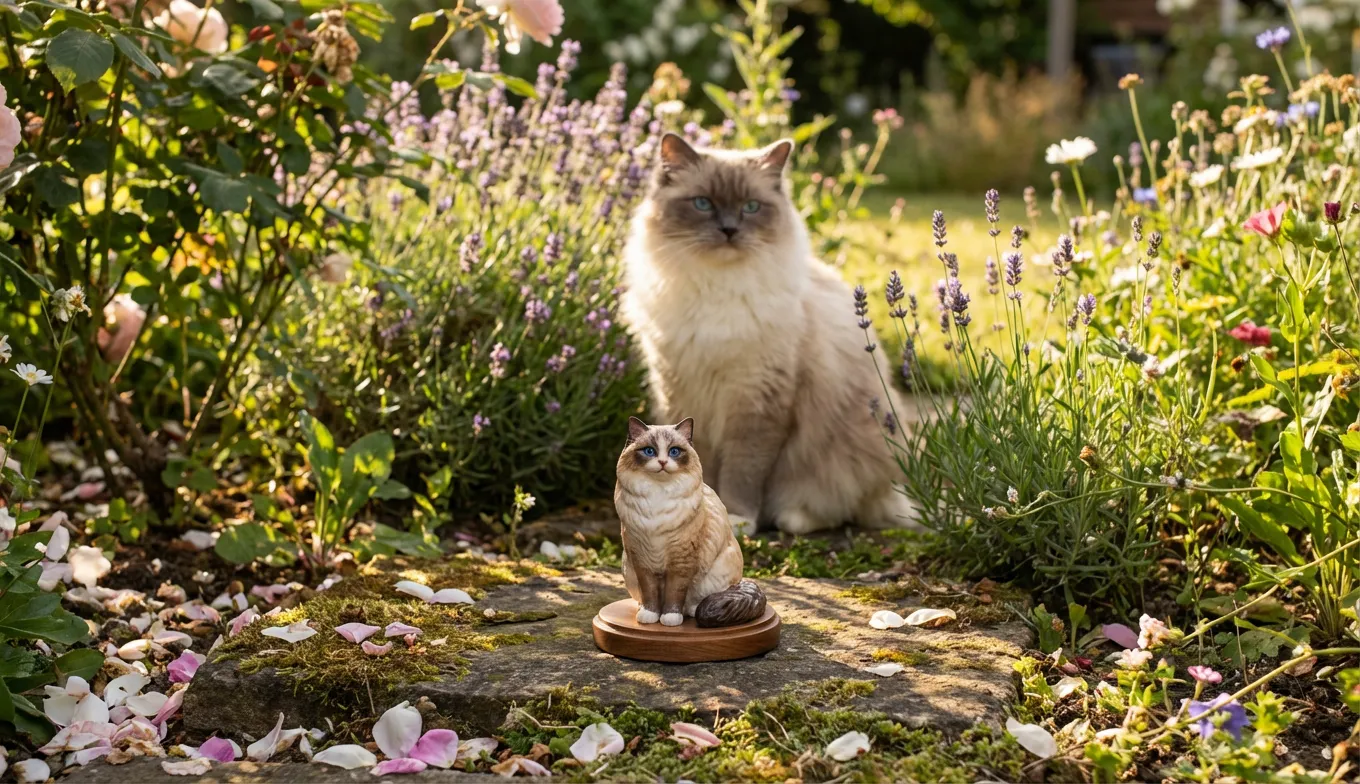
Since Ragdolls are indoor cats at heart, consider building a "cat house" shrine—a small, weather-proof wooden structure or a stone lantern with a hollow center. Inside this protected space, you can place items that wouldn't survive the rain.This is a popular choice for families who commission our custom pet figurines. Because our artists sculpt from your photos, we capture the specific way your cat sat—maybe the "sploot" of the back legs or the specific tilt of the head. Placing a photorealistic figurine inside a garden lantern creates a "peeking out" effect. It looks like they are safe inside, watching the garden grow.
Pro-tip: If you use a resin figurine outdoors, even a high-quality one, UV rays are the enemy. Always keep it inside a lantern with glass panes or under a deep overhang, and spray it annually with a UV-resistant clear coat.
The Wind Chime Connection
If a visual representation feels too painful right now (and for many, seeing their face is just too hard for the first few months), go auditory. Hang a high-quality wind chime above the spot. Every time the wind blows, it breaks the silence of the backyard—a reminder of the movement and life they brought to the space.The Ritual of Weeding (Grooming the Earth)
Here is something no one tells you about grief: it needs a job.
When you have a high-maintenance pet like a Ragdoll, your day is structured around their care. The brushing, the feeding, the litter, the letting in and out. When that stops, the surplus time feels suffocating.
A garden shrine gives you a new job. Weeding the shrine becomes the new grooming. Deadheading the flowers becomes the new brushing.
The shift in perspective:
Don't look at garden maintenance as a chore. Look at it as an act of service. You are still caring for them; the medium has just changed from fur to soil. It allows you to spend 15 minutes a day with them, talking to them while you work, without feeling foolish.
Dealing with the "Replacement" Guilt
There is a specific shadow that hangs over the garden shrine: the fear that if you make it too beautiful, or if you stop crying when you visit it, you are forgetting them.
We've seen pet parents hesitate to plant new flowers because they feel like they are "covering up" the memory. But a garden, by definition, is about cycles. It dies back in winter and returns in spring.
Your grief will do the same.
The garden isn't a statue; it's a living system. It’s okay if you change the flowers next year. It’s okay if you eventually sit on the bench next to the shrine and read a book without crying. It’s okay if, eventually, a new kitten chases a butterfly across the mulch you laid down for the one who came before.
That isn't betrayal. That is the ecosystem of love continuing.
Bringing it Back to the Light
I eventually left the attic that day. I took the blue harness downstairs, but I didn't put it in the trash. I walked out to the backyard, to that spot under the magnolia tree where the shade is deepest—his spot.
I didn't have a plan yet, but I knew I needed to mark the earth. I needed to create a space that acknowledged the duality of his life: the safety he needed and the wildness he wanted.
Whether you choose a simple stone, a bed of soft Lamb's Ear, or a custom memorial sculpture that watches over the yard, the goal is the same. You are creating a place where the door is always open, where the sun is always shining, and where they can finally, safely, stay outside forever.
Frequently Asked Questions
How do I protect a pet memorial figurine outdoors?
Even high-quality materials can degrade with constant exposure to the elements. We recommend placing cherished figurines inside a "shrine box," such as a glass-paned lantern or a stone niche. This keeps the rain off and reduces UV exposure. If the item must be fully exposed, spray it annually with a high-quality, matte UV-resistant clear coat (available at most hardware stores).What are the best non-toxic plants for a cat memorial garden?
Even though your cat is gone, you want to ensure the space is safe for neighborhood pets or wildlife. Excellent non-toxic choices include:- Catmint (Nepeta): Hardy and produces lovely purple flowers.
- Zinnia: Bright, colorful, and safe.
- Spider Plants: Great for hanging baskets near the shrine.
- Avoid: Lilies of any kind (extremely toxic to cats), Azaleas, and Tulips.
Is it legal to bury my cat in the backyard?
This is a common assumption, but it's not always legal. urban and suburban areas often prohibit pet burial due to groundwater contamination risks. Rural areas are usually more lenient. We strongly recommend checking your local municipal code. If burial is prohibited, creating a garden shrine over buried ashes is a universally accepted alternative.How deep should I bury my cat for a garden shrine?
If you proceed with a full-body burial, depth is critical to prevent heartbreak caused by scavenging wildlife. The general rule is at least 3 feet of soil on top of the remains. Placing heavy stones or pavers (which can serve as the base for your shrine) directly over the burial spot adds an extra layer of protection against digging animals.Honor Their Memory Forever
Your pet's story deserves to be preserved in a way that captures their unique spirit. A custom PawSculpt figurine transforms your cherished memories into a timeless keepsake—every whisker, every marking, every detail that made them irreplaceable.
Free instant AI preview • 3D artist preview within 7 days • 5 free revisions