The Gift That Doesn't End Up in a Landfill: A Resin Figurine for the Pug Lover Who Has Everything
You're staring at your screen, seventeen browser tabs deep into pug owner gift ideas, and every single result is the same mug with a cartoon pug face on it. You can smell your own pug's corn-chip paws from under the desk, and honestly, she deserves better than that. So does the person you're shopping for.
Quick Takeaways
- Most "pet lover" gifts are landfill-bound within a year — choosing sustainable pet gifts breaks that cycle without sacrificing thoughtfulness
- The best pug gifts match the owner's attachment style — not just their breed preference
- Eco-friendly dog lover gifts don't have to look "earthy" or boring — premium options exist that feel luxurious
- A custom pug figurine captures what photos can't — the 3D presence of a specific, irreplaceable dog, and PawSculpt's full-color figurines are one standout option
- Spending more on fewer, lasting gifts is both greener and more meaningful — quality over quantity actually works here
Why Every Pug Gift Guide Looks the Same (And Why That's a Problem)
Here's the thing nobody talks about in gift guides: most of them are built for clicks, not for the person actually standing in a store or scrolling Amazon at midnight with a deadline breathing down their neck.
Search "gifts for pug lovers" and you'll get socks, mugs, phone cases, tote bags, throw pillows—all stamped with a generic pug illustration that looks nothing like anyone's actual dog. It's the gift equivalent of a participation trophy. Nice gesture. Zero emotional weight.
And there's a psychological reason this keeps happening. Researchers in consumer behavior call it the "category heuristic"—when we're shopping for someone whose interests we know only at a surface level (they love pugs), we default to the most obvious category symbol (a pug printed on stuff). It feels safe. It feels like we "get" them.
But the recipient's brain processes it differently. What they register, often unconsciously, is: "You know I like pugs. You don't know me beyond that."
That's not a criticism of anyone's gift-giving. It's just how our brains work. The dopamine hit from receiving a gift is tied less to the object itself and more to the feeling of being deeply known. A generic breed-themed item triggers recognition. A truly personal gift triggers attachment activation—the same neural pathway that fires when you see someone you love after a long absence.
So the real question isn't "what do pug owners want?" It's: what kind of gift makes someone feel seen?
The Landfill Problem Nobody Mentions
Let's talk about where those pug socks end up. The average American throws away about 81 pounds of clothing per year, according to the EPA. Novelty items—the funny tees, the quirky kitchen gadgets, the breed-themed accessories—have an even shorter shelf life because they're impulse-friendly and low-commitment by design.
We're not here to guilt-trip anyone. But if you're reading this, you're probably already the kind of person who wants their gift to matter. You want it on a shelf in five years, not in a donation bin by March.
Sustainable pet gifts aren't just about materials (though that matters too). They're about longevity of meaning. A gift that stays relevant, stays displayed, stays loved—that's the greenest gift there is, because it never becomes waste.
| Gift Type | Avg. Lifespan | Likely Destination | Emotional Half-Life |
|---|---|---|---|
| Novelty pug socks | 3-6 months | Trash/donation | ~2 weeks |
| Breed-themed mug | 1-2 years | Back of cabinet | ~1 month |
| Generic wall art | 2-3 years | Garage/storage | ~3 months |
| Custom pet portrait | 10+ years | Displayed prominently | Years |
| Custom 3D figurine | 10+ years | Displayed prominently | Years |
| Donation in pet's name | Permanent | N/A (intangible) | Varies |
That last column—emotional half-life—is the one nobody puts in gift guides. But it's the metric that actually predicts whether your gift lands or fizzles.

The Psychology of Gifting for the Person Who "Has Everything"
You know this person. Maybe it's your sister who already owns four pug calendars. Maybe it's your partner's mom who has a dedicated pug room (yes, those exist, and they're glorious). Maybe it's you, and you're trying to gently redirect well-meaning friends away from another pug-shaped salt shaker.
The "has everything" problem isn't really about stuff. It's about hedonic adaptation—the well-documented psychological phenomenon where repeated exposure to similar stimuli produces diminishing emotional returns. The first pug mug was delightful. The seventh is furniture.
"The gifts that stay on the shelf for years are the ones that captured something specific—not a breed, but a being."
— The PawSculpt Team
So how do you break through hedonic adaptation? Psychologists point to three factors:
- Novelty of form — something they haven't received before in this category
- Personal specificity — it's about their pug, not a pug
- Sensory richness — it engages more than one sense (visual + tactile, for instance)
That third one is underrated. Think about the gifts you remember most vividly. Chances are, you can recall how they felt in your hands, what they smelled like when you unwrapped them, the weight of them. Multi-sensory gifts encode deeper memories because they activate more regions of the brain simultaneously.
A flat print on a mug is one-dimensional. Something you can pick up, turn around, feel the texture of—that's a different neurological experience entirely.
The Counterintuitive Truth About "Practical" Gifts
Here's where most gift guides get it wrong: they tell you to buy something "useful." A pug-themed leash. A breed-specific grooming tool. A bag of premium treats.
And look, those are fine. But research on gift satisfaction (yes, this is a real field of study) consistently shows that recipients prefer gifts that feel indulgent over gifts that feel practical. The giver tends to project their own anxiety about "wasting money" onto the recipient, choosing useful items to justify the expense.
But the recipient? They wanted the thing that felt like a treat. The thing they'd never buy themselves.
This is especially true for the person who has everything. They've already bought themselves the practical stuff. What they're missing is the thing that makes them stop and go, "Oh. Oh, this is my dog."
A Gift Guide That Actually Respects Your Intelligence (And Your Pug)
Alright, let's get into specifics. But we're doing this differently. No filler items. No "stocking stuffers" that'll end up in a junk drawer. Every item here passes three tests:
- Will it still matter in a year?
- Is it specific enough to feel personal?
- Does it avoid the landfill pipeline?
Custom Full-Color Pet Figurine
Who it's for: The pug owner who photographs their dog more than their children. The person whose lock screen has been the same pug face for three years. The grieving owner who needs something to hold.
Budget: Varies by provider—visit individual sites for current pricing.
Here's where we'll be transparent about our bias: we make these at PawSculpt, so obviously we think they're worth it. But let us tell you why rather than just that.
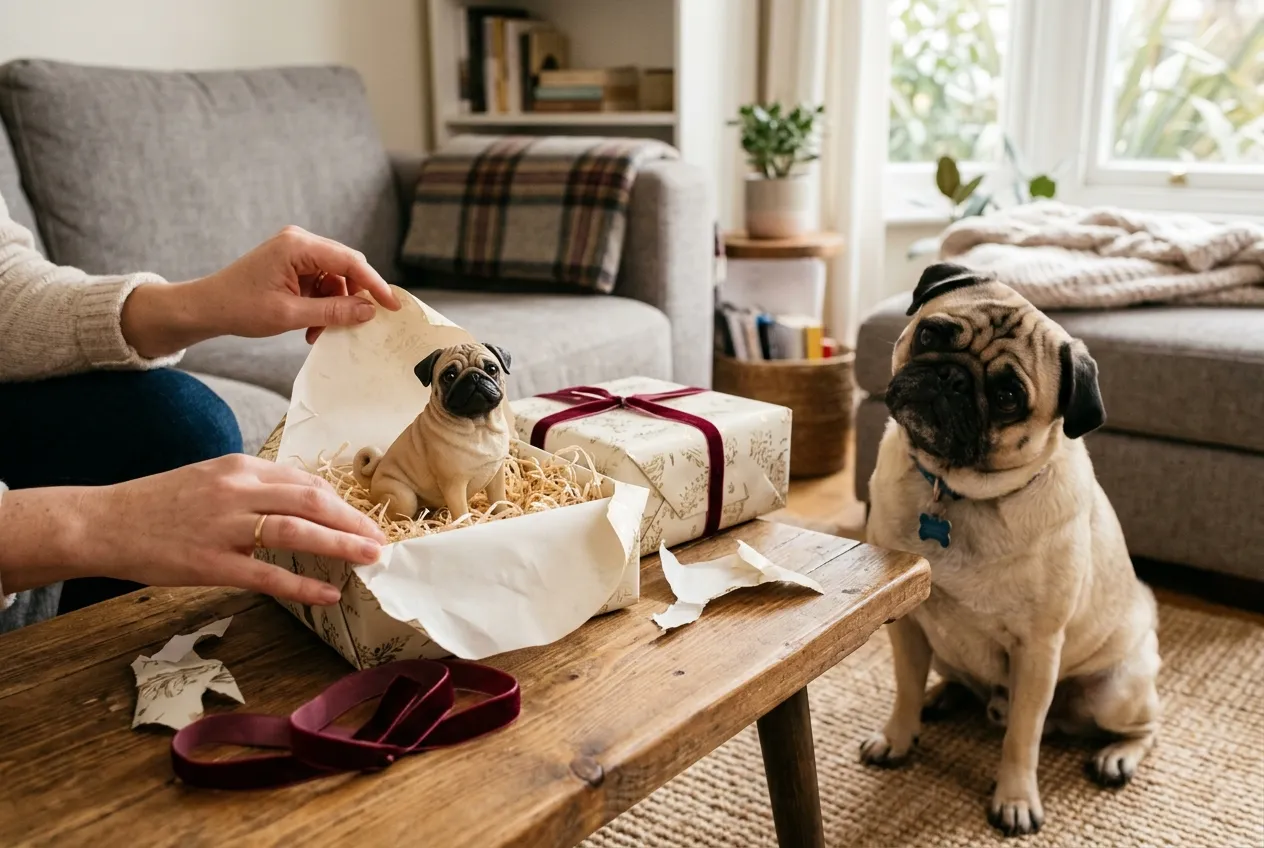
A custom pug figurine created through full-color 3D printing does something a photo can't: it exists in three dimensions. You can pick it up. You can see the way your pug's left ear folds slightly differently than the right. The wrinkles. That specific head tilt.
PawSculpt's process starts with digital sculpting by experienced 3D artists who model your pet from photos. Then the figurine is precision-printed in full-color resin—meaning the color isn't painted on top, it's embedded directly into the material, voxel by voxel. The only finishing touch is a protective clear coat for UV resistance and sheen.
The result has a natural texture—fine grain from the printing process—that actually makes it feel more authentic than something mass-produced and plastic-smooth. It's got presence. Weight. The kind of thing you pick up off someone's desk and say, "Wait, is this Mabel?"
Pro tip: If you're ordering for someone else, quietly grab photos from their social media. Candid shots with good lighting work better than posed ones. Check pawsculpt.com for specific photo guidelines and current turnaround details.
Commissioned Digital Pet Portrait (Non-Figurine)
Who it's for: The pug owner with strong aesthetic taste and wall space to fill.
Budget: $50–$300+ depending on artist and style.
This is the two-dimensional cousin of the figurine, and it's a solid choice when you know the recipient's decor style. The key is commissioning from an actual artist—not a filter app, not an AI generator. Sites like Etsy have thousands of pet portrait artists, but quality varies wildly.
What to look for: an artist whose portfolio shows they understand brachycephalic breeds specifically. Pugs have unique facial geometry—the wide-set eyes, the nose rope, the underbite—and artists who mostly paint retrievers sometimes make pugs look... off. Like a pug described from memory by someone who saw one once at a park.
Pro tip: Ask the artist if they've done pugs before and request examples. The good ones will have them ready.
Pug-Specific Wellness Subscription Box
Who it's for: The pug parent who's serious about their dog's health and loves a monthly surprise.
Budget: $30–$60/month.
Not all subscription boxes are created equal, and most generic ones include toys and treats that aren't great for pugs specifically. Pugs have sensitive stomachs, breathing considerations, and a legendary talent for gaining weight. According to the American Kennel Club's pug breed profile, they're prone to obesity, which makes treat selection genuinely important—not just a preference.
Look for boxes that let you customize for breed size and dietary restrictions. BarkBox and PupJoy both offer some customization. The real win is finding one that includes enrichment puzzles rather than just chew toys—pugs are smarter than people give them credit for, and mental stimulation helps manage the weight issue too.
Pro tip: Gift a 3-month subscription rather than 12. It's enough to feel generous without locking someone into something they might not love.
"A gift doesn't have to last forever to be sustainable. It just has to matter long enough to justify its existence."
Heritage-Quality Pug Breed Book
Who it's for: The pug history nerd. The person who already knows pugs were companions to Chinese emperors and wants the deep cut.
Budget: $25–$75.
Skip the coffee table books with stock photos. Look for breed-specific titles with actual historical depth. The Pug Handbook by Brenda Belmonte is a classic. For something more visual and collectible, older editions of breed books from the 1950s–70s can be found on AbeBooks or ThriftBooks and have a charm that modern prints can't touch.
The smell of an old book—that vanilla-and-almond scent from lignin breaking down in the pages—pairs surprisingly well with the experience of reading about a breed that's been making people laugh for over 2,000 years.
Pro tip: Tuck a handwritten note inside the front cover. Analog personalization in a digital world hits different.
Donation to a Pug Rescue in Their Name
Who it's for: The pug lover who genuinely has everything and would rather help a pug in need.
Budget: $25–$100.
Organizations like Pug Rescue of New England, DFW Pugs, or Pacific Pug Rescue always need support. Most let you make a donation in someone's name and will send a certificate or acknowledgment.
This is the gift for the person whose pug is a rescue themselves. It hits the reciprocity instinct—the deep human need to pay forward what we've received. If their pug came from a rough start, funding another pug's second chance creates a meaningful emotional loop.
Pro tip: Pair this with something small and tangible—even a card with a photo of their pug—so there's something to unwrap. The psychology of gift-giving still benefits from a physical ritual, even when the real gift is intangible.
| Gift Option | Personalization Level | Longevity | Eco-Friendly | Best For |
|---|---|---|---|---|
| Custom 3D figurine | Very High (their specific dog) | 10+ years | Yes (durable resin) | Display-proud owners |
| Commissioned portrait | High (their dog, chosen style) | 10+ years | Yes (single piece) | Decor-conscious owners |
| Wellness subscription | Medium (breed-customized) | Ongoing | Moderate | Health-focused owners |
| Heritage breed book | Low-Medium | Decades | Yes (paper) | History/knowledge lovers |
| Rescue donation | Medium (in their name) | Permanent impact | Very High | Altruistic owners |
The Smell Test: How Sensory Memory Makes or Breaks a Gift
This is the section you won't find in other gift guides, and honestly, it's the one that matters most.
Olfactory memory is the most emotionally potent form of recall we have. The olfactory bulb has direct connections to the amygdala and hippocampus—the brain regions handling emotion and memory, respectively. No other sense has this direct line. It's why a whiff of a specific shampoo can teleport you back to childhood, or why walking past a bakery can make you suddenly, inexplicably miss your grandmother.
Now think about pug owners specifically. Every pug owner knows The Smell. It's not exactly pleasant in a perfume-counter way. It's warm, slightly yeasty, vaguely corn-adjacent (those paws), with undertones of whatever they rolled in last Tuesday. It's the smell of their specific dog's head when they bury their face in it during a bad day.
Here's the day-in-the-life scenario: It's 7 AM. You're making coffee. Your pug is doing that thing where she follows you so closely she steps on your heel. You reach down without thinking, scratch behind her ear, and your hand comes away smelling like warm Frito. You don't wash it off immediately. You just... carry her with you for a minute, into your morning.
That sensory bond is what makes pug owners pug owners and not just dog owners. And it's why the best gifts for them aren't generic dog gifts with a pug label slapped on.
Why Three-Dimensional Gifts Trigger Deeper Attachment
Here's the neuroscience bit, kept simple: when you hold a physical object that represents something you love, your brain processes it through haptic perception and visual recognition simultaneously. This dual-channel processing creates what psychologists call a "richer encoding"—the memory associated with the object is stored more robustly because multiple sensory systems tagged it.
A flat image on a mug activates visual processing. That's it. One channel.
A three-dimensional object you can pick up, rotate, feel the weight of—that activates visual, tactile, and even proprioceptive processing (your brain's awareness of the object's weight and position in your hand). Three channels. Deeper encoding. Stronger emotional association.
This is why people instinctively pick up figurines and hold them. It's not just curiosity. It's your brain trying to know the object more completely.
And for someone grieving a pug they've lost? That tactile dimension isn't a luxury. It's a lifeline. The absence of a pet is felt physically—the missing weight on the couch, the empty space by your feet, the leash that hangs unused by the door and still smells faintly like leather and dog. A three-dimensional memorial object gives the hands something to do with that emptiness.
The Eco-Friendly Angle Nobody's Being Honest About
Let's get real about eco-friendly dog lover gifts for a second, because there's a lot of greenwashing in this space.
A product isn't sustainable just because it's made from bamboo or comes in kraft paper packaging. Sustainability in gift-giving is primarily about use duration divided by resource input. A resin figurine that sits on someone's shelf for twenty years has a lower per-year environmental impact than a "sustainable" cotton tote bag that gets used for six months and then forgotten in a closet.
This isn't to say materials don't matter—they do. But the most impactful environmental choice you can make when buying a gift is choosing something the recipient will actually keep.
The fast-fashion model has crept into pet merchandise in a big way. Seasonal pug pajamas. Trend-driven accessories. Limited-edition this and that. It's designed to cycle through your life quickly, making room for the next purchase.
The counterintuitive insight: the most sustainable gift might be the one that costs more upfront. A $15 pug-themed phone case replaced annually for five years costs $75 and generates five units of waste. A single, well-made keepsake at $75 generates one unit of waste and likely lasts decades.
We're not saying every gift needs to be an heirloom. Sometimes socks are just socks and that's fine. But when you're shopping for someone who matters—someone whose pug is their person—investing in permanence is both the greener and the more emotionally intelligent choice.
"Sustainability isn't about what something's made of. It's about whether anyone still cares about it in five years."
What "Museum-Quality" Actually Means (And Why It Matters for Longevity)
You see this term thrown around a lot, so let's unpack it. In the context of figurines and collectibles, museum-quality refers to:
- UV resistance — colors won't fade significantly over years of display
- Structural integrity — the piece won't warp, crack, or degrade under normal indoor conditions
- Color accuracy — the reproduction faithfully represents the source material
- Archival-grade finishing — protective coatings that prevent environmental damage
PawSculpt's full-color resin prints check these boxes because the color is integrated into the material itself rather than sitting on the surface where it can chip, peel, or fade. The clear coat adds another layer of UV protection. It's the difference between a photograph printed on archival paper versus one printed on regular copy paper—same image, vastly different lifespan.
For a gift that's meant to represent someone's living (or remembered) companion, longevity isn't a nice-to-have. It's the whole point.
How to Choose When You're Overwhelmed (A Decision Framework)
If you've made it this far and you're still not sure what to get, here's a framework that actually works. Forget browsing. Start with the recipient.
Step 1: Identify Their Attachment Style With Their Pug
This sounds clinical, but stay with me. How someone relates to their pet tells you everything about what gift will resonate:
- The Documentarian — They photograph everything. Their camera roll is 80% pug. They want to capture their dog. → Go with a custom figurine or commissioned portrait.
- The Caretaker — They research food brands obsessively. They know their pug's ideal weight to the ounce. They want to provide for their dog. → Go with a wellness subscription or high-quality health product.
- The Historian — They know their pug's rescue backstory by heart. They care about the breed's lineage. They want to understand their dog. → Go with a breed history book, a DNA test kit, or a donation to a pug-specific rescue in their dog's name.
- The Adventurer — Their pug goes everywhere they go. Stroller walks, café visits, road trips. They want to share experiences with their dog. → Go with a quality travel carrier, matching human-pet bandana set, or a pug-friendly local experience.
Step 2: Set a Budget That Reflects Your Relationship
Don't overthink price. A $30 gift chosen with surgical precision beats a $200 gift chosen by scrolling Amazon for fifteen minutes. The metric isn't dollars—it's evidence of attention. The gift that says "I notice how you are with your dog" will always outperform the gift that says "I spent a lot."
Step 3: Choose Longevity Over Novelty
This is where the landfill question becomes literal. Ask yourself: Will this gift still matter in two years? Treats are gone in minutes. Trendy accessories lose their appeal. But a custom figurine of their specific pug sits on a shelf and starts conversations for decades. A framed photo of their dog in a beautiful mount becomes part of their home. Longevity is the ultimate sustainability.
The Conversation a Good Gift Starts
The best gifts don't just sit on shelves—they change the dynamic of a room. A visitor sees a figurine of someone's pug on the mantel and asks, "Is that your dog?" That question opens a door: the adoption story, the funny behavioral quirks, the time the pug ate an entire birthday cake off the counter. The gift becomes a portal to the relationship.
That's what separates a gift from a great gift. A great gift creates recurring moments of connection, not just one moment of unwrapping.
Ready to Give a Gift That Actually Lasts?
Every pug has a personality that defies their size. Whether your gift is for a birthday, holiday, or just-because moment, a custom PawSculpt figurine captures the exact expression, posture, and spirit that makes their pug irreplaceable.
Visit pawsculpt.com to start your order—free AI preview, a 3D artist preview within 7 days, and 5 free revisions
Frequently Asked Questions
What makes a custom pet figurine a sustainable gift choice?
Unlike disposable novelty items, a custom resin figurine is made to last indefinitely. There is no battery to die, no fabric to fray, no trend to outgrow. The resin material is inert and durable, and because it is deeply personal, it never becomes the kind of thing someone donates to a thrift store six months later.
How much does a custom pug figurine cost?
Prices typically range from $100 to $250 depending on size, detail level, and whether you choose a single pet or a multi-pet composition. Some providers offer payment plans. Compared to other premium personalized gifts—custom jewelry, commissioned paintings—figurines often deliver more visual impact per dollar.
What if the pug owner already has figurines or statues?
A custom figurine of their specific pug is fundamentally different from a generic breed statue. It captures their dog's actual face, markings, posture, and personality. People who own dozens of pug-themed items still react emotionally to seeing their own dog rendered in three-dimensional detail for the first time.
Is a custom figurine appropriate as a memorial gift for someone who lost their pug?
Yes—and many people consider it one of the most meaningful memorial gifts you can give. It provides a tangible, permanent connection to the pet they lost. Timing matters though: some recipients appreciate it immediately, while others prefer receiving it a few weeks after the loss when the initial shock has settled.
How do I order a custom figurine as a surprise gift?
You will need clear photos of the recipient's pug. Discreetly ask for photos under another pretense, or browse their social media for high-quality images showing the dog from multiple angles. Most figurine services allow you to manage the entire preview and revision process yourself before shipping directly to the recipient.