
What to Give a Grieving Friend Who Just Lost Their Samoyed: A Guide That Skips the Platitudes
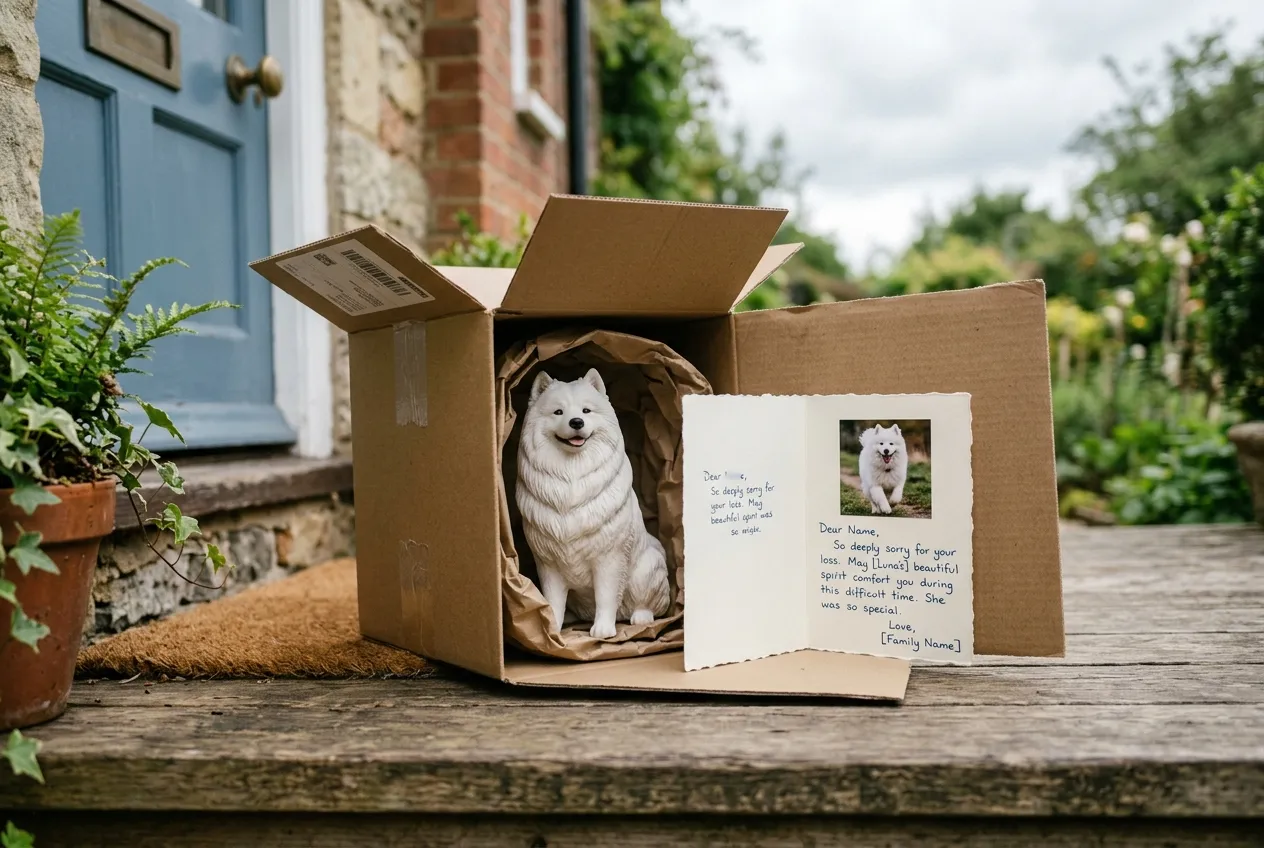
The dryer buzzing in the basement at 11 p.m., and you're pulling out a blanket still threaded with white Samoyed fur—that sound, that ordinary click and hum, is where grief ambushes you. If you're searching for a gift for a friend who lost their dog, specifically that impossible cloud of a Samoyed, you already know the standard sympathy card won't cut it.
Quick Takeaways
- Skip flowers and generic cards — they fade fast and say almost nothing specific to a dog loss
- Time your gift to the "second wave" — the 2-to-6-week window when everyone else has stopped checking in
- Match the gift to the griever's style — introverts, extroverts, and ritual-builders need different things
- A tangible, lasting keepsake outperforms almost everything — options like custom 3D-printed pet figurines give grief a physical anchor
- Samoyed-specific details matter more than you think — acknowledging the breed shows you truly saw the dog
Why Most Pet Sympathy Gifts Miss the Mark (And What Actually Lands)
Here's what most gift guides won't tell you: the majority of pet sympathy gifts are designed to comfort the giver, not the griever.
That sounds harsh. But think about it. You grab a bouquet, a card with a paw print, maybe a candle. You feel like you did something. Your friend receives it, says thank you, and sets it on a counter already crowded with similar gestures. Within a week, the flowers are dead. Within two weeks, the candle's burned down. And your friend is still reaching for a leash that's hanging on a hook by the door, still hearing the phantom click of nails on hardwood at 6 a.m.
We've worked with thousands of pet families through the memorial process at PawSculpt, and one pattern keeps showing up: the gifts that actually help are the ones that acknowledge the specific dog, not just the general concept of loss. A Samoyed is not a Chihuahua. The grief isn't interchangeable. The gift shouldn't be either.
The counterintuitive insight? Sometimes the most meaningful gift isn't the one you give on Day 1. It's the one that arrives three weeks later, when the casserole train has stopped and the "how are you holding up?" texts have thinned out.
"Grief doesn't need fixing. It needs a witness—something that says, 'I saw your dog. I remember.'"
That's the lens we're using for this entire guide. Not "here are 15 things you can buy on Amazon." Instead: here's how to think about what your friend actually needs, when they need it, and why certain gifts resonate on a frequency that others can't reach.

Understanding Samoyed-Specific Grief (This Part Gets Overlooked)
A Samoyed isn't just a dog. Samoyed owners will tell you this within thirty seconds of meeting you, and they're not wrong.
The breed is vocal—not barking, exactly, but a kind of conversational warbling that fills a house with constant sound. Samoyeds talk. They grumble when they're bored. They howl in a specific, almost musical register when they're excited. They do this thing called the "Sammy smile," a permanent upturned grin caused by the shape of their mouth, and it genuinely changes the emotional temperature of a room.
So when a Samoyed dies, the loss isn't just emotional. It's acoustic. The house goes from a place with a soundtrack to a place without one. That absence of sound—the missing click of paws on tile, the gone warble at dinnertime—is physically disorienting.
According to the American Kennel Club's Samoyed breed profile, these dogs were originally bred as working companions in Siberia, sleeping alongside their families for warmth. They're velcro dogs. They follow you from room to room. The physical absence is enormous—no more 50-pound warm body pressed against your legs while you cook, no more fur tumbleweeds drifting across the floor like tiny ghosts.
What This Means for Gift Selection
When you understand what a Samoyed owner has actually lost, you can choose gifts that address the real gap—not just "a pet died" but "an entire sensory world disappeared."
| What They Lost | The Sensory Gap | Gift That Addresses It |
|---|---|---|
| The "Sammy smile" | Visual — that face greeted them daily | Photo-based keepsake or custom figurine |
| Conversational vocalizations | Sound — the house is now eerily quiet | Wind chime, music box, or voice-recording memorial |
| Constant physical presence | Touch — no warm body nearby | Weighted blanket, plush replica, or fur keepsake |
| Grooming ritual (Samoyeds shed a lot) | Routine — a shared daily activity gone | Journal, ritual-replacement gift, or craft project |
| The social magnet effect | Community — Sammies attract strangers | Donation to breed rescue in the dog's name |
That table isn't random. Each row represents a specific dimension of loss that most sympathy gifts completely ignore. Your job as the gift-giver is to pick the row that matters most to your friend.
The Timing Framework: When to Give What
This is the part nobody talks about. Timing a pet sympathy gift wrong doesn't just reduce its impact—it can accidentally make things worse.
The First 48 Hours: Tread Lightly
In the first two days, your friend is likely in shock. Even if the loss was expected (illness, old age), the finality hits differently than anticipated. During this window:
- Don't send anything that requires a response or decision
- Don't send food that needs preparation (a grieving person doesn't want to cook your frozen lasagna)
- Do send a short text: "I loved [dog's name]. I'm here. No need to reply."
- Do drop off ready-to-eat food silently—leave it on the porch with a note
The mistake most people make? Showing up in person during the first 48 hours expecting to comfort. Some grievers want company. Many don't. Ask, don't assume.
Days 3–14: The "Acknowledged Grief" Window
This is when most sympathy gifts arrive. Cards, flowers, maybe a donation notice. These are fine. They're expected. They communicate "I know this happened."
But here's the thing—they also blend together. If you want your gesture to stand out, wait.
Weeks 2–6: The "Second Wave" Sweet Spot
This is the window we'd recommend for a meaningful, lasting gift. Here's why:
By week two, the initial support has dried up. People have gone back to their own lives. Your friend is now sitting in a quiet house, probably still finding fur in unexpected places—inside a jacket pocket, woven into a scarf, clinging to the backseat of the car. The grief hasn't lessened. The audience has just left.
A gift that arrives during this window says something profoundly different than one that arrives on Day 2. It says: I'm still thinking about your dog. This isn't over for me either.
Months 2–6: The Legacy Gift
Some gifts work best with distance. A custom figurine, a commissioned portrait, a photo book—these require time to create, and they also require the griever to be in a place where they can receive a detailed likeness of their dog without it triggering acute pain. More on this below.
"The best memorial gifts don't arrive when everyone's watching. They arrive when no one else remembers."
— The PawSculpt Team
The Gift Guide: Ranked by Emotional Impact, Not Price
We've organized these not by budget (though we've included ranges) but by what we've seen actually matter to grieving Samoyed owners. Our ranking criteria: emotional resonance, longevity, and breed-specificity.
1. A Custom 3D-Printed Figurine of Their Samoyed
Best for: The friend who treasured their dog's unique physical appearance—the specific way their Sammy's ears tilted, or how their coat feathered around the chest.
Budget: Varies — visit pawsculpt.com for current options.
Why it stands out: This is our top pick, and not just because it's what we do. A Samoyed's coat is one of the most complex in the dog world—pure white with subtle cream or biscuit undertones, a double layer that catches light differently depending on the angle. Flat photos can't capture that dimensionality. A full-color resin figurine, digitally sculpted by master 3D artists and then precision-printed in full color, preserves the actual volume and texture of that coat in three dimensions.
The color is embedded directly in the resin material—it's not a coating that chips or fades. A protective clear coat adds durability and a subtle sheen. The result looks like a tiny, frozen moment of your friend's actual dog.
Pro tip: You don't need to involve the grieving friend at all. Gather 4-6 clear photos from different angles (check their social media—Samoyed owners always have hundreds) and submit them yourself. The PawSculpt team handles the digital sculpting and sends a preview for approval before printing. It can be a complete surprise.
The Samoyed-specific advantage: That famous white coat with its subtle warm undertones is notoriously difficult to capture in traditional art. Full-color 3D printing technology reproduces fur patterns and color gradients directly in resin, which means the cream shadings around the ears and the bright white of the chest actually read as distinct tones—not just "white."
2. A Breed-Specific Memorial Wind Chime
Best for: The friend whose house now feels too quiet without their Sammy's vocalizations.
Budget: $30–$75
Why it stands out: This addresses the acoustic gap directly. A quality wind chime—not a cheap tin one, but a deep-toned, tuned set—gives the porch or garden a gentle ambient sound that partially fills the void left by a vocal breed. Look for chimes in a lower register; Samoyeds have a surprisingly deep, resonant voice for their size, and a bass-toned chime echoes that frequency better than a high, tinkling one.
Pro tip: Pair this with a handwritten note that says something like, "Your house was never quiet with [dog's name] around. This felt right." That specificity is what elevates a wind chime from generic to meaningful.
3. A Weighted Blanket (Yes, Really)
Best for: The friend who mentions the house "feeling empty" or who used their Samoyed as a literal body pillow (which is most Samoyed owners).
Budget: $50–$150
Why it stands out: This is the counterintuitive pick on the list, and honestly, the one that surprised us most. Samoyeds are heavy-contact dogs. They lean on you. They sleep pressed against your side. They drape themselves across your lap despite being 50+ pounds. When that physical pressure disappears, the body notices before the mind catches up.
A 15-to-20-pound weighted blanket doesn't replace a dog. Nothing does. But it addresses the tactile absence in a way that flowers never will. We heard from one customer who said she didn't even realize why she couldn't sleep until her sister gave her a weighted blanket three weeks after her Samoyed passed—her body had been waiting for the weight.
Pro tip: Choose one in white or cream. It sounds small, but the color association matters more than you'd expect.
4. A Curated Photo Book (But Not the Obvious Kind)
Best for: The friend who documented everything—walks, naps, holidays, the dog's opinion on every piece of furniture.
Budget: $30–$80
Why it stands out: The key word here is curated. Don't just dump 200 photos into a Shutterfly template. Instead, build a narrative. Organize it chronologically or thematically. Include captions that reference inside jokes or specific memories. "The day she ate an entire stick of butter and looked proud about it." "His spot on the couch that no human was allowed to use."
Pro tip: Reach out to mutual friends for photos your grieving friend might not have seen. A photo of their Samoyed from someone else's perspective—at a barbecue, at the park, caught mid-zoomie by a neighbor—can be more powerful than the hundreds they already have on their own phone.
5. A Donation to a Samoyed Rescue in the Dog's Name
Best for: The friend who was active in the breed community or adopted their Sammy from a rescue.
Budget: $25–$100
Why it stands out: This is the gift that extends the dog's legacy outward. Organizations like the National Samoyed Rescue or regional Samoyed-specific rescues will send a notification card to your friend. The gift says: your dog's life created a ripple, and that ripple is still moving.
Pro tip: If you can, find the specific rescue the dog came from. That level of detail communicates something a generic ASPCA donation doesn't.
6. A Custom Spotify Playlist
Best for: The creative, music-loving friend. Also: costs nothing.
Budget: Free
Why it stands out: This is the sleeper pick. Build a playlist titled with the dog's name. Fill it with songs that reference the dog's personality, the owner's memories, or just the general vibe of their life together. Include a mix of bittersweet and uplifting. Share it with a note: "For the drives that feel too quiet now."
Nobody else on any gift guide is recommending this. That's exactly why it works. It's unexpected, personal, and it fills the sound void that Samoyed owners feel acutely.
Pro tip: Include at least one ridiculous song that would've matched the dog's energy. Every Samoyed has chaotic-good energy. Lean into it.
7. A Handwritten Letter (Not a Card—A Letter)
Best for: Everyone. Truly.
Budget: Free (plus a stamp)
Why it stands out: A card has a pre-written message with your signature underneath. A letter is yours. Write about a specific memory of the dog. Describe what you noticed—how their tail curled over their back, how they always greeted you at the door, how your friend's face changed when they talked about their Sammy. Be specific. Be detailed. Use the dog's name repeatedly.
Pro tip: Mail it. Don't hand it over. There's something about finding a handwritten envelope in a mailbox full of junk mail that hits differently.
| Gift | Budget | Best Timing | Addresses Which Gap | Effort Level |
|---|---|---|---|---|
| Custom 3D figurine | Varies | Weeks 4–12 | Visual, emotional | Medium (photo gathering) |
| Memorial wind chime | $30–$75 | Weeks 2–4 | Sound, ambient | Low |
| Weighted blanket | $50–$150 | Weeks 1–3 | Touch, physical presence | Low |
| Curated photo book | $30–$80 | Weeks 4–8 | Memory, narrative | High |
| Rescue donation | $25–$100 | Days 3–14 | Legacy, community | Low |
| Custom playlist | Free | Anytime | Sound, emotional | Medium |
| Handwritten letter | Free | Weeks 2–6 | Emotional, personal | Medium |
What We Wish We Knew Sooner
Candid Retrospective Insights from the PawSculpt Team
After years of working with families navigating pet loss, we've picked up a few things the hard way. These aren't polished talking points—they're honest lessons.
We wish we'd known that surprise gifts can backfire if the timing is wrong. Early on, we had a customer order a figurine as a surprise for her sister, who had lost her Golden Retriever just four days prior. The figurine was beautiful. The sister sobbed—not from gratitude, but because she wasn't ready to see her dog's face rendered in such detail. The gift eventually became her most treasured possession, but the initial moment was painful. Now we gently suggest waiting at least three to four weeks before presenting a highly realistic memorial keepsake.
We wish we'd known how much breed-specific details matter. A customer once told us that a generic "pet loss" card she received had a silhouette of a Labrador on it. Her dog was a Samoyed. "It felt like they didn't even know what kind of dog I had," she said. That sounds petty on paper. It's not. When you're grieving, details are everything. They're proof that someone paid attention.
We wish we'd known that the griever's partner or family might grieve on a completely different timeline. One person in the household might be ready for a memorial gift in two weeks. Another might need two months. If you're giving a gift to a household, consider something neutral (like a donation or a letter) first, and save the visual memorial for when both people are ready.
We wish we'd known that humor is sometimes the most healing gift. Not a joke card. Not "at least they're in a better place." But a genuine, affectionate reference to something funny the dog did. One of our favorite customer stories: a woman ordered a figurine of her Samoyed posed mid-"zoomie," tongue out, ears back, pure chaos. She said it was the first time she'd laughed in weeks. The figurine didn't capture her dog in a dignified pose—it captured his personality. That mattered more.
The Gifts That Seem Thoughtful but Usually Aren't
We'll be real—some popular pet sympathy gifts are well-intentioned but land flat. Not always, but often enough that it's worth flagging.
"Rainbow Bridge" Poems and Prints
The Rainbow Bridge poem is everywhere. It's on cards, plaques, framed prints, ornaments. And for some people, it's genuinely comforting. But for many grieving pet owners—especially those who aren't religious or spiritual—it can feel hollow or presumptuous. You're making an assumption about their beliefs during one of their most vulnerable moments.
The alternative: If you want to give something with words, write your own. Or find a poem that's less ubiquitous. Mary Oliver's "The Summer Day" or "Her Grave" hit harder because they're unexpected.
Paw Print Jewelry (Unless You Know Their Style)
Paw print necklaces and bracelets are the go-to on every "pet sympathy gift" listicle. And some of them are lovely. But jewelry is deeply personal. If your friend doesn't wear jewelry, or wears only gold and you buy silver, the gift becomes an obligation rather than a comfort.
The alternative: If you're set on wearable memorabilia, consider a simple bracelet with the dog's name engraved—less visually specific, more universally wearable.
Stuffed Animal Replicas
Custom stuffed animals that look like the deceased pet exist, and some are impressively accurate. But we've heard mixed reviews. Several customers have told us that a soft, squeezable version of their dog felt uncanny in a way that was more unsettling than comforting—especially if the weight and texture were wrong.
The alternative: A detailed 3D-printed figurine sits on a shelf and serves as a visual anchor for memory without trying to replicate the tactile experience of holding the actual dog. It's a portrait, not a replacement. That distinction matters.
How to Write the Note (Because the Card Matters More Than the Gift)
Whatever you give, the words you attach to it carry at least half the weight. Maybe more.
Here's a framework that works. It's not a template—it's a structure.
The Three-Sentence Method
- Name the dog. "I keep thinking about Luna." Not "your dog" or "your pet." The name.
- Share one specific memory or observation. "I loved how she'd press her nose against the window whenever she heard your car pull up." The more precise, the better.
- Acknowledge the ongoing nature of the loss. "I know the house sounds different now. I'm here for that, too."
That's it. Three sentences. No platitudes. No "they're in a better place." No "at least you had so many good years." No "you can always get another dog." (If you're tempted to say that last one, please close this article and go sit quietly somewhere.)
Phrases That Actually Help vs. Phrases That Don't
| Say This | Not This |
|---|---|
| "Tell me about her." | "At least she had a good life." |
| "I loved [specific thing] about [dog's name]." | "She's in a better place now." |
| "There's no timeline for this." | "It's been a few weeks—are you feeling better?" |
| "I'm bringing dinner Thursday. No need to reply." | "Let me know if you need anything." |
| "I miss her too." | "You can always get another one." |
That last column? Those are the phrases that make a grieving person's jaw tighten. They're said with love. They land like sand in a wound.
"The most powerful thing you can say to someone who lost their dog is the dog's name. Just the name. It proves the dog was real."
Navigating the "Is It Too Much?" Question
A common hesitation: "I want to give something meaningful, but I don't want to make it weird. It was their dog, not mine."
Let's dismantle that.
Pet grief is disenfranchised grief. That's a clinical term from bereavement psychology, and it means society doesn't fully legitimize it. People feel embarrassed crying over a dog. They minimize their own pain because "it's not like losing a person." They go back to work after a day or two because there's no formal bereavement leave for pets (though some companies are changing this—slowly).
The ASPCA's research on pet loss confirms what most pet owners already know: the bond between a person and their animal companion is genuine, deep, and neurologically significant. The grief is real grief. Full stop.
So when you give a meaningful gift—something that says "this loss is significant and I'm treating it that way"—you're not being dramatic. You're being one of the only people in their life who's giving them permission to grieve fully.
That's not too much. That's exactly enough.
For the Friend Who Says "I'm Fine"
You know the one. They texted you that their Samoyed passed, followed by "I'm doing okay" and a period that felt heavier than any exclamation point.
They might actually be fine. Some people process quickly. But more often, "I'm fine" after losing a dog that slept in their bed every night for twelve years means "I don't have the energy to perform my grief for you right now."
For this friend, the best gift is presence without pressure. Show up with coffee. Don't mention the dog unless they do. Sit in the quiet. If they bring it up, listen. If they don't, that's fine too.
And then, two or three weeks later, send one of the gifts from this list. No fanfare. Just a package on the porch or a letter in the mailbox. Let the gift do the talking you both know needs to happen but can't quite manage face-to-face yet.
A Note on Grieving Alongside Other Pets
If your friend's Samoyed wasn't their only pet, the surviving animals are going through something too. Dogs grieve. They search for their companion. They might stop eating, become clingy, or seem restless.
A thoughtful add-on gift: something for the surviving pet. A new toy, a treat box, a cozy bed. It serves a dual purpose—it helps the remaining animal, and it gives your friend something alive and present to focus their caregiving energy on.
This is a detail almost no pet sympathy guide mentions, and it's one of the most practical things you can do.
When You're Grieving Too
Sometimes you're not just the gift-giver. You're also mourning. Maybe you were the regular dog-sitter. Maybe you walked that Samoyed every Tuesday. Maybe you're the one who first met the dog as a puppy and watched them grow into that magnificent, shedding, smiling creature.
Your grief counts too.
It's okay to say that in your card. "I'm grieving with you" is one of the most powerful sentences in the English language when it's true. And giving a gift from a place of shared loss—rather than from a place of obligation—changes the energy of the gesture entirely. Your friend will feel the difference.
Putting It All Together: A Decision Framework
Still not sure what to give? Run through these questions:
- How close are you to this person? Acquaintance → card + donation. Close friend → personal gift from the list above. Best friend → combination of gifts over time.
- What's their grief style? Private processor → mail something, don't show up unannounced. Social griever → show up, bring food, sit with them. Ritual-builder → help them create a memorial (plant a tree, build a shadow box, order a figurine).
- What did the Samoyed mean in their daily life? Exercise partner → donate to a dog park in the Sammy's name. Emotional support → weighted blanket or letter. Social icebreaker → something that honors the dog's public personality.
- What's your budget? Zero dollars → letter + playlist. Under $50 → wind chime or donation. $50–$150 → weighted blanket or photo book. More → custom figurine or combination of gifts.
- When are you giving it? This week → food, text, or card. In 2–4 weeks → the "second wave" gift. In 1–3 months → the legacy keepsake.
The Basement, Revisited
Remember that dryer buzzing at 11 p.m.? The blanket covered in white fur?
Here's what nobody tells you about finding your dead dog's fur months later: it's not always sad. Sometimes—eventually—it's a strange, soft gift. A reminder that this creature existed so thoroughly in your home that their DNA is woven into the fabric of your actual life. You can't wash it all away. You don't want to.
The best gift for a friend who lost their Samoyed isn't the most expensive one or the most Pinterest-worthy one. It's the one that says: I know what you lost. Not "a pet." Not "a dog." But that specific, ridiculous, glorious, fur-covered tornado of a Samoyed who changed the sound and shape and warmth of your entire home.
Name the dog. Show up late. Give something that lasts.
That's the whole guide.
Frequently Asked Questions
What should I give a friend who just lost their dog?
The most meaningful pet sympathy gifts are specific to the dog that died—not generic "sorry for your loss" items. Use the dog's name, reference their breed and personality, and consider timing your gift for 2–6 weeks after the loss, when most other people have stopped reaching out. A handwritten letter, a custom keepsake, or even a curated playlist can carry more weight than expensive but impersonal options.
How much should I spend on a pet sympathy gift?
Honestly, some of the most impactful gifts on this list are free. A handwritten letter or a Spotify playlist costs nothing but communicates deep thoughtfulness. If you want to spend money, $30–$150 covers most meaningful options. The amount matters far less than the specificity and timing of the gesture.
Is it appropriate to give a pet memorial gift weeks after the loss?
Not only is it appropriate—it's often better. The 2-to-6-week window is what we call the "second wave" sweet spot. Initial support has faded, and your friend is now processing grief without an audience. A gift that arrives during this period communicates ongoing care in a way that Day 1 flowers simply can't.
What should I write in a pet sympathy card?
Use the dog's name—repeatedly. Share one specific, concrete memory of the dog. Acknowledge that the grief is ongoing and real. Avoid "at least" statements ("at least she had a long life"), avoid suggesting they get another dog, and avoid projecting spiritual beliefs. Three honest, specific sentences beat a paragraph of platitudes.
How long does grief last after losing a dog?
There's no fixed timeline, and anyone who gives you one is oversimplifying. Acute grief—the raw, can't-function phase—typically spans a few weeks to a couple of months. But missing the dog, reaching for the leash out of habit, tearing up at a photo? That can surface for years, and that's completely normal. The AVMA recognizes the human-animal bond as a significant attachment, and the grief that follows its loss is legitimate bereavement.
What is a good memorial keepsake for a Samoyed owner specifically?
Samoyed owners tend to be deeply attached to their dog's visual appearance (that iconic white coat and smile) and vocal personality. Gifts that capture those specific traits—like a custom full-color 3D figurine that reproduces the coat's subtle tonal variations, a deep-toned wind chime that echoes the breed's vocal register, or a photo book organized around the dog's personality—resonate more than generic paw-print items.
Ready to Honor a Beloved Samoyed?
When someone loses their Samoyed, the right gift doesn't just sit on a shelf—it becomes a quiet anchor for every memory of that extraordinary dog. A custom PawSculpt figurine, digitally sculpted and precision-printed in full-color resin, captures the details that made their Sammy irreplaceable: the specific tilt of the ears, the cream undertones in that white coat, the unmistakable smile. If you're looking for the right samoyed loss sympathy gift, this is the kind of keepsake that says everything a card can't.
Visit pawsculpt.com to see how the process works, explore options, and start preserving what matters most