
When the Cat Tree Stays Empty: Grieving Your Bengal's Climbing Spirit
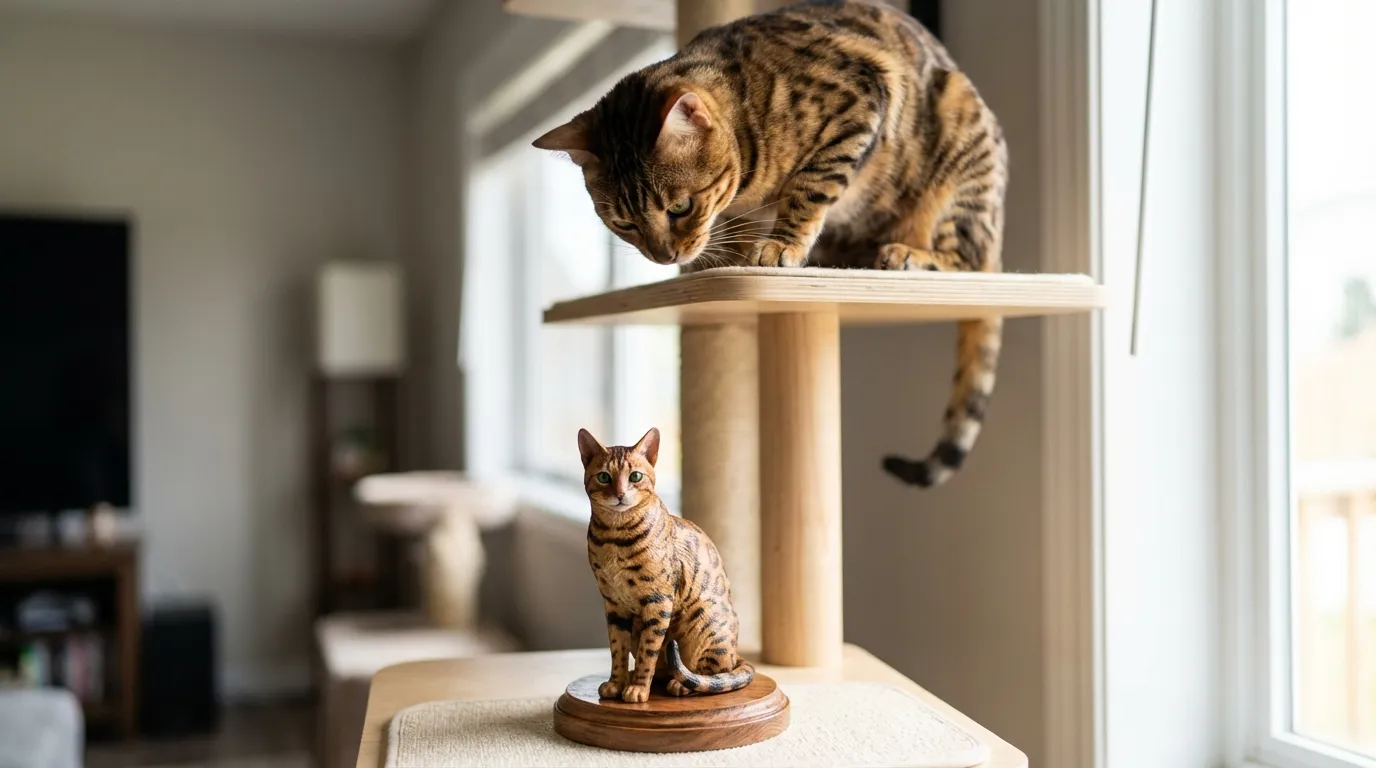
A healthy Bengal cat can jump up to three times its height in a single bound—roughly five feet straight up from a standing start. That kinetic energy is a biological fact, but until you’ve lived with it, it’s just a statistic. Then, you find yourself standing in the pet store aisle, staring at the "heavy-duty" wand toys—the ones with the reinforced braided wire because regular string didn't stand a chance—and your hand reaches out before your brain catches up. You don't need the indestructible toy anymore. The creature that could scale your doorframes and turn your living room into an obstacle course is gone. The heavy bag of high-protein, grain-free kibble feels like dead weight in your cart, not fuel for a miniature leopard.
Quick Takeaways:
- The "Vertical Void": Grieving a Bengal is unique because you aren't just missing a pet on the floor; you're missing a presence on your shelves, cabinets, and door tops.
- The Relief/Guilt Cycle: It is entirely normal to feel a confusing sense of relief that the "chaos" has stopped, followed immediately by guilt.
- Memorializing Motion: Static photos often fail to capture a Bengal's essence. Consider 3D tributes like custom figurines that capture their muscular build and unique posture.
- The Equipment Problem: Don't rush to dismantle cat wheels or ceiling-high trees. The sudden change in your room's layout can trigger "spatial grief."
The Silence of the Ceiling: Understanding Spatial Grief
When you lose a typical house cat, you look at the empty spot on the sofa. When you lose a Bengal, you look at the empty space on top of the refrigerator.
This is what we call "spatial grief," and for Bengal owners, it is vertically integrated into your home. These cats don't live in 2D; they live in 3D. They occupy the negative space above your head. Our team has spoken to countless families who tell us the hardest part isn't looking down—it's the muscle memory of looking up every time they walk into a room to see which shelf is being stalked.
The house feels bigger, but not in a good way. It feels cavernous. That giant cat wheel in the corner, which used to rumble like a freight train at 2:00 AM, is now a silent sculpture gathering dust. The floor-to-ceiling scratching post that dominates your living room stands like a monument to a civilization that suddenly vanished.
The Counterintuitive Insight:
Most grief guides tell you to put away the pet's things when you're ready. With a Bengal, we actually suggest the opposite for the large furniture. Because their equipment—the towers, the wheels, the wall-mounted walkways—often structures the flow of your room, removing it immediately creates a "shock" to your living environment. Your brain registers the room as "wrong" before it registers "sad."
Leave the cat tree up for a while. Let it become a piece of furniture for a few weeks. Disassembling it requires physical labor and tools, and doing that while fresh in grief can feel like you are actively dismantling their memory with a screwdriver. Give yourself a month. The tower isn't hurting anyone by standing there.
The Complicated Relief: When the Chaos Stops
We need to talk about the emotion that almost no Bengal owner wants to admit to, but one that we hear about in whispered tones when clients call us to commission a memorial.
Relief.
Bengals are not easy pets. They are beautiful, intelligent, and affectionate, yes. But they are also demanding, loud, destructive, and high-maintenance. They are essentially toddlers with knives and a vertical leap. Living with a Bengal means living in a state of constant, low-level vigilance. Is the door latched? Did I leave a glass on the counter? Is he bored? Is he going to scream for the next hour?
When that stops, your nervous system suddenly downshifts. You can leave a glass of water on the nightstand without it being knocked over. You can sleep past 5:00 AM. You don't have to "childproof" your groceries.
And then, the guilt hits you like a truck.
You might think, Am I a monster for enjoying this full night of sleep? Did I not love him enough because I'm relieved my curtains aren't being shredded?
Here is the truth: You are not a monster. You are a human being who was acting as a zoo keeper for a wild hybrid animal. That wave of relief isn't a lack of love; it's your cortisol levels dropping. You can deeply mourn the loss of your companion while simultaneously appreciating that your home is no longer a gymnasium. These two feelings can coexist. Allow them to.
Capturing the "Glitter" and the Muscle
One of the unique challenges of memorializing a Bengal is that standard photography rarely does them justice. Sure, you have thousands of photos on your phone, but how many of them are blurry streaks of gold and black?
Bengals are defined by two physical traits that are notoriously hard to capture in 2D: their "glitter" (the translucent hollow hair structure that makes their coat shimmer) and their distinct anatomy. They don't sit like domestic shorthairs. They have a longer back, higher hindquarters, and a thick, low-carried tail. They move with a prowl, not a walk.
We've found that Bengal owners often struggle with flat portraits because the "spirit" of the cat was in its dimensionality. This is where tactile memorials bridge the gap.
Increasingly, we're seeing owners turn to custom figurines rather than just urns or photos. Why? Because a sculptor can capture the tension in the muscles. We can recreate that specific posture—the shoulder blades bunched up right before a pounce, or that long, elegant stretch that shows off the rosettes on their flank.
When you can run your finger over the curve of a figurine's back and feel the familiar geometry of their build, it triggers a different kind of memory than looking at a screen does. It grounds the memory in physical space, which is exactly where your Bengal used to dominate.
The "Talking" Ghost: Auditory Hallucinations
If you owned a Bengal, you didn't just have a pet; you had a roommate who wouldn't stop yelling.
Bengals are vocal. They chirp, trill, howl, and scream. They narrate their own lives. "I am entering the room now!" "I have killed the red dot!" " The water bowl is 2% lower than optimal!"
The silence that follows their passing is heavier than with other breeds. It’s an auditory void. Many owners report "hearing" their cat weeks after they've passed. You might hear the distinct thump-thump-thump of them running down the hallway, or the specific "chirrup" they made when you opened the fridge.
Actionable Coping Strategy:
Don't try to drown out the silence immediately. But if the quiet is becoming oppressive, introduce "white noise" that mimics life. A low-volume radio in the kitchen or a fan in the bedroom can help break up the deafening silence that makes your brain search for the missing sounds.
Furthermore, if you have videos of your Bengal vocalizing, back them up now. Cloud storage, external hard drive, and email them to yourself. That specific, raspy Bengal meow is one of the first things memory begins to blur. Preserving the audio is just as important as preserving the photos.
What To Do With The Wheel?
We touched on the cat tree, but the cat wheel is a different beast. It’s massive, expensive, and specifically designed for high-energy cats. Seeing it sit still can be heartbreaking.
When you are finally ready to part with it (and remember, there is no timeline—if it takes six months, it takes six months), consider a specific kind of donation.
Don't just drop it at a generic thrift store where it might be misunderstood or undervalued. Look for breed-specific rescues. There are Bengal rescues all over the country that are desperate for sturdy equipment. These organizations take in Bengals who were surrendered for being "too much" for their previous owners.
Donating your cat's wheel to a rescue means that another high-energy, misunderstood cat will get to burn off that anxiety and perhaps become adoptable. It transforms your loss into a direct lifeline for another animal. It’s a legacy of movement.
Navigating the "Next Cat" Anxiety
Here is a fear we hear often: "I can't get another cat because it won't be Him."
Or, conversely: "I'm afraid if I get a regular cat, I'll be bored."
Bengal owners are often ruined for other breeds. Once you've had a dog-cat hybrid that plays fetch, walks on a leash, and opens doors, a sleeping ragdoll might seem... inactive.
But this is also an opportunity. If and when you decide to bring another pet into your life, give yourself permission to get a "boring" cat. You aren't betraying your Bengal by getting a cat that actually wants to sit on your lap for three hours. You are simply entering a different season of life.
One of our customers told us, "I got a senior shelter cat six months after my Bengal died. At first, I was disappointed he didn't want to play fetch. But then I realized: I can knit without my yarn being stolen. I can leave a glass of water on the table. It’s not better, it’s not worse. It’s just different love."
The Final Leap
Grief, much like a Bengal, is not linear. It doesn't walk in a straight line; it ricochets off the walls. It hides under the sofa and then pounces on you when you're just trying to make coffee.
There will be days when you miss the chaos so much your chest aches, and days when you are thankful for the peace. Both days are valid.
Your Bengal spent their life defying gravity, refusing to be bound by the floor. Your grief will likely refuse to be bound by standard stages, too. When you look at that empty spot on top of the kitchen cabinets, try to remember: the only reason the space feels so empty is because they filled it with so much life.
Frequently Asked Questions
How do I deal with the guilt of feeling relieved?
This is the most common "secret" emotion Bengal owners face. Because Bengals are high-maintenance—often requiring "childproofing," intense play sessions, and tolerance for destruction—their passing brings a sudden drop in household stress. This relief is biological, not emotional. Your body is standing down from "high alert." It does not mean you didn't love them; it means you were tired. Be gentle with yourself.What should I do with the cat wheel and heavy equipment?
We recommend waiting at least 3-4 weeks before making major changes to the room's layout. Removing large structures like wheels or floor-to-ceiling posts immediately can make the home feel shockingly empty. When you are ready, look for Bengal-specific rescues or sanctuaries. They are always in need of heavy-duty equipment that can withstand hybrid energy levels.Why do I feel like I can't get a "normal" cat now?
Bengals have such distinct, dog-like personalities that owning one changes your baseline for what a "cat" is. A regular domestic shorthair might feel inactive or "boring" by comparison. This is a normal fear. However, many owners find that adopting a different breed later on allows them to appreciate a new kind of bond—one that is calmer and more cuddly—without constantly comparing the new cat to the Bengal.How long does it take to make a custom figurine?
Because we focus on museum-quality anatomical accuracy—essential for capturing a Bengal's unique build—our process typically takes several weeks. This includes a digital sculpting phase where you get to review the 3D model and request unlimited changes to ensure we've captured that specific "prowl" or facial expression. You can learn more about our process and timeline here.Honor Their Memory Forever
Your pet's story deserves to be preserved in a way that captures their unique spirit. A custom PawSculpt figurine transforms your cherished memories into a timeless keepsake—every whisker, every marking, every detail that made them irreplaceable.
Free instant AI preview • 3D artist preview within 7 days • 5 free revisions