
When the Dog Walker Stops Coming: Grieving Your Social Golden Retriever
You’re standing in aisle four of the local pet supply store, your hand hovering over a bag of large-breed dental chews. A woman with a bouncy chocolate Lab puppy brushes past your cart, offering an apologetic smile as she wrestles the leash. "He's still learning his manners," she laughs. Your "dog parent" reflex kicks in instantly—your mouth opens to ask how old he is, to offer a tip about turning your back when he jumps. But then your hand freezes on the bag. The realization hits you like a physical blow to the chest, knocking the wind out of you right there under the fluorescent lights. You don't need the dental chews. You don't need to ask about the puppy. You aren't "that person" anymore. You pull your hand back as if the bag burned you, turn your cart around, and walk out of the store without buying a single thing.
The automatic doors slide shut behind you, sealing off the world you used to belong to.
Quick Takeaways:
- The "Mayor" Effect: Losing a Golden Retriever often means losing your neighborhood social network and daily human interactions.
- Secondary Loss: You aren't just grieving a pet; you're grieving a lifestyle, a routine, and an identity.
- The "Relief" Trap: Feeling relief about regained freedom (no more 6 AM walks in the rain) is normal and does not negate your love.
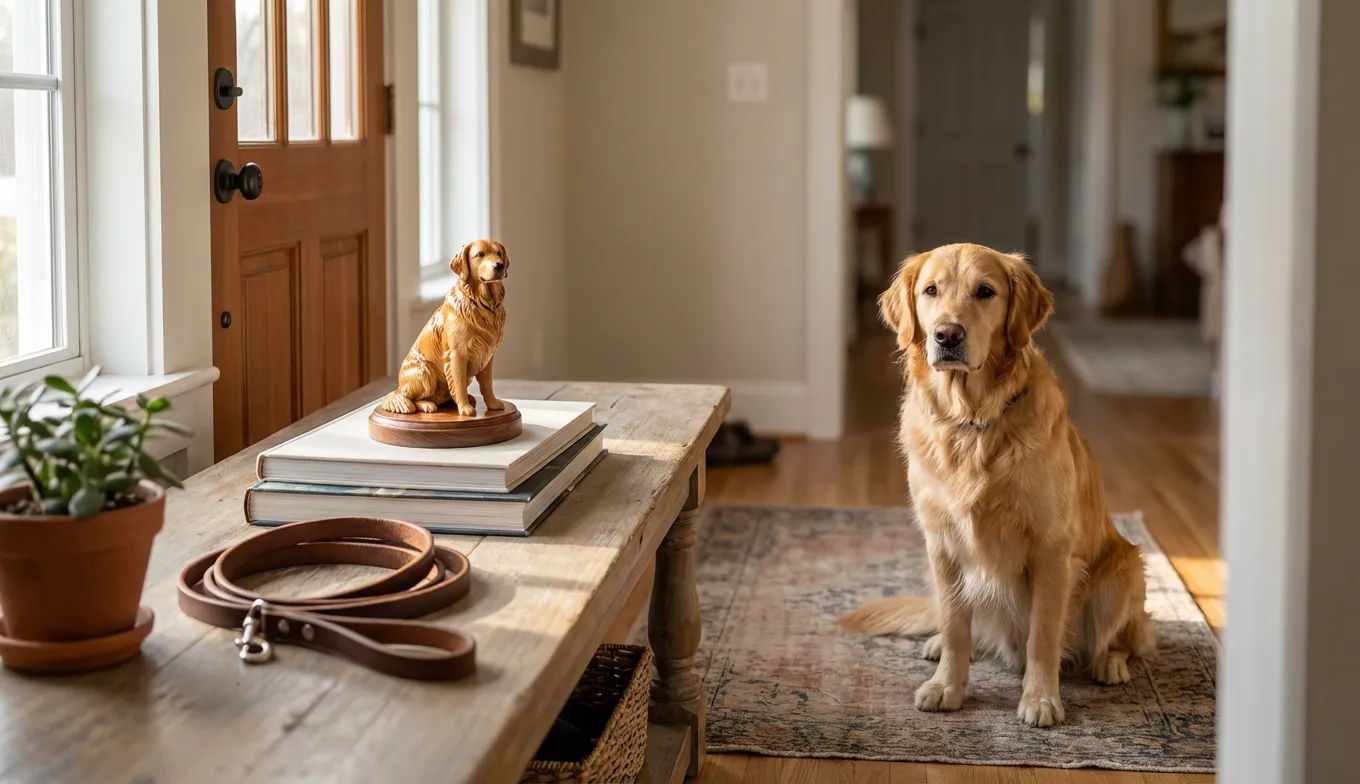
- Tangible Memories: Custom figurines can help bridge the gap when photos feel too flat to capture a Golden's dynamic personality.
- Action Step: Create a new morning ritual immediately to fill the void left by the morning walk.
The Silence of the Leash Hook
When you lose a Golden Retriever, you lose more than a dog. You lose the neighborhood mascot. Goldens are, by nature, social bridges. They are the reason you know the name of the guy three houses down (even if you only know him as "Cooper's dad"). They are the reason you stop at the park bench to talk to the elderly woman who keeps treats in her pocket.
Most grief guides tell you how to handle the sadness. They rarely tell you how to handle the sudden, jarring anonymity.
We call this "disenfranchised social grief." It’s the loss of your status as the person on the other end of the leash. For ten, maybe twelve years, your day was bookended by social outings disguised as potty breaks. You were a public figure in your micro-community. Now, without that golden, tail-wagging anchor by your side, you might feel invisible. You walk down the same street, but nobody stops. The cars don't slow down to wave. You are suddenly just another pedestrian, and that shift in identity can be as painful as the silence in the house.
The "5:30 PM" Phantom Limb
It’s 5:28 PM. Your body knows it. There is a biological clock in your chest that starts ticking faster, anticipating the "boof"—that low, muffled bark Goldens do when they’re trying to be polite but really need you to hurry up.You look at the clock. You look at the door. And then you remember.
This is the physiological side of grief that catches people off guard. Your nervous system has been trained for years to spike in cortisol and dopamine at specific times of the day. When the stimulus (your dog) is removed, your body doesn't get the memo immediately. You are left with a surge of energy and nowhere to direct it.
Counterintuitive Insight: Don't try to "relax" during these times. Most people try to sit on the couch and force themselves to watch TV to distract from the time. This usually fails because your body is primed for movement. Instead, keep the movement but change the modality. If you walked at 5:30, go for a drive at 5:30. If you played fetch, do 15 minutes of yoga. Match the energy expenditure, but change the context so your brain doesn't constantly compare it to the missing walk.
Navigating the "Dog Park Friends" Dilemma
Here is a scenario we hear about constantly at PawSculpt: You have a circle of friends you only see at the dog park. You know their dogs' allergies, their vacation schedules, and their kids' names. But you don't have their phone numbers.
When your Golden passes, you face a unique form of isolation. Do you go to the park without a dog? That feels voyeuristic and painful. Do you just disappear? That feels like erasing a decade of friendship.
This is where the isolation feels sharpest. You realize your social contract with these people was signed by your dog. Without him, the contract feels void.
- The "Bridge" Visit: If you can bear it, go once. Go without the leash. It will be a tear-jerker. Tell them what happened. Allow them to hug you. This provides closure for them too—remember, they loved your dog.
- The Note: If you can't face them in person, tape a laminated note to the park gate or bench. "To the Saturday Morning Crew: We said goodbye to Bailey this week. Thank you for being his pack." It sounds dramatic, but it allows you to acknowledge the relationship without the trauma of a face-to-face conversation you aren't ready for.
The Taboo Emotion: Relief (And the Guilt That Follows)
Let's talk about the thing nobody wants to admit. Goldens are wonderful, but they are also a lot of work. The hair (the endless tumbleweeds of hair). The muddy paws. The neediness. The health issues in their later years—the hips, the cancer scares, the slow walks.
There will be a moment, perhaps a week after the loss, where you look at your dark floors and realize they are clean. Or it’s pouring rain outside, cold and miserable, and you realize you don't have to go out in it. You can stay in your pajamas.
And then, immediately after that thought, you will feel like a monster.
We need to normalize this. Feeling relief that the caretaking burden has lifted is not a betrayal of your dog. It is a biological response to the cessation of stress. Caregiver fatigue is real, even with pets. You can be devastated that they are gone and simultaneously relieved that you aren't cleaning up accidents at 3 AM anymore. These two emotions can coexist.
The guilt is grief's way of trying to maintain a connection. If you feel guilty, you're still "doing something" for them. But you don't need the guilt to prove you loved them. Your grief is proof enough.
When Photos Aren't Enough: The Need for Tangible Memory
In the digital age, we have thousands of photos of our pets. You probably have a camera roll full of that famous Golden Retriever smile—tongue lolling out, eyes crinkled shut in pure joy. But after a loss, scrolling through photos on a flat screen can sometimes feel hollow. It highlights the absence rather than filling the void.
This is why we see so many families turn to three-dimensional tributes. There is something about the physical presence of a Golden—the broadness of the chest, the feathered tail, the specific way they hold their head—that a 2D image struggles to convey.
At PawSculpt, we've worked with countless families who tell us that the hardest part is looking at the empty spot on the rug where their dog used to nap. Placing a custom figurine in that spot, or on the mantle overlooking the room, serves as a physical anchor. It’s not about replacing them; it’s about acknowledging that their presence in the room was heavy, real, and substantial.
One customer told us, "I didn't want a generic statue. I wanted his goofy sit—the one where he kicked his leg out to the side." Capturing those quirks—the "lazy sit," the ear that always flipped inside out—is what transforms an object into a connection. It helps bridge the gap between the physical dog you lost and the memories you're trying to hold onto.
Rebuilding Your Routine (Without Erasing Them)
You cannot simply "move on." You have to rebuild the scaffolding of your life, which was previously held up by your dog's needs.
The "Honor Walk"
If you aren't ready to walk the old route, don't. It's filled with landmines of memory—the tree he peed on, the house with the cat he barked at.However, stopping exercise entirely leads to depression. Try the "Honor Walk." Drive to a nature trail or a park you never visited with your dog. Walk for yourself. Listen to a podcast. Reclaim the act of walking as something you do for your health, not just a chore you did for his.
The "Golden" Legacy
Golden Retrievers are practically made of love and social connection. The best way to grieve them is not to shut down the social side of yourself, but to redirect it.- Volunteer (but not with dogs yet): If the shelter is too painful, volunteer at a food bank or a community garden. Use the energy you spent caring for a dependent creature and pour it into something else that needs nurturing.
- The "Hello" Rule: Your dog forced you to say hello to strangers. Keep doing it. It will feel awkward without the buffer of a cute animal, but don't let the world shrink. When you see a neighbor, wave. Keep the channel open.
The Long Tail of Grief
The grief of losing a social dog like a Golden has a "long tail." You might be fine for three months, and then the first warm spring day hits—the kind of day he would have loved—and you’ll fall apart.
This is normal. The timeline for grieving a "lifestyle dog" is longer than for a low-maintenance pet. You are untangling years of neural pathways, social habits, and emotional regulation strategies.
Be patient with the silence in the house. It won't always feel empty. Eventually, it will just feel peaceful. And when you walk past the treat aisle in the pet store, the sting will lessen. You’ll look at the dental chews and smile, remembering how he used to carry one around for an hour before eating it, just to show it off.
You’ll walk out of the store, not because you’re running away, but because you’re okay.
Frequently Asked Questions
How long does the disruption of routine last after pet loss?
The physical "phantom limb" sensation—waking up at 6 AM automatically or reaching for the leash—typically peaks in the first 3 to 6 weeks. This is roughly the time required to break a long-standing habit loop. However, the emotional desire for the routine can last much longer. Be gentle with yourself during this neurological reprogramming.Is it normal to feel relief after a sick pet dies?
Absolutely. We cannot stress this enough: relief is a reaction to the end of suffering (both yours and theirs). If you have been acting as a hospice nurse for your Golden, managing mobility issues or medication schedules, your body has been in a state of high alert. The relief you feel is your parasympathetic nervous system finally exhaling. It does not mean you loved them any less.Should I get another Golden Retriever immediately?
Golden owners are often breed-loyal, but rushing can be a mistake. If you get a puppy next week, you might find yourself resenting it for not being him. You might get frustrated that the puppy bites or isn't house-trained, comparing it to your well-behaved senior dog. A good rule of thumb: Wait until the thought of a new dog makes you excited about the future, rather than just wanting to fix the past.How do I tell my "dog park friends" that my dog passed?
This is a specific type of social anxiety. If you have one contact number for the group, text that person and ask them to share the news. If you don't, it is perfectly acceptable to stop going. You do not "owe" the park an appearance. However, if you want support, going once during a quiet time to tell a few key people can result in a beautiful outpouring of love that helps the grieving process.What is the best way to memorialize a Golden Retriever?
Because Goldens are so physical—they lean on you, they put their paws on you—tangible memorials are often very healing. Many families choose to keep the collar or a favorite toy. For a more artistic tribute, custom figurines allow you to see their form in 3D, capturing the specific way they sat or the "happy tail" blur, which can be more comforting than a flat photograph.Honor Their Memory Forever
Your pet's story deserves to be preserved in a way that captures their unique spirit. A custom PawSculpt figurine transforms your cherished memories into a timeless keepsake—every whisker, every marking, every detail that made them irreplaceable.
Free instant AI preview • 3D artist preview within 7 days • 5 free revisions