Why Hand-Painting Matters: Capturing the Cream Points of a Siamese Cat
You’re standing in the aisle of a big-box pet supply store, holding a mass-produced ceramic cat statue that claims to be a Siamese. It feels heavy and cold in your hand. You look at the face—a stark, black mask stamped onto a beige head with zero transition. It looks like a bandit mask, not your cat. Your thumb traces the hard edge of the paint, and you realize exactly why this $20 trinket feels so hollow. It captures the breed standard, sure, but it misses the biology. It misses the way the chocolate color on your cat’s nose fades into the cream of her cheek, a transition so soft it looks like smoke dissipating in still air.
Quick Takeaways:
- The "Gradient Problem": Machines struggle to print soft color transitions; true Siamese points require hand-applied glazing techniques.
- Surface prep is key: You cannot paint a realistic coat on a 3D print without sanding away the 35-micron layer lines first.
- Material matters: We use specialized grey resins to spot imperfections before a single drop of paint touches the model.
- The eyes have it: Siamese blue is complex. It requires multiple layers of transparent blue and a UV-gloss finish to mimic the "wet" look of a living eye.
- Why custom wins: Mass production uses stencils; custom artists use reference photos to map your specific cat's asymmetry.
The Engineering Behind the Art: Why "Printing" is a Misnomer
When people hear "3D printed pet figurine," they often imagine a machine spitting out a fully colored, finished statue like a document coming out of an inkjet. If only it were that simple. In the additive manufacturing world, specifically with the high-fidelity SLA (Stereolithography) and MSLA (Masked Stereolithography) printers we use, the machine only provides the canvas.
The printer creates the geometry. The artist creates the life.
For a breed like the Siamese, the geometry is unforgiving. With a fluffy Golden Retriever, the texture of the sculpted fur hides a multitude of sins. If the printer leaves a tiny layer line or a support scar, the chaotic texture of the fur covers it up. But a Siamese? They are sleek, architectural creatures. Their coat is like satin.
This means the "canvas" must be flawless. In our shop, we print at layer heights usually between 25 and 50 microns. To give you a sense of scale, a human red blood cell is about 7 microns wide. We are slicing your cat's digital sculpture into thousands of cross-sections thinner than a sheet of paper.
- Solvent Wash: Removing uncured resin with isopropyl alcohol.
- Support Removal: Snipping the scaffolding that held the print against gravity.
- UV Curing: Locking in the polymer chains for durability.
- Sanding: The most critical step for shorthair cats. We wet-sand the surface to ensure the "coat" looks like skin and fur, not plastic topography.
The "Point" of Contention: Why Machines Can't Paint Siamese Cats
Here is the technical hurdle that mass manufacturing fails to clear every time: The Siamese "point" pattern is temperature-dependent.
Biologically, the enzyme that creates color in a Siamese cat doesn't work at normal body temperatures. It only works on the cooler parts of the body—the ears, tail, paws, and nose. This creates a gradient, not a pattern. It is a slow, biological fade from warm cream to cool chocolate (or blue, or lilac).
A machine using a pad-printing process or a spray mask deals in absolutes. It puts pigment here but not there. That’s why that statue in the pet store looked like it was wearing a mask.
The Glazing Technique
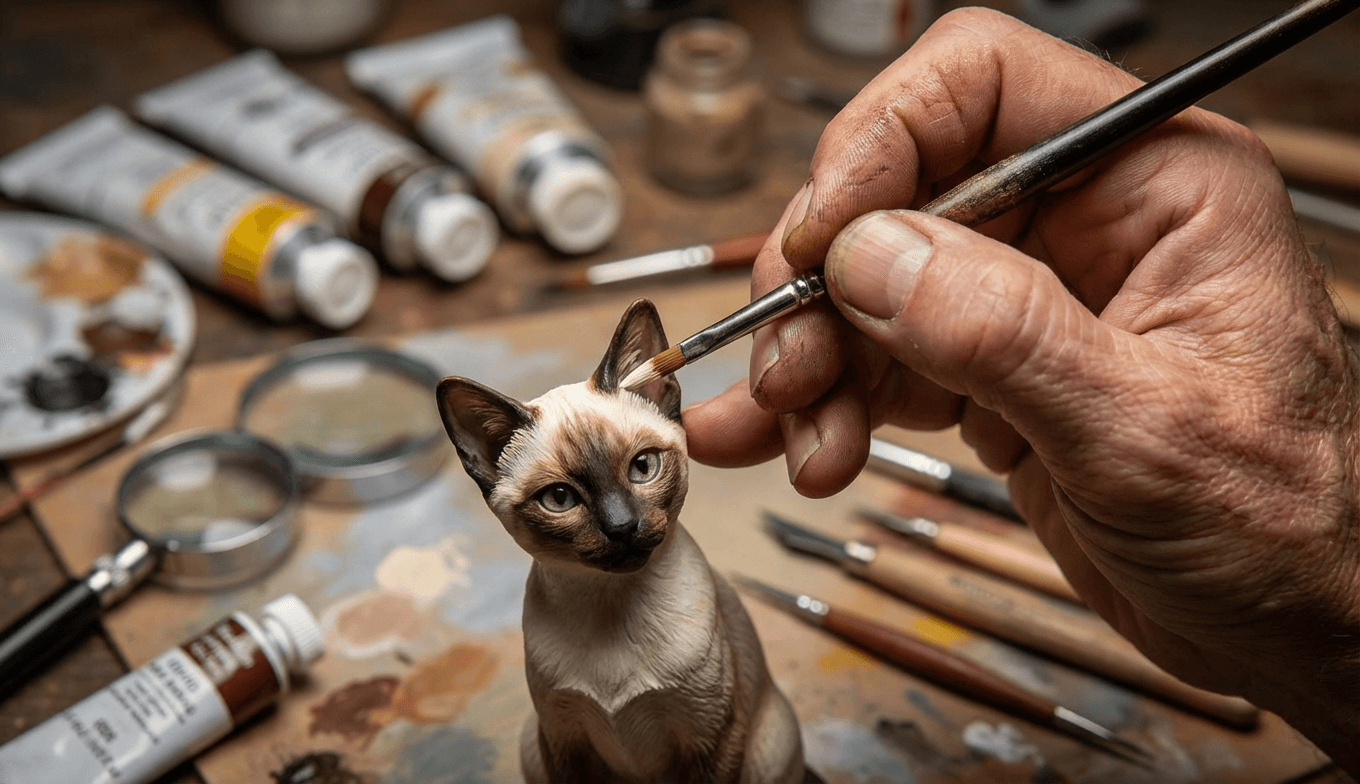
To capture that smoky transition, we use a technique borrowed from classical oil painting and adapted for modern acrylics: glazing.Instead of mixing a "seal point brown" and slapping it on the nose, we dilute the pigment with a flow improver until it is semi-transparent. We apply thin, watery layers, one over the other.
- Layer 1: A wash of pale fawn over the entire muzzle.
- Layer 2: A slightly darker cool brown, starting halfway down the nose.
- Layer 3: Deep espresso, focused only on the very tip of the nose and the edges of the ears.
Because the layers are transparent, the cream color underneath shines through the brown, creating an optical mixing effect that perfectly mimics the way fur grows. It’s tedious. It takes time to dry between layers. But it’s the only way to get that "soft focus" look that defines the breed.
Orientation Strategy: avoiding the "Scar"
Let's talk about a heuristic we use on the shop floor called "orientation logic." When we set up a file for printing, we have to decide which way the model faces in the machine.
Resin printing requires supports—tiny pillars that hold the model up as it prints upside down. Where those supports touch the model, they leave tiny divots or bumps.
For a long-haired dog, we can hide supports almost anywhere. For a Siamese cat, we have to be surgical. We can't place supports on the face, the smooth arch of the back, or the tips of the ears. Those surfaces are the "money shots."
We typically orient a Siamese model at a 45-degree angle, leaning back, so the supports cluster on the belly and the underside of the paws. We sacrifice the detail on the stomach (which no one sees) to ensure the face and the dorsal line (the spine) are pristine. If you look closely at a low-quality 3D print, you might see what looks like "pockmarks" on the chin or ears. That’s bad orientation. It’s a sign the operator prioritized print speed over surface quality.
The Color of Shadow: Painting "White" Animals
A common misconception is that Siamese cats are white or beige. If you paint a figurine pure white, it looks like a ghost. It looks flat.
Living things are never one solid color. Even the cream body of a Siamese has temperature. The chest might be a warm, yellow-toned cream. The flanks might have a cooler, violet-grey shadow where the body curves away from the light.
- We prime the whole model in a dark grey.
- We spray white ink from directly above the model (where the "sun" would be).
- This creates natural, baked-in shadows in the armpits, under the chin, and between the toes.
When we hand-paint the cream coat over this guide, the shadows remain subtle but present. It gives the figurine volume. It makes it look heavy and real, rather than like a lightweight toy.
The Eyes: The Window to the Resin Soul
Siamese eyes are intense. They aren't just blue; they are sapphire, ice, or sometimes violet-tinged. And unlike a dog's dark eyes, which absorb light, a Siamese's pale eyes reflect it.
Getting this right on a figurine is tricky because resin is opaque. We have to "fake" the depth.
We paint the pupil not as a black dot, but as a deep, dark well. We paint the iris with striations—tiny lines radiating from the pupil—using a lighter blue and a darker blue. Then, and this is the secret sauce, we apply a tiny dot of pure white in the upper corner of the pupil. This is the "catchlight." It tricks the human brain into thinking the surface is wet and reflective.
Finally, after the matte varnish is applied to the rest of the cat to simulate soft fur, we go back in with a high-gloss UV resin on just the eyeballs. This physical gloss catches the real room light. When you move the figurine, the eyes seem to sparkle.
Why Customization Matters for Points
Here is where the "custom" part of custom pet figurines becomes non-negotiable.
"Seal Point" is a breed standard, but your cat is an individual.
Maybe your cat has a "locket"—a tiny patch of white fur on the chest that is technically a show fault but is 100% him*.
- Maybe the mask on your cat doesn't cover the eyes fully, giving him a perpetually surprised look.
- Maybe as your cat aged, the cream body darkened (a phenomenon called "toasting" in the Siamese community).
A generic figurine cannot capture the "toasting." It cannot capture the locket.
At PawSculpt, we ask for photos from multiple angles not just to see the shape, but to map the melanin. We need to see exactly where the brown stops and the cream starts on your cat's specific paws. We've had customers send us photos of just the tail tip because there was a specific kink or color break they wanted to remember.
That’s the difference between a decoration and a memorial.
Durability and Material Science: The "Yellowing" Risk
As an engineer, I have to be honest about the tradeoffs of resin. Standard UV resins have a weakness: they hate UV light. Over time, sunlight can cause clear or white resins to yellow.
For a Siamese cat figurine, which is predominantly light-colored, this is a major technical concern. If the resin yellows, your cat looks like it’s been stained with nicotine.
- Opaque Primers: We never rely on the raw resin color. We completely seal the model in a high-grade, UV-resistant primer. The paint isn't just decoration; it's a protective shield for the plastic underneath.
- UV-Resistant Clear Coats: The final step is a clear coat that acts like sunscreen for the figurine.
We often tell clients: treat these like watercolor paintings. Don't leave them on a windowsill in direct, scorching sunlight for five years. But with proper sealing, modern high-end resins are incredibly stable.
The Emotional Weight of the Process
I remember a ticket that came through the shop last year. It was for a Siamese mix named "Luna." The owner sent a reference photo of Luna sleeping in a sunbeam, and specifically mentioned, "She always had this smudge of chocolate on her left back toe, just one toe."
When you’re working the production floor, it’s easy to get lost in the numbers—exposure times, lift speeds, support density. But when you see a note like that, you stop.
I remember painting that toe. I remember steadying my hand against the workbench, holding a brush with literally ten bristles, and carefully glazing that single toe bean chocolate brown. It’s a detail that would never, ever exist on a factory line.
When we shipped it, we weren't just shipping a piece of cured plastic. We were shipping the memory of that one toe.
Frequently Asked Questions
Why are custom hand-painted figurines more expensive than store-bought ones?
The price difference comes down to labor and customization. A store-bought statue is cast in a mold thousands of times and sprayed by a machine. A custom piece from a studio like ours involves a digital sculptor creating a unique 3D mesh, an engineer setting up the print, and a specialized artist spending hours hand-glazing the fur patterns. You are paying for the time and talent of three different craftspeople.How do I clean my 3D printed pet figurine?
Treat it like a fine collectible or a camera lens. Use a soft, dry microfiber cloth or a clean, fluffy makeup brush to dust it gently. Never use water, soap, or household cleaners like Windex. While the figurine is sealed, moisture can eventually compromise the acrylic paint, and harsh chemicals can strip the UV coating that protects the resin.Can you fix the figurine if it breaks?
Resin is a fantastic material for detail, but it shares a physical property with ceramic: it is brittle. If dropped onto a hardwood floor, it can snap. The good news is that resin usually breaks cleanly. A tiny dot of super glue (cyanoacrylate) applied with a toothpick can often fix a snapped tail or ear invisibly. For catastrophic damage, we recommend contacting us—we keep the digital files on hand and can often arrange a reprint.How long does the custom figurine process take?
Because we aren't pulling stock off a shelf, the timeline is typically 3 to 6 weeks. The digital sculpting phase alone can take a week, especially if we go back and forth with you on revisions to get the expression just right. The painting is the bottleneck—oil washes and acrylic glazes need time to fully dry between coats to prevent the paint from tearing or muddying.Do I need professional photos for a custom figurine?
Not at all. In fact, candid phone photos are often better because they capture your pet's natural personality. However, for a Siamese, lighting is critical. Flash photography washes out the "points" and makes the cat look white. Try to take photos near a window with indirect natural light. We need to see the transition zones—where the legs turn to paws and where the mask fades into the face.Ready to Get Started?
Now that you know what goes into creating the perfect pet figurine, it's time to bring your vision to life. Our master sculptors are ready to capture every detail that makes your pet unique.
Free preview within 48 hours • Unlimited revisions • Lifetime guarantee