
Honoring Your Senior Golden Retriever: Creating a Sunset Routine Memorial
"How lucky I am to have something that makes saying goodbye so hard." — A.A. Milne
The basement air always carries that specific scent of damp concrete and stored memories, but today, it hits differently. You’re down there looking for a winter coat, but your hand brushes against a plastic bin in the corner. Inside is the "Chuckit" ball thrower you haven't used in three years. Next to it, the heavy-duty hiking harness from when your Golden Retriever could still scramble up rocks without hesitation. Holding that dusty plastic handle, the reality of the timeline crashes down on you. The days of endless fetch are gone, replaced by slow, shuffling potters around the backyard and the rhythmic sound of heavy breathing as he sleeps.
It’s a sharp, physical ache in your chest—the realization that you are living in the "after" of his prime, but the "before" of the end. Most people wait until their dog has passed to think about memorials. But with a senior Golden, whose decline can be a slow, sweet, heartbreaking fade, waiting feels like a wasted opportunity. The most profound way to honor them isn't just a funeral; it's what you do while their tail is still wagging, however faintly.
Quick Takeaways:
- Shift perspective: Move from "anticipatory grief" to "active celebration" by creating a daily Sunset Routine.
- Capture the texture: Photos are great, but tangible keepsakes (like custom figurines or preserved textiles) trigger stronger emotional recall.
- Validate the relief: It is normal to feel exhausted by senior dog care; feeling relief when it ends does not negate your love.
- The "Sniffari": Replace distance walks with sensory experiences to keep their mind engaged even if their hips are tired.
The "Sunset Routine": Memorializing the Living
Here is the angle most pet grief articles miss: We spend so much time dreading the empty space they will leave behind that we accidentally hollow out the time they are still here. We treat them like they are already gone.Instead of counting down the days with dread, we recommend establishing a "Sunset Routine." This is a deliberate, daily ritual dedicated solely to connection, devoid of caretaking stress (no pills, no lifting, no cleaning accidents).
For a Golden Retriever, whose love language is almost entirely physical touch and presence, this might look like 15 minutes of floor time every evening. Not watching TV while petting them, but lying on the rug, face-to-face, breathing in that corn-chip smell of their paws. It’s about memorizing the geography of their face—the specific way their "sugar face" (that beautiful white mask of age) has spread around their eyes.
Why this matters: When the end comes, the regrets usually aren't "I wish I bought better food." They are "I wish I had just sat with him more." A Sunset Routine banks those memories now, so you can draw on them later.
The Unspoken Weight: Guilt, Relief, and Exhaustion
Let’s be honest about something few people admit in public. Caring for a senior Golden Retriever—a dog that likely weighs 60 to 80 pounds—is physically demanding. When their hips give out on the stairs, or when they can no longer stand to eat, you become their physical support system.There is a complex emotional cocktail that comes with this stage. You might feel a flash of frustration when you have to wake up at 3:00 AM again to help them outside. You might feel guilty for canceling plans because you can't leave them alone.
And then, there is the darkest feeling of all: the anticipation of relief.
We have spoken to hundreds of families who whispered, almost in shame, that part of them was relieved when the struggle ended. Hear this: That relief is not a betrayal. It is the exhaustion of a caregiver recognizing that the suffering—both yours and theirs—has finished. It doesn't mean you loved them less. It means you loved them enough to carry the weight until you couldn't, and then you loved them enough to let them go. Acknowledging this complexity helps prevent the "grief spiral" where you punish yourself for having human limits.
Capturing the "Golden" Essence
Golden Retrievers have a specific energy. It’s the "happy tail" that thumps against the wall, the "soft mouth" that carries a stuffed hedgehog around for years without tearing it, and the crimped fur behind their ears that feels like silk.Standard photos often fail to capture this volume and texture. A photo is flat; a Golden is substantial.
The Tactile Tribute
Because Goldens are such tactile creatures, your memorial strategy should involve touch.- The Unwashed Blanket: This sounds counterintuitive, but when they pass, do not wash their favorite bedding immediately. Seal one blanket in a vacuum bag. Scent is the strongest trigger for memory. Six months down the road, when you feel like you're forgetting them, opening that bag can bring them back to the room instantly.
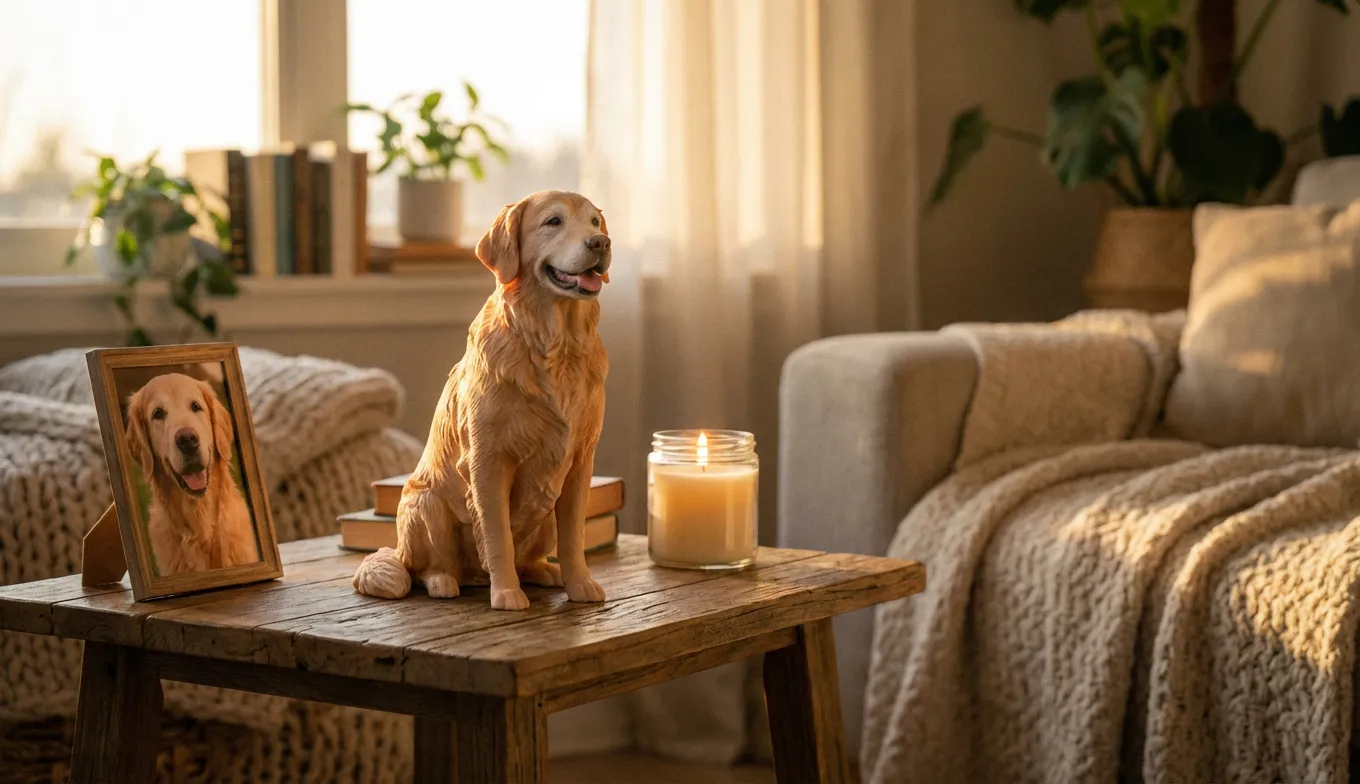
- The Physical Anchor: We’ve seen a rise in families seeking three-dimensional representations of their pets. While photos are beautiful, they don't occupy space. A custom pet figurine can capture the specific posture of your senior dog—maybe the way he sat with one hip kicked out, or the way he rested his chin on his paws. Having a physical object to touch on a desk or mantle helps ground the grief when you instinctively reach out to pet a dog that isn't there.
The "Sniffari" Shift
As your Golden slows down, they can't hike the trails they used to. This often causes owners to feel guilty, like they are depriving their dog.Flip the script. Stop walking for exercise; start walking for information. A "Sniffari" is a walk where the dog sets the pace and chooses the direction. If they want to smell a single blade of grass for four minutes, let them. For a senior dog, mental stimulation is just as tiring as physical exercise. This adjustment allows them to feel capable and engaged without the pain of forced marching.
The "Sugar Face" Photography Session
You have thousands of photos of your dog on your phone. But do you have photos of you with your dog?Most of us are guilty of being the photographer, not the subject. But in our experience, the photos owners cherish most after a loss are the ones showing the relationship.
- The Grip: Take a close-up of your hand burying into their neck fur.
- The Gaze: Have someone take a photo of your Golden looking at you. That specific look of adoration is a Golden Retriever trademark.
- The Scale: Goldens are big dogs. Get a photo that shows their size relative to you.
Pro Tip: Do this while they are still relatively mobile. Don't wait for the very last days when they look sick or distressed. You want to remember the dignity of their senior years, not just the medical crisis at the end.
When the House is Too Quiet
The silence following the loss of a Golden Retriever is heavy. These are dogs that take up space—acoustically and physically. You miss the click-clack of nails, the heavy sigh as they settle, the thumping tail.Reclaiming the Space
One of the hardest moments is dismantling the "sick room"—the area with the orthopedic bed, the ramps, and the water bowls.- Don't rush: There is no rule that says you must hide the dog bed by Tuesday. If seeing it brings you comfort, leave it. If seeing it breaks your heart, move it to the basement.
- Create a focal point: Instead of an empty corner, create a deliberate memorial shelf. This is where a custom figurine or a framed paw print can live. It transforms a "void" into a "tribute."
The Legacy of the "Good Boy"
Goldens are often called the "best dogs ever" for a reason. They teach us about unconditional optimism. The best memorial you can build is to adopt a piece of their personality.- Did they greet everyone with enthusiasm? Try to be warmer to strangers.
- Did they forgive instantly? Try to hold fewer grudges.
- Did they find joy in a simple tennis ball? Try to find joy in your morning coffee.
Integrating their nature into your character ensures they survive not just in memory, but in action.
Moving Forward, Not Moving On
There is a distinct difference between "moving on" and "moving forward." Moving on implies leaving them behind. Moving forward means carrying them with you.That dusty Chuckit in the basement? You don't have to throw it away. But maybe, eventually, you move it to a box of keepsakes rather than leaving it out as a painful reminder of what you can't do anymore.
Your senior Golden has spent their entire life studying you—learning your routine, your moods, and your heart. They have been the witness to your life. Creating a sunset routine and planning a meaningful memorial is simply returning the favor. It is saying, "I see you. I honor you. And I will make sure your story doesn't end just because you aren't here to write it anymore."
Frequently Asked Questions
How do I know when it's time to say goodbye to my senior Golden?
This is the hardest question every owner faces. We recommend using a "Quality of Life" scale (many vets provide these). Look for the balance of good days versus bad days. For Goldens specifically, watch for the loss of their "spark"—if they stop greeting you, can't get up to follow you from room to room, or lose interest in food, they are likely telling you they are tired. Trust your gut; you know them better than anyone.Is it weird to get a memorial figurine before my dog passes?
Not at all. In fact, we see this often at PawSculpt. Ordering a custom figurine while your dog is still with you allows you to compare the sculpture to your pet to ensure the coloring and expression are perfect. For many, having the keepsake ready before the loss provides an immediate sense of comfort and continuity during the difficult first days of grief.How can I help my other pets grieve the loss of a Golden Retriever?
Animals understand death, but they struggle with sudden disappearance. If possible, allow surviving pets to see and sniff the body after your Golden has passed. This provides closure. If that isn't possible, expect behavioral changes—clinging, searching the house, or depression. Stick to their routine rigidly; predictability provides safety when their pack dynamic has changed.What is anticipatory grief in pet owners?
Anticipatory grief is the mourning that begins before the actual death. It hits hard when you receive a terminal diagnosis or notice significant aging. You might find yourself crying while your dog is sleeping peacefully at your feet. Please know this is normal. It is your mind trying to prepare your heart for the impact. Recognizing it as a form of love, rather than weakness, can help you cope.Honor Their Memory Forever
Your pet's story deserves to be preserved in a way that captures their unique spirit. A custom PawSculpt figurine transforms your cherished memories into a timeless keepsake—every whisker, every marking, every detail that made them irreplaceable.
Free instant AI preview • 3D artist preview within 7 days • 5 free revisions