Explaining the Empty Paddock: Helping Kids Grieve a Senior Pony
"The essential joy of being with horses is that it brings us in contact with the rare elements of grace, beauty, spirit, and fire." – Sharon Ralls Lemon
The gravel on the walking trail leading to the barn always sounds louder when you’re walking it alone. For years, this path was a prelude to noise: the rhythmic thud of hooves against a stall door, the sharp intake of breath from a waiting animal, the low, welcoming nicker that vibrated right through your chest. But today, the wind cuts across the pastures without obstruction, and the silence hanging over the paddock isn't peaceful—it’s heavy.
You watch your daughter pause at the gate, her hand instinctively reaching into her pocket for a peppermint that isn't needed anymore. She traces the wood where the cribbing marks are deep and jagged—scars from a habit you used to find annoying, but now serve as the only physical proof that he was really here. The halter hanging on the hook looks impossibly small and lifeless without the warm, velvet weight of a nose inside it.
Quick Takeaways:
- The "Teammate" Dynamic: Unlike house pets, losing a pony is losing a partner in sport and labor, which complicates the grief with a loss of identity.
- The Physical Void: Horses are massive animals; their absence creates a literal, spatial emptiness in a child's life that requires tangible acknowledgement.
- Validating Relief: It is crucial to normalize the "caregiver relief" parents and children feel after caring for a high-maintenance senior horse—it does not negate love.
- Tangible Tributes: Because the barn feels so empty, physical memorials like a braided tail keepsake or a custom figurine can help bridge the transition.
- Returning to the Saddle: There is no timeline for riding again; forcing it too soon can create resentment, while waiting too long can build anxiety.
The Unique Weight of Equestrian Grief
We often make the mistake of categorizing all pet loss under the same emotional umbrella. We assume the grief for a pony is just a larger version of the grief for a goldfish or a family dog. But in our years working with equestrian families at PawSculpt, we’ve learned that the loss of a horse occupies a completely different psychological space, particularly for a child.
When a child loses a dog, they lose a best friend and a playmate. When a child loses a pony, they are losing a teammate.
Consider the dynamic: Your child trusted a 1,000-pound animal with their safety. They learned a silent language of leg pressure, weight shifts, and breath control to communicate with another species. They didn't just "own" the pony; they worked with him. They groomed him, mucked his stall, and hauled his water buckets. The relationship was built on labor and mutual reliance.
The grief, therefore, is also a loss of competence. A child who identifies as a "rider" might suddenly feel like they have lost their superpower. Without their partner, who are they? This identity crisis is often the angle parents miss. You aren't just comforting a sad child; you are comforting a grounded pilot.
Navigating the "Empty Barn" Syndrome
The sheer biological mass of a horse means their absence is visceral. You can't ignore the empty space in a 12x12 stall. The sensory deprivation is intense.
One mother we spoke with described it perfectly: "The house felt quiet when our dog died. But the barn feels dead without our mare."
The Sensory Shock
For a child, the barn was an assault on the senses—in a good way. The smell of pine shavings and molasses, the warmth radiating from the horse’s flank, the rough texture of a tongue licking a hand. When that is gone, the barn becomes a cold, sterile structure.Actionable Advice: Don't rush to sanitize the stall.
The instinct is often to strip the stall, scrub the buckets, and put everything away to "clean up." Resist this. Allow your child to help dismantle the space when they are ready. Let them keep the unwashed blanket that still smells like their pony for a while. That scent is a powerful, temporary connection that helps the brain process the transition.
The Taboo Emotion: Relief Mixed with Grief
Here is the nuance that almost no one talks about in polite circles, but we see it constantly in the messages we receive from grieving owners: The relief of the burden.
Senior ponies are rarely easy keepers. By the end, you and your child were likely managing Cushing’s disease, soaking hay cubes because of bad teeth, dealing with abscesses, managing distinct dietary restrictions, and waking up early to administer meds. The labor of love is heavy.
When the pony passes, that labor stops instantly. Suddenly, you can sleep in on Saturday. You don't have to rush home in a thunderstorm to put a sheet on.
Your child might feel this relief too—no more mucking out a freezing stall before school—and then immediately feel crushed by guilt for feeling it. They might think, "I'm glad I don't have to go to the barn today," followed by, "I'm a terrible person for thinking that."
How to Handle It:
Verbalize it first. You can say, "I miss Buster so much, but I am glad his legs aren't hurting him anymore, and I'm glad we can rest a little bit today. It's okay to feel both things." By normalizing the relief as a reaction to the suffering and labor ending, rather than the love ending, you free your child from a shame spiral.
The "Cheating" Guilt: Riding Another Horse
This is perhaps the most heartbreaking hurdle for equestrian kids. The moment they swing a leg over another horse, they often feel like they are cheating on their deceased pony.
Horses have distinct movements. A new horse’s trot will feel bouncy where the old pony’s was smooth. The steering will be different. These physical differences act as constant reminders of the loss. A child might get angry at a lesson horse simply for not being their pony.
The Counterintuitive Approach:
Don't try to find a "lookalike" or a pony with a similar temperament immediately. The best way to break the "cheating" association is often to have them ride a horse that is completely different.
If they had a lazy, grey hunter pony, put them on a forward-moving bay quarter horse. The stark contrast helps the brain categorize this as a "new activity" rather than a "replacement relationship." It allows them to learn new skills without the constant, painful comparison.
The "Lesson Horse" Bridge
Remind your child that their pony taught them how to ride so they could be a good partner to other horses. Frame it as a legacy: "Star taught you to have soft hands. Now you have to use Star's lesson to help this new horse who needs a gentle rider." This turns riding into a tribute rather than a betrayal.Creating Tangible Anchors in a Digital World
In the age of iPhone photos, we often forget the power of three-dimensional objects. But for a child who is used to the massive physical presence of a horse, a digital photo on a screen often feels flat and insufficient. They are used to touching, brushing, and holding.
This is where physical memorials become essential anchors for grief.
Braided Horsehair:
If you were able to clip a lock of tail or mane hair, having it braided into a bracelet or put inside a locket is a classic tradition. It gives the child a tactile connection they can carry with them to school.
The Stall Plate:
Don't throw away the nameplate from the halter or the stall door. Clean it up, mount it on a nice piece of wood, and hang it in their bedroom. It validates that the pony existed and had a place in the world.
Preserving the Conformation:
One specific challenge with horses is that they are structurally unique. A generic "horse statue" from a home goods store rarely looks like a specific senior pony. It won't have the swayback, the high withers, or the specific way they held their head.
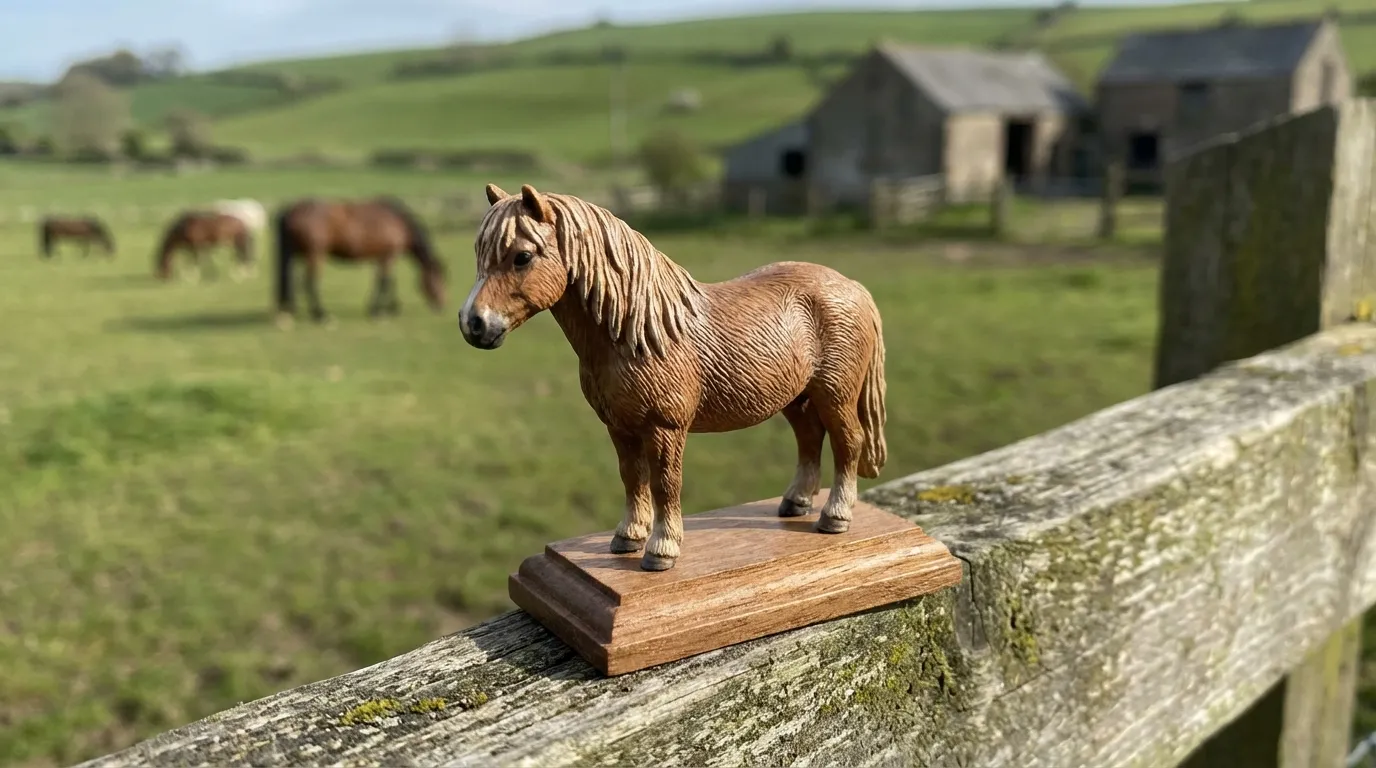
We’ve seen a significant shift toward families commissioning custom figurines for this exact reason. When a child can run their finger over a sculpture and recognize the specific markings or the unique posture of their pony, it triggers a different part of the brain than a photograph does. It acknowledges the space the animal took up in the world. It’s not about replacing the pony; it’s about giving the memory a physical form that can sit on a nightstand—a small presence to combat the large absence.
Age-Appropriate Truths (Skip the Euphemisms)
Barn kids are usually more biologically literate than their suburban peers. They know where manure comes from; they’ve likely seen barn cats hunting mice; they understand the cycle of seasons.
Do not tell a barn kid that the pony "went to sleep" or "ran away to a farm." They know better, and the dishonesty creates anxiety.
For ages 4-7: Focus on the body stopping. "Star's body got too old and tired to work anymore. The vet helped him die peacefully so he wouldn't hurt. He can't eat or run anymore, and he won't be coming back, but he isn't in pain."
For ages 8-12: You can be more specific about the medical cause. "His colic was too severe for the doctors to fix." This age group often seeks logic to manage their emotions. Giving them the medical "why" helps them understand it wasn't their fault (e.g., "It wasn't because I gave him too many treats").
When Grief Looks Like Anger
Be prepared for your child to be angry at the vet, angry at you, or angry at the barn owner. In the equestrian world, decisions about euthanasia are often scheduled and pragmatic. To a child, this can look like murder.
If you had to schedule the euthanasia, your child might blame you for "killing" their friend.
The Response:
Validate the anger without accepting the blame. "I know you are furious. It feels so unfair that we had to make that choice. But the choice wasn't between 'living' and 'dying.' It was between 'suffering' and 'peace.' We chose peace because we loved him."
Moving Forward: The New Normal at the Barn
Eventually, the tears will come less frequently. The smell of the barn will start to smell like potential again, rather than loss.
There will come a day when your child walks down that gravel path and doesn't look at the empty paddock with despair, but with a fond memory of a gallop or a funny spook.
Helping them grieve a senior pony isn't about getting them "over it." You never get over a teammate who taught you how to fly. It's about helping them integrate that loss into their foundation as a rider and a human. It's about teaching them that the pain of the goodbye is the price we pay for the privilege of the partnership—and that, eventually, they will be brave enough to pay that price again.
The paddock may be empty, but their heart is full of the lessons, the grit, and the grace that only a horse can bestow. And that is a piece of tack they will carry forever.
Frequently Asked Questions
How long should I wait before letting my child ride another horse?
There is no "correct" waiting period. Some children find comfort in the rhythm of riding and want to get back in the saddle immediately—it’s their coping mechanism. Others feel a deep sense of loyalty and may refuse to ride for months. Both reactions are normal. The key is to offer the opportunity without pressure. Let them groom a horse without riding, or just visit the barn to see friends, until they signal they are ready.Should I let my child be present for the euthanasia of their pony?
This depends heavily on the child's maturity and previous exposure to veterinary care. For teenagers who have been active caregivers, being present can prevent the agonizing "what if" scenarios and provide closure. However, equine euthanasia can be visually dramatic (the body dropping). If you choose to let them be present, explain every step of the physical process beforehand so they aren't shocked by the involuntary muscle movements or the speed of the collapse. For younger children, saying goodbye before the vet administers the sedative is often the best balance.My child is angry at the vet. Is this normal?
It is incredibly common for children to target the veterinarian with their anger. The vet is the person who physically administered the injection, making them an easy villain in the child's narrative. Do not punish this anger. Instead, reframe the narrative: "Dr. Smith didn't want Star to die; she wanted Star to stop hurting. She did the hardest job of all because she cares about animals."What are good memorial ideas for a horse?
Horses leave behind wonderful physical artifacts. You can create a shadow box with their halter, favorite treats, and ribbons. Jewelry made from braided tail hair is a timeless keepsake. Many families also choose to plant a tree near the paddock. For a lasting visual tribute, custom figurines that capture the horse's unique conformation and markings can be a comforting presence on a bedside table.How do I explain to my child why we can't just get another pony immediately?
Aside from financial realities, it's important to explain the emotional necessity of a pause. Explain that a new pony deserves a rider who is ready to love them for who they are, not just as a replacement for the one who was lost. Use the "heart space" analogy: "Our hearts are a little broken right now, and we need to let them heal so they are strong enough to hold a new friend."Honor Their Memory Forever
Your pet's story deserves to be preserved in a way that captures their unique spirit. A custom PawSculpt figurine transforms your cherished memories into a timeless keepsake—every whisker, every marking, every detail that made them irreplaceable.
Free instant AI preview • 3D artist preview within 7 days • 5 free revisions