
Lighting Tips: Capturing the Glossy Coat of Your Black Labrador for 3D Art
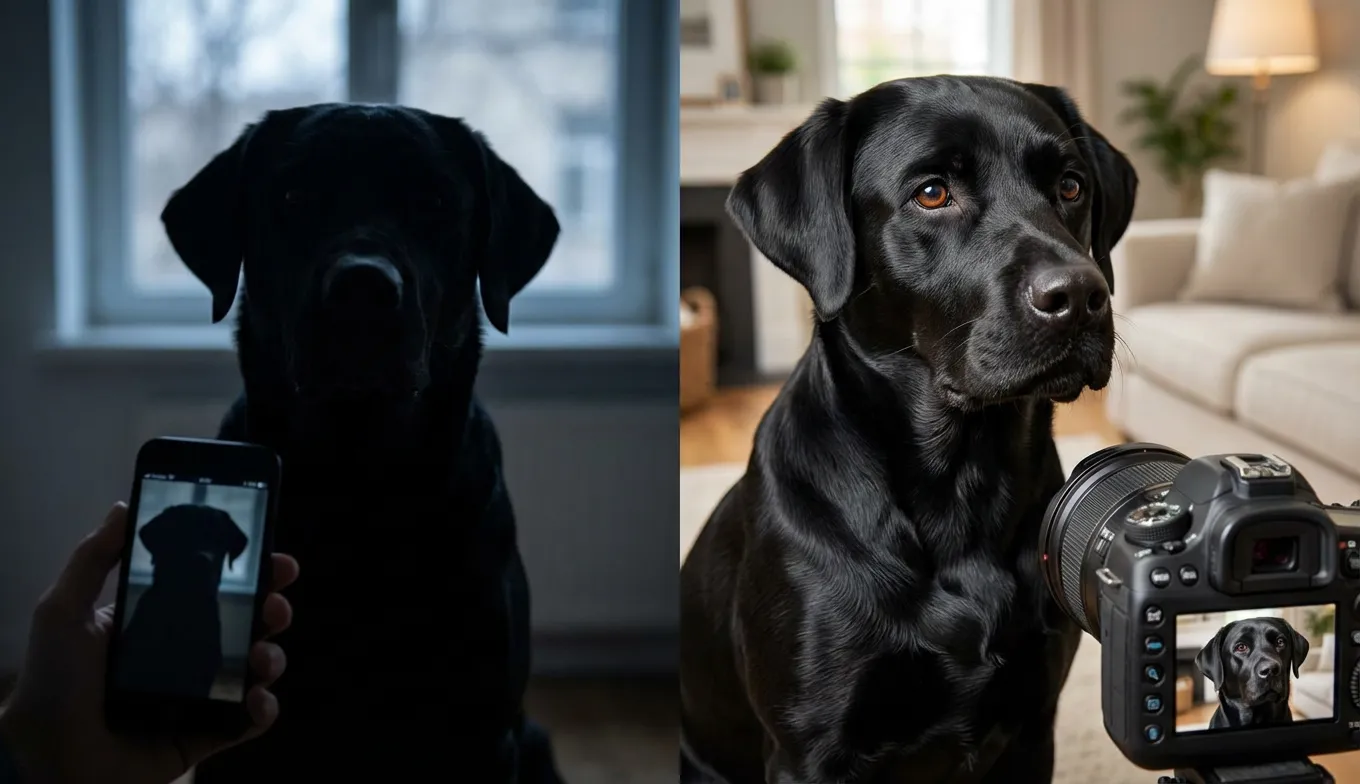
The studio lights used to hum with a frantic, high-pitched whine back in 2010, the kind that gave you a headache by noon. I was trying to scan a client’s Black Labrador, "Midnight," using an old-school structured light scanner that cost as much as a sedan. It was a disaster. Every time the light hit Midnight’s coat, the data just vanished into a void of shiny, black noise. The scanner saw nothing but holes where a dog should be. I remember the owner, holding a treat, looking at the monitor and asking, "Why does he look like Swiss cheese?" Today, sitting in my quiet home office reviewing a submission for a PawSculpt order, I see a photo taken on an iPhone that captures more usable surface detail than that fifty-thousand-dollar rig ever did. The tech has changed, but the physics of light—and the challenge of the "black hole effect"—remains exactly the same.
Quick Takeaways:
- The "Black Hole" Problem: Cameras and scanners struggle to find contrast on black fur, flattening 3D shapes into 2D blobs.
- Diffuse is King: Avoid direct flash; use soft, indirect daylight to reveal muscle definition and fur texture.
- Rim Lighting: A light source behind your dog separates them from the background, crucial for 3D modeling.
- Exposure Compensation: You almost always need to slightly overexpose photos of black dogs to pull detail out of the shadows.
- Why it Matters: Better photos = better geometry. We can't sculpt what we can't see.
The Physics of the "Black Blob"
If you’ve ever tried to take a picture of your Black Lab indoors, you know the struggle. You see a beautiful, soulful dog with expressive eyes and a velvet coat. The camera sees a silhouette. A void.
From an engineering perspective, this is a signal-to-noise ratio problem. In 3D modeling and photogrammetry (the science of making measurements from photographs), we rely on surface variation to understand depth. We need to see where the light curves around a shoulder muscle or dips into the hollow of an ear.
Black fur absorbs the vast majority of light hitting it. When a surface absorbs light, it returns very little data to the camera sensor. Without that data, our sculpting team is essentially guessing at the topography of your dog. We know anatomy, sure—we know where a Labrador’s scapula sits—but we don't know your dog's specific build. Is he field-bred and lanky? English-bred and stocky? Without lighting that reveals surface texture, those nuances are lost in the shadows.
The "Raking Light" Technique
In the workshop, when we inspect a 3D printed prototype for sanding marks or layer lines, we don't shine a light directly at it. We shine a light across it. This is called raking light.
For your Black Lab, the principle is similar. Direct, head-on light (like a camera flash) flattens the image. It reflects straight back, creating harsh white specular highlights (those shiny white spots) while leaving the rest pitch black.
How to execute this:
Instead of shooting with the sun directly behind you, position your dog so the light hits them from a 45-degree angle. 1. Window Light: Place your dog sideways to a large window. The light should flow across their body, from nose to tail or side-to-side. 2. The Shadow Test: Look at the floor. If the shadow is harsh and black, the light is too hard. If the shadow has soft, fuzzy edges, you’re in business. 3. Why it works for 3D: This side-lighting creates a gradient. We see the highlight on the ribcage, the mid-tone on the flank, and the shadow on the belly. That gradient tells our sculptors exactly how round the ribcage is.Counterintuitive Insight: Overcast days are actually better than sunny ones. A bright, cloudless noon sun acts like a spotlight, creating extreme contrast that digital sensors can't handle. A cloudy sky acts like a giant softbox, diffusing light evenly and reducing that "shiny plastic" look black coats often get.
Rim Lighting: separating the Dog from the Void
One of the most common failure modes we see in reference photos is the "floating eyes" effect—where a black dog is photographed against a dark background, and we literally cannot tell where the dog ends and the couch begins.
In additive manufacturing, we deal with orientation logic—figuring out how an object sits in 3D space. To sculpt your pet effectively, we need to define the boundary edges.
The Fix: You need Rim Lighting (or Backlighting).
Position your dog so there is a light source slightly behind and to the side of them. This creates a thin "halo" of light along the outline of their fur.
- Outdoors: Put the sun behind the dog, but block the direct glare with the dog’s body or a tree.
- Indoors: Turn on a floor lamp behind the dog while using window light for the front.
This halo separates the subject from the background. It gives us the exact curvature of the neck and the set of the ears—critical data points for the initial digital armature.
Exposure Compensation: The "Plus One" Rule
Most cameras and smartphones are programmed to average out the light in a scene to "18% grey." When you point your camera at a Black Lab, the meter panics. It thinks the scene is too dark, but because the dog is supposed to be black, the camera often over-corrects or under-corrects depending on the background.
Usually, if the background is bright (grass, sky), the camera exposes for the background, turning your dog into a silhouette.
The Engineering Fix:
You need to force the camera to let in more light than it thinks it needs.
- On iPhone: Tap the blackest part of your dog on the screen. A yellow box with a sun icon appears. Drag that sun icon UP.
- On Android: Similar process—tap to focus, then use the exposure slider to brighten the image.
- DSLR Users: Dial in +0.7 or +1.0 EV (Exposure Value).
The Tradeoff: The background might get blown out (turn pure white). We do not care. For a custom figurine, we only care about the data on the dog. If the grass looks like nuclear waste but we can see the texture of the fur on the chest, that is a winning photo.
The Gloss Factor: Specularity vs. Texture
Black Labs are famous for their glossy, otter-like coats. In 3D printing, specifically with SLA (Stereolithography) or DLP (Digital Light Processing) resin printers, we are constantly fighting against the material's nature. Resin cures into a hard plastic. If we print a smooth blob, it looks like plastic. To make it look like fur, we need texture in the sculpt.
Here is the catch: A super glossy coat in a photo can hide texture. The reflection is so strong it masks the direction of the fur growth.
The "Polarizer" Trick (for the pros):
If you have a DSLR or even a clip-on lens for your phone, get a circular polarizing filter. It cuts through the glare on the fur, just like it cuts glare on water. Suddenly, instead of seeing white reflection, you see the deep, rich black and the individual tufts of hair. This is arguably the single most high-value reference photo you can send us. It allows us to sculpt the "coat flow"—the specific way the hair swirls on the chest or settles on the haunches.
Why This Matters for the Final Print
Let’s talk about the shop floor for a second. When we move from the digital sculpt to the physical print, we are dealing with layers that are often 25–50 microns thick (thinner than a human hair).
If the reference photos are flat shadows, the sculptor has to "invent" the detail. They might sculpt a generic Lab chest. But maybe your Lab has that specific cowlick near the collarbone, or a slightly deeper chest keel.
If we miss those details in the geometry, no amount of post-processing saves it. We can sand the support nubs perfectly, we can do the isopropyl alcohol wash and the UV cure until the resin is chemically stable, and our painters can airbrush the blackest blacks—but if the shape isn't there, the soul isn't there.
We recently had a customer send in photos of their senior Lab, "Duke." The photos were taken in a garage, under fluorescent lights—awful conditions. But, the owner had used a flashlight from the side to illuminate Duke's lumpy lipomas (fatty bumps) and the specific way his arthritis made him stand. Because of that side-lighting, we could see the volume. We sculpted those bumps. We sculpted that stance. When the owner opened the box, they didn't see a black plastic dog; they saw Duke.
A Note on "The Eyes"
The eyes are the first thing to disappear in a photo of a black dog. They blend right into the mask.
The Catchlight: You need a reflection in the eye. Without a white dot of reflected light (catchlight), the eye looks dead.
- The Trick: Hold a piece of white paper or a white towel near your chest while you take the photo. The dog’s eyes will reflect the white object. It sounds stupid, but it separates the pupil from the iris and gives the sculptor the exact gaze direction.
Common Mistakes (Heuristics for Failure)
Over the last decade, I've noticed patterns in the photos that lead to "revision hell"—where we have to go back and forth ten times to get the sculpt right.
- The "Down-the-Snout" Selfie: Cute for Instagram, useless for engineering. It distorts the proportions (big nose, tiny body). We need photos taken from the dog's eye level. Get on your belly.
- The Flash Blast: Using the on-camera flash creates "red eye" (or green eye for dogs) and flattens all muscle definition.
- The Black Blanket: Photographing a black dog on a black rug. We call this "camouflaging the asset." Put them on concrete, wood, or a light sheet.
Integrating the Memories
It’s strange, the things we remember when they’re gone. You might not think about the specific way the light hit your dog’s coat during your morning walk, but your brain has stored that data. When you look at a custom pet figurine, your brain is running a rapid comparison against those stored memories.
If the lighting in your reference photos is good, it allows us to capture the way the skin folds when they sit, or that distinct ridge of fur down their spine. These aren't just geometry; they are the tactile map of your relationship.
Closing Thoughts
I still have that scan of Midnight from 2010. It’s a mess of polygons and holes. But I also have the figurine we eventually made, sculpted by hand using photos the owner took in their backyard during the "golden hour" before sunset.
You don't need a $50,000 scanner. You don't need a professional studio. You just need to understand that light is information. By controlling the light, you are translating your dog from a shadow into a shape, and eventually, into something you can hold.
So, grab a handful of treats, wait for a cloudy day or find a nice window, and get down on the floor. The extra ten minutes you spend getting the lighting right is the difference between a statue of a dog and a statue of your dog.
Frequently Asked Questions
Why do my black dog photos look like a silhouette?
Cameras operate by measuring reflected light. Since black fur absorbs most light, the camera's sensor gets confused, especially if the background is bright. It essentially "gives up" on the dark area to save the details in the background. To fix this, you have to manually tell the camera to brighten the image (Exposure Compensation) or use side-lighting to create contrast on the fur itself.What is the best time of day to photograph a black dog?
Ideally, shoot on an overcast day. Clouds act like a giant softbox, diffusing the sunlight so it wraps around your dog rather than hitting them like a laser beam. If it's sunny, aim for "golden hour"—the first hour after sunrise or the last hour before sunset. The light is softer and comes from a lower angle, which is perfect for highlighting texture.Do I need a professional camera for figurine reference photos?
Not at all. A modern smartphone is more than capable, provided you don't use the digital zoom (which degrades quality). The most critical factor isn't the camera resolution; it's the lighting angle. A smartphone photo with good side-lighting is infinitely better for our sculptors than a DSLR photo taken with a direct flash.How many photos should I send for a custom figurine?
For a custom pet figurine, quantity is good, but variety is better. We typically need: 1. Eye-level side profile (Left & Right): To see the body build and snout length. 2. Front face: To capture expression and ear set. 3. Top-down (Dorsal): To see the width of the ribcage vs. the waist. 4. Tail/Rear: To see how the tail sits. 5. Detail shots: Close-ups of any unique spots, scars, or collar quirks.Ready to Get Started?
Now that you know what goes into creating the perfect pet figurine, it's time to bring your vision to life. Our master sculptors are ready to capture every detail that makes your pet unique.
Free instant AI preview • 3D artist preview within 7 days • 5 free revisions