Memorial Tattoos vs. Figurines: Ways to Honor Your Rottweiler
The shovel hit a rock with a sharp clink, jarring your wrist and sending a dull ache up your forearm. You stopped, breathing hard, staring at the patch of disturbed earth near the fence line where the hydrangeas are just starting to turn brown. It’s the spot where he always patrolled, that heavy, rhythmic trot wearing a path into the grass that no amount of reseeding could fix. Now, the yard feels impossibly big. The air is heavy, pressing in on the spaces where 110 pounds of muscle and goofy affection used to be. You wipe sweat from your forehead, leaving a streak of dirt, and for a split second, you brace yourself for the wet nose nudge that usually follows any moment of stillness. But the nudge doesn't come.
Quick Takeaways:
- Tattoos offer a "portable" memorial that stays with you, often providing catharsis through the physical process of getting inked.
- Custom Figurines restore a physical presence to the home, reclaiming the empty space left by a large dog.
- Rottweiler Specifics: Capturing the specific "Rottie Lean" or their signature blocky head requires high-level artistry, whether in ink or resin.
- Emotional Impact: Tattoos are private and internal; statues are shared and external.
- Best for: Tattoos for those who travel or move often; custom figurines for those who miss seeing their dog in a specific spot at home.
The Weight of the Absence
When you lose a Rottweiler, you don't just lose a pet; you lose a massive physical presence. These aren't dogs that tuck neatly into a corner. They are furniture-sized family members who lean their entire body weight against your legs while you cook, whose heads rest heavy on your lap, and whose deep "woof" vibrates through the floorboards.When they’re gone, the house doesn't just feel empty; it feels light. Too light.
In our work with grieving families, we’ve noticed that Rottweiler owners struggle specifically with this loss of mass. You’re used to navigating around a large, loving obstacle. This is why the choice between a memorial tattoo and a physical tribute like a figurine is so difficult—one keeps them close to your skin, while the other puts them back in the room.
The Case for Memorial Tattoos: Grief You Can Wear
There is something primal about marking your skin to honor the dead. For many, the physical pain of the tattoo needle serves as a strange, necessary counterweight to the emotional pain of the loss. It grounds you.The "Portable" Guardian
Rottweilers are natural protectors. Having their likeness inked on your forearm, over your heart, or on your calf can feel like you’re keeping that protection with you. We’ve spoken to owners who say they feel a phantom warmth over their tattoo when they’re stressed.The Counterintuitive Insight:
Most people rush to get a portrait tattoo immediately. However, we often advise waiting at least 3-6 months. Why? Because in the immediate aftermath of grief, you are hyper-focused on their end. You might subconsciously choose a photo where they look tired or older. Giving it time allows your brain to cycle back to their prime years, ensuring you select an image that captures their vitality, not their decline.
The Challenge with Rottweiler Tattoos
Here is the practical reality that tattoo artists might not tell you upfront: Rottweilers are incredibly difficult to tattoo well.Because they are primarily black and tan, a mediocre artist can easily turn your beautiful dog into a dark, unrecognizable blob after a few years of ink settling. The subtle definition of their eyebrows (those expressive tan pips) and the glossy texture of their coat require an artist who specializes in realism and understands contrast. If you go this route, do not bargain hunt.
The Case for Custom Figurines: Reclaiming the Space
While a tattoo travels with you, a physical memorial anchors the home. This is where the psychology of grief gets interesting.Visualizing the "Rottie Lean"
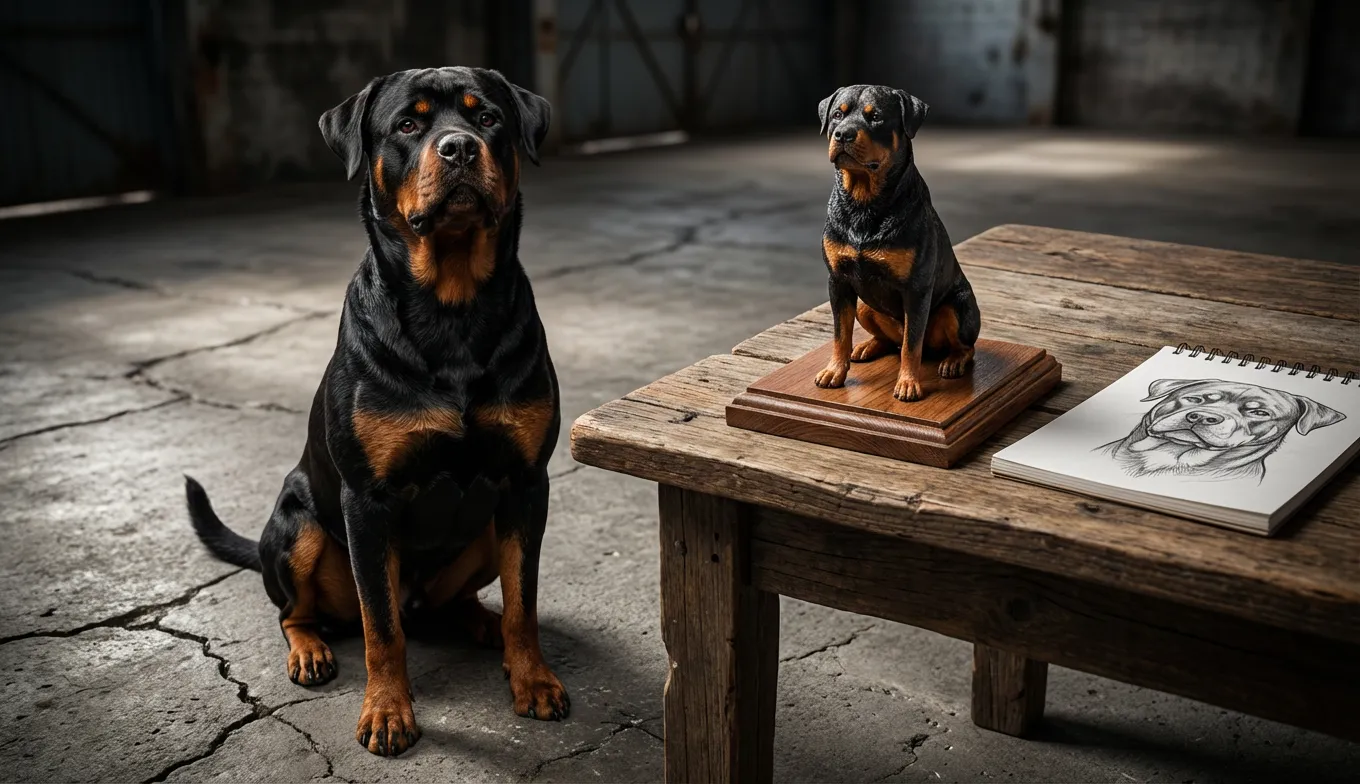
If you owned a Rottweiler, you know "The Lean." It’s that specific way they press their side against you, demanding contact. A flat photo doesn't capture that. A tattoo can’t occupy space.This is where three-dimensional tributes change the dynamic of a room. Placing a custom figurine on the mantle, or by the back door where they used to wait, interrupts the visual emptiness. It gives your eye a place to land.
At PawSculpt, we’ve seen families use custom figurines not just as statues, but as touchstones. One family we worked with placed their figurine next to their dog’s urn and collar. Every morning, the husband would tap the figurine’s head—a mimicry of the morning pat he gave his dog for 12 years. It didn’t fix the grief, but it maintained the ritual. And rituals are what keep us sane when the world feels wrong.
The "Scary Dog" Stigma and Private Grief
Here is an emotional nuance that few people talk about: The isolation of grieving a "scary" breed.When a Golden Retriever dies, the world weeps with you. When a Rottweiler dies, you might encounter people who offer muted condolences, or worse, imply that it’s a relief not to have a "dangerous" dog around.
This can make you feel fiercely protective of their memory. You want to scream that he was a giant marshmallow who was afraid of thunder and let the cat sleep on his head.
A custom figurine allows you to immortalize that softness. Unlike generic garden statues that often depict Rottweilers with spiked collars or snarling teeth, a custom piece can capture your dog's goofy grin, the way his ear flopped to the left, or that specific look of adoration he gave you. It’s a way of correcting the narrative, showing the world the soul of the dog you knew.
The "Relief-Guilt" Cycle
We need to pause here and address something uncomfortable.Rottweilers are prone to brutal health issues—osteosarcoma (bone cancer) and severe hip dysplasia being the most common thieves of their joy. The end is often physically difficult to manage. Lifting a 100-pound dog who can no longer stand is a labor of love that takes a physical toll on your back and knees.
When they pass, you might feel a wave of relief. The physical struggle is over. Their pain is gone.
Then, the guilt hits.
You feel like a traitor for feeling relieved. Please know this: That relief isn't a lack of love; it's a reaction to the cessation of suffering—both yours and theirs. Whether you choose a tattoo or a figurine, let the memorial be a symbol of their life, not an apology for your relief at the end of their pain.
Comparison: Which is Right for You?
If you are torn between the two, consider these practical factors:
1. Longevity and Maintenance
- Tattoo: Will fade over 10-15 years and require touch-ups. Sun exposure damages the detail. However, it is truly permanent in that it cannot be lost or broken.
- Figurine: A high-quality resin piece from a custom pet figurine artist is archival quality. It won't fade indoors. However, it is a physical object that must be packed carefully if you move.
2. The "Sharing" Factor
Tattoo: This is for you*. Unless you roll up your sleeve, no one sees it. It’s a private conversation between you and your memory.
Figurine: This is for the family*. It invites conversation. Guests will see it and ask, "Oh, is that Bear?" It keeps his name spoken in the house.
3. Cost vs. Value
- Tattoo: A high-quality realism portrait of a Rottweiler will cost between $800 and $2,000 depending on the artist.
- Figurine: Custom sculptures typically range from $150 to $500 depending on size and detail level.
A Third Option: The Hybrid Memorial
You don't actually have to choose. We’ve seen a beautiful trend emerging where owners use the design process of one to inform the other.One of our customers commissioned a digital 3D model for a figurine to capture her Rottweiler’s unique sitting posture. She then took the high-resolution renders of that model to her tattoo artist. Because the artist had a 360-degree reference of the dog's anatomy (rather than just a flat, dark photo), the resulting tattoo was incredibly dynamic.
She now has the statue on her desk and the ink on her shoulder. The statue is for the days she needs to see him; the tattoo is for the days she needs to feel him.
Moving Forward (Without Moving On)
There is a fear that if we stop grieving actively, we will forget. That if we don't cry every time we see a tennis ball, we are betraying them.But memories, like Rottweilers, are resilient.
Whether you choose to etch their likeness into your skin or place a miniature version of them on your bookshelf, the goal isn't to replace them. It's to create a new way of interacting with the love they left behind.
Look back at that spot in the garden. The grass will eventually grow back. The path he wore into the earth will disappear. That’s nature. But the path he wore into your life? That’s permanent.
Frequently Asked Questions
How much does a custom Rottweiler figurine cost compared to a tattoo?
There is a significant price difference. A high-quality realism tattoo (which is necessary for a black dog like a Rottweiler) typically costs between $800 and $2,000, depending on the artist's hourly rate and the size of the piece. Custom figurines generally range from $150 to $500, making them a more accessible option for a highly detailed tribute.Why are Rottweilers difficult to tattoo?
It comes down to color and contrast. Rottweilers are primarily black and tan. Without a skilled artist who understands "negative space" (using your skin tone as a highlight) and contrast, the large dark areas can merge into an unrecognizable blob over time as the ink settles. If you choose a tattoo, look for an artist with a portfolio full of dark-furred animals.Can I incorporate my dog's ashes into a figurine or tattoo?
Yes to both, though the processes differ. "Ritual tattoos" or "commemorative tattoos" involve mixing a tiny amount of sterile cremation ash into the ink. Similarly, some custom figurine studios (including PawSculpt) can incorporate a small chamber for ashes within the base, or you can place the figurine atop a custom urn box.How long should I wait after my dog dies to get a memorial?
While there is no right answer, we often recommend waiting 3 to 6 months before making a permanent decision like a tattoo. In the immediate stages of grief (the first few weeks), your brain is often hyper-focused on their final, perhaps sickly, appearance. Waiting allows your memory to "reset" to their prime years, ensuring you choose a reference photo or pose that captures their true spirit, not their decline.Honor Their Memory Forever
Your pet's story deserves to be preserved in a way that captures their unique spirit. A custom PawSculpt figurine transforms your cherished memories into a timeless keepsake—every whisker, every marking, every detail that made them irreplaceable.
Free instant AI preview • 3D artist preview within 7 days • 5 free revisions