Honoring a Tripod: Memorializing Your Three-Legged Rescue Greyhound
You sit on the front porch steps, the ceramic of your coffee mug warming your hands against the morning chill, and you catch yourself listening for it. You’re waiting for that distinctive, syncopated rhythm—thump-thump-hop, thump-thump-hop—the beat of three paws hitting the decking. It was a clumsy, beautiful sound, usually followed by the wet nose of a needle-nosed alien nudging your elbow, demanding to lean seventy pounds of bony weight against your thigh. But the yard is still. The squirrel that would have normally triggered a chaotic, three-legged scramble is foraging undisturbed near the oak tree.
It’s in these quiet, in-between moments that the reality of the loss truly settles in. It’s not just that your dog is gone; it’s that the specific, inspiring, defying-the-odds energy of your tripod greyhound has left a void that feels disproportionately large. You aren't just mourning a pet; you are mourning a survivor who taught you that "broken" doesn't mean "less than."
Quick Takeaways:
- The bond is different: Caring for a disabled dog creates a level of interdependence that makes the grief sharper and more complex.
- Don't "fix" them in memory: The most powerful tributes honor the disability rather than erasing it.
- Nuanced emotions are normal: Feeling relief that their physical struggle is over does not negate your love.
- Tangible grief anchors help: Many owners find comfort in physical representations, like a custom figurine that captures their unique stance, to help process the invisibility of loss.
- Legacy over loss: Channeling their resilience into support for other rescue greyhounds can be a healing path forward.
The Unique Geometry of Grief
We need to talk about the "lean." If you’ve owned a greyhound, you know the lean. But if you’ve owned a tripod greyhound, you know that the lean was different. It was heavier. It was a transfer of balance. They weren't just showing affection; they were physically relying on you to be their fourth pillar of support.
When that support is no longer needed, your own center of gravity feels off.
In our work with pet owners, we’ve noticed that those who lose disabled pets often experience a grief that is physically disorienting. You spent years anticipating their movements, lifting their hindquarters into SUVs, laying down yoga mats to cover slippery hardwood floors, and watching their gait like a hawk for signs of soreness. Your life was architected around their physical limitations.
Now, you can walk through the house without checking for trip hazards. You can leave a door ajar without worrying about a tumble. And ironically, this freedom feels terrible. It feels like a betrayal.
This is the part of grief that generic advice columns miss. They tell you to miss the "unconditional love." They don't tell you that you’ll miss the specific anxiety of watching them navigate stairs, or the triumph of watching them run—that awkward, galloping joy—despite everything the world took from them.
The "Fixing" Instinct vs. The Reality
Here is a counterintuitive insight that we see play out constantly in the memorial space: When a tripod dog passes, well-meaning friends or artists often try to "fix" the dog in tributes.
You might commission a painting, and the artist asks, "Do you want me to add the leg back in? So they look whole at the Rainbow Bridge?"
It’s a kind offer, born from a place of compassion. But for most tripod parents, the answer should be a hard no.
Your greyhound’s missing leg wasn't a defect. It was their biography written on their body. It was evidence of the track life they survived, the bone cancer they fought, or the accident they overcame. To add the leg back in a memorial is to erase the very resilience that made them who they were.
We had a customer once who sent us photos of her brindle greyhound, Miller, who had lost his front right leg to osteosarcoma. She specifically requested that our sculptors pay attention to the way his shoulder muscle had overdeveloped on the left side to compensate. "That muscle," she told us, "was his strength. Don't smooth it out."
She was right. True honor lies in remembering them exactly as they were—perfectly imperfect. Whether you are looking at photos, commissioning art, or just remembering them in your mind’s eye, try to visualize that unique silhouette. That three-legged stance was their victory pose.
The Emotion No One Admits: The Relief-Guilt Cycle
We need to have an honest conversation about a feeling that might be sitting in the pit of your stomach—one you’re probably too ashamed to say out loud.
Relief.
Caring for a large, three-legged dog—especially a greyhound, with their fragile skin and long, lever-like limbs—is physically and emotionally exhausting. Toward the end, you may have been carrying them outside. You may have been waking up three times a night to help them adjust position because they couldn't get leverage to roll over. You may have spent months in a state of high-alert anxiety, waiting for the other shoe (or leg) to drop.
When they pass, that physical burden vanishes instantly. And often, the first thing you feel, right alongside the crushing sadness, is a wave of relief.
I don't have to lift 75 pounds of dead weight this morning.
I don't have to worry about him slipping on the ice.
He isn't in pain anymore, and neither is my back.
And then, immediately, the guilt hits. How can I be relieved? I would carry him forever if I could.
Please hear us on this: Relief is not a lack of love. Relief is the body’s natural reaction to the cessation of stress. It is actually a testament to how hard you worked to keep them comfortable. You took on their physical struggle as your own. Now that they have laid that struggle down, you are allowed to lay it down, too.
The guilt that follows is a liar. It tries to tell you that your relief means you wanted them gone. You didn't. You just wanted the struggle to end. And now it has. Be gentle with yourself in this space.
Tangible Tributes: Memorializing the Tripod Spirit
Because the loss of a disabled pet is so physical—you literally carried them—the most effective memorials are often tangible. You need something to touch. Here are a few ways to honor a tripod greyhound that go beyond the standard urn on the mantel.
1. The "Zoomie" Garden Stone
Greyhounds are 45mph couch potatoes, but tripods are famous for their modified "zoomies"—that spinning, hopping burst of energy. Create a stepping stone for your garden, but instead of a generic print, try to cast or carve their specific paw pattern. If you have old videos of them running, watch the pattern. It’s unique. Capturing that rhythm in stone in your garden creates a permanent space for their energy.2. The Shadow Box of Resilience
Don't just put the collar in a box. Tell the story.- The Collar: Often worn and soft.
- The "Badge": If they had a racing tag or a medical tag.
- The Sock: Many tripod owners use traction socks or booties for their dogs on slippery floors. It seems like a piece of trash, but that worn-out, non-slip sock represents your care. Frame it. It’s a symbol of the safety you provided.
3. The Accurate 3D Tribute
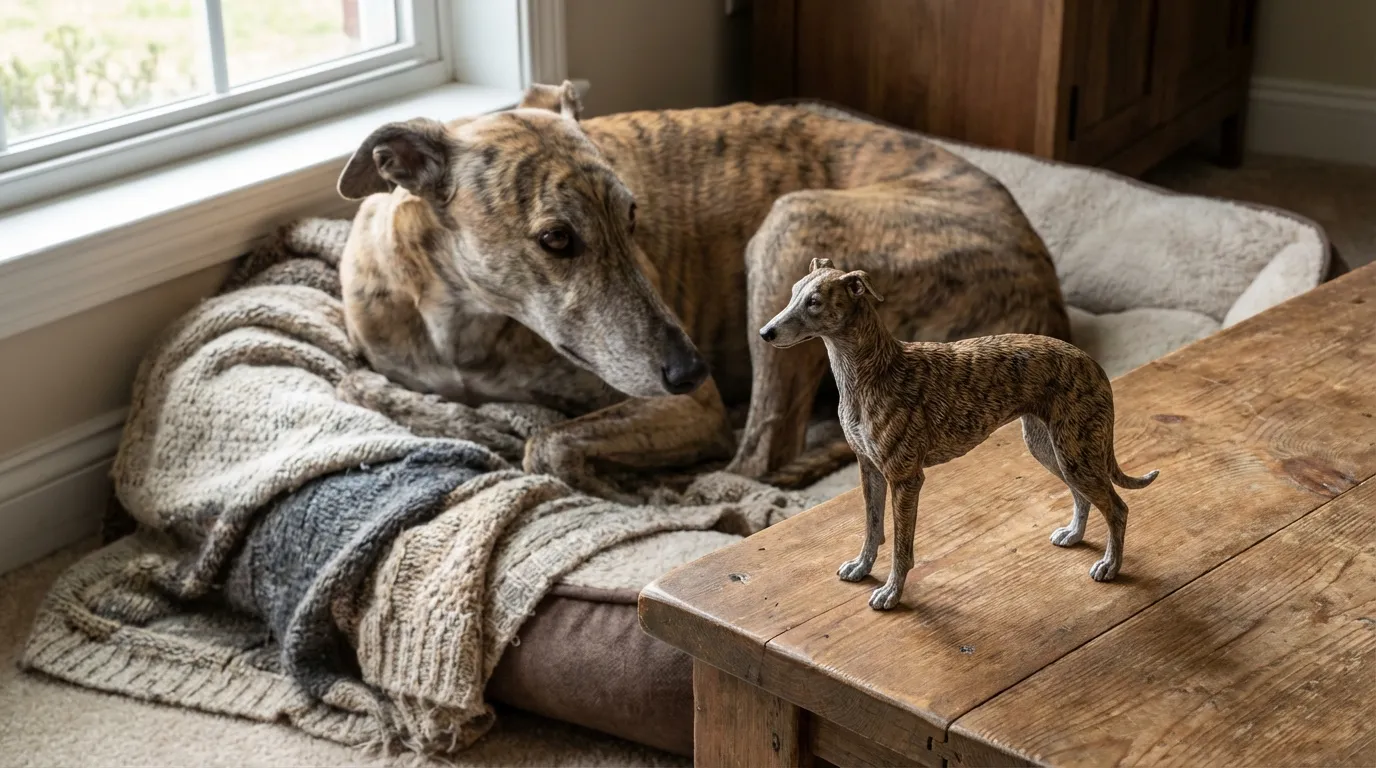
We’ve learned that for many people, photographs can feel flat. They capture a moment, but they don't capture presence. This is particularly true for greyhounds, whose anatomy is so sculptural—the deep chest, the tuck, the roached back. This is where a custom figurine can be profoundly healing. We’ve had clients ask us to sculpt their greyhound in a "roaching" position (legs in the air), capturing the specific way a tripod balances even when upside down. Being able to run your thumb over the curve of their spine or the specific shape of their ears can trick the brain—just for a second—into feeling that connection again. It grounds the grief in something solid.4. The "Phantom Limb" Donation
This is for the legacy-minded. The cost of amputation and rehab for a rescue greyhound is high—often thousands of dollars. This high cost sadly leads to euthanasia for many broken-legged racers who could have been wonderful pets. Consider sponsoring an amputation for a rescue dog in your late dog's name. There is no greater "f* you" to death than paying for another dog’s second chance at life. It turns your loss into someone else’s beginning.Navigating the "Pity" of Others
One aspect of owning a tripod that lingers after they are gone is the memory of public perception. You remember the looks on the street. The "Oh, you poor thing" comments from strangers.
You probably spent a lot of time defending your dog’s happiness. "He’s fine! He’s happy! He doesn't know he’s missing a leg!"
Now that they are gone, you might feel a defensive anger when people say, "At least he’s whole now," or "He’s running on four legs in heaven."
It’s okay to reject that narrative. You don't have to agree that they needed to be "whole" to be happy. You knew the truth: they were whole the entire time. They were complete in their spirit, their sass, and their ability to steal a sandwich off the counter despite lacking the front-end leverage.
Hold onto your version of them. The warrior version. The one who hopped up the stairs. The one who didn't feel sorry for themselves, so you didn't have to either.
When the Silence is Too Loud
Let's go back to that front porch. The silence where the thump-thump-hop used to be.
The hardest part of losing a greyhound is that they are such large dogs that take up so little space—until they are gone. Then, the empty space expands to fill the whole house.
You don't have to fill that silence right away. You don't have to rush to get another dog, and you certainly don't have to rush to "get over it."
If you find yourself looking at the spot on the rug where they used to struggle to stand up, and you feel that pang of sadness mixed with the memory of their grit, let it be. That grit is their gift to you.
They navigated a world not built for them, on a body that was compromised, and they did it with a wagging tail and chattering teeth. If they could do that, you can survive this grief. You can endure the missing limb of your family. You’ll wobble for a while. Your balance will be off. But like them, you will find a new rhythm.
It won't be the same gait you had before. But you will keep moving forward.
Frequently Asked Questions
How do I deal with the guilt of feeling relieved after my disabled dog passes?
This is one of the most common, yet least discussed, aspects of pet grief. Relief is a biological response to the cessation of high-stress caregiving. It does not negate your love. You are likely relieved that their suffering has ended and that the physical toll of caretaking has lifted. Try to reframe the guilt: the relief you feel is proof of how hard you were working to keep them safe.Should I include my greyhound's missing leg in a memorial painting or statue?
This is a deeply personal choice, but in our experience, most tripod owners choose to memorialize the dog as they were. The missing leg was a symbol of their survival and strength. "Fixing" them in art can sometimes feel like a denial of the life they actually lived. A tribute that shows their three-legged stance honors the warrior spirit they displayed every day.What are good memorial ideas specifically for greyhounds?
Greyhounds have very specific cultures and accessories. Beyond standard ideas, consider:- Framing their martingale collar and racing silk/tag.
- Donating to a "broken leg fund" at a local greyhound rescue.
- Creating a shadow box with their favorite "house coat" or pajamas.
- Commissioning a 3D sculpture that captures the "greyhound lean" or their "roaching" sleeping position.
Why is the grief for a disabled pet often more intense?
The bond with a disabled pet is often deeper because it is built on absolute reliance. You weren't just their friend; you were their mobility, their safety, and their nurse. When they pass, you lose that "job" instantly, leaving a massive void in your daily routine and sense of purpose. It takes longer to untangle your life from theirs because your lives were more tightly knotted together.Honor Their Memory Forever
Your pet's story deserves to be preserved in a way that captures their unique spirit. A custom PawSculpt figurine transforms your cherished memories into a timeless keepsake—every whisker, every marking, every detail that made them irreplaceable.
Free instant AI preview • 3D artist preview within 7 days • 5 free revisions