
New Year, New Home: Moving Without Your Senior Poodle's Presence
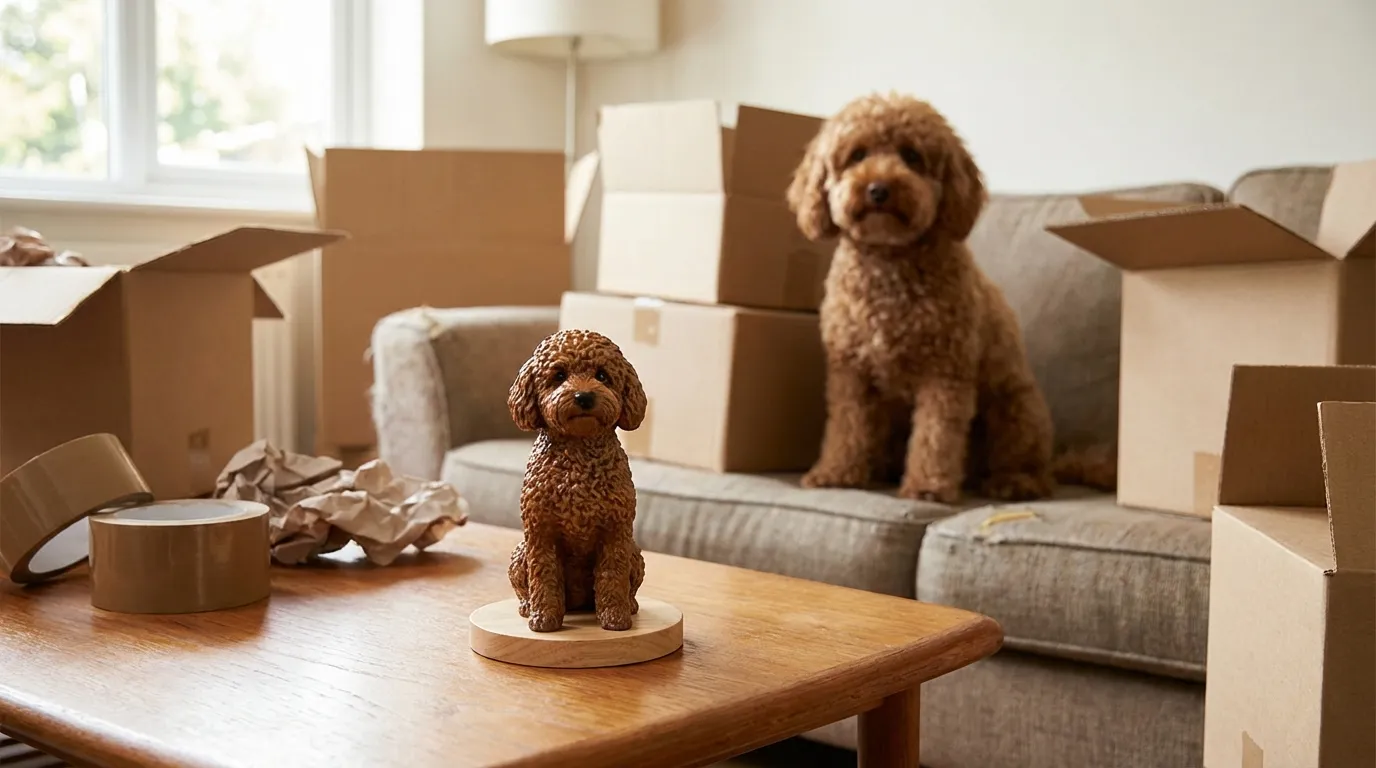
You pull the heavy oak nightstand away from the wall, the screech of wood against floorboards echoing in the empty room. There, outlined in a slightly lighter shade of beige on the carpet, is the ghost of where his orthopedic bed sat for the last four years. You instinctively reach down to brush away a tuft of white curly hair trapped in the baseboard, and your hand freezes. If you sweep it up, if you pack this room, you aren't just leaving a house. You’re leaving the last place he ever existed.
Quick Takeaways:
- Moving is a "secondary loss": It triggers a fresh wave of grief because you are separating yourself from the physical space where your memories live.
- Create a transition ritual: Don't just leave; say goodbye to the specific spots in the house your poodle loved.
- Bring the memory with you: Anchoring your pet’s presence in the new home through a specific object, like a custom figurine or a framed collar shadowbox, can bridge the gap.
- Guilt is normal but untrue: Moving forward physically does not mean you are leaving them behind emotionally.
The specific panic of "Spatial Grief"
We talk about grief as an emotional state, but for pet owners, it is intensely physical and spatial. Your body knows the layout of your home based on where your dog is. You step over a specific spot in the hallway because that’s where he liked to sprawl. You listen for the click-clack of nails on the hardwood when you open the fridge.
When you move, you aren't just changing zip codes. You are erasing the sensory map of your life with him.
This is particularly acute with senior poodles. They are often "velcro dogs," shadowing us from room to room. Over the last few years of his life, as his world shrank due to age or mobility issues, your home became his entire universe. The corners of the rugs are worn where he paced; the bottom of the sliding glass door is smudged at nose-height.
The panic sets in when you realize the new house won't have these scars. The new house won't "know" him. It feels clean, sterile, and devastatingly empty.
The counter-intuitive relief (and the guilt that follows)
Here is something few people will admit to you, but we hear it from grieving pet parents constantly: There is a tiny, hidden part of you that is relieved he isn't here for the move.
Moving is loud. It is chaotic. It involves open doors, strangers walking in and out, and the disorientation of a new environment. If your senior poodle was blind, deaf, or suffering from cognitive decline (doggie dementia), this move would have been a nightmare for him. He would have been anxious, pacing, and confused.
You might feel guilty for feeling that relief. You might think, I would give anything to have him confused in the new house, as long as he was here. But give yourself some grace. Acknowledging that he was spared the stress of upheaval doesn't mean you love him less. It means you are realistic about the fragility of his final months.
Mapping the memories before you lock the door
Before you hand over the keys, you need to do something that seems odd to non-pet people but is essential for your closure. You need to document the "negative space."
Most of us have thousands of photos of our dogs. But we rarely take photos of the places they occupied.
Walk through your empty house one last time. Take a picture of the sunbeam on the living room floor where he spent his mornings. Take a picture of the backyard fence where he patrolled for squirrels. Take a close-up of the scratch marks on the door frame.
Why this works:
Psychologically, you are acknowledging that the memory belongs to you, not the house. By capturing these images, you are metaphorically packing the memories to take with you. You are proving that he was here.
Establishing the "Shrine" in the new space
One of the hardest moments is walking into the new home for the first time after the boxes are unloaded. It’s a blank slate. It has no history.
Do not wait to unpack his things.
Common advice says to "put away the sad things" so you can focus on the excitement of the new chapter. We disagree. Buried grief doesn't disappear; it just waits to ambush you later.
Instead, make setting up his memorial one of the very first things you do—before you unpack the kitchen plates or hang your clothes.
Choosing the Anchor Object
You need a physical anchor in the new space. This tells your brain, He moved with us.For some, this is an urn on the mantle. For others, it’s a shadow box with his collar and favorite toy. However, we’ve found that many families struggle with urns because they represent the death, not the life.
This is often why people turn to us at PawSculpt. When you place a photorealistic figurine of your poodle on a shelf in the new living room—captured in his favorite pose, maybe with that specific goofy haircut he had—it changes the energy of the room. It’s not a symbol of loss; it’s a representation of presence. It allows you to look at the new space and see him in it.
Placement matters:
- Don't hide the memorial in a bedroom corner or a drawer.
- Do place it in a high-traffic area, like the living room or near the kitchen. He wanted to be where the family was. Keep him there.
The "New Dog" question in a new city
A new home often triggers the question from well-meaning neighbors or new friends: "Do you have any pets?"
When you say "No," it feels like a betrayal. When you say "I used to," it brings down the mood.
And then comes the inevitable follow-up: "Since you have a big new yard, are you going to get another one?"
The fresh environment can actually make the urge to get a new dog stronger, or conversely, make it feel impossible. Some people feel that getting a new dog in a new house is "wiping the slate clean," erasing the senior poodle who never got to see this yard.
The Reality Check:
A new house does not replace the old dog. If you get a new puppy, they will not know the old routines. They won't know that the old poodle wasn't allowed on the white sofa. They will forge new paths.
If you aren't ready, use the "foster excuse." Tell people (and yourself), "We are settling in right now." It is okay to enjoy the cleanliness of a new home for a while without feeling guilty that you aren't immediately filling the void with fur.
When the grief arrives late
You might get through the move just fine. You’re busy with logistics, utilities, and cardboard boxes. Adrenaline carries you through.
Then, three weeks later, you’re sitting on your new porch with a cup of coffee, and you look down at the empty space beside your chair, and it hits you like a freight train.
This is the "delayed drop." In the old house, the grief was constant because the triggers were everywhere. In the new house, the absence of triggers can initially feel like relief, until the silence becomes deafening.
What to do when this happens:
- Talk to him. It sounds crazy, but speak out loud in the new house. "You would have loved this porch, buddy." "Check out this squirrel." Fill the new air with his name.
- Walk the new neighborhood. Carry his leash in your pocket if you need to. Imagine his pace. Where would he have sniffed? Which mailboxes would he have marked? Overlay his memory onto the new geography.
Moving forward, not moving on
There is a profound difference between moving on and moving forward.
Moving on implies leaving something behind, discarding it like an old sofa that doesn't fit the new aesthetic. Moving forward means carrying the love with you as you step into the future.
Your senior poodle doesn't live in the hardwood floors of your old house. He doesn't live in the stained carpet or the specific layout of the backyard. He lives in the way you treat other animals. He lives in the way you pause to appreciate a sunny day. He lives in the standards of love and loyalty you now hold for the rest of your life.
As you tape up that final box, take a breath. You aren't leaving him. You are simply taking him to a new place where he can continue to watch over you, just from a different vantage point.
Frequently Asked Questions
Is it normal to feel guilty about moving after my pet died?
Absolutely. This is what grief counselors call "secondary loss." You aren't just missing your dog; you are mourning the loss of the container that held your life together. You feel like you are abandoning the physical space where their spirit lingers. It helps to create a conscious ritual to "bring them with you," such as taking soil from their favorite backyard spot or photographing the empty rooms before you lock the door.Should I set up a pet memorial in my new house immediately?
We recommend setting it up first—before the kitchen, before the closet. Don't hide the grief. Placing their urn, photos, or a custom figurine in a central living space helps ground their presence in the new home. It prevents the new space from feeling sterile and signals to your brain that this is their home, too.What should I do with my deceased dog's bed and toys when moving?
This is a practical struggle with emotional weight. If the items are heavily worn, soiled, or smell of illness, it is okay to throw them away. You are throwing away fabric and foam, not the dog. If you want to keep them, seal them in an airtight plastic bin so the scent is preserved. You do not have to unpack this bin immediately. Put it in the back of the closet and open it only when you feel ready to handle the wave of memories.How do I handle the "do you have pets" question from new neighbors?
This question can sting when you're fresh in a new neighborhood. It is best to be honest but brief. "We recently lost our senior poodle, so we're taking some time right now." This honors your pet without inviting unwanted advice about getting a new one immediately. It sets a gentle boundary while acknowledging your loss.Will getting a new dog help the house feel less empty?
A new dog will fill the silence, but not the void. The danger in a new house is trying to replicate the old life. If you get a new pet, ensure you want a new dog with a new personality, not just your old dog back. If you do adopt, try to frame it as the new house being a fresh start for a new friend who needs a home, rather than a replacement for the one you lost.Honor Their Memory Forever
Your pet's story deserves to be preserved in a way that captures their unique spirit. A custom PawSculpt figurine transforms your cherished memories into a timeless keepsake—every whisker, every marking, every detail that made them irreplaceable.
Free instant AI preview • 3D artist preview within 7 days • 5 free revisions