
Why You Still Hear the Nails: Phantom Sounds After Losing a Boxer
You drop a piece of cheddar cheese on the kitchen floor. It hits the linoleum with a soft, wet thwack. Instinctively, your body freezes. You pull your toes back to avoid being stepped on. You wait for the scramble of claws, the heavy, rhythmic panting, and the inevitable "kidney bean" wiggle that usually threatens to knock you over.
But the cheese just sits there.
The refrigerator hums. The air conditioner cycles on. But the specific, chaotic, joyful noise of your Boxer is gone. It is in these micro-moments—not the dramatic final goodbye at the vet, but the Tuesday evening while making a sandwich—that the reality of the loss hits you with the force of a physical blow. You might even swear, for a split second, that you heard the click-click-click of nails in the hallway, or the distinct "woo-woo" grumble they made when they wanted your attention.
You aren't losing your mind. You are experiencing a very specific, neurological aspect of grief that hits Boxer owners harder than most.
TL;DR: Quick Takeaways
- It's biological, not psychological: Your brain is a prediction machine; it is still "predicting" the sounds it has heard daily for years.
- Boxers leave a "loud" void: Because Boxers are physically vocal and heavy-footed dogs, their absence creates a more drastic sensory deprivation than quieter breeds.
- The "Relief-Guilt" Cycle: If your Boxer had respiratory issues (common in the breed), the silence can feel peaceful and horrifying at the same time. This is normal.
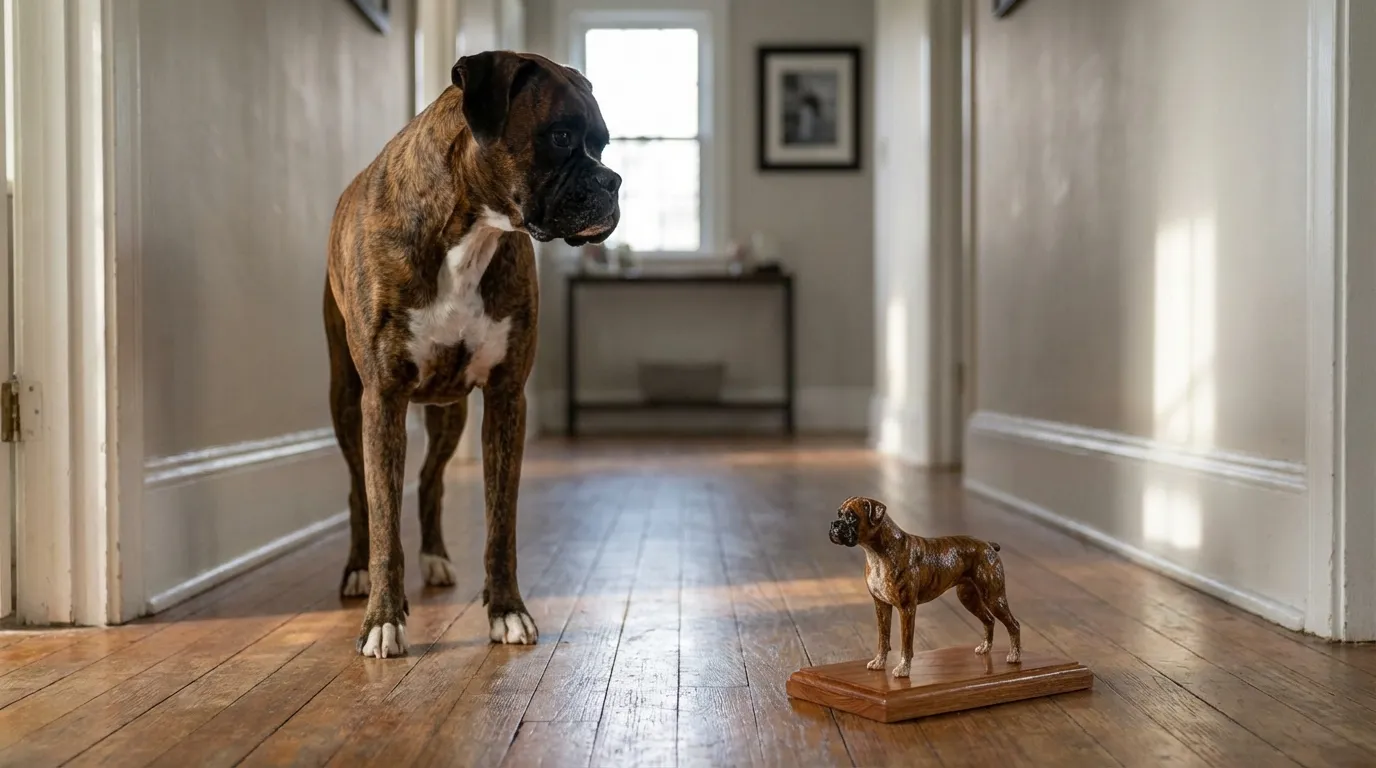
- Sensory replacements help: Transitioning from auditory memories (which fade) to visual or tactile memorials (like custom pet figurines) can help ground your grief.
The Neurology of "Phantom Barks"
Let’s get the scary part out of the way first: hearing your dog after they’ve passed does not mean you are hallucinating in a clinical sense. Psychologists call this "Auditory Pareidolia" or, more simply, a grief hallucination.
Here is what is actually happening. Your brain is efficient. To save energy, it doesn't just passively process every sound that comes into your ears in real-time. Instead, it operates on a prediction model. For the last decade, your brain’s baseline for "home" included the background frequency of your Boxer.
When that sound is suddenly subtracted, your brain interprets the silence as an error. It tries to fill in the gap with the data it expects to be there.
We see this constantly in the families we work with. One customer told us she kept waking up at 6:00 AM because her brain "inserted" the sound of her Boxer, Duke, shaking his collar tags beside the bed. It wasn't a ghost. It was a habit loop. The brain takes time to rewrite its code.
Why the Silence of a Boxer is Different
All dogs leave a quiet house behind, but Boxer owners face a unique acoustic challenge. We need to be honest about this: Boxers are not subtle creatures. They are the bulls in the china shop of our hearts.
A Boxer doesn't just walk; they trot with a heavy, distinct cadence. They don't just breathe; they snort, snuffle, and snore with a volume that rivals a grown man. They are vocal, communicative dogs that use a wide range of grumbles, whines, and "talking" noises to interact with you.
When you lose a cat or a smaller, quieter dog, the sensory change is significant but often visual. When you lose a Boxer, the volume of your life is turned down by 50%. The contrast is jarring.
Common "Phantom Sounds" Boxer Owners Report:
The thud* of a heavy body collapsing against the front door.
- The "snort" of derision when they don't get what they want.
- The rhythmic clicking of nails on hardwood (Boxers have thick, strong nails that are hard to keep silent).
- The sound of a collar tag hitting a water bowl.
It’s the absence of this "white noise" that makes the house feel so empty. You didn't realize how much comfort you derived from that background cacophony until it was muted.
The Emotion We Don't Talk About: Relief (And the Guilt That Follows)
This is the part of the article where we need to have a difficult, honest conversation. This is the nuance that you won't find in most sympathy cards.
Boxers are prone to health issues that can make the end of their lives loud. Degenerative Myelopathy (DM) causes scraping nails. Boxer Cardiomyopathy or cancers can lead to labored, heavy breathing.
For the last few months of your dog's life, you might have been hyper-vigilant to these sounds. You listened to every breath to make sure they were okay. You woke up at every rustle, terrified it was a seizure or a fall.
When they pass, the silence is instantaneous. And for many owners, the first feeling isn't just sadness—it's relief.
The sound of suffering is gone. You can sleep through the night. You don't have to listen for the struggle.
Immediately following that relief, however, comes a crushing wave of guilt. How can I feel relieved that my best friend is gone?
Please hear us on this: That relief does not mean you didn't love them. It means you loved them enough to carry the burden of their illness, and that burden was heavy. Your nervous system was in "fight or flight" mode for months, listening for danger. The silence allows your nervous system to stand down. It is a biological response, not a moral failing.
Grounding Techniques: What to Do When You "Hear" Them
So, you're standing in the kitchen, and you swear you just heard a bark. Your heart races. Then the realization hits, and the grief crashes down all over again. How do you handle it?
1. Acknowledge, Don't Suppress
When you hear the phantom sound, don't shake your head and try to force it away. Stop. Take a breath. Say out loud, "I miss you, too." Acknowledging the sound validates the connection without feeding the delusion. It tells your brain, I know what that was, and it's okay.2. Replace the Sensory Input
Your brain is craving the sensory input of your pet. Since the auditory input is gone, you need to overload the other senses to help your brain calibrate to the new reality.This is where tangible memorials become vital. Many of our clients find that having something physical to touch bridges the gap. We’ve had Boxer owners commission custom pet figurines specifically to keep on their nightstand.
Why? Because when you wake up expecting to hear them, and the silence creates anxiety, reaching out to touch a physical representation—feeling the familiar slope of the Boxer brow or the muscle of the shoulder—provides a tactile "anchor." It grounds you in the present moment while honoring the memory.
3. Change the Acoustic Environment
If the silence is deafening, don't suffer in it. Change the background noise of your home.- Put on music: Soft jazz or lo-fi beats can fill the frequency range that your dog's panting or movement used to occupy.
- White noise machines: Running a fan or a white noise machine at night can prevent your brain from "hunting" for sounds in the silence.
The Fear of Forgetting
There is a shadow side to these phantom sounds. Eventually, they stop.
Three weeks or three months from now, you will drop cheese on the floor, and you won't flinch. You won't hear the nails. And that moment can be just as painful as the grief itself. It feels like a betrayal. Am I forgetting them?
You aren't forgetting. You are healing.
The auditory memory is usually the first to fade. It’s harder to recall a sound than it is to recall a face. This is why preserving the memory in other ways is so critical.
We often tell people to write down the specific sounds now, while they are fresh.
- Did they have a specific "yodel" when you came home?
- Did they snore like a chainsaw or whistle through their nose?
- Did they sigh dramatically when told to get off the couch?
Document these "acoustic quirks." Later, when the phantom sounds fade, you can read these notes and hear them clearly in your mind again.
Moving Forward, Not Moving On
There is no timeline for when the phantom nails will stop clicking in the hallway. For some, it's weeks. For others, years later, a certain slant of light or a quiet afternoon will trigger a phantom "woo-woo."
When it happens, try to reframe it. Instead of a painful reminder of absence, try to see it as an echo of impact. Your Boxer took up so much space, had so much personality, and loved so loudly that the world simply hasn't adjusted to the quiet yet.
The silence is heavy, yes. But it is heavy only because the life that filled it was so significant.
Frequently Asked Questions
Is it normal to hear my deceased dog barking?
Yes, it is extremely normal. Psychologists refer to this as "auditory pareidolia" or grief hallucinations. Your brain is a pattern-recognition machine that has spent years expecting certain sounds in your home. When those sounds stop, your brain momentarily "fills in the blanks" with what it expects to hear. It is not a sign of mental illness; it is a sign of deep habituation and love.How long do phantom pet sounds last?
There is no set timeline, but they are typically most intense during the first month. As your brain establishes new routines and accepts the new "quiet" as the baseline, the instances will decrease. However, it is not uncommon to have a recurrence months later, especially during times of high stress or fatigue.Why do I feel relieved my sick dog has passed?
This is perhaps the most common, yet least discussed, emotion in pet grief. If your Boxer had a chronic illness like DM or cancer, you were likely in a state of high-stress caregiving for months. The relief you feel is your parasympathetic nervous system finally stepping down from "alert" mode. It means you are glad their suffering (and the stress of managing it) has ended. It does not mean you don't miss them.How can I stop feeling guilty about moving on?
Try to change your language from "moving on" to "moving forward." Moving on implies leaving something behind. Moving forward implies carrying their memory with you into the future. Many pet parents find that creating a lasting tribute—whether that's a custom figurine, a photo book, or a donation in their name—helps alleviate the fear that they will be forgotten as life continues.Honor Their Memory Forever
Your pet's story deserves to be preserved in a way that captures their unique spirit. A custom PawSculpt figurine transforms your cherished memories into a timeless keepsake—every whisker, every marking, every detail that made them irreplaceable.
Free instant AI preview • 3D artist preview within 7 days • 5 free revisions