Perfecting the Shot: Photo Tips for Your Custom 3D Pet Figurine
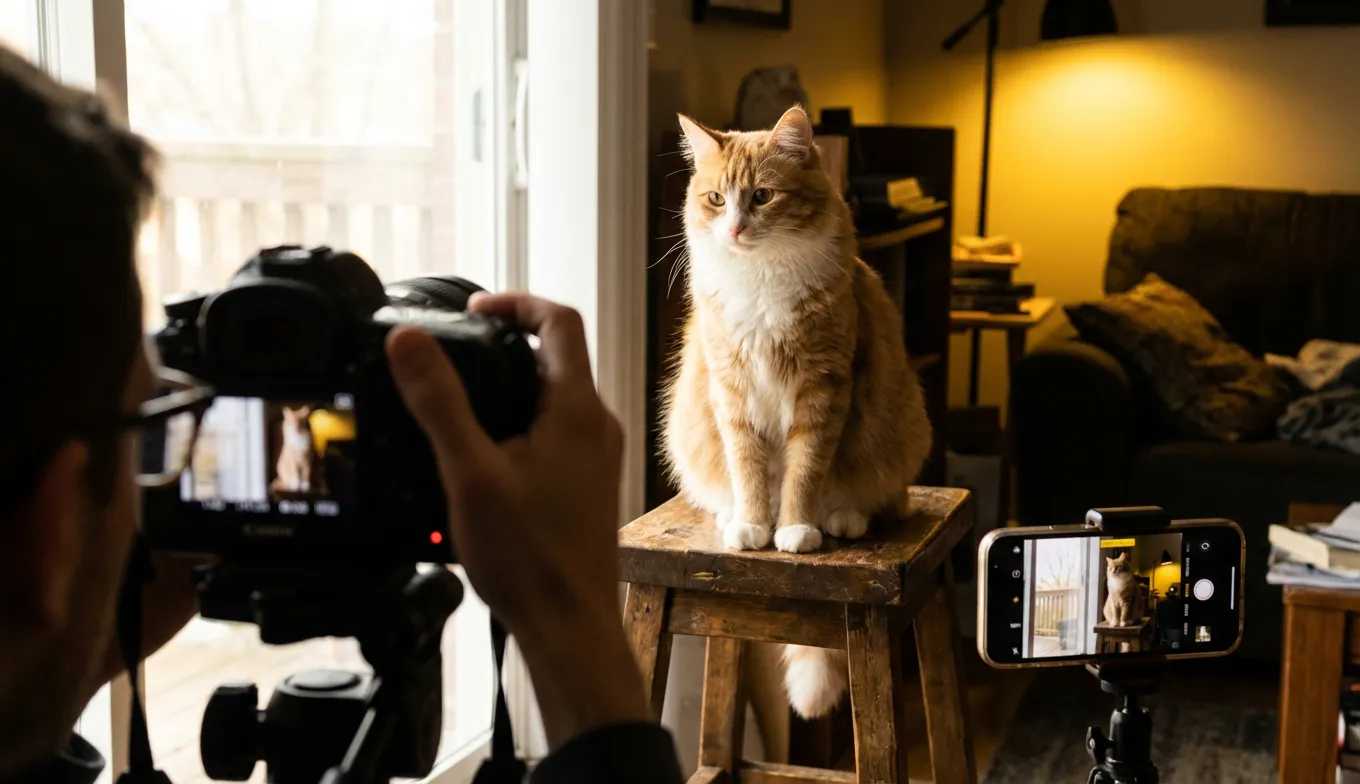
The treat is crumbling in your pocket, leaving a trail of crumbs that will inevitably end up in the washing machine. Your knees are grinding into the hardwood floor, and your Golden Retriever, usually a creature of boundless joy, is looking at you with the profound boredom of a teenager asked to do the dishes. You snap the photo. It’s blurry. The lighting makes him look orange, not gold. And worst of all, his nose looks enormous while his ears seem to have vanished into the background.
We see this photo three weeks later in our studio. And while we love every animal we see, that photo presents a massive engineering challenge. When you commission a custom piece, you aren't just sending a picture; you are providing the blueprints for a complex architectural project.
If the blueprint is warped, the building—or in this case, the figurine—won't stand true.
Quick Takeaways:
- Get on their level: Shooting from standing height distorts body proportions (the "big head, small body" effect). You must be eye-to-eye.
- Diffuse light is king: Avoid direct noon sun. It creates harsh shadows that hide fur texture. Overcast days or bright shade are ideal.
- The "T-Pose" equivalent: We need at least one photo of your pet standing or sitting squarely, taken from the front, side, and back.
- Zoom in, don't lean in: Use your phone’s 2x or 3x telephoto lens. The standard 1x wide lens distorts facial geometry.
- Texture matters: We model fur flow based on shadows. If a black dog looks like a black blob in the photo, the sculptor has to guess the fur direction.
The Geometry of the Soul: Why Reference Photos Matter
Most people assume 3D modeling is a magical scan where we press a button and the computer generates a dog. In reality, creating a custom pet figurine is much closer to classical Renaissance sculpting, just done with a stylus instead of a chisel.
Here is the hard truth from the production floor: If we cannot see it, we have to invent it.
When an artist looks at a photo where a dog’s ears are pinned back in fear or excitement, they have to mentally reconstruct the ear shape. If the tail is hidden behind the body, we have to guess the feathering. Every guess is a tiny deviation from reality. When you stack twenty guesses on top of each other, the figurine stops looking like your Bella and starts looking like a generic Border Collie.
We are looking for "landmarks." The specific distance between the eyes. The way the jowls hang over the canine teeth. The unique cowlick on the chest. These are the topographic data points we use to map the geometry of the face.
The Engineer’s Guide to Distortion (Or: Why Your Phone Lies)
Let’s get technical for a moment. Most smartphone cameras use a wide-angle lens (roughly equivalent to 24mm-28mm). Wide-angle lenses are fantastic for landscapes, but they are disastrous for portraits.
Why? Perspective distortion.
If you put your phone six inches from your cat’s nose to get a close-up, the nose will appear 30% larger relative to the ears. The skull will look narrow. The eyes will wrap around the side of the head.
If we model the figurine based strictly on that photo, the 3D print will look like a caricature.
The Fix: Back up. Physically step back about 4 to 6 feet from your pet. Then, use the optical zoom (telephoto) on your phone or camera to frame the shot. This compresses the image, flattening the features and presenting the anatomy as it actually exists in 3D space. This is the single biggest factor in achieving a likeness that feels "real."
The "Holy Trinity" of Angles
In the additive manufacturing world, we work with "orthographic views." These are flat, non-perspective drawings of an object from the Front, Side, and Top. Since we can't ask your dog to stand in a T-pose inside a CAD program, we need you to replicate this.
1. The Profile (The Side View)
Get your pet to stand. Not sit—stand. We need to see the "underline" (the belly), the tuck of the waist, and the angulation of the hock (the back knee). A common mistake is photographing a sitting pet from above. This compresses the spine and hides the neck length. We need to see the silhouette of the spine from the neck to the tail base.2. The Mugshot (The Front View)
This is for the eyes and expression. Get their attention with a squeaker, but wait for the split second after the excitement peaks. We want a relaxed face, not the "crazy eyes" of a dog about to launch at a tennis ball. Ensure the ears are in their natural resting position.3. The Top-Down (The Loaf View)
This is the one everyone forgets. We need to see the width of the ribcage compared to the hips. Is your Bulldog a barrel or a brick? Does your Greyhound have that dramatic taper? A quick shot from above (while they are standing) gives us the volume data we need to bulk out the digital clay.Lighting: Solving the "Vantablack" Problem
Black dogs and white cats are the nemesis of digital sculptors.
Light works by bouncing off surfaces. On a black dog, light gets absorbed. On a white cat, it gets blown out. In both cases, the result is a flat shape with zero definition. We can't see where the shoulder muscle ends and the neck begins.
The Secret: You need "rim lighting" or soft, directional side light.
Don't use the flash. The flash flattens everything. Instead, position your pet near a large window, but not in the direct sunbeams. You want the light to rake across the fur. This creates micro-shadows that reveal the texture of the coat.
For black pets, try to take photos outside on an overcast day. The clouds act as a giant softbox, diffusing the light so it wraps around the black fur, revealing the brown or blue undertones and the direction of the hair growth.
From Screen to Machine: The Production Reality
Here is where I need to put on my engineer hat and explain what happens after the model is finished. Understanding this process will help you understand why we ask for specific details.
At PawSculpt, we don't use the plastic filament printers (FDM) you might see in a hobby shop. Those leave visible layer lines that look like topographic maps. We use SLA (Stereolithography) or MSLA (Masked Stereolithography) resin printing.
This involves a vat of liquid photosensitive resin and a UV laser or LCD screen. The build plate lowers into the goo, and light cures a single layer—often as thin as 0.03mm (30 microns). That is thinner than a human hair.
Why does this matter for your photos?
1. Supports and Gravity
Liquid resin is heavy. As the figure is pulled out of the vat upside down, gravity tries to rip it apart. To prevent this, we generate "supports"—scaffolding structures that hold up overhangs like chins, tails, and floppy ears.
The Tradeoff:* Wherever a support touches the model, it leaves a tiny pockmark. We sand these down during post-processing, but we strategically place them in "hidden" areas (under the belly, inside the back legs).
Your Role:* If your pet has a very specific tummy spot or marking, tell us! We need to know so we don't place a support structure right through a defining feature.
2. The Hollowing Factor & Suction
We rarely print models 100% solid. Large solid blocks of resin can crack over time due to uncured resin trapped inside generating gas. Instead, we hollow the model, leaving a wall thickness of about 2-3mm.
The Drain Hole:* To let the liquid resin escape the hollow cavity, we have to drill a small drain hole, usually 3-5mm wide. We typically hide this under a paw or at the base of the tail.
The Physics:* If we don't hollow it, the "suction force" of pulling a large solid layer off the FEP film (the bottom of the resin tank) creates a popping sound and can actually rip the model in half during the print.
3. The Surface Finish & Painting
Fresh off the printer, your pet is a sticky, grey alien. It smells like acrylic and chemical sharpies.
- Washing: We scrub it in Isopropyl Alcohol (IPA) to remove uncured slime.
- Curing: It goes into a UV chamber to harden completely.
- Priming: We spray it with a fine-grit primer to reveal imperfections.
Painting: This is where your photos are critical again. The sculptor looks at shape; the painter looks at tone*.
If your photos are all taken indoors under yellow incandescent bulbs, your white dog looks yellow. If we paint him yellow, you’ll be unhappy. We need at least one photo taken in natural daylight so we can color-match the paint accurately. We use high-grade acrylics designed for miniatures, applying washes and dry-brushing to catch the texture the sculptor created.
Emotional Truth: Capturing the "Micro-Expressions"
Technique is vital, but let’s talk about the heart of the matter. You aren't buying a figurine of a dog. You are buying a figurine of your dog.
The difference is in the micro-expressions.
Does your Boxer have a "worry wrinkle" that appears when you say the word "vet"? Does your cat have a specific way of holding her tail—a little hook at the end like a question mark?
We call these "character anchors." They are the visual cues that trigger recognition in your brain.
A customer once sent us twenty perfect, professional studio photos of her Great Dane. They were beautiful, technically flawless, and totally sterile. Then, almost as an afterthought, she attached a blurry iPhone photo of the dog sleeping on the couch with his lip caught on his teeth—the classic "snaggletooth."
We sculpted the snaggletooth. When she received the box, she wrote to us saying that was the detail that made her burst into tears. The studio photos showed what he looked like to the world; the snaggletooth showed what he looked like to her.
Pro Tip: Include a "personality dossier" with your photos. Tell us: "She always lifts her left paw when she's waiting for a treat" or "His ears are never symmetrical; the right one is always lazy." We can build that asymmetry into the model.
Troubleshooting Common Photo Challenges
"My pet passed away and I only have old photos."
This is the most common scenario we handle. We don't expect orthographic perfection here.
- Strategy: Gather everything you have. Even videos. We can take screenshots from video clips, which often show angles photos miss.
- Crowdsource: Ask friends and family to check their phones. You’d be surprised how many photos of your dog exist on your sister’s camera roll from Thanksgiving three years ago.
- Describe: If the photos are blurry, describe the texture. "He was wiry, not fluffy." "His nose was leather-textured, not wet." Words help fill the gaps the pixels miss.
"My dog is hyperactive and won't stay still."
- Video Mode: Don't try to time the shutter. Record a 4K video while walking around your dog in a circle. We can pull high-quality frames from the video.
- The High-Value Bribe: Peanut butter on the roof of the mouth. It sounds weird, but it keeps a dog stationary and looking up (great for face geometry) for a solid 30 seconds while they lick it off. (Just be aware this creates a specific "licking" mouth shape, so get the body shots this way and the face shots separately).
Caring for Your Miniature Masterpiece
Once your custom figurine arrives, you need to understand the material limitations. This isn't injection-molded PVC (like a mass-produced toy). It is UV-cured resin.
- Over-curing: The resin becomes incredibly brittle, like glass.
- Yellowing: Even with a UV-resistant clear coat (which we apply), intense sun will eventually yellow the clear coat or fade the paint.
Best Practice:* Display on a shelf away from direct window beams.
Temperature Shock:
Resin expands and contracts with heat. Avoid placing it directly above a fireplace mantel or next to a radiator. Rapid temperature cycles can cause hairline cracks, especially where the hollowed interior meets the solid walls.
Cleaning:
Never use harsh chemicals or soaking water. A soft, dry makeup brush is the best tool for dusting. If you must wipe it, use a slightly damp microfiber cloth. No Windex, no bleach.
Frequently Asked Questions
How long does the modeling process take compared to the printing?
Honestly? The modeling takes 70% of the time. Printing takes maybe 10-15 hours. Painting takes another 5-10 hours. But the digital sculpting—interpreting your photos, refining the geometry, getting the "soul" right—can take weeks of back-and-forth. We don't hit "print" until you approve the digital render.Can you remove the collar/harness in the figurine if they are wearing it in the photos?
Yes, absolutely. This is standard practice. However, you must tell us what the fur looks like under the collar. Is it flat? Is there a ruff of longer fur? If you send us photos only in a harness, and we remove it digitally, we have to guess the chest anatomy. A description or one photo without the gear helps immensely.Why do some 3D printed figurines look "melty" or soft?
That is usually a result of over-polishing or poor resolution printing. Some services use automated "smoothing" algorithms to hide layer lines, which erases fur texture. Others use thick layers (0.1mm) to print faster. At PawSculpt, we print at 0.03mm-0.05mm and hand-sand only the support marks, preserving the sharp crispness of the digital sculpt.Can I get a figurine of my pet doing a specific trick?
Yes, but physics is the limit. A dog balancing on one paw is a nightmare for structural integrity. Resin is heavy. If the center of gravity is too far off-base, the figurine will tip over or eventually snap at the ankle. We often suggest adding a scenic base (like a sculpted grassy patch or a log) to anchor dynamic poses securely.The Final Polish
There is a moment in the workshop that never gets old. It’s after the wash, after the cure, and after the final matte varnish has dried. We pack the figurine into the foam, and for a split second, we look at the painted eyes.
If we’ve done our job—and if you’ve given us the "blueprints" we need—it’s not a piece of plastic staring back. It’s a presence.
Taking these photos might feel like a chore, especially when you’re wrestling a cat who refuses to sit or a dog who thinks the camera is a treat dispenser. But you aren't just taking pictures. You are documenting a legacy. You are freezing a moment in time so that years from now, when you reach for that figurine on the shelf, your thumb will find the exact spot where their cowlick used to be, and the memory will be as sharp as the day it was printed.
Take the time. Get the lighting right. Get on the floor. The result is worth every second.
Ready to Get Started?
Now that you know what goes into creating the perfect pet figurine, it's time to bring your vision to life. Our master sculptors are ready to capture every detail that makes your pet unique.
Free instant AI preview • 3D artist preview within 7 days • 5 free revisions