
Creating a Shadow Box for Your Rabbit: Preserving Whiskers and Toys
You’re standing in the middle of the living room, staring at that specific corner near the baseboard. The x-pen is folded up in the garage now, but your eyes still trace the ghostly outline of where it used to be. You almost expect to hear the familiar thump-thump of back feet warning you about a scary noise, or the gentle rustle of timothy hay being pulled from a rack. But the room is still. It’s a stillness that feels heavier than it should, considering how small the occupant of that corner was.
There is a stray piece of hay stuck in the carpet fibers that the vacuum missed. You reach down to pick it up, and suddenly, you’re paralyzed. Throwing away that single, dried stalk feels like erasing the last physical proof that they were here. That they mattered.
This is the moment where the panic sets in—the fear that as you clean up the physical traces of your rabbit, the memories will fade too. You need a place for these things. Not a drawer where they’ll gather dust, but a sanctuary that honors the unique, quiet magic your bunny brought into your life.
Quick Takeaways:
- The "Chew" tells the story: Don't throw away destroyed toys; a half-eaten willow ball often holds more emotional weight than a pristine one.
- Whiskers are gold: If you haven't saved shed whiskers, check the corners of their favorite hidey-house or the bottom of toy baskets.
- Depth matters: Standard photo frames won't work for rabbit memorabilia. You need a shadow box with at least 2-3 inches of depth for toys and clay paws.
- Anchor the memory: Use a central focal point—like a custom figurine or a favorite photo—to ground the smaller, chaotic items like hay and fur.
- Preservation is key: Use acid-free mounting tape to prevent fur and organic materials from yellowing over time.
The Unique Isolation of Rabbit Loss
We need to talk about something that rarely gets acknowledged in pet grief circles. Losing a rabbit is a uniquely isolating experience. When a dog passes, the world rushes in to support you. Neighbors understand; coworkers send cards. But when you lose a rabbit, you often get the polite, confused nod. You might even hear the dreaded, "Oh, I’m sorry... it was just a bunny, right?"
They don't know.
They don't know the complexity of a rabbit’s personality. They don't know the specific language of a nose twitch, the explosion of joy that is a "binky," or the profound trust involved when a prey animal decides to fall asleep on your lap.
Because rabbits are quiet, their absence is a different kind of loud. It’s an internal silence. This isolation can make you feel like your grief is "too much" or disproportionate. It is not. Your grief is the exact size of your love, and for rabbit owners, that love is fierce, protective, and deeply attentive.
Creating a shadow box isn't just an arts and crafts project. It is a validation of that love. It is a physical structure that says, "This life was real, this personality was complex, and this loss matters."
Curating the Artifacts: What to Keep
When you start gathering items for your shadow box, your instinct might be to look for the "pretty" things. A clean collar (if they wore one), a perfect photo, a nice bag of treats. But in our experience working with grieving pet parents, the most powerful memorials are the ones that embrace the messy, destructive, tactile reality of living with a rabbit.
The "Destroyed" Objects
Rabbits interact with their world through their teeth. It’s how they shape their environment. A pristine wooden carrot toy doesn't represent your rabbit; it represents a toy they ignored.Look for the destruction.
- The half-eaten willow ball: That unraveled mess of twigs shows their persistence.
- The chewed baseboard: Okay, you can't put a wall in a box, but we’ve seen people take a small photo of "that spot" they always chewed and include it.
- The cardboard castle piece: If they had a favorite cardboard hideout they "renovated" with a custom door, cut out a piece of that jagged cardboard. It’s architectural proof of their work.
The Whiskers
Rabbit whiskers are majestic. They are long, tactile sensors that gave your bunny their spatial awareness. Hopefully, you might have found a few shed ones over the years and tucked them away (a very common habit among bunny lovers!). If not, check the bedding or the corners of their carrier.- Pro Tip: Whiskers are nearly invisible against a white background. Mount them on a piece of dark cardstock or velvet inside the box to make them visible.
The Fur
Rabbit fur is distinct—it’s softer than almost anything else in nature. But it’s also incredibly fine and difficult to manage.- Don't glue it directly: Glue will mat the fur and make it look wet or dark.
- The Vial Method: Place a lock of fur inside a small glass apothecary vial. This keeps it safe and allows you to see the texture without it getting dusty.
- The Ribbon Tie: If the fur is long enough (like from an Angora or Lionhead), tie a small bundle with a silk ribbon and mount the ribbon, not the hair.
The Organic Elements
Did your rabbit have a favorite treat? Maybe a specific brand of dried strawberry or a particular type of hay?- Dried Flowers/Herbs: If they loved chamomile or rose petals, include dried versions. They add color and softness to the display.
- Timothy Hay: This is tricky because it turns brown and brittle. If you include hay, spray it with a matte floral sealant (available at craft stores) to help it hold its color and structure, or braid a few strands together to make it intentional rather than messy.
Choosing the Vessel: The Box Itself
Not all shadow boxes are created equal. You are building a museum for an audience of one (you), so the materials matter.
Depth is Critical
Rabbits have three-dimensional lives. A clay paw print, a willow ball, or a small plush toy requires depth. Look for a box with at least 2 to 3 inches of interior space. If you try to squash a favorite toy into a 1-inch frame, it will look cramped and sad.The Background
The backing of the shadow box sets the mood.- Velvet/Felt: Adds a softness that mimics the tactile nature of a rabbit. Dark greens or navy blues often make white or tan fur pop.
- Patterned Paper: Did they have a favorite blanket? You could use a piece of that fabric as the background, or find scrapbooking paper with a similar pattern (carrots, floral, etc.).
- Simplicity: A clean, cream-colored linen background is timeless and won't distract from the items.
Access
Consider a front-loading box (one that opens like a door) rather than a back-loading one. Why? because grief comes in waves. Six months from now, you might find a lost whisker under the sofa. With a front-loading box, you can easily open it and add that treasure. With a back-loading box, you have to dismantle the whole display.The Centerpiece: Anchoring the Memory
A shadow box full of small items—whiskers, hay, tags—can sometimes look cluttered or chaotic without a focal point. You need an anchor. This is where the eye will rest first.
The Photograph Problem
Photos are the standard choice, and they are wonderful. But photos are flat. They capture the look of your rabbit, but maybe not their presence. Photos can sometimes feel like looking at a ghost.The Three-Dimensional Alternative
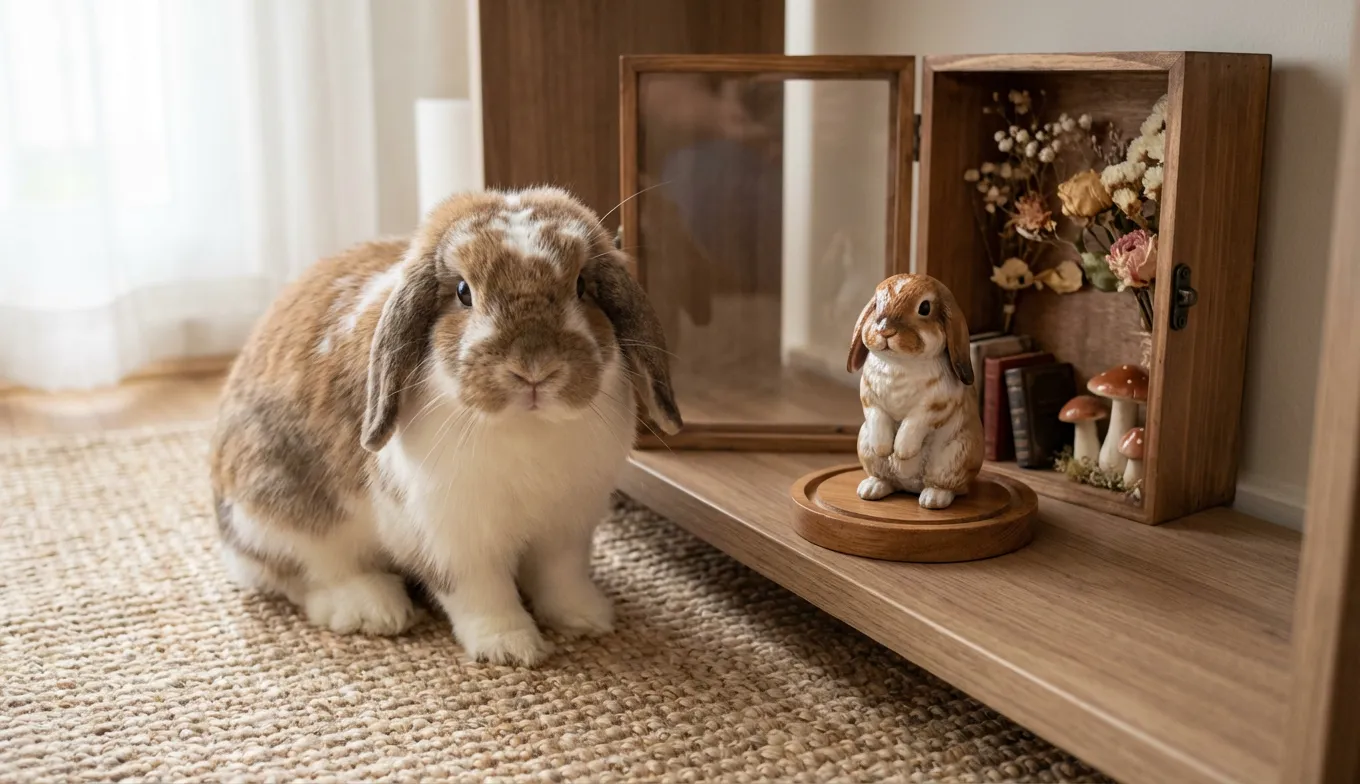
This is where many rabbit owners are finding comfort in something more tangible. At PawSculpt, we’ve noticed a significant shift toward custom figurines for smaller pets.Because rabbits are so often held, stroked, and physically close to the ground, we miss their shape intensely. We miss the curve of the spine when they loaf, or the way their ears settle when they are relaxed. A custom figurine, sculpted from your photos, captures that specific posture.
Imagine opening your shadow box and seeing not just a flat image, but a perfect, miniature recreation of your bunny doing their signature "flop." It adds a level of realism and presence that transforms the box from a collection of things into a scene. It creates a sense that they are still occupying space in your home.
If you choose a figurine as your centerpiece, you can arrange the other items around it—the hay positioned near the mouth, the toy near the paws—creating a little diorama of their life, rather than just a display of their belongings.
Layout and Composition: Telling the Story
Don't just glue things down randomly. Think about the story you are telling.
The "Day in the Life" Layout
Arrange items in a circle or a flow that mimics their routine. 1. Top Left: A photo of them waking up or yawning. 2. Middle: Their food bowl tag or favorite dried treat. 3. Bottom: The destroyed toy (playtime). 4. Center: The figurine or main photo (rest).The "Anatomy of a Bunny" Layout
Group items by what they represent.- Touch: The vial of fur and the whiskers.
- Play: The toys and chewed cardboard.
- Identity: Their name tag or vet band.
The Gravity Rule
Heavier items (clay paw prints, rocks, dense toys) should generally go at the bottom of the box. Visually, this feels stable. Lighter items (whiskers, photos, dried flowers) can "float" near the top. This prevents the box from looking top-heavy or anxious.Mounting Techniques: The Practical Side
We've seen heartbreaking situations where people used the wrong glue, and three years later, their precious photos are stained yellow.
- Avoid Hot Glue: It can melt plastic, discolor paper, and eventually becomes brittle and pops off.
- Use Museum Wax or Putty: For hard items like a clay paw print or a custom figurine (yes, the techniques are the same for rabbits!), use museum wax. It holds strong but is removable if you ever want to take the item out to hold it.
- Sewing Pins: For fabric items or soft toys, don't glue them. Use long sewing pins. Push the pin through the toy and into the foam backing of the box at an angle. This is invisible and secure.
- Acid-Free Tape: For photos and paper, always use acid-free, archival-quality double-sided tape.
The Fear of Forgetting (And How to Fight It)
There is a specific nuance to grief that rabbit owners know well: the fear that because they were small, the memory of them will be small too. You worry that without the daily routine of salad prep and litter box cleaning, the details will slip away.
You might feel guilty when you finally sweep up that last piece of hay. You might feel a wave of panic when you realize you can't quite recall the exact texture of the fur behind their ears.
This is why the shadow box is not just decoration. It is a memory palace.
By preserving the texture (the fur), the activity (the chewed toy), and the form (the figurine or photo), you are triangulating your memory. You are giving your brain physical cues to help it hold on.
When you look at the box, you won't just see objects. You will trigger the sensory memories. You’ll see the chewed willow ball and remember the sound of the crunching. You’ll see the fur and remember the softness against your cheek. You’ll see the custom replica and remember exactly how they looked when they waited for breakfast.
Closing Thoughts
It’s okay if you can’t make the box right away. It’s okay if the bag of their things sits in your closet for six months because looking at it hurts too much. Grief has no timeline, and neither does love.
But when you are ready, creating this shadow box can be a profound act of healing. It’s a way to take that empty corner of the living room—the one that feels so silent right now—and fill it with a different kind of presence. Not a replacement, but a tribute.
A tribute to the little soul who, despite their size, took up so much room in your heart.
Frequently Asked Questions
What size shadow box is best for rabbit memorials?
We generally recommend a box with at least 2 to 3 inches of depth. Unlike dog collars which lay flat, rabbit keepsakes often include spherical items like willow balls, small plushies, or clay paw prints. A standard 1-inch deep frame will squash these items. As for dimensions, a 10x10 or 12x12 inch box usually offers enough "breathing room" to arrange items artistically without them looking cluttered.How do I preserve rabbit fur for a shadow box?
Rabbit fur is incredibly fine and can look greasy or dark if you apply glue directly to it. The best method is to use a small glass vial (corked apothecary jars work beautifully). Stuff the fur gently inside; this protects it from dust and keeps it fluffy. Alternatively, if you have longer fur, tie it with a small ribbon and pin the ribbon to the backing board.Can I include fresh flowers or hay in a shadow box?
No, never put fresh organic material in a sealed box—it will mold and rot, potentially ruining your other keepsakes. You must use completely dried flowers or hay. If you want to include timothy hay, select a few thick stalks and let them dry out completely in a low-humidity area for a few weeks before mounting. You can also spray them with a floral sealant to help maintain color.How do I attach heavy items like a clay paw print?
Gravity is your enemy here. Hot glue often becomes brittle and snaps after a year or two. For heavy clay prints or stones, we recommend using museum wax (also called museum putty) or heavy-duty mounting tape designed for outdoor use. For extra security, you can poke two small holes in the backing board and use thin wire to strap the item down.Is it weird to keep my rabbit's chewed toys?
It is absolutely not weird. In our experience, the "imperfect" items are the ones that bring the most comfort later on. A brand-new carrot toy looks like it came from a store. A carrot toy that has been gnawed down to a nub looks like it belonged to your rabbit. Those chew marks are their signature—preserve them.Honor Their Memory Forever
Your pet's story deserves to be preserved in a way that captures their unique spirit. A custom PawSculpt figurine transforms your cherished memories into a timeless keepsake—every whisker, every marking, every detail that made them irreplaceable.
Free instant AI preview • 3D artist preview within 7 days • 5 free revisions