
7 Shareable Keepsakes for an Adult Child Marking the Anniversary of Losing a Ferret
You watch your grown kid go quiet every time you pass the pet aisle, and you know exactly why. A year ago this week, a ferret was still curling warm into the crook of their neck. Now you're searching for a pet loss anniversary gift that says the one thing they need most: I remember him too.
Quick Takeaways
- The one-year mark reactivates grief on purpose — plan for it instead of hoping it passes quietly.
- "Shareable" means a keepsake more than one person can hold — grief shrinks when it's witnessed, not hidden.
- Give it a few days before the anniversary, not on it — timing changes everything about how it lands.
- A tangible object calms the nervous system — which is why families increasingly choose custom 3D-printed figurines over cards that get tucked in a drawer.
- Name the ferret out loud when you give it — using the name is the gift underneath the gift.
Why the One-Year Mark Hits Harder Than Anyone Warned Them
Here's something most people don't understand about the anniversary of a pet's death: it isn't a slow, gentle fade. It's a spike.
Psychologists call it an anniversary reaction — a well-documented resurgence of grief that lands around the date of a significant loss. The body keeps a kind of calendar the conscious mind forgets. The light shifts to how it looked that week. The weather smells the same. And suddenly your adult child is thirty-one going on the exact person they were the morning they found the cage still and quiet.
This isn't weakness. It's biology. Grief lays down deep memory associations, and the brain files them alongside sensory cues — season, temperature, the angle of afternoon sun through a window. When those cues return, the memory returns with them, often unannounced.
So the day sneaks up. Your kid might not even connect the dots at first. They just feel heavier, shorter-tempered, more tired. Then the date registers, and the whole thing makes sense.
What you're really doing when you send a gift isn't marking a sad day. You're getting ahead of the spike. You're telling their nervous system: someone else is holding the weight of this too.
The part almost everyone gets wrong about ferret grief
Now here's the piece that competing articles skip entirely.
When someone loses a dog, the world mostly agrees the grief is real. When someone loses a ferret — a "pocket pet," a "small animal" — the sympathy shrinks. People say things like "it was just a ferret" or "at least it wasn't the dog." Some don't say anything at all, because they genuinely don't know it counts.
Grief researchers have a term for this: disenfranchised grief. It's mourning that society doesn't fully recognize or permit, which makes it lonelier and, counterintuitively, longer-lasting. The Association for Pet Loss and Bereavement has spent years documenting how unacknowledged losses tend to sit unresolved, precisely because the griever gets no social permission to process them out loud.
"A ferret-sized absence is not a small grief. Love was never measured in pounds."
Your adult child may have spent a full year quietly minimizing their own pain because everyone around them did. Which means the most powerful thing your gift can do — before it's beautiful, before it's clever — is simply legitimize the loss. To say: this mattered because he mattered, and I saw that.
That reframing changes how you shop. You stop looking for something sad and start looking for something that honors a specific, ridiculous, wonderful little animal who did the weasel war dance across the kitchen floor and stole socks he had no use for.

What "Shareable" Actually Means When You're Grieving
The keyword in every gift guide right now is "shareable," and most writers assume it means Instagram. Post the memorial. Get the likes. Move on.
That's not what shareable means to a grieving person.
For someone in mourning, a shareable keepsake is an object that gives more than one person permission to remember together. It sits on a shelf where a partner notices it and asks about him. It's the thing a sibling picks up and says, "God, I loved how he'd flatten out like a liquid to slide under the couch." It becomes a doorway other people can walk through to meet the memory.
This matters because of one of the most robust findings in bereavement science: grief is regulated socially, not just privately. We co-process loss. When a memory is witnessed and spoken aloud by another person, the emotional charge softens. When it stays sealed inside one head, it calcifies.
"Shareable doesn't mean public. It means a memory more than one heart gets to hold."
So as you evaluate the seven keepsakes below, run each one through a simple test: does this invite other people into the memory, or does it lock the grief in a private box? The best anniversary gifts are conversation-starters disguised as objects.
A quick day-in-the-life to show you what that looks like. It's a Tuesday evening, months from now. Your kid's partner is setting the table and glances at the little figurine on the windowsill, the one you gave them. "Was his tail really that fluffy?" they ask. And your kid laughs — actually laughs — and launches into the story about the time he burrowed into the laundry basket and refused to come out for six hours. That's the gift working. That's what shareable means.
Before we get into the list, here's a comparison to help you match the keepsake to your budget and your goal.
| Keepsake | Typical Budget | Best For | Shareability |
|---|---|---|---|
| Custom full-color figurine | Mid to premium | A physical presence in the room | Very high — invites questions |
| Photo memory book | $40–$120 | Story-tellers who miss the details | High — meant to be flipped through |
| Memorial jewelry | $50–$300 | Carrying him everywhere, quietly | Low — deeply personal |
| Custom portrait print | $80–$400 | A visual centerpiece on the wall | High — always visible |
| Memorial garden stone | $30–$150 | Ritual-oriented, outdoor lovers | Medium — for visitors who ask |
| Digital tribute montage | $0–$100 | Scattered family across distance | Very high — easy to send |
| Embroidered blanket or pillow | $60–$200 | Comfort-seekers, tactile grievers | Medium — cozy and personal |
The 7 Shareable Keepsakes
1. A Custom Full-Color Figurine of the Ferret Himself
Who it's for: The adult child who keeps a photo as their phone lock screen and still can't scroll past it.
Budget: Premium — visit pawsculpt.com for current details, since pricing and turnaround shift over time.
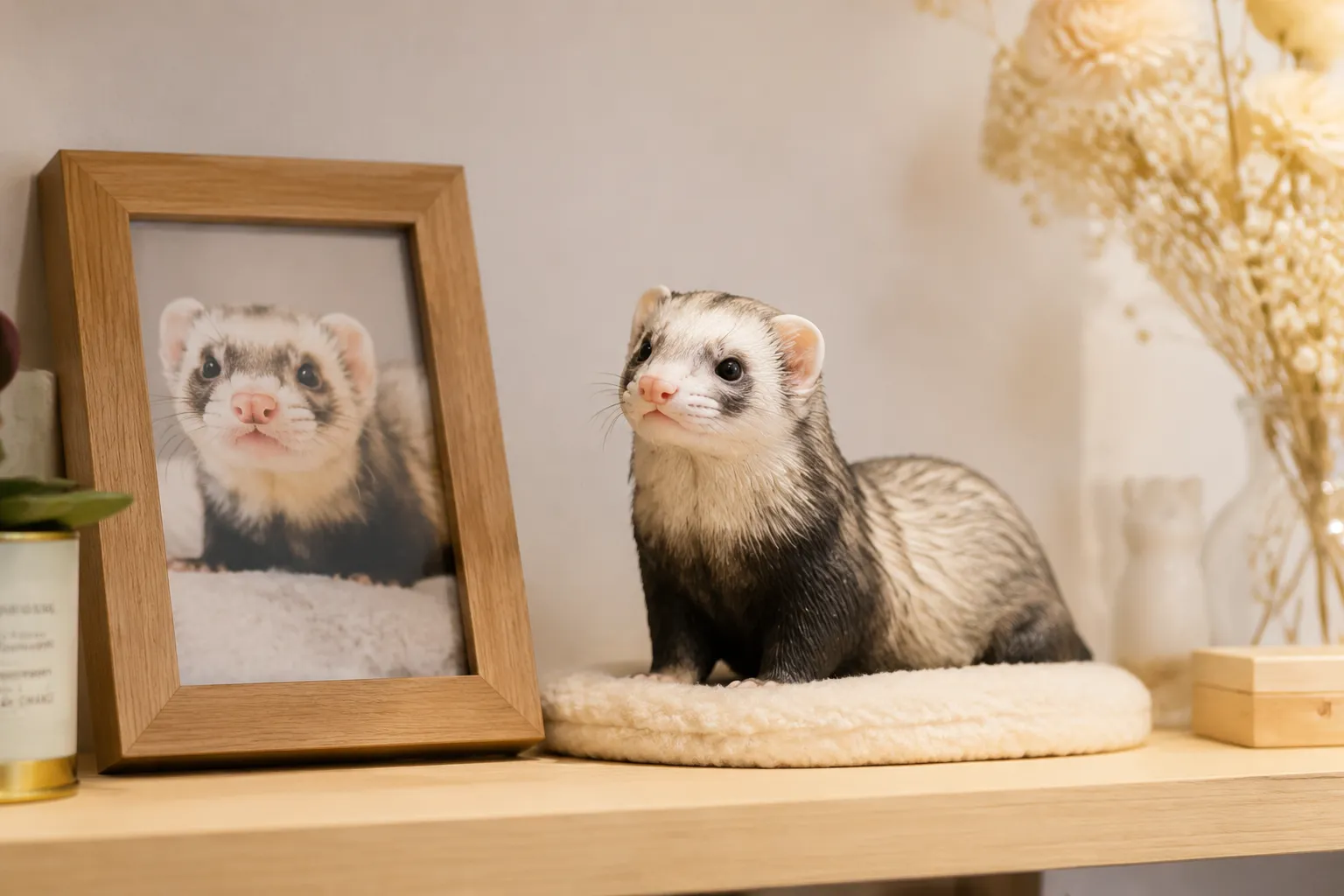
Of all the keepsakes on this list, a figurine is the only one that puts him back in the room — a physical presence with actual weight, dimension, and detail. And ferrets are exactly the kind of subject that rewards three dimensions. That long, low body. The mask markings. The way the fur shifts from cream at the throat to deep sable along the spine.
Companies like PawSculpt create these through full-color 3D printing — the model is digitally sculpted by 3D artists, then precision-printed in full-color resin where the color is baked into the material itself, not layered on afterward. The technology reproduces those specific markings and fur patterns directly in the resin, then a clear protective coat gives it a subtle sheen. The result has an honest, tactile texture. It reads as real, not glossy-plastic-perfect.
Here's why it earns the top spot for an anniversary specifically: the weight in the hand matters. When someone holds a solid, cool-to-the-touch object during a wave of grief, it engages the body's grounding response — the same reason people clutch a mug or a stone when they're overwhelmed. The figurine isn't just something to look at. It's something to hold on the hard days.
Pro tip: Dig up a photo that captures his signature pose — mid-war-dance, or that flat-out "dead sleep" that terrifies every new ferret owner. Personality-forward reference photos produce a keepsake that makes people smile, not just ache.
2. A Photo Memory Book That Tells the Whole Ridiculous Story
Who it's for: The kid who narrates every photo — who remembers not just the picture but the day, the light, the thing he'd just done.
Budget: $40–$120, depending on page count and print quality.
Ferrets steal things. It's practically their job. A good memory book leans into that — not a somber gallery, but a scrapbook of the whole chaotic personality. The stolen keys under the couch. The tube he refused to leave. The half-second he held still long enough for a decent photo.
Why it works: grief science points to narrative reconstruction as one of the healthiest coping mechanisms. Turning a loss into a coherent, told story — with a beginning, a middle, and a whole lot of stolen socks — helps the brain integrate the loss rather than get stuck in the raw fact of it. A photo book is narrative reconstruction you can hold.
And it's genuinely shareable. Books get passed across couches. People flip through them together. That's the whole point.
Pro tip: Write short captions in your own voice, not generic ones. "He hated this sweater" beats "Winter 2021" every single time.
3. Memorial Jewelry That Carries Him Quietly
Who it's for: The private griever — the one who won't display anything but wants him close.
Budget: $50–$300, higher if it holds fur or ashes.
Some people don't want a shelf display. They want to carry it. A small pendant, an engraved cuff, or a piece that holds a lock of his fur lets them keep him against their skin without announcing it to the room.
This is the least "shareable" item on the list by design, and that's okay — not every keepsake needs to be a conversation piece. Some grief wants to be portable and private. The tactile element matters here too: people reach for jewelry the way they'd reach to stroke his fur, a small self-soothing motion the hand remembers.
Pro tip: If you're including fur, ask first. Some families keep a clipping in a small envelope; others find the request itself painful. Tread gently.
4. A Custom Portrait Print for the Wall
Who it's for: The design-minded kid who wants him honored, but honored tastefully — something that fits the apartment.
Budget: $80–$400 depending on size, medium, and framing.
A framed portrait turns grief into decor in the best possible way. It says: he belongs on this wall, next to the other things we love. Unlike a photo, an illustrated or stylized portrait feels intentional and permanent — a deliberate act of honoring rather than a snapshot that could've been anyone's.
Why it lands: visibility. A wall piece is seen daily, by everyone who enters. It quietly normalizes his continued presence in the home, which is exactly what continuing bonds theory — the modern understanding of healthy grief — encourages. We're not supposed to "get over" our lost loves and sever the connection. We're supposed to relocate them to a place where they can stay with us. A portrait on the wall is that relocation, literally.
Pro tip: Match the frame to their existing decor so it reads as belonging, not as a shrine. The goal is integrated, not isolated.
5. A Memorial Garden Stone or Living Planter
Who it's for: The ritual-oriented, outdoorsy kid who needs somewhere to go.
Budget: $30–$150.
Grief often craves a destination. A place to stand. An engraved stone tucked into a garden bed, or a planter growing something living above where a small heart used to beat, gives the anniversary a physical location and a small act to perform — watering, weeding, sitting nearby.
Rituals aren't sentimental fluff. They're regulatory. Performing a small, repeatable action on a hard day gives the nervous system a script to follow when everything else feels formless. The stone gives the anniversary somewhere to happen.
"The best memorial isn't the one that ends the missing. It's the one that gives it somewhere to go."
Pro tip: Choose a hardy, low-maintenance plant. A memorial that dies from neglect creates a second, sharper wound. Succulents and perennials are forgiving.
6. A Shareable Digital Tribute for Scattered Family
Who it's for: Families spread across cities and time zones who all loved him.
Budget: $0–$100 if you use editing apps or a memorial platform.
Sometimes the people who need to grieve together can't be in the same room. A short video montage — clips of the war dance, the dooking, the stubborn refusal to be picked up — set to a song and shared in a family group chat, becomes a place everyone can gather for a few minutes. Some families also create a small online memorial page where relatives leave notes.
This is the most literally shareable keepsake, and it does something the physical objects can't: it lets an aunt in another state, a college roommate, and a sibling all witness the same memory at once. Remember, grief regulates socially. A shared tribute is co-regulation across distance.
Pro tip: Keep it under three minutes. Grief attention spans are short, and the goal is a warm flood of recognition, not an exhaustive documentary.
7. A Custom Embroidered Blanket or Pillow
Who it's for: The comfort-seeker — the kid who copes by burrowing under something soft.
Budget: $60–$200.
There's a reason weighted blankets and soft textures show up in every anxiety-relief guide. Touch and warmth trigger a parasympathetic (calming) response, lowering the stress hormones that spike during an anniversary wave. A blanket or pillow embroidered with his likeness combines the emotional comfort of remembrance with the actual physical comfort of something to hold on a bad night.
For a ferret owner especially, softness is loaded. So much of that relationship happened through touch — the fur, the surprising warmth of a sleeping ferret, the way he'd tunnel into a hoodie pocket. A soft keepsake speaks that same tactile language.
Pro tip: Choose a texture that echoes his fur if you can — something with a little pile or plush to it, not stiff canvas. The hand remembers what it's reaching for.
"We've learned that the smallest pets leave the widest quiet. Our job is to give that quiet a shape you can hold."
— The PawSculpt Team
How to Actually Give It (Without Making It Weird)
You could pick the perfect keepsake and still fumble the delivery. So let's talk about the part nobody covers.
Timing: earlier is better than on-the-day
The instinct is to have it arrive on the anniversary, like a floral delivery. Don't.
Landing a grief gift on the exact date can feel like an ambush — a spotlight on a day they may have wanted to move through quietly. Worse, if the mail runs late, a gift meant for the hard day shows up two days after, when the spike has passed and the moment's gone.
Aim for three to five days before. This gives them time to absorb it privately, cry if they need to, and arrive at the anniversary already holding the thing rather than being surprised by it mid-wave. It also signals foresight — that you were thinking about them before the calendar forced it.
Words: name him
This is the smallest instruction and the most important one.
Use the ferret's name. Out loud, in the card, in the text. Not "your little guy" or "your pet." His name.
Grieving people are starving to hear the name of who they lost, because most people avoid it, afraid of "reminding" them. Here's the truth every bereavement counselor will confirm: you cannot remind someone of a loss they think about constantly. Saying the name doesn't reopen a wound. It tells them the wound is allowed to exist, and that someone else remembers he was here.
So write it plainly. "I know this week is hard. I've been thinking about Loki and how he used to launch himself off the back of the couch. I miss him too."
That last line — I miss him too — is worth more than anything you can wrap.
The mistake most people make
The most common misstep isn't buying the wrong thing. It's over-explaining.
People get nervous around grief, so they pile on qualifiers: "I wasn't sure if this was okay, I hope it's not too much, tell me if it's weird, no pressure." All that anxiety transfers straight to the recipient, who now has to manage your discomfort on top of their own.
Give it simply. A short, warm note. Then let it be. Silence after giving a grief gift isn't awkward — it's spacious. It lets them feel what they feel without performing gratitude on cue.
Here's how the anniversary tends to unfold, and where a keepsake fits into each phase.
| Phase | When | What They're Feeling | How a Keepsake Helps |
|---|---|---|---|
| The build-up | 1–2 weeks before | Vague heaviness, irritability, fatigue | Arriving early gives grief a focus before it turns formless |
| The date itself | The anniversary | Acute sadness, memories flooding back | A held object grounds the nervous system in the moment |
| The aftermath | Days to weeks after | Softer ache, reflection, gratitude | A displayed keepsake keeps the bond present, not buried |
| The long tail | Months onward | Occasional pangs, warm remembering | The object becomes a conversation piece that invites sharing |
Match the keepsake to the person, not the trend
One last reframe. Don't buy the "best" keepsake — buy the right one for your specific kid.
A private, contained griever will feel exposed by a giant wall portrait but comforted by a small pendant. A story-teller will treasure a memory book and barely glance at a garden stone. A tactile, comfort-seeking kid will sleep with an embroidered pillow every night and use a figurine as a shelf piece — or vice versa.
You know this person. Trust what you know about how they process feeling. The keepsake should meet them where they already are, not where a gift guide says grievers "should" be.
Bringing It Home
Think back to that quiet at the pet aisle — the way your kid goes somewhere else for a second, then comes back with a small, brave smile.
A year is a strange milestone. It's long enough that the world assumes they're "over it," and short enough that some mornings the loss still feels like it happened yesterday. The gap between those two truths is exactly where a good keepsake lives. It says: I know you're not over it. I know you never will be, not really. And that's not a problem to fix.
Whatever you choose from this list — the memory book, the garden stone, the soft blanket, or a ferret memorial keepsake like a custom figurine that puts his familiar shape back on the shelf — the object matters less than the message underneath it. That message is simple, and it's the whole reason you started looking: He was real. He mattered. And I remember him too.
Give it a few days early. Say his name. Then let it sit in the room and do its quiet work, day after day, for as long as it takes. That's not a gift that gets used up. That's a gift that keeps giving them permission to have loved something small with their whole enormous heart.
Frequently Asked Questions
What is a good pet loss anniversary gift for an adult child?
The strongest gifts honor the specific pet rather than offering generic sympathy. A custom figurine, a photo memory book, or a piece of memorial jewelry all work well. What matters most is pairing the object with a personal note that uses the pet's name and acknowledges that this week is hard. Match the type of keepsake to how your child processes emotion — private grievers prefer something they can carry, while story-tellers love a book they can flip through.
Is it normal to still grieve a ferret a year later?
Completely normal. The one-year mark often triggers an anniversary reaction, where grief resurfaces around the date of the loss because the body associates that season, light, and weather with the memory. Small pets like ferrets also carry a layer of disenfranchised grief — mourning that others minimize with comments like "it was just a ferret" — which tends to make the loss last longer, not shorter, because it goes unacknowledged.
What makes a memorial gift "shareable"?
For a grieving person, shareable doesn't mean posting online. It means a keepsake that more than one person can experience, so the memory gets witnessed and spoken about together. A figurine on a windowsill invites a partner to ask about the pet. A photo book gets passed around a couch. Grief regulates socially, so objects that spark conversation actually help more than ones locked away in a drawer.
When is the best time to give a pet loss anniversary gift?
Give it three to five days before the anniversary rather than on the exact date. Arriving early lets your child absorb the gift privately, feel what they need to feel, and reach the hard day already holding something comforting instead of being surprised mid-wave. It also protects against shipping delays that could push a thoughtful gift past the moment it was meant for.
How are custom pet figurines actually made?
At PawSculpt, figurines are digitally sculpted by 3D artists working from your reference photos, then precision printed using full-color resin 3D printing. The color is part of the material itself, printed directly into the resin, which reproduces the pet's unique markings and fur patterns. The only manual step is a protective clear coat that adds a subtle sheen. Visit the website for current process details and turnaround.
What if my adult child says they don't want to "make a big deal" of it?
Honor that, but understand it often masks a fear of burdening others. A low-key keepsake — a small pendant, a modest framed print — lets you acknowledge the loss without turning it into a spectacle. Keep your note brief and warm, name the pet, and resist over-explaining. The quiet gesture usually reaches them far more than they let on.
Ready to Celebrate Your Pet?
Every pet has a story worth preserving, right down to the war dance and the stolen socks. Whether you're honoring a companion who's crossed the rainbow bridge or helping your adult child through a difficult anniversary, a custom PawSculpt figurine captures the specific details that made their ferret one-of-a-kind — the markings, the pose, the personality. It's the kind of ferret memorial keepsake and pet loss anniversary gift that turns quiet grief into a shared, treasured presence in the room.
Visit pawsculpt.com to learn more about our full-color 3D printing process, flexible revisions, and quality guarantee.