
5 Signs Your Senior Pet Needs More Comfort at Home
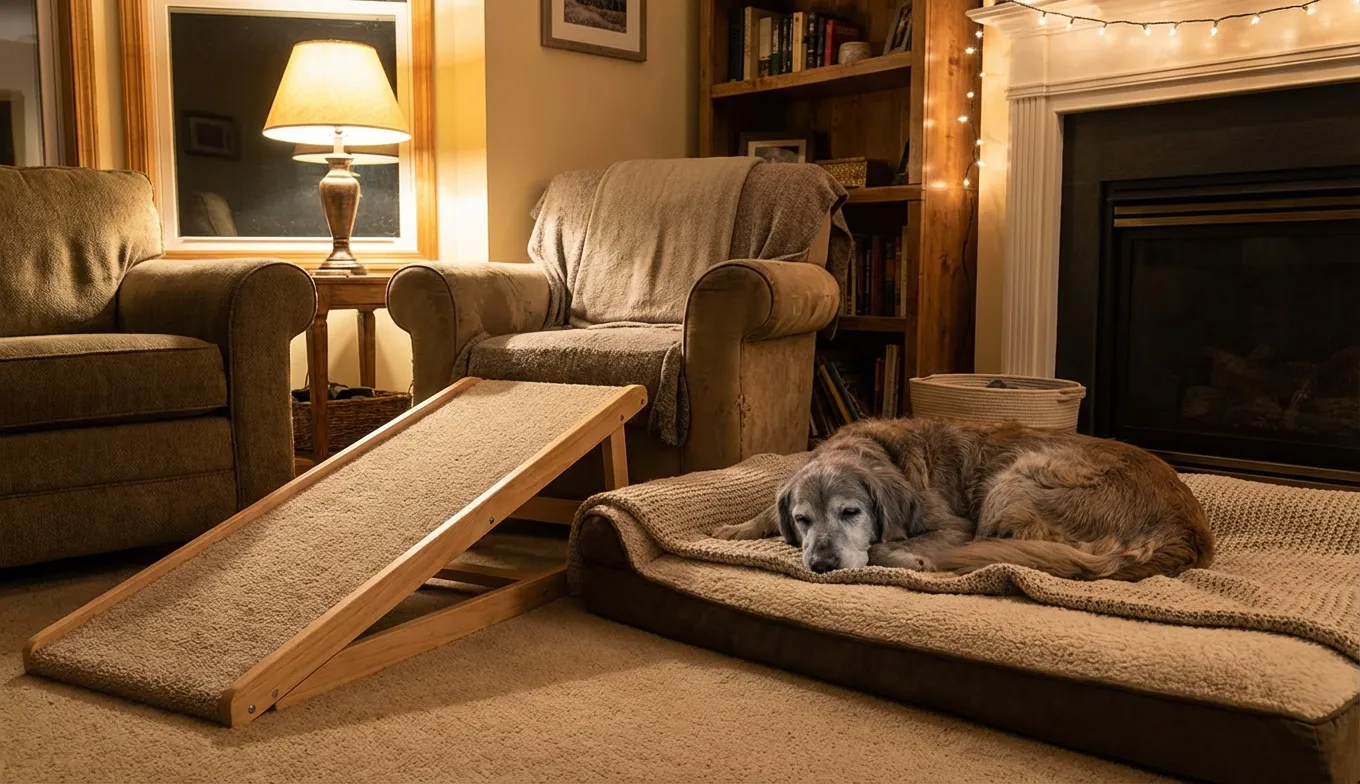
The sound used to be a sharp click-click-click of claws on hardwood, a rapid-fire rhythm announcing that someone was awake and hungry. Now, it’s a sliding scritch, a pause, and a heavy sigh. You watch him hesitate at the threshold of the kitchen, calculating the effort it takes to cross the slick tile floor just to get to his water bowl. It’s not that he doesn’t want to come in; it’s that the geography of his own home has turned against him. We often think of aging in our pets as a medical chart—kidney values, joint supplements, cataracts—but the real story happens in the quiet moments between vet visits. It happens when the sunbeam moves across the rug and, for the first time in twelve years, he doesn't get up to follow it because the effort outweighs the warmth.
Quick Takeaways:
- The "Hesitation Step": If your pet pauses before jumping or walking on slick floors, it’s not stubbornness—it’s a loss of proprioception and confidence.
- Nighttime Restlessness: Pacing at 3 AM often signals cognitive dysfunction or anxiety, not just a full bladder.
- Changes in Grooming: A cat with matted fur on their lower back isn't lazy; they are likely too stiff to twist around.
- Sensory Mapping: Failing eyesight changes how pets navigate; moving furniture even slightly can cause immense stress.
- The "Velcro" Effect: Increased clinginess is a biological response to feeling vulnerable; they are borrowing your safety.
1. The Geometry of Movement Has Changed
We had a customer recently, let's call her Sarah, who ordered a figurine of her Golden Retriever, Buster. She told us she wanted to remember him "mid-leap," catching a frisbee. But in the same email, she admitted that for the last year of his life, Buster wouldn't even step onto the linoleum in the entryway. She thought he was just being difficult. The reality was much heartbreakingly simpler: he had lost his traction, and with it, his confidence.
Most guides will tell you to "watch for limping." But by the time a dog or cat is visibly limping, they have been in pain for months, maybe years. Animals are masters of masking weakness—it’s an evolutionary survival tactic. The sign you need to look for isn't a limp; it's a change in geometry.
Does your cat take three small hops to get onto the sofa instead of one fluid leap? Does your dog take a wide, sweeping turn to avoid a tight corner? This is called "compensatory movement." They are rewriting their internal maps to avoid pain.
The Counterintuitive Truth:
The mistake most people make is assuming that if a pet can do something, they are fine doing it. Just because your dog can jump into the SUV doesn't mean the landing isn't sending a shockwave of pain through their lumbar spine.
Actionable Comfort Strategy:
Stop waiting for the limp. Audit your floor plan today.
- The Yoga Mat Hack: You don't need to re-carpet your whole house. Buy a roll of cheap yoga mats or interlocking foam tiles. Create "runways" across slick floors. We’ve seen senior dogs who seemingly "aged backwards" overnight simply because they regained the traction to walk confidently.
- The 4-Inch Rule: For cats, the leap down is harder than the leap up. Their elbows take the brunt of the impact. Place an ottoman or step stool near their favorite high perches. If the drop is more than your knee height, give them a midway point.
2. The 3 AM Pacing (It’s Not Just the Bathroom)
There is a specific kind of exhaustion reserved for parents of geriatric dogs. It’s the 3 AM wake-up call—the click of nails, the panting, the aimless wandering. You let them out. They stand in the yard, staring into the darkness, do their business (maybe), and come back in. Ten minutes later, the pacing starts again.
It is easy to get frustrated. It feels behavioral. But this is often the hallmark of "Sundowner Syndrome" or Canine Cognitive Dysfunction (CCD). It’s similar to Alzheimer’s in humans. Their sleep-wake cycles are fragmented. The darkness disorients them. They aren't trying to annoy you; they are lost in their own living room.
We see this reflected in the stories people tell us when they commission a PawSculpt figurine. They often mention the "quiet nights" they miss, or the anxiety of those final months. One family told us they spent the last six months sleeping on a mattress in the living room because their Great Dane panicked if he woke up alone.
The "Aha" Moment:
The pacing isn't always about the bladder; it's about anxiety regulation. As senses dull (vision and hearing fade), the world becomes a scary place at night. Shadows look like predators. Silence feels like abandonment. They pace to soothe themselves, much like a human might wiggle their leg or pace a waiting room.
Actionable Comfort Strategy:
- Light Therapy: Don't leave them in the pitch dark. Plug in nightlights—specifically ones with a warm, amber hue rather than harsh blue-white LEDs. Place them near water bowls and sleeping areas to create visual anchors.
- White Noise: If their hearing is fading, they might be developing a hypersensitivity to vibrations or sudden noises (like a truck driving by). A white noise machine running near their bed can smooth out the sonic environment, reducing the "startle reflex" that wakes them up.
- The "Thundershirt" Effect: Sometimes, physical compression helps. A snug-fitting t-shirt or anxiety wrap can provide proprioceptive feedback that grounds them, literally holding them together when they feel like they’re falling apart.
3. They’ve Stopped Grooming the "Hard-to-Reach" Places
Cats are fastidious creatures. A cat that stops grooming is a cat in crisis. But with seniors, it’s rarely a total cessation of grooming; it’s a specific neglect of the "back 40"—the base of the tail, the hips, and the hind legs.
If you notice your senior cat’s coat looking "spiky" or clumped, or if you feel small mats forming near their lower spine, this is a screaming red flag for osteoarthritis. To groom that area, a cat has to twist their spine and flex their hips significantly. If that movement hurts, they simply stop doing it. They choose being dirty over being in pain.
For dogs, this manifests differently. They might stop shaking off when they get wet (because the rotational force hurts their spine) or they might stop scratching behind their ears.
Insider Insight:
A greasy coat isn't just an aesthetic issue; it’s a skin health issue. Mats pull on the skin, causing constant, low-grade pain. Dandruff indicates that the natural oils aren't being distributed. When we create memorial pieces, we often have to look at photos from 3-4 years prior to capture the pet's coat at its healthiest, because the end-of-life photos show this loss of luster.
Actionable Comfort Strategy:
You have to become their mobility assistant.
- The 5-Minute Brush: Switch to a soft-bristled brush (boar bristle is great). Wire slickers can be too harsh on thin, aging skin. Spend 5 minutes a day gently brushing those hard-to-reach spots. You aren't just cleaning them; you are stimulating blood flow to the skin, which feels incredible to an achy body.
- Warm Compress Therapy: Before you brush, try placing a warm (not hot) towel on their hips for 2-3 minutes. It loosens the stiff muscles and makes the grooming session feel like a spa treatment rather than a chore.
- Sanitary Trims: Don't be afraid to ask your groomer (or vet) to shave the hair around the anus and hind legs. It saves your pet the indignity of getting waste stuck in their fur when they can no longer squat as deeply as they used to.
4. Their World Has Shrunk (And They Need You to Expand It)
There is a subtle tragedy in watching a dog’s world shrink. It used to be the dog park, the hiking trail, the beach. Then it became just the neighborhood block. Then just the backyard. Finally, it’s just the bed and the food bowl.
When mobility declines, enrichment often drops to zero. We assume that because they can't run, they don't want to do anything. This is false. Their bodies are tired, but their minds are often still bored and craving engagement. A bored senior pet is a depressed senior pet. Depression accelerates physical decline.
Challenging Assumptions:
Most owners think "comfort" means leaving the pet alone to sleep. But true comfort includes mental stimulation. The brain needs to work to keep the neural pathways firing. If you stop engaging them, the cognitive decline will snowball.
Actionable Comfort Strategy:
Bring the world to them.
- Sniff Safaris: If they can’t walk far, take them to a new spot (a park bench, a friend's garden) and just sit there. Let them sniff the air. Sniffing lowers a dog's pulse and reduces stress. It is mental exhaustion in the best way. 10 minutes of intense sniffing is equivalent to an hour of walking in terms of mental energy expenditure.
- The "Stroller" Conversation: Look, we know. You swore you’d never be that person pushing a dog in a stroller. Get over it. We have seen countless clients extend their dogs' quality of life by months simply by using a wagon or stroller to get them to the park, then letting them out for 5 minutes of interaction. It keeps them part of the family pack.
- Texture Boxes: For indoor cats or bedbound dogs, bring the outdoors in. Fill a shallow box with dry leaves, pinecones, or fresh grass clippings. Let them investigate the scents. It triggers the primal parts of their brain that remember being a hunter, even if they can no longer hunt.
5. The "Velcro" Clinginess is a Survival Instinct
"He's suddenly under my feet everywhere I go."
"She cries if I go into the bathroom without her."
We hear this constantly. Owners often interpret this sudden clinginess as affection—and it is—but it’s rooted in vulnerability. In the wild, an aging animal is a target. They know, on an instinctual level, that their senses are dulling and their reflexes are slowing. You are their eyes, their ears, and their bodyguard.
When they press their body against yours, they are borrowing your warmth, yes, but they are also using you as a sensory extension. They can feel you tense up if there's danger. They can feel you relax when it's safe.
The Emotional Truth:
It can be suffocating. It is okay to admit that. When you are tripping over a 70-pound Labrador while trying to cook dinner, or when your cat is howling at 4 AM because the bedroom door is closed, compassion fatigue is real. You aren't a bad owner for feeling overwhelmed by their neediness.
Actionable Comfort Strategy:
Visual Access: If they can't be with you, they need to see* you. Use baby gates instead of closed doors.
- Scent Anchors: If you have to leave the house, leave a worn t-shirt in their bed. Your scent is a powerful biological signal that says "safety is here."
- The "Place" Command 2.0: Retrain the "place" or "bed" command, but make it highly rewarding. Use a specific mat that you can move from room to room. If you are in the kitchen, the mat is in the kitchen. If you are in the office, the mat is in the office. They get to be near you, but they have a designated "safe zone" that keeps them from being underfoot.
The Subtle Art of the "Good Days"
There is a phenomenon we see often at PawSculpt when we work with grieving families. They tell us, "He had a really good day right before the end."
In geriatric pet care, the "good days" can be deceptive. Sometimes, a burst of energy is just a burst of adrenaline masking the decline. But more often, the "good days" are the result of you, the owner, finally getting the comfort equation right.
When you manage their pain, secure their footing, and soothe their anxiety, you aren't just making them comfortable—you are giving them their personality back. You strip away the noise of suffering, and the dog or cat you’ve loved for fifteen years shines through again.
It requires a shift in mindset. You are no longer their playmate or their trainer. You are their nurse, their advocate, and their seeing-eye human. It is a heavier burden, undoubtedly. But there is a profound intimacy in this stage. You are communicating in a language of touch and trust that is deeper than any game of fetch.
A Note on Memorializing the Journey
We talk a lot about the end, but the "senior years" can last a long time. This is a distinct chapter of their life, worthy of being honored. It’s why so many of our clients choose to create a custom figurine not just as a memorial after death, but as a celebration while the pet is still here.
There is something grounding about holding a tangible representation of your pet—capturing that specific way their ear flopped, or the greying pattern on their muzzle. It serves as a reminder that while their body is failing, their spirit—the thing you fell in love with—is permanent.
Don't wait until they are gone to cherish who they are now. The grey muzzle is a badge of honor. It means you did your job. You got them to the finish line.
Frequently Asked Questions
How do I know if my senior pet is in pain?
They likely won't cry out. Look for subtle changes: panting when not hot, trembling, hesitation to lie down or get up, loss of appetite, or behavioral changes like aggression or withdrawal. A "grimace scale" (check Feline or Canine Grimace Scale online) can help you read their facial expressions for pain.Is it confusing to move furniture for a blind dog?
Yes, extremely. Dogs create a "cognitive map" of their home. If you move the sofa, you have essentially erased a landmark. Keep main pathways clear and consistent. If you must move furniture, walk your dog on a leash through the new layout several times, using treats to guide them, to help them re-map the space.My senior dog sleeps all day. Is that normal?
Yes and no. Senior dogs need more sleep (18-20 hours is not uncommon), but look at the quality of awake time. Are they alert and happy when awake? Or are they lethargic and checked out? Excessive sleeping can also be a sign of heart issues, hypothyroidism, or pain. It’s worth a vet check if the change is sudden.How can I help my old cat use the litter box?
Arthritis makes high-sided boxes a nightmare. Switch to a low-entry litter box or even a large potting tray. Ensure the box is on the main floor so they don't have to navigate stairs to relieve themselves. If they have accidents, don't punish them—they are likely trying their best but couldn't physically make it in time.When is it "time"?
This is the hardest question. We recommend the "Good Day/Bad Day" calendar. Mark each day on a calendar as happy/neutral or painful/struggling. When the bad days consistently outnumber the good, or when the things they loved (eating, greeting you) no longer bring them joy, it is time to have the conversation with your vet.The transition from "adult dog" to "senior dog" doesn't happen on a specific birthday. It happens on a Tuesday morning when you realize the walk is taking ten minutes longer. It happens when you buy the ramp for the car. It is a series of small adjustments, a dance of accommodation.
But here is the beautiful thing: They would do it for us. If the roles were reversed, and you were the one whose legs were failing, your dog would sit by your side. He would adjust his pace to yours. He would wait.
So we wait for them. We put down the yoga mats. We turn on the nightlights. We lift them onto the bed. We give them the comfort they have earned a thousand times over.
Celebrate Your Pet's Unique Personality
Every pet has quirks and characteristics that make them one-of-a-kind. A custom PawSculpt figurine captures those details—the way they tilt their head, their favorite pose, the spark in their eyes.
Free instant AI preview • 3D artist preview within 7 days • 5 free revisions