
The 'New Home' Kit: Anchoring a Move with a Familiar Tabby Cat Figurine
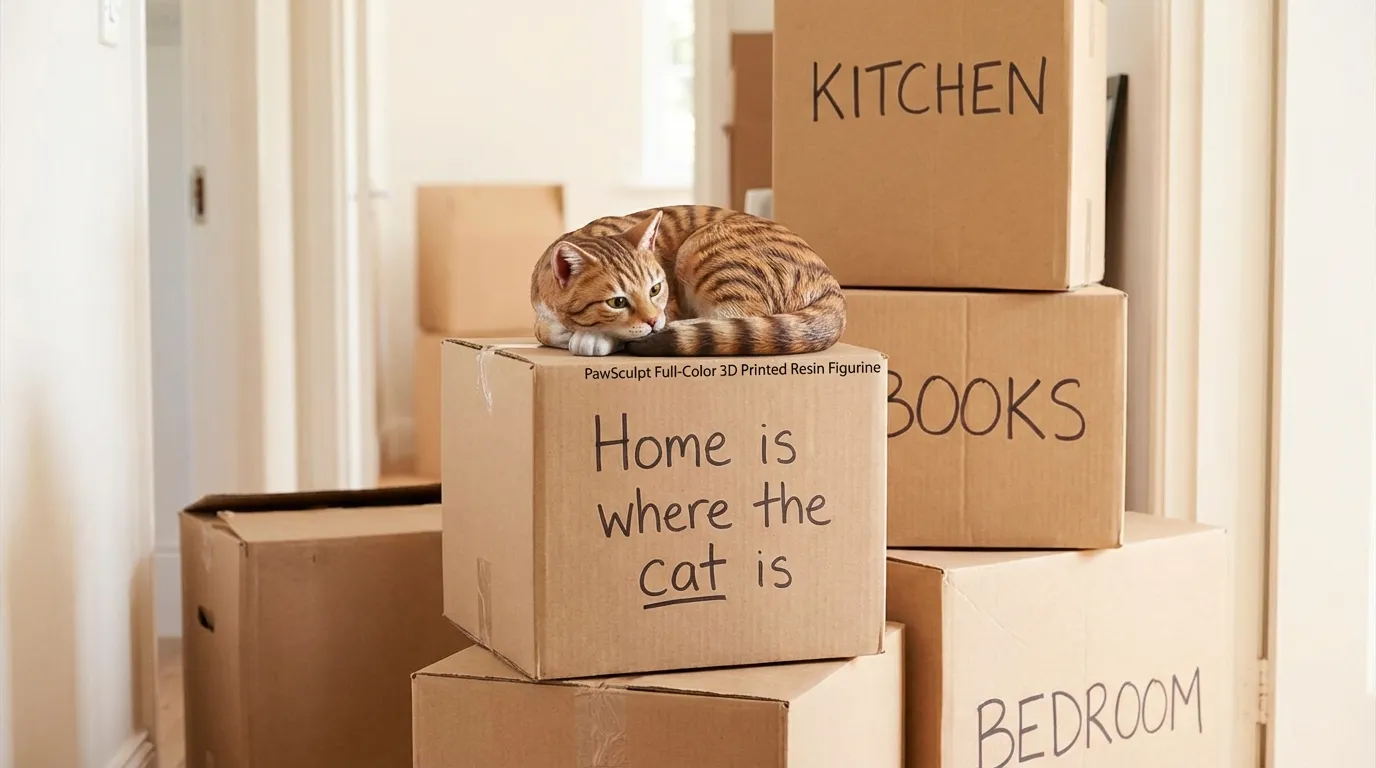
The harsh riiiip of a packing tape gun echoes off the bare hardwood floors, causing a pair of wide, amber eyes to vanish instantly beneath the last remaining armchair. For us, moving is a logistical headache of boxes and bubble wrap; for a territorial tabby, it is the dismantling of their entire universe, stripping away the scent markers and sunbeams that define their safety.
Quick Takeaways
- Create a "Landing Zone" — Set up a dedicated sanctuary room in the new house with familiar bedding before the cat arrives.
- Preserve the Scent Profile — Do not wash your cat’s favorite blankets or beds for at least two weeks post-move; that "dirty" smell is their security blanket.
- Anchor with Familiar Visuals — Place a custom pet figurine on the first shelf you unpack to establish a sense of permanence and "home" amidst the chaos.
- Maintain Ritual Continuity — Feed meals at the exact same times and in similar bowls to bridge the gap between the old space and the new.
The Architecture of Comfort
We often think of "home" as a structure—walls, a roof, a mortgage. But as artists and pet lovers, we know home is actually a texture. It’s the specific way the afternoon light hits the dust motes in the hallway, or the rhythmic sound of claws clicking on the kitchen tile. When we move, that texture is ripped away.
For a cat, particularly the observant and pattern-oriented tabby, this disruption is seismic.
The mistake most people make is focusing entirely on the physical logistics—the litter box location, the food bowl placement. While those matter, the emotional architecture is far more critical. We need to reconstruct the feeling of safety before we worry about where the scratching post looks best.
"Home isn't just a place you park your car. It's the collection of small, familiar geometries that tell your nervous system it's okay to exhale."
This is where the concept of "anchoring" comes in. It’s a psychological trick not just for the pet, but for the pet parent. When you feel unsettled, your cat reads that anxiety in your pheromones and body language. If you can anchor yourself, you anchor them.
The Tabby's Coat: A Lesson in Detail
Have you ever truly looked—I mean, really studied—the coat of a tabby cat?
In our studio, when we are digitally sculpting a tabby, we aren't just applying stripes. We are mapping a chaotic, beautiful landscape. There is the "agouti" hair, where each individual strand has bands of light and dark color. There are the mackerel patterns that look like fish bones, or the classic swirls that resemble marble cake. And, of course, the signature "M" on the forehead, a mark of distinction that seems to carry ancient history.
Why does this matter for a move?
Because these details are the visual language of your bond. When you are sitting in a new living room surrounded by unopened boxes, feeling like a stranger in your own life, seeing those specific details—the exact curve of that tail, the asymmetry of those stripes—can be ground.
We've found that placing a highly realistic representation of the pet in a prominent spot—a mantle, a windowsill—acts as a visual totem. It says: We are here. This is our space. The family unit is intact.
Why Generic Decor Fails
You might find a generic "striped cat" statue at a home goods store. It’s cute. It’s fine. But it’s not yours. It lacks the specific architecture of your cat’s face. It doesn't have the nick in the left ear or the white socks that go up just a little too high on the back legs.Generic art fills space. Custom art holds memory.
The 'New Home' Survival Kit
If you are moving, or if you are looking for the ultimate housewarming gift for a cat lover, forget the bottle of wine. Wine is gone in an hour. A "New Home" Kit is about survival and adaptation.
Here is what we recommend packing in a clearly labeled "Open First" box:
1. The Scent Soakers
Pack the unwashed pillowcase your cat sleeps on. Pack their scratching post (even if it’s ugly and shredded). These items are soaked in facial pheromones.
2. The Chemical Assist
Feliway or similar synthetic pheromone diffusers. Plug these in immediately upon getting the keys, ideally 24 hours before the cat enters the door.
3. The Visual Anchor
This is where the custom figurine comes in. It serves a dual purpose. For the human, it’s a piece of art that celebrates the animal they are working so hard to protect. For the home, it’s a declaration of occupancy.
4. High-Value Bribes
Freeze-dried chicken or Churu treats. These are not for nutrition; they are for apology.
The First 24 Hours: A Timeline
| Timeframe | Activity | The Goal |
|---|---|---|
| 0-2 Hours | The "Safe Room" Setup | Keep the cat in ONE room (bathroom or spare bedroom) with all essentials. Do not let them roam. |
| 2-6 Hours | The Passive Introduction | Sit in the room with them. Read a book. Don't force interaction. Let them approach you. |
| 6-12 Hours | The Scent Swap | Rub a clean sock on the cat's cheeks, then rub that sock on doorframes in the rest of the house. |
| 12-24 Hours | The Anchor Placement | Unpack the custom figurine and place it in the main living area. It sets the intention for the space. |
| 24+ Hours | The Slow Reveal | Open the door. Let them explore at their own pace. If they retreat, let them. |
The Art of the Replica: How We Capture the Spirit
When we talk about creating a figurine for a "New Home" gift, we aren't talking about a rough approximation. We are talking about a technological marvel that bridges the gap between digital artistry and physical presence.
At PawSculpt, we don't use brushes. We don't use acrylic paints that chip or fade. We use advanced full-color 3D printing technology.
The Process of Preservation
1. Digital Sculpting: Our master 3D artists look at your photos. They don't just see a cat; they see the geometry of the snout, the posture of the hips, the way the ears swivel. They sculpt this in a virtual environment, voxel by voxel. 2. Color Injection: This is the game-changer. The color isn't painted on; it is printed in. The resin itself cures in the specific colors of your tabby’s coat. This allows us to capture those impossible gradients—the way a tabby’s stripe fades from charcoal to smoke to cream. 3. The Finish: The only manual step is the application of a protective clear coat, sealing the memory in a durable, UV-resistant finish.This matters because a move is chaotic. You want keepsakes that are durable, vibrant, and true to life. You want something that catches the light in the new house and makes you smile, reminding you why you go through all this trouble for a ten-pound animal.
"We've seen families heal by holding something tangible. Grief needs an anchor, but so does transition. A familiar face makes a strange place feel like home."
— The PawSculpt Team
The Counterintuitive Truth About Relocation
Here is something most moving guides won't tell you: Your cat might hate the new house for weeks.
And that is okay.
We often project our human excitement onto our pets. We think, "Look at all this space! Look at the bay window!" The cat thinks, "I don't know where the escape routes are, and it smells like fresh paint and anxiety."
The counterintuitive insight is that ignoring your cat is often the best way to help them settle.
When we hover, when we constantly check on them, we validate their suspicion that something is wrong. By going about our business—unpacking books, setting up the coffee maker, placing our art and figurines on the shelves—we signal normalcy.
The Role of Routine
Routine is the metronome of a cat's life. If you usually feed them at 7:00 AM, feed them at 7:00 AM in the new house, even if you’re exhausted. If you usually have lap time during the evening news, make sure you sit down and offer that lap.The furniture might be different. The view out the window might be different. But the ritual remains the same.
A Gift for the "Pet Parent" Housewarming
If you are reading this because your friend is moving, you have a unique opportunity to stand out.
Most housewarming gifts are for the house. Towels. Candles. Gift cards to Home Depot.
A custom figurine is a gift for the heart of the home.
Why it works:
- It’s Personal: It shows you know who the most important member of their family is (the cat).
- It’s Permanent: Unlike flowers or food, this lasts a lifetime.
- It’s a Conversation Starter: When new neighbors come over, the figurine becomes a story. "Oh, is this your cat?" "Yes, that's Barnaby. He's currently hiding in the closet, but this is what he looks like when he's brave."
Housewarming Gift Comparison
| Gift Type | Pros | Cons | Best For |
|---|---|---|---|
| Potted Plant | Adds life/greenery | Many are toxic to cats (lilies are fatal) | Non-pet owners |
| Wine/Champagne | Celebratory | Consumable, temporary | Acquaintances |
| Custom Pet Figurine | Highly emotional, permanent, unique | Requires photos of the pet | Close friends/Family |
| Gift Card | Practical | Impersonal | Coworkers |
Capturing the Light in a New Room
There is a moment, usually about three weeks after a move, where the dust settles. The boxes are mostly flattened. The smell of the previous owners has faded, replaced by the scent of your coffee and your laundry detergent.
You walk into the living room, and there, curled up in a patch of sun on the new rug, is your tabby. They are washing a paw, completely unbothered. The light hits their fur, illuminating that complex map of stripes and swirls.
On the shelf above them, the figurine catches the same light.
It’s a mirror image. One living, one crafted. Both essential.
Moving is essentially an act of faith—faith that we can transplant our lives and our loves to a new soil and have them thrive. It’s a messy, exhausting process. But when you anchor that process with intention, with patience, and with art that honors the bond you share, you aren't just occupying a building. You are weaving the texture of home.
Frequently Asked Questions
How long does it take to make a custom cat figurine?
Quality takes a little time. Our process typically runs about 2-3 weeks from the moment you give the thumbs-up on the digital sculpt. We believe in getting it right rather than rushing, ensuring the 3D print captures every unique marking that makes your cat who they are.Do I need professional photos of my cat?
Not at all. In fact, candid smartphone photos often capture the personality better. We just need clear, well-lit images from a few different angles (front, side, and back). Natural lighting (near a window) is best because it helps our artists see the true colors and gradients of the fur.Is the figurine breakable?
Think of it like a high-quality ceramic or stone sculpture. Our full-color resin is solid and has a substantial weight to it, making it quite durable. However, it is a piece of art, so if it takes a tumble onto a tile floor, it could chip or break. We recommend a stable shelf or mantle for display.Can you capture the specific stripe pattern of my tabby?
Absolutely. This is our specialty. Our digital sculptors don't use generic templates; they hand-map the patterns based specifically on your photos. The full-color 3D printing technology then reproduces those patterns directly into the material, capturing the complexity of mackerel, classic, or spotted tabby coats.Ready to Celebrate Your Pet?
Every pet has a story worth preserving, especially during big life changes. Whether you're honoring a beloved companion who's crossed the rainbow bridge or celebrating your furry friend's unique personality in a new home, a custom PawSculpt figurine captures those details that make your pet one-of-a-kind.
Free instant AI preview • 3D artist preview within 7 days • 5 free revisions