
Bittersweet Joy: When Your New Baby Never Met Your Late French Bulldog
"Grief, I’ve learned, is really just love. It’s all the love you want to give, but cannot. All that unspent love gathers up in the corners of your eyes, the lump in your throat, and in that hollow part of your chest. Grief is just love with no place to go." — Jamie Anderson
The fluorescent light of the garage flickered on, illuminating a collision of two different lives. On the left wall, stacked in pristine, labeled bins, were the remnants of the last decade: a orthopedic dog bed specifically designed for Frenchie hips, a basket of half-chewed rubber frogs, and a harness that still held a few stray fawn hairs. On the right wall stood the future: a towering box containing a high chair, a collapsed stroller, and a diaper pail.
Standing there between the plastic bins and the cardboard boxes, the breath catches in your throat. It’s a specific kind of suffocation that hits when you realize the two greatest loves of your life—your soul-dog and your new child—will never exist in the same room. You had the script written in your head for years. You imagined the "sniff test" when you brought the baby home. You pictured your Frenchie’s bat ears perking up at the baby’s first cry, the gentle supervision during tummy time, the inevitable sharing of dropped cheerios.
Instead, you are navigating the strangest emotional intersection: the overwhelming joy of a new life crashing into the sharp, lingering pain of a recent goodbye.
Quick Takeaways:
- The "Gap" is Real: It is normal to mourn the relationship that never happened between your pet and your child.
- Relief is Okay: Admitting that caring for a senior dog and a newborn simultaneously would have been impossible doesn't minimize your love.
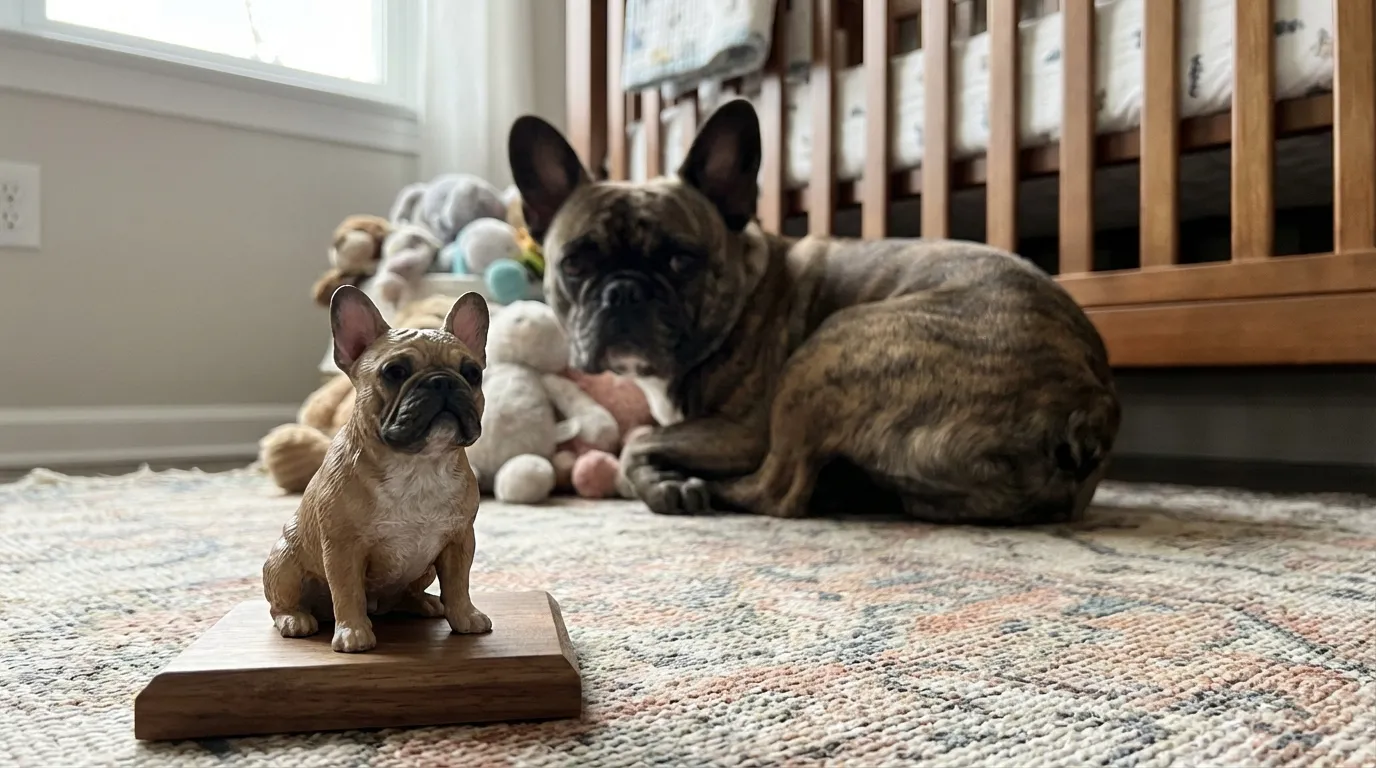
- Tangible Legacies: Children understand physical objects better than abstract memories; consider a custom figurine or a photo book to bridge the gap.
- Narrative Matters: Keep your Frenchie's name in your daily vocabulary so they remain a character in your family's story.
The Ghost in the Nursery
We need to talk about the silence. Not the quiet of the house—with a newborn, the house is rarely quiet—but the specific absence of sound that only French Bulldog owners understand. It’s the lack of clicking claws on the hardwood following you to the changing table. It’s the missing rhythmic snore that used to be the soundtrack to your life.
When you are up at 3:00 AM rocking a fussing infant, that is when the grief tends to sit heaviest. Your muscle memory still expects a warm, solid weight pressing against your foot or a sleepy, smashed face peering around the doorframe checking on you.
This is where the "unique angle" of your grief lives. It isn't just that you miss your dog. It's that you are mourning a future that was stolen. You aren't just grieving the dog you lost; you are grieving the "big brother" or "big sister" your baby never got.
The Counterintuitive Truth:
Psychologists often talk about "disenfranchised grief"—grief that isn't acknowledged by society. But for new parents who have lost a pet, there is an added layer we call "overshadowed grief." Society expects you to be in a bubble of pure bliss with your new baby. If you cry, people assume it's postpartum hormones. They rarely consider that you are heartbroken because your family feels incomplete, even as it grows.
The Secret Guilt (And Why You Need to Release It)
Here is the thing almost no one admits out loud, but our team at PawSculpt hears it in the emails and messages from families we work with: There is often a tiny, shameful sliver of relief.
And immediately following that relief comes a crushing wave of guilt.
French Bulldogs, especially in their senior years, are high-maintenance companions. They often struggle with mobility issues (IVDD), breathing difficulties, or allergies that require strict regimens. They need help up the stairs. They need medications at specific times. They need your undivided attention.
Now, look at your reality with a newborn. The sleeplessness. The chaos. The physical recovery.
If your Frenchie was still here, struggling with their health while you struggled to keep a human infant alive, both of you would have suffered. You might have resented the dog for needing to go out when the baby finally fell asleep. You might have missed a dose of medication in the fog of exhaustion.
A Micro-Story:
We recently worked with a customer named Sarah. Her Frenchie, Barnaby, passed away three months before her daughter was born. She told us, "I felt like a monster because one day, while changing a blowout diaper with a screaming baby, I thought, 'Thank god I don't have to carry Barnaby down the stairs right now.' I felt so guilty I cried for an hour."
If you have felt this, you are not a monster. You are a human being recognizing your limits. Sometimes, our dogs leave us before the baby arrives not because they are abandoning us, but because they are clearing the path. They loved you enough to know you couldn't carry both burdens at once.
Building a Bridge Between Two Worlds
Just because they never met in the physical world doesn't mean they can't have a relationship. Children have a magical capacity to love things they cannot see, provided we give them the tools to build that connection.
The mistake many parents make is treating the late dog like a taboo subject—a sad thing we don't talk about to avoid upsetting ourselves. instead, integrate the dog into the baby's developing world.
1. The "Guardian" Narrative
Frenchies are naturally protective and clownish. Frame your late pup as the baby's personal guardian. When the baby smiles at nothing at the ceiling, say, "Oh, is Louie making faces at you?" When the wind blows the mobile, "That's just Bella saying hello."This turns the grief into a playful, protective presence rather than a heavy absence.
2. Physical Touchpoints
Babies and toddlers are sensory learners. They cannot understand "memory." They understand what they can see and touch.- The "Soft" Photo: Print a photo of your Frenchie on fabric or a pillow so the baby can physically hug the image.
The Durable Tribute: This is where many families find comfort in our work. A custom figurine sitting on a high shelf in the nursery serves as a physical anchor. As your child grows, they learn that this* specific shape, those bat ears, that squat stance, represents a member of the family. It becomes a storytelling prompt: "That's Barnaby. He loved cheese and snored louder than Daddy."
3. Sensory inheritance
Did your Frenchie have a specific blanket? Wash it (but maybe don't use heavy bleach—let a hint of the scent remain if possible) and use it during story time. Let the baby touch the texture that the dog loved. "This was Buster's blanket. He was soft, just like this."Navigating the "Firsts" Without Them
The first time you take the baby for a walk in the stroller, you will reach for the leash. It is automatic. Your hand will grasp at air, and it will hurt.
The first time the baby drops food on the floor, you will wait for the vacuum-cleaner sound of a Frenchie inhaling it. When the food just sits there, it feels wrong.
- Validation: You confirm to your own brain that your grief is real.
- Introduction: You teach your child that Mochi is still part of the kitchen dynamic, even if invisible.
We have seen families who create new rituals. One family we know takes a "family photo" every year on the baby's birthday, and they always include their PawSculpt figurine in the shot, right next to the birthday cake. It’s a subtle nod that says, you are still at the table.
What Your Frenchie Left You (The Parenting Prep)
If you really think about it, your Frenchie was your first parenting instructor.
They taught you how to decipher non-verbal cues (that specific whine that meant "water" vs. "outside"). They taught you how to clean up bodily fluids without flinching. They taught you how to advocate for a living thing that couldn't speak for itself at the vet's office.
But most importantly, they taught you about unconditional love.
That fierce, protective, overwhelming love you feel for your new baby? Your Frenchie stretched your heart out to make room for that. They were the warm-up act, stretching the muscles of your soul so that when the main event arrived, you were ready to love this deeply.
Closing: The Introduction Has Already Happened
There is a beautiful concept in various cultures that suggests our loved ones don't just disappear; they become part of the atmosphere we breathe.
Maybe your baby has met your Frenchie. Maybe that's why your newborn sleeps so soundly amidst noise—because they were already used to the spiritual sound of Frenchie snores while they were growing inside you. Maybe that's why your toddler has that stubborn, hilarious streak—they inherited a little bit of that "bull" attitude.
You don't have to choose between the joy of the new baby and the grief of the lost dog. You can hold both. You can look at your child and tell them about the funny, snorting, bat-eared creature that made you a mother before you ever held a human baby.
Your Frenchie isn't gone. They just moved from the dog bed in the living room to the stories you tell in the nursery. And that is a legacy that lasts a lifetime.
Frequently Asked Questions
How do I explain a pet's death to a toddler who never met them?
When your child gets old enough to ask, keep it simple, honest, and concrete. Toddlers don't understand abstract concepts like "passed away." Avoid euphemisms like "went to sleep," as this can cause fear around bedtime. Instead, explain that the dog's body stopped working because they were very old or sick. Frame the pet as a legendary character in your family's history: "This is Hugo. He lived here before you, and he helped Mommy and Daddy get the house ready for you."Is it normal to feel less excited about the baby because of pet grief?
Absolutely. Grief is exhausting. It consumes the same emotional energy required for excitement and bonding. If you feel "numb" rather than overjoyed, it doesn't mean you don't love your baby. It means you are processing a major loss while navigating a major life change (and likely sleep deprivation). This is a form of "overshadowed grief." Give yourself grace; the bond with your baby will grow, and the sharpness of the grief will soften.Should I keep my late dog's toys for the baby?
This depends on your emotional attachment to the items. Soft plush toys can be washed and passed down, which can be a sweet way to share the legacy. However, ensure they are safe for infants (no button eyes that can be chewed off). Hard rubber toys or distinct "dog" items are usually better kept in a memory box or displayed next to a memorial, like a PawSculpt figurine, to keep the boundaries clear while honoring the memory.How can I include my late dog in newborn photos?
You don't need Photoshop to make this happen. We love seeing families include a framed photo, the dog's collar, or a custom figurine in the newborn photoshoot. You can place these items on a shelf in the background, or for a more direct tribute, place the dog's favorite blanket near the baby's feet. It’s a beautiful, subtle way to acknowledge that your family includes members both present and past.Honor Their Memory Forever
Your pet's story deserves to be preserved in a way that captures their unique spirit. A custom PawSculpt figurine transforms your cherished memories into a timeless keepsake—every whisker, every marking, every detail that made them irreplaceable.
Free instant AI preview • 3D artist preview within 7 days • 5 free revisions