
Engaging the Hunter: Enrichment Games for Indoor Bengals
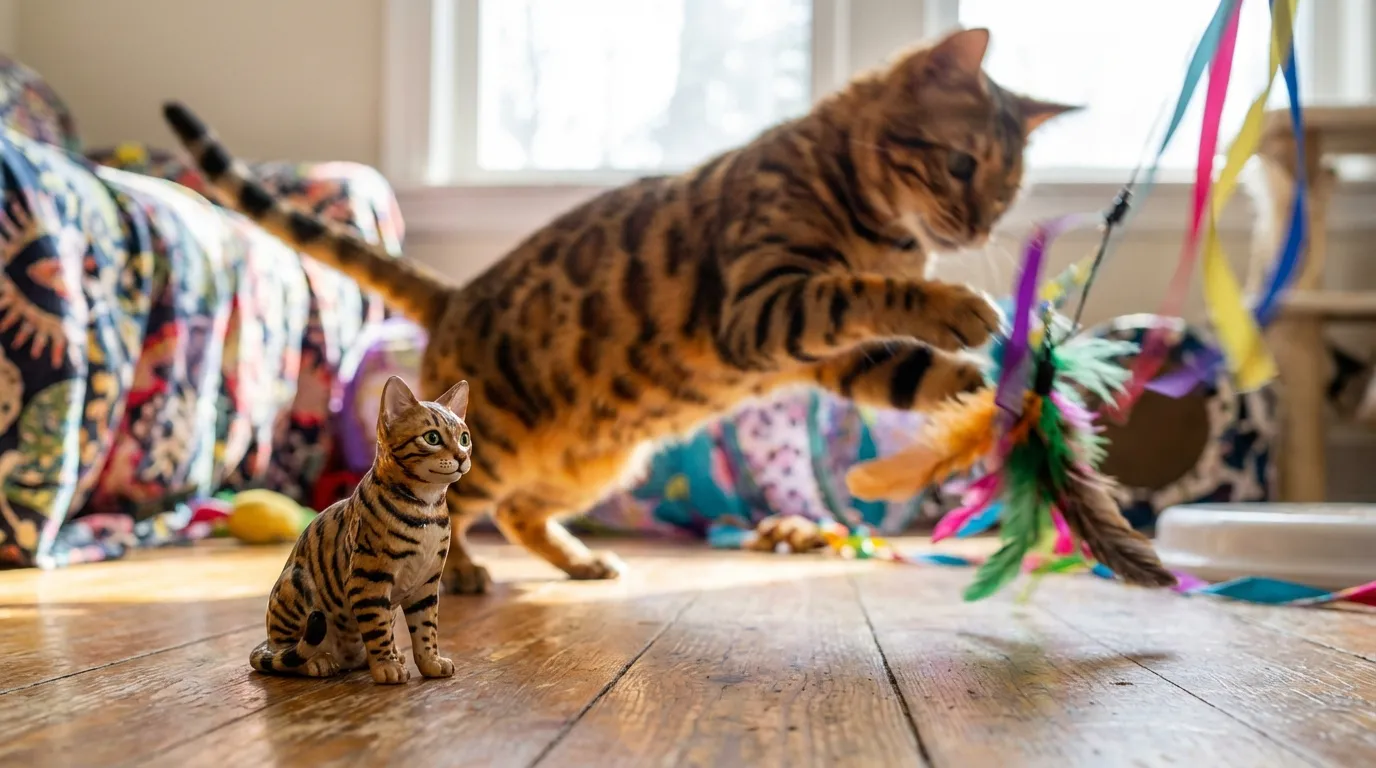
You wake up to the sound of something shattering in the living room, followed by the thundering gallop of paws on hardwood. It’s 3:00 AM, and while you’re exhausted, your Bengal is just getting started, looking at you with wide, expectant eyes that ask, "What’s next?" This isn't just a cat; it's a high-octane athlete trapped in a domestic setting, and the standard feather wand you bought last week has already been destroyed or ignored.
In this guide, we’ll move beyond basic bengal cat toys to explore the psychology of the hunt and share enrichment strategies that actually work to calm the wild energy in your living room.
The Psychology of the Living Room Leopard
Most cat owners make a critical mistake when trying to tire out a Bengal: they focus entirely on physical exhaustion. But here is the counterintuitive truth—you cannot physically tire out a healthy Bengal. Their stamina will always outlast your arm's ability to wave a wand.
The secret isn't running them ragged; it's exhausting them mentally.
Bengals possess a hyper-active prey drive that requires a full "predatory sequence": searching, stalking, chasing, catching, and "killing." Most indoor cat hunting games only engage the chase. If you skip the mental puzzle of the search or the satisfaction of the catch, you leave the cat physically ramped up but psychologically frustrated. That frustration is exactly what turns into shredded curtains and knocked-over vases.
"A bored Bengal isn't just lazy—they are a destructive engineer looking for a project."
The "Boil and Simmer" Method
We’ve learned from working with hundreds of Bengal owners that these cats operate on a "boil and simmer" energy cycle. They don't need three hours of play; they need 15 minutes of intense, intellectual problem-solving.
1. The Disappearing Prey (The Stalk)
Instead of waving a toy in their face (which no real prey does), create a scenario where the toy "hides."- The Setup: Use a wand toy with a substantial lure (like a fur mouse).
The Action: Move the toy behind a sofa or into a box and stop moving it*. Make a tiny scratching sound against the cardboard.
- The Result: Watch your Bengal’s pupils dilate. They will freeze, lower their body, and calculate the jump. This moment of stillness is actually burning more mental energy than running laps.
2. The Puzzle Feeder Protocol
Stop feeding your Bengal from a bowl. Seriously. In the wild, they work for every calorie. A bowl is a missed opportunity for active cat care.- Start Simple: Use egg cartons. Put kibble in the depressions and close the lid loosely. They have to pry it open and fish the food out.
- Level Up: Hide small saucers of food in different locations around the house (on top of the fridge, under a chair, behind a door). This forces them to "patrol" their territory to eat.
Sensory Enrichment: Beyond the Visual
We often rely too heavily on visual stimulation (lasers, feathers). But a Bengal’s world is mapped by scent and texture. Engaging their nose is like giving them a complex book to read.
Scent Mapping
Bring the outdoors in—safely.- The Strategy: Once a week, bring in a "scent object" from outside. A pinecone, a dry leaf, or a clean rock.
- The Reaction: Place it in the middle of the floor. Your Bengal will spend 20 minutes sniffing, rubbing, and analyzing the "intruder."
- Safety Note: Ensure the items haven't been treated with pesticides and aren't toxic plants (avoid lilies at all costs).
Texture Variety
Does your cat have only plush toys? They might be bored with the "mouth feel."- The Fix: Introduce cardboard scratching blocks, sisal rope toys, and even crinkly paper balls. The sensation of sinking claws into different resistance levels mimics the variety of prey in nature.
The 4-Stage Hunt Cycle
To truly satisfy a Bengal, your play session needs to follow a biological arc. Random play creates anxiety; structured play creates satisfaction.
| Stage | Activity | Duration | Goal |
|---|---|---|---|
| 1. The Stalk | Slow movement of toy behind cover. Scratches and rustles. | 3-5 mins | Engage focus and planning centers of the brain. |
| 2. The Chase | High-intensity sprinting, jumping up cat trees. | 5-7 mins | Burn explosive physical energy. |
| 3. The Catch | Letting the cat actually capture the toy. | Intermittent | Provide the dopamine hit of success. |
| 4. The Feast | Give a high-value treat or meal immediately after play. | End of session | Signals the "hunt" is over; time to groom and sleep. |
Why "Laser Pointer Syndrome" is Real
We need to talk about laser pointers. For Bengals, they can be psychologically damaging if used incorrectly. The red dot is prey that can never be caught.
If you use a laser, you must end the session by landing the dot on a physical toy or treat that the cat can grab. Without this tactile closure, Bengals can develop obsessive-compulsive behaviors, searching for the red dot for hours after it's gone.
"Enrichment isn't about buying more toys. It's about letting your cat be a cat in a world designed for humans."
Capturing the Spirit of the Hunter
There is something undeniably majestic about a Bengal in mid-stalk. The way their shoulder blades shift, the intensity in their eyes, the rosette patterns rippling over their muscles—it’s a glimpse of the wild right in your living room.
We see this intensity in the photos customers send us. When we craft custom figurines for Bengal owners, we often advise against generic "sitting" poses. We encourage owners to choose a pose that captures that alert, intelligent energy—perhaps a paw raised in mid-step or a head cocked listening for a sound. It’s that specific "hunter" personality that makes a Bengal, well, a Bengal.
"Capturing a Bengal in a figurine is a unique challenge because their stillness is just a pause between bursts of energy; we try to sculpt that potential motion."
— The PawSculpt Team
Advanced Tactics for the "Impossible" Cat
If you've tried everything and your Bengal is still opening cabinets at 4 AM, it's time for the advanced tier of active cat care.
Clicker Training
Many people think you can't train a cat. You absolutely can, especially this breed.- The Trick: Teach them to "high five" or jump through a hoop.
- Why it works: It forces them to figure out what you want. The mental effort of learning a command is exhausting. Five minutes of clicker training can knock a Bengal out for the afternoon.
The "Cat TV" Window
A window is only as good as what's on the other side.The Upgrade: Install a bird feeder suction-cupped to the outside* of the window. This provides hours of "live television" that engages their prey drive visually without the frustration of the chase, provided you have a play session afterward to burn off the excitement.
According to the American Association of Feline Practitioners, environmental enrichment is actually a key factor in preventing stress-related health issues in cats, particularly urinary tract problems. A bored Bengal is a stressed Bengal, even if they don't look like it.
The Peace After the Storm
When you finally crack the code—when you synchronize your play style with their predatory instincts—the change is almost magical. The destructive behavior stops. The 3 AM wake-up calls fade.
Instead of a roommate who destroys your blinds, you get a companion who sleeps heavily beside you, satisfied and secure. You haven't suppressed their nature; you've honored it. And looking at them sleeping there, looking like a miniature leopard, you realize that the wildness is exactly why you love them.
Frequently Asked Questions
How much play time does a Bengal cat actually need?
While every cat is different, Bengals typically thrive on 30 to 60 minutes of active engagement daily. However, the type of play matters more than the clock. Two focused 15-minute sessions involving "hunt-catch-kill" mechanics are far more effective than an hour of leaving them alone with a pile of toys.Why is my Bengal cat so destructive?
Destruction is rarely malice; it's usually misdirected energy. Bengals are high-intelligence working cats. If you don't provide a "job" (like a puzzle feeder or a training session), they will invent their own job, which usually involves unrolling toilet paper, opening cabinets, or scratching furniture to mark territory.Are laser pointers bad for Bengal cats?
They can be psychologically frustrating if used as the only toy. The "prey" (the dot) can never be caught, which denies the cat the dopamine release of a successful hunt. If you use a laser, always end the game by landing the dot on a physical toy or treat that the cat can grab, bite, and "kill."Can I train my Bengal cat to walk on a leash?
Absolutely. In fact, Bengals are one of the easiest breeds to harness train. Safe outdoor exploration provides an explosion of scents and sights that tires out their brain rapidly. Just be sure to use a secure, escape-proof harness designed for cats.Ready to Celebrate Your Pet?
Every pet has a story worth preserving. Whether you're honoring a beloved companion who's crossed the rainbow bridge or celebrating your furry friend's unique personality, a custom PawSculpt figurine captures those details that make your pet one-of-a-kind.
Free instant AI preview • 3D artist preview within 7 days • 5 free revisions