
Border Collie Figurine, Studio vs Studio: How Resin Density Decides the Sharpest Likeness
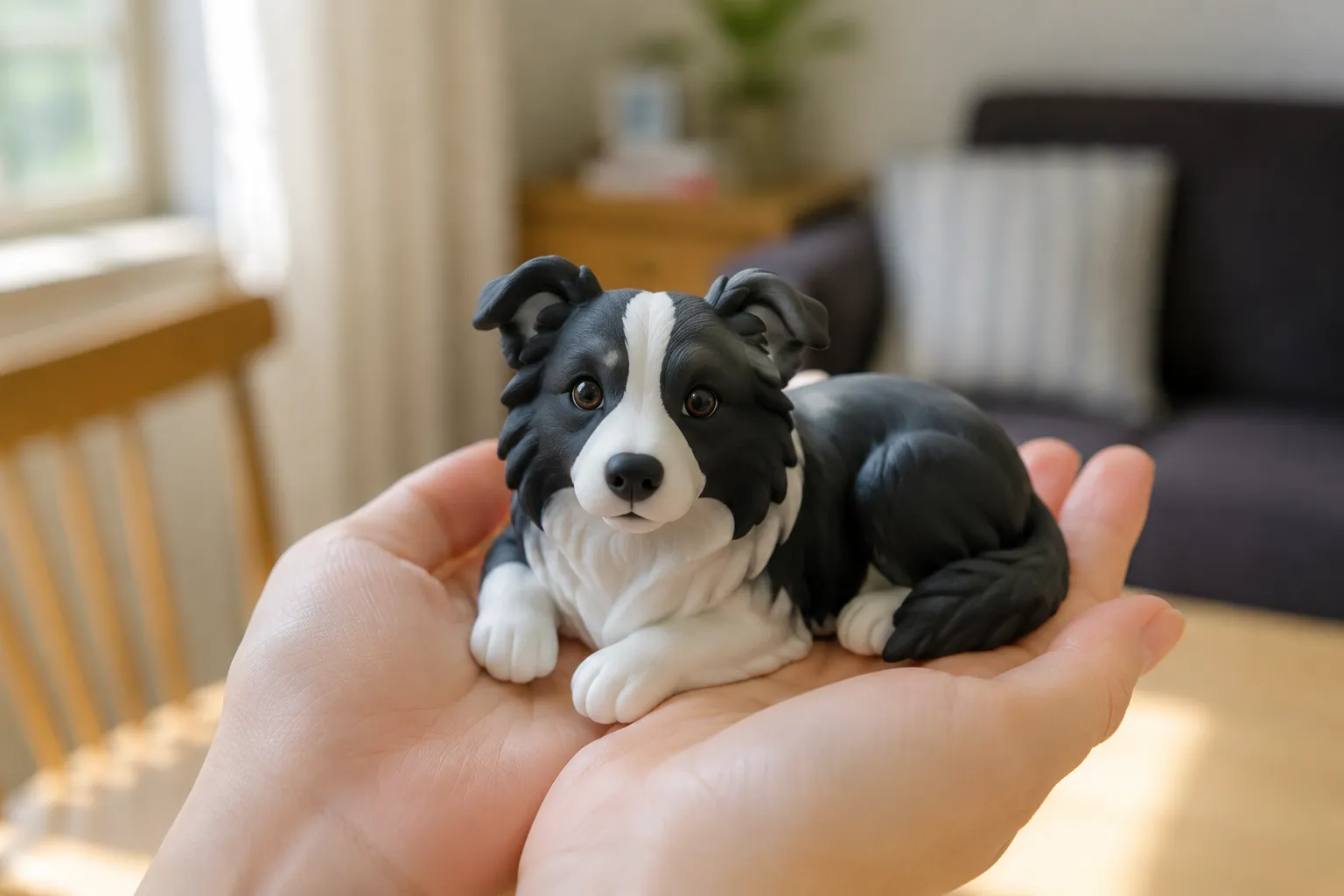
Sand still clung to the base of one figurine. Two border collie figurines, built from the same beach photo of a dog frozen mid-leap, sent to two different studios. One came back razor-sharp. The other looked oddly soft around the ears, like a face seen through fog.
Resin density is the single biggest factor in how sharp a border collie figurine looks. Denser, higher-resolution full-color resin holds fine transitions like the double coat's feathering and the tri-color mask, while low-density prints blur those edges. In a figurine likeness comparison, resin quality and print resolution matter more than a studio's reputation alone.
Quick Takeaways
- Density beats detail — dense, high-resolution resin holds sharp fur edges no amount of surface work can fake.
- Border collies expose weak resin — their hard black-to-white color boundaries reveal blur instantly.
- Portfolio photos hide the truth — always ask about print resolution and material grade, not just reviews.
- Compare studios on substrate, not just style — see how full-color resin captures markings in custom sculpted pet portraits before you decide.
- The goal is character, not a clone — a good figurine reads as your dog from across the room.
Why the Same Photo Gives You Two Different Dogs
Here's the thing that surprises almost everyone who orders their first figurine. You send the identical photo to two studios. You describe the same dog. And what shows up on your counter can look like two distant cousins rather than the same animal.
We've watched this play out with hundreds of border collie orders. One family sent us a photo of their dog, Pip, sitting alert on wet sand with that classic collie stare. They'd ordered a comparison piece elsewhere first. When both figurines sat side by side on the windowsill, the difference wasn't in the pose or the size. It was in the eyes and the fur line along the cheek.
The cheaper one had a face that read as "generic black-and-white dog." Ours read as Pip.
The gap between those two outcomes almost always traces back to one thing people never think to ask about: resin density. Not the sculpting skill, not the software, not even the photo. The material itself, and how tightly the machine lays it down.
What Resin Density Actually Does to a Border Collie Figurine
Full-color 3D printing builds an object one thin layer at a time, placing color voxel by voxel. Think of a voxel as a 3D pixel. The more voxels packed into a given space, the finer the detail the print can hold. That packing is what we mean by density and resolution.
Low-density resin is like printing a photo on cheap paper. The image is technically there, but the fine transitions smear. High-density resin is the glossy photo print. The line between black fur and white fur stays crisp.
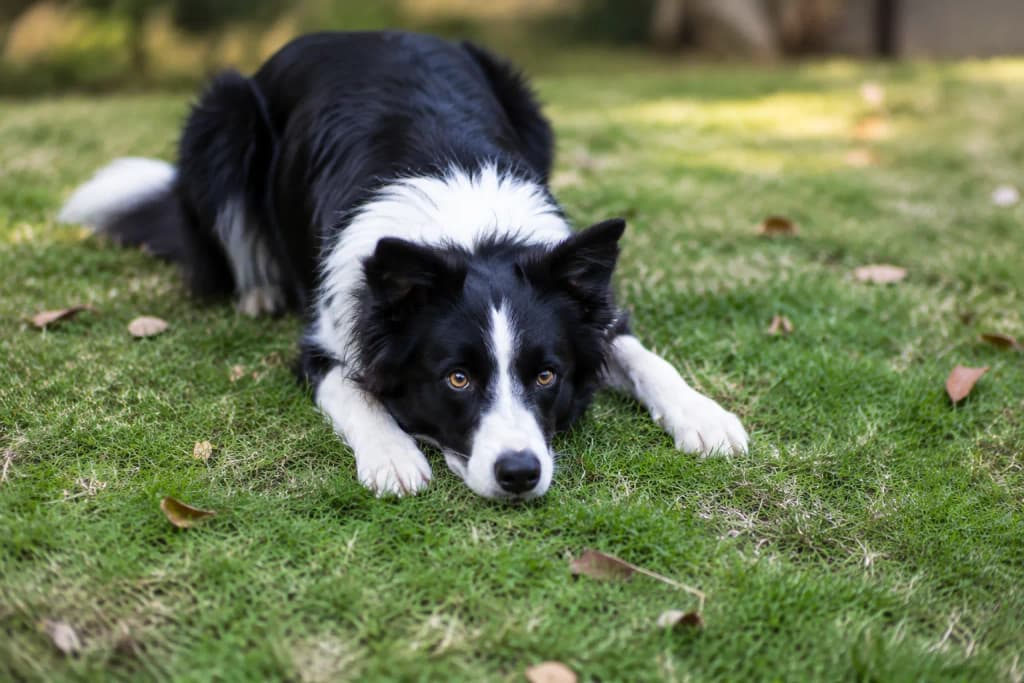
For most breeds, a little smear is forgivable. A solid-colored Labrador can lose a bit of edge sharpness and still read as itself, because there's no dramatic color boundary to blur. A border collie is the opposite. Its whole visual identity lives in the boundaries.
Why your brain notices the blur before you do
There's a reason a slightly-off figurine gives you that nagging "it's not quite him" feeling you can't explain.
Human brains run a specialized pattern-recognition system for faces and familiar shapes. It's fast, automatic, and brutally sensitive to small errors. Researchers call the discomfort we feel when something is almost-but-not-quite right the uncanny valley. Your visual cortex flags the mismatch long before your conscious mind can name it.
So when the sharp black mask of your dog's face melts into a gray mush at the edges, you don't think "ah, insufficient resin density." You just feel that the figurine is a little sad, a little wrong. That gut reaction is your neuroplasticity at work. Your brain has spent years memorizing exactly where your dog's white blaze meets the black, and it will not be fooled by an approximation.
This is also why we keep saying a figurine should be a portrait, not a photocopy. The aim isn't to trick your brain into thinking it's a photo. It's to capture enough of the true structure that recognition clicks instantly.
"Your brain memorized where the white blaze meets the black years ago. A blurry edge doesn't just look off. It breaks the recognition."
Myth vs. Reality: What Actually Decides Sharpness
A lot of what gets repeated online about figurine quality is either outdated or flat wrong. Let's clear up the three we hear most.
Myth 1: More surface detail equals a better likeness.
Reality: Adding more surface texture to a low-density print is like turning up the sharpness slider on a blurry photo. It creates noise, not clarity. The detail has to be held by the material. Density comes first. Detail comes second.
Myth 2: A bigger figurine always looks more like your pet.
Reality: Scale helps only if the resolution scales with it. A large print in low-density resin just makes the blur bigger. A smaller piece in dense, high-resolution resin often reads as a far better likeness. Size is not sharpness.
Myth 3: The finish coat is where the magic happens.
Reality: The clear coat protects the piece and gives it a natural sheen. It cannot add detail that the resin didn't capture. If a studio leans hard on "our special finish" and stays vague about the print itself, that's a signal worth noticing.
The Border Collie Test: Why This Breed Is the Toughest Case
If you want to stress-test any studio's resin, hand it a border collie. According to the American Kennel Club's breed profile, the breed carries a dense double coat and comes in a wide range of markings, from the classic black-and-white to red, blue merle, and tricolor. That variety is exactly what trips up weak printing.
Consider what a collie asks a figurine to reproduce:
- Hard color boundaries where black meets white with almost no gradient
- The feathered coat on the chest, legs, and tail that catches light differently than the smooth face
- The intense, focused eye that gives the breed its famous herding stare
- Merle mottling, if your dog has it, which is a fine speckled pattern that low-density resin turns to gray soup
One order that stuck with us was a blue merle named Juniper. The owner had tried another route first and told us the mottling had come back looking like "someone smudged pencil across her side." In dense full-color resin, that same speckle pattern held its individual flecks. Same dog, same photo. The material was the whole story.
Here's how different material approaches tend to handle a collie's demands.
| Approach | Holds hard color edges? | Handles merle/mottling? | Best for |
|---|---|---|---|
| Low-density color resin | Poorly, edges blur | No, turns to gray | Simple solid-color pets |
| Standard resin, then color added on top | Inconsistent | Rarely | Budget keepsakes |
| High-density full-color resin (color in the material) | Yes, crisp | Yes, flecks stay distinct | Border collies and complex markings |
| Ceramic or cast figurines | Depends on the caster | No, color is limited | Decorative, not likeness-driven |
The reason full-color resin, where the pigment is part of the material rather than a layer on top, wins for collies is simple. There's no separate color coat to smear or chip at a boundary. The black voxel sits right next to the white voxel. The edge stays where your dog's edge actually is.
"A border collie is the honest test. If the resin can hold that black-and-white line, it can hold almost anything."
— The PawSculpt Team
How to Read a Figurine Likeness Comparison Like an Insider
Most buying guides tell you to "read reviews and check the portfolio." Useful, but incomplete. Portfolio photos are shot under perfect studio lighting and often lightly retouched. They can hide exactly the blur we've been talking about.
What actually separates a sharp likeness from a soft one is stuff you have to ask about directly. Use this as your checklist.
| What to check | What good looks like | Red flag |
|---|---|---|
| Print resolution | Studio can describe voxel-level, full-color detail | Vague "high quality" with no specifics |
| Material type | Full-color resin, color in the material | Color applied on top of plain resin |
| Preview process | You see a digital 3D preview before production | No preview, just "trust us" |
| Photo requirements | They ask for clear, well-lit reference shots | They accept any blurry photo without comment |
| Honest framing | "A sculpted interpretation of your pet" | Promises of a photo-perfect exact clone |
That last row matters more than it looks. Any studio promising an "exact replica indistinguishable from a photo" is either overselling or doesn't understand the medium. A figurine is a sculpted object. The good ones capture your dog's character, posture, expression, and unique markings as a charming keepsake. The great ones do it in resin dense enough that the recognition is instant.
The counterintuitive part
Most people shop for a figurine studio the way they shop for a photographer. They look at the pretty pictures and pick the style they like.
But a photographer captures light. A figurine studio captures structure in a physical material. The two skills are related but not the same. The most beautiful portfolio in the world means little if the resin can't hold the edge on your particular dog's markings.
So flip your process. Judge the substrate first, the style second.
What to Expect When You Order
If you decide a border collie figurine is the right keepsake, whether it's for a birthday, a celebration of a living dog, or a memorial, here's roughly how the creative process unfolds. We keep this general on purpose, because details evolve and the current specifics always live on the pet portrait service page.
- You start with a photo. Clear, well-lit, taken at the dog's eye level works best. Natural daylight beats flash. A shot that shows the face and the body markings gives the sculptors the most to work with.
- You get an early look. There's a free instant AI preview on the website, and after a deposit, the artist's 3D preview typically arrives within 7 days so you can see the structure before anything prints.
- Production and finishing. The piece is digitally sculpted by master 3D artists, then precision-printed in full-color resin. The only manual step afterward is a protective clear coat for durability and sheen.
- Delivery. Pieces typically arrive in about 27 to 40 days within the US, and 33 to 47 days internationally, after final payment. Every piece ships insured, tracked, and carefully packed.
A quick honest note. We're a sculpted portrait studio, not a veterinary or pet-loss counseling service. If you're ordering a memorial and grief feels overwhelming, resources like the Association for Pet Loss and Bereavement offer real support that a figurine can sit alongside, not replace.
Some families plant a small garden. Others keep a paw print or a photo book. And a growing number choose a tangible keepsake, like a full-color resin sculpture that holds the exact tilt of the head their dog always gave them. There's no single right way. The figurine is one anchor among many.
Photos that print sharp
Since the reference photo feeds everything downstream, a few specifics help the resin do its job:
- Shoot in soft natural light near a window or outdoors on an overcast day
- Get down to the dog's eye level, not looming above
- Capture the markings clearly, especially where black meets white
- Avoid heavy shadows across the face that hide the eye
- If your collie is merle, include a shot that shows the mottling in good light
Blurry input limits even the best resin. The sculptors can interpret character from a decent photo, but they can't invent an edge the camera never caught.
The Corner Where the Figurine Sits
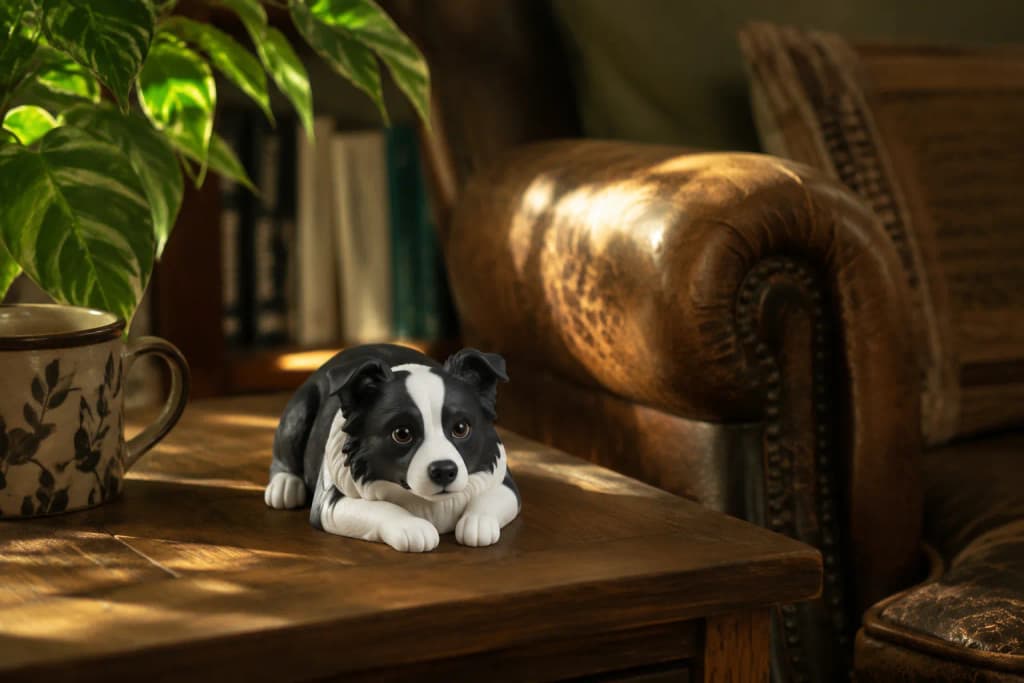
Think about where this piece will actually live. A shelf by the door. The corner of a desk. The windowsill where the afternoon light lands, the same spot your dog used to stretch out in.
That's the space a figurine has to survive. Not the perfect lighting of a product photo, but the ordinary distance of a room you walk through a dozen times a day. From across that room, a low-density print blurs into "some black-and-white dog." A dense, sharp one still catches your eye and says him before you've even turned your head.
That instant recognition, from six feet away, in imperfect light, is the entire point. It's why resin density is not a technical footnote. It's the difference between a decoration and a companion on the shelf.
Back to those two figurines on the counter, the sand still on the base. The soft one wasn't ugly. It was just anonymous. The sharp one made the whole family go quiet for a second, because for a heartbeat it wasn't a figurine at all. It was Pip, mid-leap, tongue out, exactly as the beach had known her.
That's what dense resin buys you. Not perfection. Recognition. The small, sudden gift of seeing your dog again, clearly, in a corner of the room where the light happens to fall. Ask the studio about their resin before you ask about anything else, and you'll be far more likely to get that moment instead of the fog.
Frequently Asked Questions
Does resin density really affect a border collie figurine's likeness?
Yes, more than almost any other factor. A border collie's identity lives in its hard color boundaries, and denser resin holds those edges crisp. Low-density resin lets black and white bleed together, which reads as a generic dog rather than your dog.
Why do two studios produce such different results from the same photo?
The sculpting and software may be similar, but the material and print resolution often aren't. Low-density resin smears fine transitions like feathered fur and merle mottling, while high-density full-color resin keeps them distinct. The substrate, not the photo, usually explains the gap.
Is a bigger figurine always more accurate?
Not on its own. Size only improves likeness if the print resolution scales with it. A larger piece in low-density resin simply makes the blur bigger, while a smaller piece in dense resin can capture your dog far more sharply. Judge resolution before size.
What photo works best for a custom border collie figurine?
A clear, well-lit photo taken at your dog's eye level in soft natural daylight. Show both the face and the body so the markings are visible, especially where black meets white. For merle coats, include a shot that captures the mottling in good light.
How do custom figurines compare to flat portraits or prints?
A print captures light and a moment on a flat surface. A figurine captures structure you can hold and see from every angle in the room. For many families, the three-dimensional presence is what makes a figurine feel like a companion on the shelf rather than a picture.
Can a figurine look exactly like my pet?
It can look convincingly like your pet, but it's a sculpted interpretation, not a photographic clone. The best pieces capture character, posture, expression, and unique markings so recognition is immediate. Think of it as a portrait, not a photocopy.
Ready to Celebrate Your Pet?
Every pet has a story worth preserving. Whether you're honoring a beloved companion who's crossed the rainbow bridge or celebrating your dog's unique personality, a custom border collie figurine from PawSculpt — a sculpted portrait, not a photocopy — captures the character and sharp markings that make your dog one-of-a-kind, held in dense full-color resin.
See a free instant AI preview and the artist's 3D preview before production. Every piece ships insured, tracked, and carefully packed.