Capturing the Gentle Spirit of a Rescue Greyhound for a Custom Statue
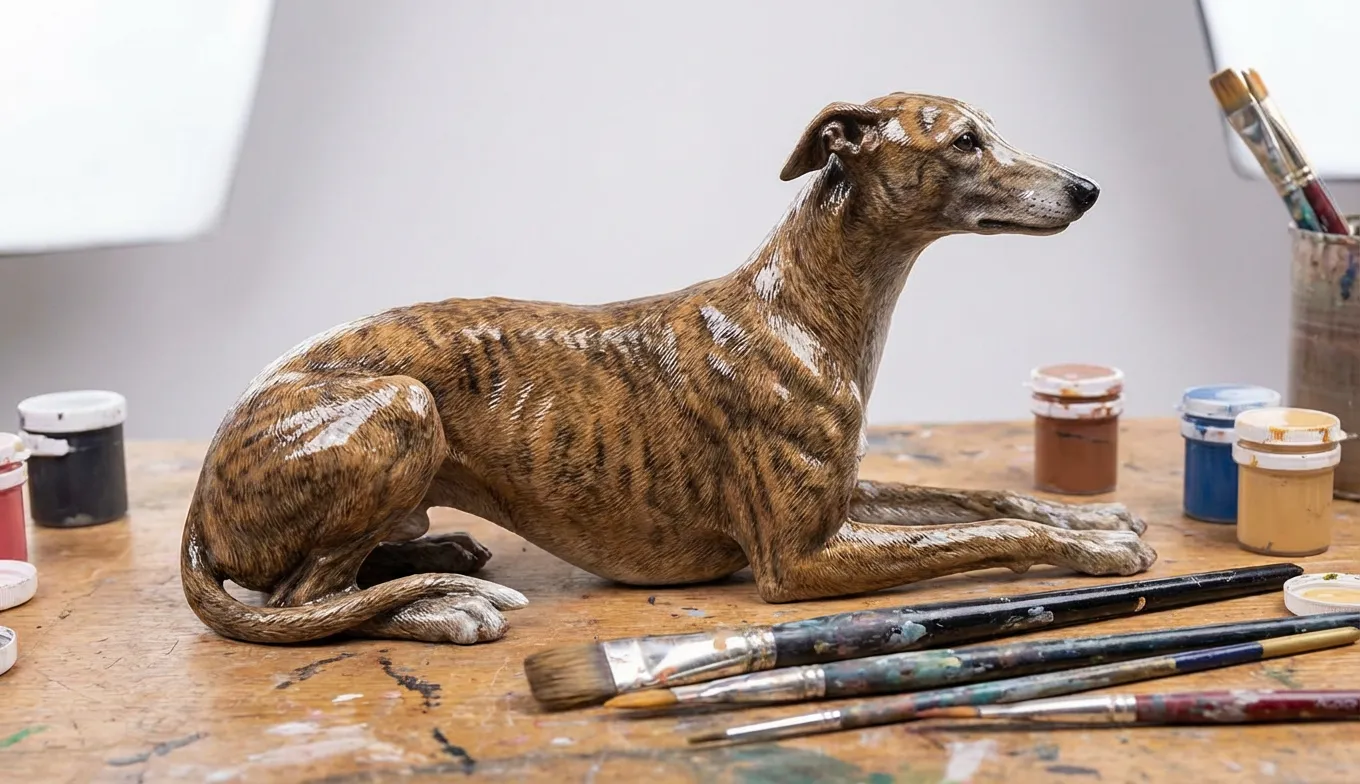
"Dogs are not our whole life, but they make our lives whole." — Roger Caras
The sun was just beginning to dip below the fence line in the backyard, casting long, stretched shadows across the grass—shadows that looked remarkably like the silhouette of a Greyhound in mid-sprint. It was in this quiet, golden hour that the absence felt heaviest. You could almost hear the rhythmic thud-thud-thud of paws tearing up the turf, followed by the inevitable collapse into a "roaching" position on the nearest soft surface. When you lose a Greyhound, you don't just lose a dog; you lose a kinetic sculpture that lived in your home. The stillness they leave behind is profound, precisely because their presence was so defined by that unique blend of explosive speed and absolute, lazy gentleness.
Quick Takeaways:
- Anatomy Matters: Greyhounds have unique proportions (deep chests, spindly legs) that make generic statues look "off."
- 3D Printing Tech: Resin printing (SLA/MSLA) captures the fine muscle definition better than FDM (plastic filament) or hand-sculpted clay.
- Pose Selection: For structural durability, a lying-down or "sphinx" pose is safer than a standing pose due to thin ankles.
- The "Soul" Factor: It’s not just about measurements; it’s about capturing the "roach," the ear tuck, or the "lean."
- Timeline: High-end custom work typically takes 3-6 weeks from digital sculpt to final cure.
The Engineering Challenge of the "45-MPH Couch Potato"
As someone who has spent over a decade on the production floor of additive manufacturing shops, I can tell you: Greyhounds are a nightmare to print. And I mean that with the utmost respect for the breed.
Most dog breeds are relatively compact. A Labrador or a Bulldog is essentially a solid block of mass. In the world of 3D printing and statue making, "blocky" is safe. It’s stable. But a Greyhound? A Greyhound is an engineering contradiction. They are massive chests supported by legs that look like pencils.
When we approach a custom dog figurine for a sighthound, we aren't just looking at a cute face. We are looking at a physics problem.
The "Spaghetti Leg" Risk
In resin printing (specifically SLA or MSLA, which uses light to cure liquid resin into solid plastic), we build objects layer by layer, often upside down. As the build plate lifts, it pulls the fresh layer off the bottom of the vat. This creates "peel force."If we print a standing Greyhound, those long, elegant legs have to support the weight of that deep, muscular chest as it prints. If the orientation isn't perfect—usually tilted back at 30 to 45 degrees—the legs can warp or snap during the print process. We often have to use "heavy" supports (scaffolding structures) on the paws and ankles, which then requires incredibly delicate sanding during post-processing to ensure we don't sand away the actual anatomy.
The Counterintuitive Insight: If you want a standing pose, we often have to cheat the physics slightly. We might suggest a base with tall grass or a blanket that touches the belly. This isn't just aesthetic; it’s a hidden structural support column that ensures your statue survives shipping and lasts for decades.
Translating "The Lean" into Digital Clay
You know the "Greyhound Lean." It’s that move where they press their entire body weight against your thigh, trusting you implicitly to hold them up. Capturing that specific emotional nuance requires more than just a 3D scanner or a generic model.
The Photo-to-Sculpt Workflow
When we work on a rescue Greyhound piece, we aren't looking for "show dog" perfection. Rescue Greys often have scars from their racing days, bald patches on their thighs (kennel rub), or a specific way their ears fold back when they're happy (the "rose ear").Our sculptors, who have years of experience in digital organic modeling, look for:
- The Spine Curve: The "roach" back is iconic, but it changes depending on whether the dog is alert or relaxed.
Muscle Definition: Greyhounds are ripped. Even the couch potatoes. We need to sculpt the vastus lateralis and the biceps femoris* clearly. If we smooth these out too much, it looks like a Weimaraner, not a Greyhound.
- The Eyes: Sighthounds have almond-shaped eyes that are set somewhat differently than other breeds. Getting the "worry" lines above the brow is critical for that soulful expression.
We typically ask for photos from the side (profile), front, and top-down. But the most valuable photo you can send? The one where they look goofy. The one with the tongue lolling out the side (ETS - Escaped Tongue Syndrome). That’s where the personality lives.
Material Science: Why Resin Choice is Critical
Here is a detail most custom shops won't tell you: Standard 3D printing resin is brittle. It’s like hard candy. If you drop a standard resin print of a Greyhound, those legs will shatter.
At PawSculpt, we learned early on that standard resins are a no-go for spindly breeds. We use engineering-grade "tough" resins, often mixed with a flexible additive.
- Standard Resin: High detail, but snaps like glass.
- ABS-Like Resin: Better, but still prone to stress cracking over time.
- High-Toughness Blends: This is the sweet spot. It allows the thin tail or the delicate ears to have a tiny bit of "give."
The Hollowing Debate
To save money, many makers hollow out their models. For a Bulldog, hollowing is fine; you punch a drain hole in the bottom, wash out the uncured resin, and cure it.For a Greyhound? We almost always print the legs solid. There isn't enough room inside a 1:6 or 1:12 scale Greyhound leg to hollow it out without making the walls paper-thin. A solid leg provides the necessary tensile strength. The chest might be hollowed to reduce top-heavy weight, but we have to be extremely careful about "suction cups"—trapped pockets of air during printing that can blow out the side of the model.
Surface Finish: The Challenge of the Smooth Coat
A Golden Retriever statue is forgiving. The texture of the fur hides layer lines (the microscopic ridges left by the 3D printer). A Greyhound, however, is sleek. They are aerodynamic.
This means the surface of the statue must be flawless. Any imperfection in the print—like "voxel lines" or support pitting—will show up immediately on that smooth flank.
The Post-Processing Gauntlet
1. The Wash: We use 99% Isopropyl Alcohol in a vortex mixer to strip every molecule of uncured resin. Any residue left behind results in shiny, tacky spots later. 2. The Cure: UV light hardens the plastic. But here's the trick: we submerge the print in water during curing. Oxygen inhibits the curing process. Water blocks the oxygen, resulting in a harder, tack-free surface. 3. The Sanding: This is where the artistry happens. We use high-grit sandpaper (up to 1000 grit) to wet-sand the flanks and neck. We have to be careful not to sand away the subtle rib definition. 4. Priming: A high-fill primer reveals any remaining scratches. We often prime, sand, and prime again before a drop of color touches the piece.Capturing the Brindle (and Other Complex Coats)
Greyhounds come in amazing colors: Blue, Fawn, Black, and the notoriously difficult Brindle.
Painting a Brindle pattern on a statue is one of the hardest tasks for our artists. It’s not just stripes; it’s a chaotic, organic flow of dark fur over a lighter base. If you hand-paint it with a brush, it looks like a zebra. It looks artificial.
We use a technique involving airbrushing for the base coat to get that soft, biological gradient. Then, we use dry-brushing and transparent washes to build up the brindle stripes. This gives the coat depth. It looks like the hair is growing out of the skin, rather than paint sitting on top of plastic.
Pro Tip: If your rescue Grey had a "bald butt" or scars, tell us. We can simulate the skin texture underneath the thinning fur. It might sound strange, but for a rescue owner, those imperfections are often the most beloved parts of the dog.
Why "The Roach" is the Safest Pose
I mentioned earlier that standing poses are risky. Let's talk about the "Roach." This is when a Greyhound lies on its back, legs sticking up in the air like a dead bug.
- Center of Gravity: The bulk of the body is on the ground. It’s stable.
- Support Structure: The legs are in the air, meaning we can support them easily without scaring the main body.
- Emotional Truth: Nothing says "retired racer" quite like a dog completely abandoning dignity for comfort.
If you are worried about breakage—say, you have cats that knock things off shelves—a sleeping or "sphinx" pose (lying on belly, paws out) is the most durable option. It turns the statue into a singular, solid unit.
The Emotional Weight of the Object
We’re engineers and artists, but we’re also pet owners. We know that when you open that box, you aren't looking for a piece of plastic. You’re looking for a connection.
There is a specific feeling when you hold a physical representation of your dog. It’s different than a photo. You can run your thumb over the curve of the skull, just like you used to.
We had a customer recently who sent us a photo of her Greyhound, Luna, who had lost a leg to osteosarcoma. She asked if we should sculpt Luna with three legs or four. We told her what we tell everyone: Sculpt the version of them that lives in your heart. For her, that was the three-legged warrior who still ran zoomies in the yard. For others, it’s the young, four-legged racer before the illness took hold. There is no wrong answer.
Moving Forward
Creating a memorial for a sighthound is a balance of delicate engineering and heavy emotion. It requires understanding that their fragility was part of their beauty.
If you are considering a custom piece, look for a studio that understands anatomy, not just 3D printing. Look for people who know that a Greyhound isn't just a dog—it’s a creature made of wind and velvet.
At PawSculpt, we pride ourselves on getting those details right. From the tuck of the waist to the specific shade of a brindle coat, we treat every commission with the reverence it deserves. Because we know that while the statue is small, the hole they left in your life is very, very big.
Frequently Asked Questions
Why are Greyhound statues harder to 3D print than other breeds?
Greyhounds present a unique engineering challenge due to their extreme proportions. They have massive, deep chests supported by incredibly thin legs. In 3D printing, this top-heavy distribution creates significant "peel force" and leverage against the ankles during the print process. We have to use specialized orientation strategies and tougher resins to ensure the legs don't warp or snap under the weight of the body.What is the most durable pose for a custom Greyhound figurine?
If durability is your primary concern, we highly recommend a lying-down pose—either the "sphinx" (belly on ground) or the "roach" (lying on back). These poses keep the center of gravity low and eliminate the stress on the thin ankles. If you prefer a standing pose, we often suggest adding a scenic element, like a patch of tall grass or a blanket, to act as a discreet structural support for the legs.Can you replicate the specific brindle pattern of my dog?
Absolutely. Brindle is complex, but we specialize in it. Rather than painting simple black stripes over brown, we use a multi-layer approach. We start with an airbrushed base coat to establish the underlying tone, then use transparent washes and dry-brushing to build up the brindle pattern. This technique mimics the way fur layers over itself, creating a natural, organic look rather than a rigid pattern.How long does a custom pet statue take to make?
True custom work cannot be rushed. Typically, the process takes 3 to 6 weeks from the moment we receive your photos. This timeline allows for the digital sculpting phase (including your revisions), the printing and curing time (which can take several days for proper stability), and the meticulous hand-painting process. We believe in taking the time to get the "soul" of the dog right, rather than rushing a product out the door.Ready to Get Started?
Now that you know what goes into creating the perfect pet figurine, it's time to bring your vision to life. Our master sculptors are ready to capture every detail that makes your pet unique.
Free instant AI preview • 3D artist preview within 7 days • 5 free revisions