
Sleeping vs. Sitting: Choosing the Best Pose for Your Senior Beagle
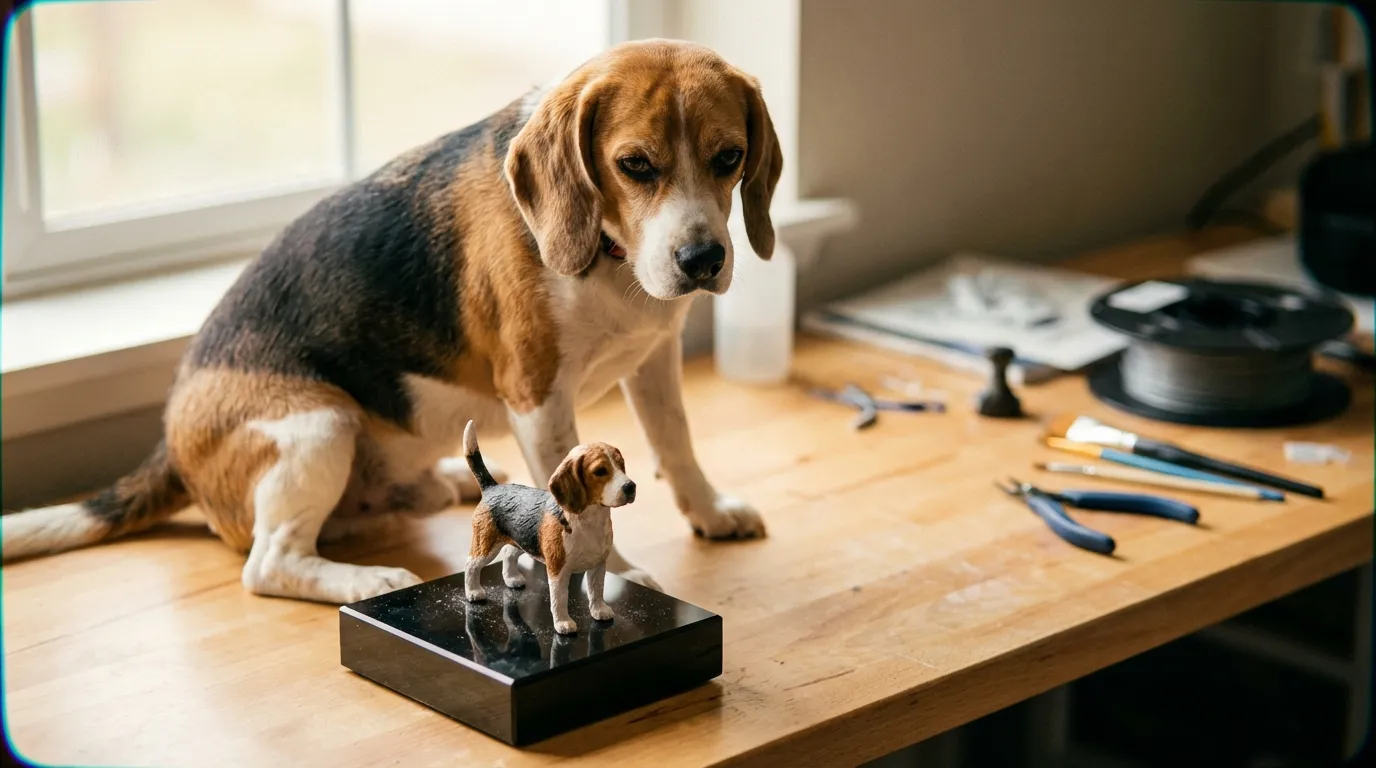
A Beagle possesses roughly 220 million scent receptors, compared to a human’s paltry five million. Even when your old hound is fast asleep in the sun-dappled corner of the garden, twitching his nose at a passing breeze, he is technically still "seeing" the world more vividly than you ever will. That quiet twitch—the subtle movement of a dog dreaming of rabbits he can no longer chase—is often the memory that sticks hardest when they’re gone.
In this guide, we’ll breakdown the technical and emotional tradeoffs between sitting and sleeping poses for custom pet figurine poses, ensuring your senior Beagle’s memorial is as durable as it is touching.
The Engineering of Aging: Why Gravity Matters
In the additive manufacturing world, we talk a lot about "support geometry" and "tensile strength." But when we sculpt a senior dog, we have to talk about biology.A 14-year-old Beagle doesn't hold his body the same way a 2-year-old does. The muscle mass along the spine depletes (sarcopenia), the hips tuck under, and gravity takes a toll on that loose, velvety skin Beagles are famous for.
If you choose a standing or sitting pose for a senior dog figurine, we often have to "cheat" the physics. In a 3D print, a standing dog is top-heavy. The torso is a solid block of cured resin, supported by four relatively thin legs. For a senior Beagle, those legs are often sculpted to look arthritic or stiff. This creates stress points. If that figurine ever tips over, the ankles are the first thing to snap.
The Counterintuitive Insight:
Most people think a sitting pose is "regal." But for a senior Beagle, a sleeping or "sploot" pose is actually more structurally sound and often more anatomically accurate to their final years. It lowers the center of gravity to zero. It removes the risk of "ankle snap." And from a sculpting perspective, it allows us to focus on the face without worrying about structural supports marring the texture of the legs.
"We don't just print a dog; we print the weight of their years and the comfort they finally found."
The "Suction Cup" Effect: A Printer’s Perspective
Let’s get technical for a moment. We typically use MSLA (Masked Stereolithography) printers for these high-fidelity collectibles. We’re curing liquid resin layer by layer, often at a height of 35 to 50 microns (thinner than a human hair).When we print a sitting Beagle, the cross-section of the belly is large. As the build plate lifts, it creates a massive suction force against the FEP film (the bottom of the resin vat). To combat this, we have to add heavy supports—scaffolding—under the chest and chin.
Why this matters for your figurine:
- Sitting Pose: Requires supports under the chin and chest. When we remove these supports during post-processing, it requires heavy sanding. This can sometimes smooth out the fine fur texture on the chest ruff.
- Sleeping Pose: The bottom of the dog is the base. We can orient the print so the supports are mostly on the underside, which is never seen. The fur on the back, the ears, and the face remains untouched by support scarring.
If you want the maximum amount of visible, unblemished fur detail on your senior dog memorial, a sleeping pose is technically superior.
The Geometry of the Hound Ear
Beagles present a unique challenge in 3D sculpting: those magnificent, heavy ears.In a sitting pose, gravity pulls the ears straight down. In resin printing, long, thin features that hang down are prone to "warping" or shifting slightly during the peel force of the print process. We have to support the tips of the ears heavily.
In a sleeping pose, the ear drapes over the body or fans out on the floor. This is what we call "self-supporting geometry." The ear is supported by the body or the base. This allows us to sculpt the ear much thinner and more realistically. We can capture the delicate fold where the ear meets the skull without worrying that it will be too brittle to survive shipping.
Pose Comparison: Technical Tradeoffs
| Feature | Sitting/Standing Pose | Sleeping/Resting Pose |
|---|---|---|
| Center of Gravity | High (Risk of tipping) | Low (Extremely stable) |
| Support Scarring | Likely on chin, chest, belly | Hidden on underside/base |
| Ear Durability | Fragile (thin hanging parts) | Robust (supported by surface) |
| Hollowing | Requires discreet drain holes (often in paws) | Drain holes hidden underneath |
| Senior Accuracy | Can look stiff/unnatural | Captures "relaxed" anatomy |
Capturing the "Sugar Face"
One of the most emotional aspects of a Beagle figurine is the "sugar face"—that whitening of the muzzle and around the eyes.This isn't just about paint; it's about surface texture. White fur reflects light differently than the black or tan saddle. When we sculpt a senior, we actually vary the depth of the fur texture. The white hairs on a Beagle's muzzle are often coarser and stiffer than the velvet on their ears.
We use a technique called "raking light" inspection during the quality control phase. We shine a light at a sharp angle across the print to check the fur flow.
- In a sitting pose, the head is up, and lighting hits it evenly.
- In a sleeping pose, the head is often turned. This creates shadows and highlights that accentuate the depth of the muzzle.
When our full-color 3D printing reproduces these details, a sleeping pose often provides a better "canvas" for the face because it's framed by the paws or the blanket, drawing the eye directly to the expression.
The Workflow: From Photo to Resin
To give you confidence in the process, here is what actually happens on the shop floor when you order a custom pet figurine:- The Mesh Check: We import your photos. If you send a photo of your Beagle sleeping in a pile of blankets, we don't just guess what's under the blanket. We check the anatomy. We look at the "stop" (the angle of the forehead) and the width of the snout.
- Hollowing & Draining: We don't print solid blocks of resin (they would crack over time due to uncured resin trapped inside). We hollow the model with roughly 2mm walls. We must add drain holes for the liquid resin to escape. In a sleeping pose, we hide these huge holes on the bottom. In a sitting pose, we sometimes have to hide them under the tail or in the armpit.
- The Wash & Cure: The print comes out of the vat dripping with toxic resin. It goes into an IPA (isopropyl alcohol) bath. Then, it goes into a UV curing chamber.
"The best pose isn't just the one that looks cute. It's the one that survives the chemistry of creation."
When to Choose "Sitting" Anyway
I’ve argued hard for the sleeping pose, but there is a time for sitting.If your Beagle was a "food hound"—the type who spent 90% of his life staring at the refrigerator or sitting under the table waiting for a crumb—then a sitting pose is emotionally correct.
However, if you choose this, we recommend a "seated with support" pose. This might mean the dog is leaning against a favorite toy, or we sculpt a small base that includes a patch of grass or a rug. This allows us to anchor the resin more securely, mitigating the structural risks we discussed earlier.
The Emotional Weight of "Rest"
There is a final, non-engineering reason we often recommend sleeping poses for senior dog memorials.When a pet owner looks at a figurine of their dog standing or begging, they sometimes feel a pang of guilt. Did I walk him enough? Did he want a treat? It implies an unfulfilled action.
When you look at a figurine of your Beagle sleeping, especially in that curled "bagel" shape or the "sploot" with legs out back, the brain registers peace. It registers safety. It tells you that the dog was warm, fed, and comfortable enough to close his eyes.
For a grieving owner, seeing their friend in a state of permanent, comfortable rest can be a subtle, daily psychological balm.
Frequently Asked Questions
How long does the 3D printing process take?
While the actual printing time on the machine might only be 6 to 12 hours depending on layer height, the full cycle is longer. Sculpting takes days of refinement. Post-processing (removing supports, sanding nubs, priming) is labor-intensive manual work. Painting is an art form. Typically, you should expect a timeline of 3-6 weeks for a truly high-end custom piece.Can you fix a broken tail on a resin figurine?
Resin is durable but brittle—like ceramic. If a tail snaps, it can be repaired with a tiny dot of cyanoacrylate (super glue) and a steady hand. However, this is why we emphasize "compact" poses for Beagles. Their white-tipped tails are often thin. A pose where the tail is tucked against the body eliminates this break risk entirely.Do I need a 3D scan of my dog?
No, and honestly, most consumer 3D scans are messy. We work best from standard photos. We need a front view, a side profile (to get the snout length right), and a view of the back markings. For seniors, close-ups of the eyes (to catch that cloudy blue tint if desired) and the nose texture are incredibly helpful.Will the white paint on the muzzle yellow over time?
This is a common issue with cheap 3D prints. We use a UV-resistant, non-yellowing clear coat (often automotive grade) to seal the paint. However, resin is photoreactive. Even fully cured and painted resin should be kept out of direct, scorching sunlight (like a windowsill in July) to ensure it lasts for generations.Ready to Celebrate Your Pet?
Every pet has a story worth preserving. Whether you're honoring a beloved companion who's crossed the rainbow bridge or celebrating your furry friend's unique personality, a custom PawSculpt figurine captures those details that make your pet one-of-a-kind.
Free instant AI preview • 3D artist preview within 7 days • 5 free revisions