
A $500 Christmas Splurge for a Teen Missing a Deployed Parent: Their Husky in Full Color
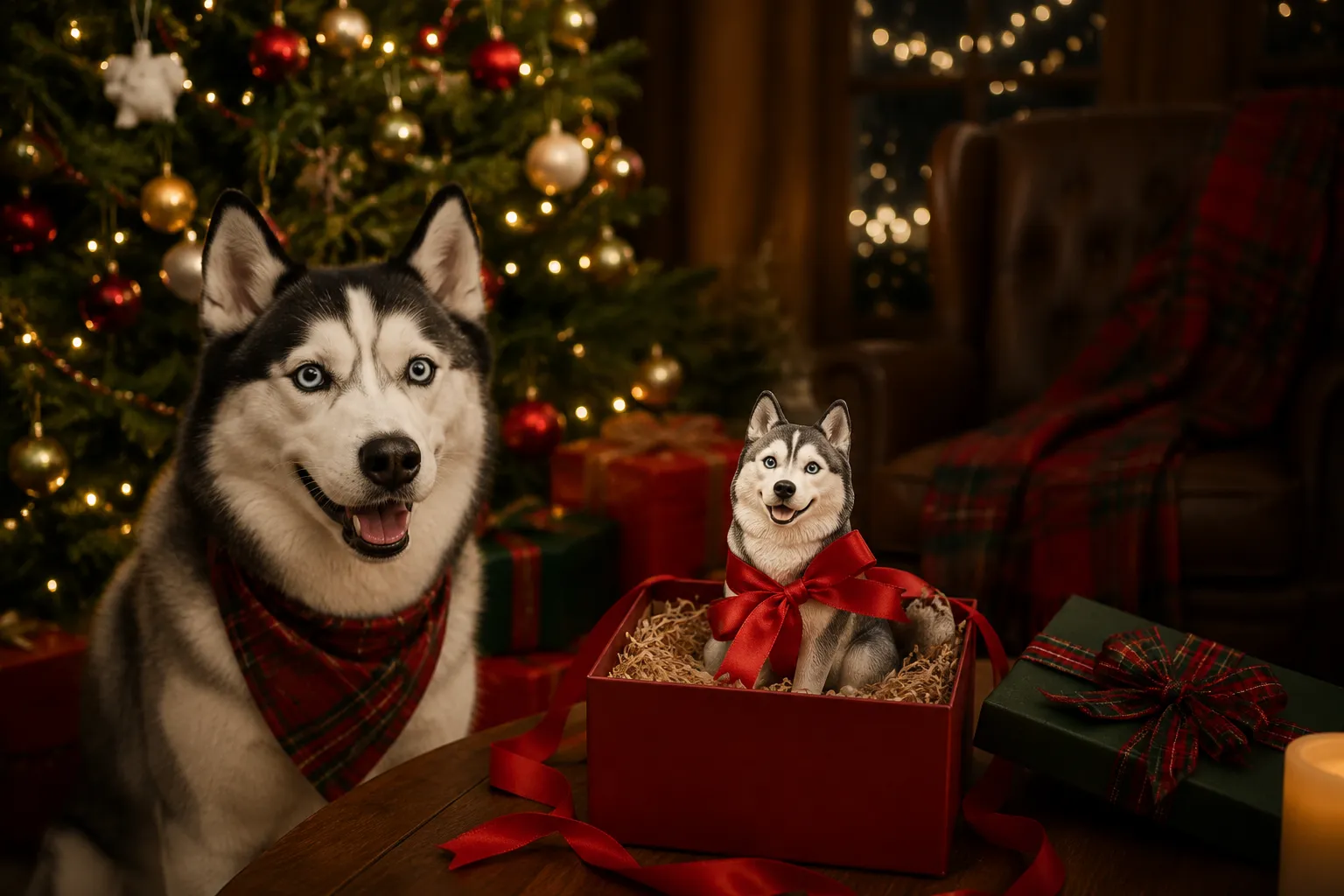
The vet tech calls a name, and in the corner chair a mother is thumbing through photos of her son's husky—and somewhere between the third and fourth swipe, the idea lands whole: a luxury husky figurine gift, waiting under the tree, for a boy counting the months until his father comes home from deployment.
Quick Takeaways
- A splurge gift for a teen missing a parent works best when it anchors the family unit, not just the wish list — choose meaning over spectacle.
- The dog is often the emotional glue during a deployment — honoring that bond speaks louder than a screen or a console.
- Presence beats price — a $500 gift lands only if it says "our family is still whole, just stretched across an ocean."
- A full-color 3D-printed keepsake preserves the exact dog, not a generic breed — explore how custom pet figurines capture real markings, posture, and personality.
- Time the reveal for maximum steadiness — the object should outlast the tears of Christmas morning and become a daily touchstone.
Why Deployment Rewrites the Emotional Math of a Teenager's Christmas
Consider what a deployment actually does to a household. It doesn't just remove a person. It removes a rhythm—the specific weight of footsteps on the stairs at 6 a.m., the particular way a voice calls the dog in from the yard, the sound of a truck door closing in the driveway that once meant he's home, dinner soon.
Teenagers feel this in a way that's easy to miss. They're old enough to understand the danger and the calendar, and young enough to have no real tools for the ache. They mask it. They retreat into headphones and group chats and a studied indifference that parents sometimes mistake for coping.
It usually isn't coping. It's containment.
Attachment theory—the framework developed by psychologist John Bowlby to explain the bonds between children and caregivers—tells us something useful here. A secure attachment isn't about constant proximity. It's about the reliable belief that the attachment figure exists and will return. Deployment strains exactly that belief. Not because the teen doubts the parent's love, but because the nervous system is wired to read absence as a low, humming alarm.
"A teenager's silence during deployment is rarely indifference. It's the sound of someone rationing their own hope."
And this is where a lot of well-meaning families go wrong at Christmas. They try to distract the teen out of the ache. Bigger gift, louder gift, faster gift. The newest console, the phone upgrade, the thing that promises hours of dopamine.
Here's the counterintuitive part. Distraction gifts often deepen the loneliness, because they pull the teen away from the family and into a solitary experience. What a grieving-in-advance kid usually needs isn't escape. It's an anchor. Something that says the family bond is intact and physical and here in the room, even when one member is nine time zones away.
That's the emotional math. You're not buying an object. You're buying a piece of evidence that the family still exists as a unit.

The Science of Why a Tangible Object Actually Helps
Let's go one level deeper, because the "why" matters more than the "what."
Psychologists use the term transitional object to describe the item a child clings to—the worn blanket, the one-eyed bear—when a primary caregiver isn't present. The concept comes from pediatrician and psychoanalyst Donald Winnicott, and while it's usually associated with toddlers, the underlying mechanism doesn't expire at age five.
We don't outgrow the need for objects that hold emotional information. We just get more sophisticated about which objects we allow ourselves. A wedding ring is a transitional object. So is a soldier's dog tag. So, it turns out, is a detailed figurine of the family dog.
The nervous system responds to tangible, touchable representations of a bond in measurable ways. Contact with a meaningful object can lower cortisol (the body's primary stress hormone) and nudge the system toward calm. It's part of why holding a photograph feels different from scrolling past one, and why a physical keepsake occupies a different psychological category than a digital file.
There's also the matter of object permanence extended into adulthood—the deep, almost pre-verbal reassurance that comes from something you can hold in your two hands. A screen shows you the dog. A sculpture puts the dog in the room with you. Those are not the same experience to the brain.
"A photo reminds you the dog exists. A sculpture insists on it."
The research on human-animal bonds backs this up in broad strokes. Studies suggest that interaction with dogs can increase oxytocin (the bonding hormone) and reduce physiological markers of stress. The American Kennel Club's overview of the human-canine bond touches on how deeply that connection runs. When a parent is deployed, the family dog frequently absorbs the overflow of that attachment. The teen sleeps with the door open so the husky can wander in. The dog becomes, quietly, a co-regulator—a warm, breathing thermostat for the household's anxiety.
So a figurine of that specific dog isn't a decoration. It's a physical shorthand for the one relationship that stayed steady while everything else stretched thin.
That's the insight most gift guides skip entirely.
Reading the Room: Is a $500 Splurge Actually the Right Call?
We'll be real with you, because a good gift decision deserves honesty more than encouragement.
A splurge custom pet sculpt is not automatically the correct choice just because the emotions are high. Money can't purchase the thing a teen actually misses. And a lavish gift, handed over with the wrong energy, can accidentally send a message the giver never intended: here's something expensive to make up for what's missing. Kids read subtext fluently.
So before we get to the "how," let's be honest about the "whether."
A splurge gift lands beautifully when:
- The teen has a genuine, demonstrated bond with the dog (they walk it, they talk to it, they photograph it constantly).
- The family wants a shared object—something everyone gathers around, not a solo-use gadget.
- You want a gift that keeps working in February and March, long after the wrapping paper is gone.
- The deployed parent can be part of the surprise, even remotely.
A splurge gift misfires when:
- It's used as a substitute for presence or communication rather than a complement to it.
- The teen would genuinely, deeply prefer something practical and you're overriding that for sentiment.
- The household is under financial strain and the "splurge" would create quiet resentment.
Here's the honest tradeoff. $500 is real money. For some families it's a stretch that only makes sense because the occasion is extraordinary. For others it's within reach but still worth scrutinizing. The question isn't "can a figurine be worth $500." The question is "will this object, for this kid, do the emotional work we need it to do."
If the answer is yes, keep reading. If you're unsure, the gift comparison below might clarify things.
A Quick Micro-Story
One of the situations our team has seen more than once: a parent orders a custom sculpture of the family dog while the other parent is deployed, and asks whether it's "too much" for a teenager who barely speaks at dinner. Months later they mention, almost offhand, that the figurine now sits on the kid's desk—turned to face the door, the same way the dog used to wait for it to open.
That's the tell. The gift wasn't too much. It was aimed at exactly the right ache.
Splurge Gifts for a Teen Missing a Deployed Parent, Ranked by Emotional Staying Power
Not every meaningful gift is a figurine, and we'd be doing you a disservice to pretend otherwise. So here's an honest comparison of splurge-tier options, judged by the one metric that matters for this specific situation: does it help the teen feel connected, and does that help last?
Here's a scannable overview before we get into the details.
| Gift | Budget | Best For | Emotional Staying Power |
|---|---|---|---|
| Custom full-color dog figurine | $$$–$$$$ | Teens deeply bonded to the family pet | Very high, daily touchstone |
| Premium tablet or console | $$$–$$$$ | Teens who connect with the parent via gaming/video calls | Medium, fades as novelty wears |
| Personalized jewelry (dog tag style) | $$–$$$ | Teens who want something to carry | High, but small and easy to tuck away |
| Custom portrait or commissioned art | $$$ | Visually oriented teens | High, but stays on the wall, not in hand |
| Experience gift (concert, trip) | $$$–$$$$ | Teens craving distraction and momentum | Medium, powerful but momentary |
Now the detail, because the "why" is where the decision actually gets made.
The Full-Color Custom Husky Figurine
Who it's for: The teen whose relationship with the family husky has quietly become their emotional lifeline during the deployment.
Budget: Roughly $300–$600 depending on size and detail, which puts a considered $500 splurge squarely in premium territory.
Why it stands out: This is the only gift on the list that turns the household's actual co-regulator—the dog—into something permanent and holdable. A well-made piece captures not a generic husky but the husky: the specific mask across the face, the one ear that folds, the way it sits with its tail curled just so. Modern full-color 3D printing reproduces those markings directly in the resin, so the color is part of the material itself rather than a coating on the surface. The result reads as your dog, which is the entire point.
Pro tip: Choose a pose that matches how the dog actually behaves around the teen. A husky mid-howl, or sitting alert at attention, carries more emotional charge than a generic show stance.
The Premium Tablet or Gaming Setup
Who it's for: Teens who genuinely stay connected to the deployed parent through scheduled video calls or co-op gaming across the distance.
Budget: $400–$800.
Why it stands out: When a deployed parent and a teen have built a ritual around a specific game or a nightly call, the hardware that enables it becomes meaningful by association. This is a legitimate case where a screen connects rather than isolates. The catch is that the emotional value lives in the ritual, not the device—and rituals require the parent's participation, which deployment can make unpredictable.
Pro tip: Only choose this if the connection ritual already exists. Buying the hardware in hopes of creating one is a gamble that often disappoints.
Personalized Jewelry with the Dog's Likeness
Who it's for: Teens who want something small, private, and carryable—especially those who don't want their emotions on display.
Budget: $150–$400.
Why it stands out: A pendant shaped like the dog's silhouette, or a tag engraved with its name, offers portable comfort. There's real psychological value in a keepsake you can touch inside your pocket during a hard moment. The limitation is scale—it's intimate but easy to forget in a drawer.
Pro tip: Pair it with a handwritten note from the deployed parent explaining why the dog matters to them, too. The note is what makes the metal mean something.
The Commissioned Portrait
Who it's for: Visually oriented teens who'd treasure art on their wall.
Budget: $200–$500.
Why it stands out: A beautiful rendering of the dog is a genuine heirloom. It stays present in the room and ages gracefully. The tradeoff versus a figurine is dimensionality—a portrait is admired from across the room, while a sculpture is picked up, turned over, held. For a kid who needs a touchable anchor, that distinction is everything.
Pro tip: If you go this route, request the dog looking directly at the viewer. Eye contact in art creates a stronger sense of presence.
The Experience Gift
Who it's for: Teens who are visibly wilting and need momentum, joy, and something to look forward to.
Budget: Wildly variable, $200–$1,000+.
Why it stands out: Concerts, weekend trips, a long-wished-for adventure—these break the fog. The problem is impermanence. An experience is a bright flare, not a steady lamp. It can be exactly right for a specific low point, but it won't be sitting on the desk in March doing quiet work.
Pro tip: Consider pairing a modest experience with a lasting object. The experience handles the immediate slump; the keepsake handles the long haul.
Why the Husky, Specifically, Carries So Much Weight
There's a reason this article isn't about a generic dog. Huskies occupy a particular emotional and symbolic register that makes them unusually potent as the subject of a deployment gift.
Start with the sound. Huskies don't just bark—they talk. The rising, wolf-adjacent howl. The muttered grumbles that sound like a teenager complaining about chores. The specific, unmistakable "woo-woo" that a husky owner would recognize in a crowd of a thousand dogs. In a household missing one voice, the husky becomes the loudest, most expressive presence in the room. Its vocabulary of sound fills the acoustic gap the deployment created.
Then there's the symbolism. Huskies are working dogs bred for endurance, loyalty, and the long haul across hard terrain—qualities that map almost too neatly onto a military family's experience. According to the American Kennel Club's Siberian Husky breed profile, these dogs were developed to work in teams over vast distances, pulling together toward home. A family enduring a deployment understands that image in their bones.
"The husky doesn't just wait for the door to open. It reminds the whole house that someone is coming back."
And huskies are strikingly individual. Two huskies are never marked the same way. The mask, the eyebrows, the eye color (sometimes one blue, one brown), the exact geography of the coat—these are as unique as a fingerprint. Which means a generic husky figurine, the kind you'd find in a gift shop, will always read as a husky rather than your husky.
That gap—between a breed and an individual—is precisely the gap a custom piece closes. And for a teen who knows every whisker on that dog's face, the difference between "a husky" and "my husky" is the difference between a decoration and a companion.
A Day in the Life: Where This Gift Actually Lives
Picture the ordinary Tuesday, three weeks after Christmas.
The teen's alarm goes off in the gray dark. Before the phone, before the scroll, their eyes land on the figurine on the nightstand—the husky sitting alert, ears up, exactly the way the real dog is probably stretching in the hallway right now. Downstairs, the actual husky's nails click across the kitchen tile, and there's a familiar grumbling woo as the food bowl fills. The kid touches the sculpture once, almost unconsciously, on the way out the door. It's not a ritual anyone taught them. It just became one.
That's the "so what." A splurge gift earns its price not on Christmas morning but on a random Tuesday, when it does its quiet work without anyone noticing. The value isn't in the unwrapping. It's in the four hundred ordinary mornings that follow.
What Makes a Custom Full-Color Husky Sculpture Worth the Splurge
Let's talk craftsmanship honestly, because "custom figurine" covers a wide quality range and the differences are enormous.
The version worth $500 is not a mass-produced husky with a name sticker on the base. It's a piece built from your dog's photographs—a digital likeness modeled by an artist, then produced through full-color 3D printing that renders the animal's real coloring and markings into the resin itself.
Here's the technical distinction that matters, and that most buyers don't understand. In advanced full-color 3D printing, the color isn't a coating applied over a blank model. The pigment is embedded in the material as the piece is built, layer by microscopic layer. That's why a good full-color print can reproduce the subtle gradient where a husky's black mask fades into white cheeks, or the reddish tint some coats carry near the shoulders. The color is in the object, not on it.
At PawSculpt, the model is digitally sculpted by 3D artists working from your photos, then produced in full-color resin, with a protective clear coat applied for durability and sheen. That clear coat is the only manual finishing step—everything about the color and form comes from the print itself. The finish keeps a natural, slightly textured character rather than a glossy plastic-toy perfection, which is honestly part of why it reads as authentic rather than manufactured.
"A husky's whole story is written in its markings. Our job is to keep that story exactly, so the dog on the shelf is the one the family knows by heart."
— The PawSculpt Team
We've worked with enough military families to notice a pattern in what they ask for. It's rarely "make it perfect." It's "make it him—the crooked ear, the little scar over the eye, the way he sits." Perfection isn't the goal. Recognition is.
Getting the Photos Right
Because the whole gift hinges on capturing the specific dog, the source photos carry real weight. Here's what actually helps the artists most.
| Photo Element | What Works | Why It Matters |
|---|---|---|
| Lighting | Soft, natural daylight | Reveals true coat color without harsh shadows |
| Angles | 3–5 shots: front, both sides, and a favorite pose | Lets the artist reconstruct the dog in three dimensions |
| Distance | Fill the frame with the dog, not the yard | Preserves detail in the face and markings |
| Expression | Capture the dog "being itself" | The signature look is what makes it recognizable |
| Resolution | Highest quality your camera allows | Fine details like eye color and fur direction survive |
The single most common mistake: submitting only face-forward "selfie" style photos. The artist needs to understand the dog in the round—the profile, the back, the way the coat lies along the spine. A few thoughtful angles produce a dramatically better result than a dozen shots from the same spot.
For turnaround times, revision options, sizing, and current pricing, it's best to check the details directly at pawsculpt.com, since those specifics change and we'd rather you have accurate information than a stale guess from us.
Involving the Deployed Parent in the Surprise
This is the move that turns a good gift into an unforgettable one, and almost nobody thinks of it.
The deployed parent can be part of the process even from overseas. A few possibilities we've seen families use:
- Have the deployed parent choose the pose. A short message—"I want him sitting the way he waits at the window"—means the gift carries their fingerprint even though they weren't there to wrap it.
- Record a video reveal. The parent explains, on camera, why they wanted the teen to have the family dog captured in full color. Play it as the gift is opened.
- Frame it as a shared gift, not a substitute. The message isn't "here's something because I can't be there." It's "here's our dog, so a piece of home is always in your hands until I'm back."
That reframing is the whole ballgame. A splurge gift given by the deployed parent, through the dog, says the family is intact. A splurge gift given because the parent is absent quietly underlines the absence. Same object. Opposite messages. The words around it decide which one the teen receives.
The Timing of the Reveal Matters More Than You Think
One overlooked detail: when on Christmas morning you give this.
The instinct is to save the biggest gift for last, the grand finale. For this particular gift, we'd gently push back. A deployment Christmas already carries a heavy undertow—there's an empty chair, a missing voice, a video call that ends too soon. A sentimental gift dropped at the emotional peak can tip an already-fragile morning into tears that overwhelm the moment.
Consider giving it earlier, quietly, maybe even the night before in a smaller setting. Let the teen absorb it privately first. The figurine's power is cumulative and long-term; it doesn't need the spotlight of the big reveal. Sometimes the most meaningful gifts are best handed over in a low voice, with room to feel whatever comes.
That's the kind of thing you only learn from watching how these gifts actually land in real homes.
Frequently Asked Questions
How much should I spend on a Christmas gift for a teen missing a deployed parent?
There's no universal number, but for a lasting keepsake, a range of roughly $300 to $600 is a considered splurge rather than an impulse. The better question is whether the specific gift will do real emotional work over time. Spend based on the strength of the bond and your genuine budget—never out of guilt over the empty chair.
Is a custom pet figurine really a good gift for a teenager?
It can be one of the best, but only when the teen has a genuine, demonstrated connection to the pet. During a deployment, the family dog often becomes the household's emotional stabilizer, and a figurine of that dog gives the teen something tangible to hold onto. If the bond isn't there, though, a different gift will serve better.
What photos work best for a custom husky figurine?
Aim for three to five high-resolution photos in soft, natural daylight, taken from multiple angles—front, both sides, and a pose that captures the dog being itself. The most common mistake is submitting only face-forward shots. Artists need to understand the dog in three dimensions to reproduce it accurately.
How can a deployed parent be involved in the surprise?
More easily than most families realize. The deployed parent can choose the dog's pose, record a short video explaining why they wanted the teen to have it, or have the gift framed as coming from them. That framing matters—it turns the piece into a symbol of family unity rather than a stand-in for absence.
Why a husky specifically, and not just any dog figurine?
Huskies have famously individual markings—the mask, the eyebrows, the eye color—so a generic figurine will always read as "a husky" rather than "my husky." A custom full-color piece closes that gap. Their symbolic ties to loyalty, teamwork, and endurance also resonate deeply with military families.
Will a full-color 3D-printed figurine look realistic or like a toy?
A quality full-color resin print embeds the color into the material itself, reproducing real coat gradients and markings rather than a painted-on approximation. The finish keeps a natural, subtly textured character protected by a clear coat, which is why it reads as authentic rather than glossy plastic.
Ready to Celebrate Your Pet?
Every pet has a story worth preserving. For a teenager counting the days until a deployed parent comes home, the family dog is often the quiet anchor holding everything steady—and a luxury husky figurine gift turns that bond into something they can hold in their hands on the hard mornings. Whether you're marking a deployment Christmas or simply celebrating a dog who means the world to your family, a custom PawSculpt figurine captures the exact markings, posture, and personality that make your husky unmistakably yours.
Visit pawsculpt.com to explore our full-color 3D printing process, revision options, and quality guarantee.