11 Details You'll Forget About Your Corgi's Face: How to Capture Them Before It's Too Late
The sunlight hit the backseat, illuminating the floating dust motes where his crate used to be. I reached back instinctively, my fingers brushing empty upholstery instead of coarse fur, and the sudden lack of physical resistance felt heavier than the traffic noise outside.
Quick Takeaways
- Memory consolidation is flawed; our brains prioritize general shapes over specific patterns like whisker spots.
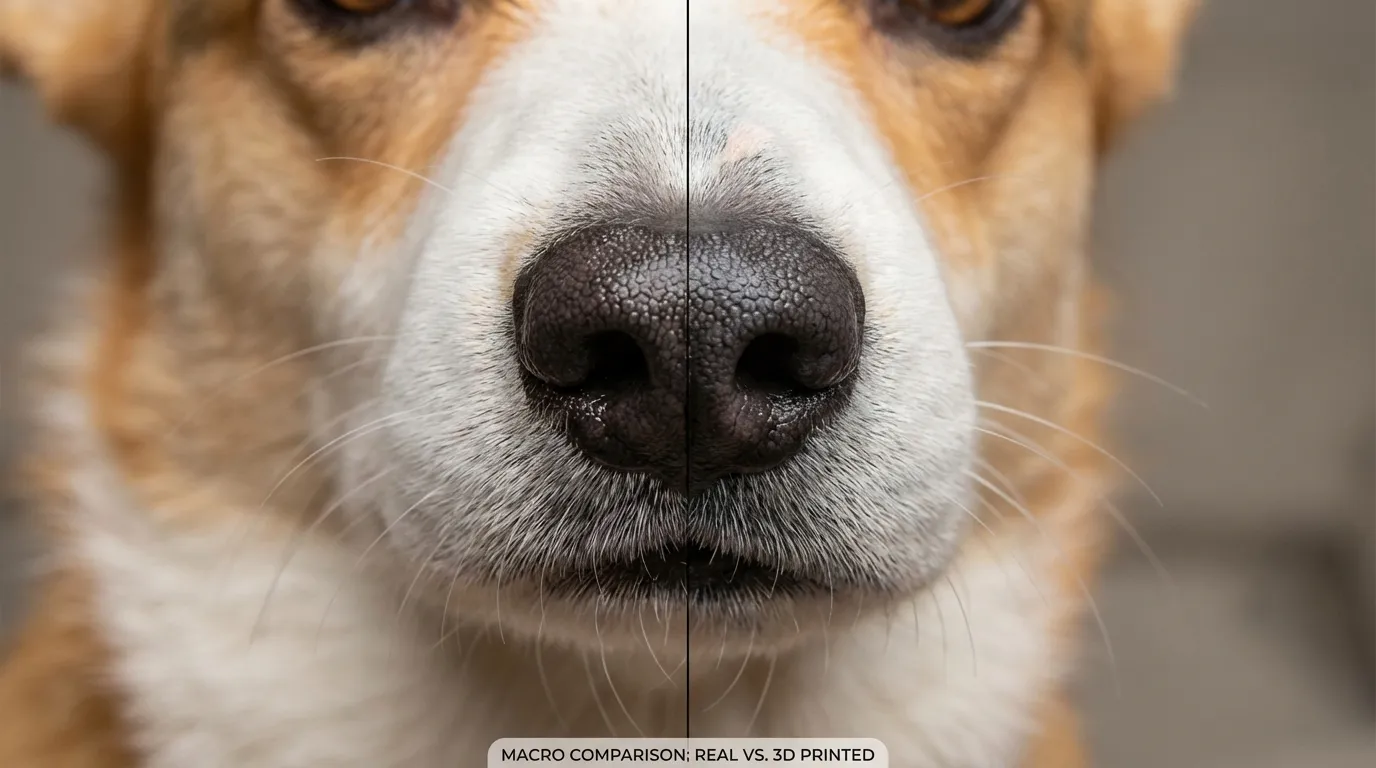
- Macro photography is essential for preserving the unique "topography" of your Corgi’s nose and paw pads.
- Tactile memory fades first, so document textures—like the coarseness of the "fairy saddle"—not just colors.
- Physical keepsakes trigger the hippocampus more effectively than digital photos, which is why custom figurines are vital for grief processing.
- Capture asymmetry because perfect symmetry is rare in nature; the "flaws" are what you will miss most.
The Neurobiology of Forgetting a Best Friend
It feels like a betrayal to admit it, but biologically, you are programmed to forget.
In cognitive psychology, this phenomenon is known as transience—the decreasing accessibility of memory over time. When you look at your Corgi today, your brain isn't actually processing every single hair or speck of pigment. Instead, your visual cortex relies on predictive coding. It sees the general shape of a dog, the color orange, and the concept of "Corgi," and it fills in the rest with a generic mental template.
This is efficient for survival, but devastating for grief.
When a pet passes, that predictive model shatters. You are left trying to reconstruct the image of your dog from episodic memory, which is notoriously reconstructive and prone to error. Within weeks, the specific jagged edge of their blaze or the exact asymmetry of their eyeliner begins to smooth out in your mind. You start remembering a "Corgi," not your Corgi.
To combat this neural pruning, you need to externalize these memories before they fade. You need to capture the data points that your brain is currently filtering out as "unnecessary noise."
Here are the 11 specific details of your Corgi’s face and physiology that you are statistically most likely to forget, and exactly how to capture them.
1. The Asymmetry of the Blaze
We tend to idealize our pets in our memories. If your Corgi has a white blaze running up their snout, your brain likely perceives it as a straight, symmetrical line. It almost certainly isn't.
In reality, pigment migration during embryonic development is chaotic. That white stripe probably jagged to the left just above the eye, or narrowed significantly near the nose bridge. This biological asymmetry is the fingerprint of your dog's face.
How to Capture It:
Do not use portrait mode on your phone, which artificially blurs edges. Take a straight-on photo in natural, overcast light. You want a "flat" image that documents the exact map of the white-to-orange transition.
"Grief isn't a problem to be solved. It's a love story that continues after the last chapter."
2. The "Fairy Saddle" Texture Change
Corgi owners know the legend of the "fairy saddle"—the patch of darker or different-textured fur on their back. But neurologically, we often store visual memories (color) better than tactile ones (texture).
You will remember the saddle was darker. You will likely forget that the hair there was coarser, thicker, and grew in a slightly different direction than the flank fur. This textural difference is crucial to the haptic memory of petting them.
How to Capture It:
Wait for the "golden hour" (just before sunset). Position your Corgi so the light hits them from the side (raking light). This angle creates micro-shadows behind each hair follicle, revealing the topography of the coat rather than just the color.
3. The Geometry of the Ear Tuft
A Corgi's ears are their radar dishes, but they aren't just triangles. There is a complex architecture of fur inside the auricle. There are usually long, wispy guard hairs protecting the canal, contrasting with the velvet-short fur on the ear tip.
Why You'll Forget:
The brain engages in schema processing. It simplifies "ear" into a triangular shape. It deletes the messy, chaotic tufts inside because they distract from the overall silhouette.
How to Capture It:
Backlighting is your friend here. Place your Corgi between you and a window. The light will shine through the thinner parts of the ear and illuminate the individual strands of the inner tufts, creating a "halo effect" that freezes that geometry in time.
4. The Whisker Map (Mystacial Vibrissae)
Whiskers aren't random. They grow in specific rows on the muzzle pads. Some are white; some might be black. As dogs age, these often change color.
You will remember they had whiskers. You will forget that on the left side, the third row down, they had two thick black whiskers amidst the white ones. This specific pattern is as unique as a fingerprint.
| Memory Type | Rate of Decay | What You Lose First |
|---|---|---|
| Visual | Moderate | Specific patterns, asymmetry, exact shades of color |
| Auditory | Fast | The specific pitch of a bark or the sound of nails on floor |
| Tactile | Very Fast | The density of fur, the heat of their belly, the coarseness of pads |
| Olfactory | Slowest | The smell of their paws (fritos), wet fur, or breath |
5. The Eyeliner (Pigmentation Rims)
Pembroke and Cardigan Corgis often have distinct black rims around their eyes, functioning like natural eyeliner to reduce glare. However, the thickness of this line varies.
The Counterintuitive Insight:
We spend so much time looking into their eyes (seeking limbic resonance and connection) that we rarely look at the structure around the eye. You are focusing on the emotional center, ignoring the anatomical frame.
How to Capture It:
You need a macro shot. If you don't have a DSLR, use the "macro" setting on a modern smartphone. Focus specifically on the rim of the lid, not the pupil.
6. The "Sploot" Mechanics and Paw Pads
When a Corgi "sploots" (lays flat on their belly with legs stretched back), it reveals the paw pads. We love the "beans," but we forget the texture. Are they smooth and puppy-soft? Or are they rough, hyper-keratinized, and textured like gravel from years of walks?
The Preservation Solution:
This is where 2D photography often fails. A photo cannot convey the roughness of a paw pad. This is why many pet parents turn to full-color 3D printing. Unlike a flat image, a custom 3D figurine is built voxel-by-voxel (3D pixels) to replicate the volume and shape of the animal.
At PawSculpt, our digital artists sculpt these pads based on your photos, ensuring that the physical representation you hold in your hand matches the volume of the real paw. It bridges the gap between seeing and feeling.
7. The Snout Freckles (Nose Pigmentation)
Many Corgis, especially as they age, develop "snow nose" (hypopigmentation) or little freckles on the bridge of their snout. These chaotic spots are visual noise that your brain filters out to see the "whole" face.
How to Capture It:
Take a top-down photo focusing solely on the nose bridge. Overexpose the image slightly to ensure the dark spots stand out against the fur.
8. The Depth of the Iris (Heterochromia or Flecks)
Does your Corgi have deep brown eyes? Look closer. There are often flecks of amber, gold, or even blue (in Cardigans) hidden in the iris.
The Science:
Change blindness suggests we often miss changes in visual stimuli we encounter daily. You assume the eyes are "brown" and stop looking for the nuance.
How to Capture It:
Go outside on a cloudy day. Have someone hold a treat above your head so the dog looks up. The sky will reflect in the bottom of the eye, illuminating the iris fibers and revealing the true depth of color.
"We've seen families heal by holding something tangible. Grief needs an anchor, and a figurine captures the weight of presence that a photo simply cannot."
— The PawSculpt Team
9. The Neck Fluff Density (The Ruff)
The Corgi "ruff"—that thick collar of fur around the neck—is a prime zone for tactile affection. It's where we scratch them. It's where we bury our faces.
Why You'll Forget:
You are remembering the feeling of comfort (oxytocin release), not the visual density of the fur.
How to Capture It:
Video is better than photography here. Record a slow-motion video of your hand running through the ruff. This captures the elasticity of the skin and the density of the undercoat in motion.
10. The Lower Incisor Crowding
Corgis have small mouths and big attitudes. Often, their lower teeth are slightly crowded or crooked. It’s a detail you only see when you're playing tug-of-war or brushing their teeth.
The Insight:
We often edit out "imperfections" from our memories to create an idealized version of the beloved. But those crooked teeth are part of the biological reality of the animal you loved. Don't shy away from photographing the goofy, snaggle-toothed grin.
11. The Fox Tail Flow (or the Dock Scar)
If you have a Cardigan (or an undocked Pembroke), the tail is a plume. If you have a docked Pembroke, there is a specific way the fur tufts over the dock.
The "flow" of a tail—how the fur fans out—is determined by gravity and hair follicle direction. A static photo rarely captures this.
How to Capture It:
Photograph the tail in a "neutral" state and an "alert" state. The fan of the fur changes completely based on muscle tension.
Integrating Memories into Physical Form
We live in a digital age, but our brains are analog. We evolved to process grief and attachment through touch and physical presence. This is why we keep collars, favorite toys, and blankets.
However, cognitive dissonance can occur when the objects we keep (a flat photo) don't match the multi-dimensional memory we hold.
This is where technology has evolved to meet emotional needs. At PawSculpt, we utilize full-color resin 3D printing. This is not a hand-painted process where a human interprets your dog's colors with a brush. Instead, we use advanced technology where the color is printed directly into the resin, layer by microscopic layer.
This allows us to capture the exact gradient of your Corgi's blaze, the specific scattering of freckles on the snout, and the unique asymmetry of their eyeliner. The result is a UV-resistant, permanent keepsake that occupies physical space—allowing your brain to interact with the memory in a way a screen never permits.
Frequently Asked Questions
Why do I feel like I'm forgetting what my dog looked like so quickly?
This is a normal psychological process called transience. Your brain is wired to be efficient, so it stores the general concept of your dog (the "schema") rather than every specific detail. Without external reinforcements like photos or physical models, the brain "smooths out" the unique irregularities that made your pet unique.What is the best lighting for photographing Corgi fur?
Avoid direct noon sun, which creates harsh shadows and washes out orange tones. The best lighting is usually overcast natural light for color accuracy. If you want to capture the texture of their coat, use "raking light"—sunlight coming from the side during the golden hour (sunrise or sunset), which highlights the depth of the fur.Can I use iPhone photos for a 3D custom figurine?
Absolutely. Our digital sculptors at PawSculpt are experts at interpreting depth from standard smartphone photos. The key is variety: try to get photos from the front, both sides (profile), and the back. Even older, slightly grainy photos can often be used if you have enough of them to show the markings.How does 3D printing differ from hand-painted statues?
Hand-painting introduces human error and brush strokes that can look artificial. Our process uses full-color 3D printing technology, where the color is built directly into the resin material. This allows for photorealistic gradients (like the fading white on a muzzle) that are impossible to achieve with acrylic paint and brushes.Ready to Celebrate Your Pet?
Every pet has a story worth preserving. Whether you're honoring a beloved companion who's crossed the rainbow bridge or celebrating your furry friend's unique personality, a custom PawSculpt figurine captures those details that make your pet one-of-a-kind.
Free instant AI preview • 3D artist preview within 7 days • 5 free revisions