
Handling Facebook Memories: Digital Grief After Losing a Maine Coon
You are standing in the aisle of the local pet supply store, staring at the bottom shelf where they keep the extra-large breed kibble. Your hand reaches out automatically for the purple bag—the one formulated for joint support because Maine Coons are heavy and their hips need help—before your brain catches up to your body. You freeze. The bag feels phantom-heavy in your grip, the crinkle of the plastic loud in the quiet store. Then the realization hits you like a physical blow to the chest. You don't need this anymore. You put it back, feeling like everyone is watching, though they aren't. Your phone buzzes in your pocket. You pull it out to distract yourself, desperate for a dopamine hit to counter the emptiness, and there it is. A notification. "On this day, 3 years ago." It’s a photo of him, draped across your shoulders like a scarf, looking majestic and alive.
Quick Takeaways:
- The Algorithm is Blind: Social media platforms are designed for engagement, not empathy. They don't know your pet has passed, and "Memories" features can feel like an emotional ambush. >
Curate to Heal: You don't have to delete your history to find peace. Archiving posts, adjusting "On This Day" settings, and creating a dedicated digital folder allows you to revisit memories on your* terms, not the app's.
>
- Tangible over Digital: Transitioning from scrolling through pixels to holding a physical tribute—like a framed print or a custom figurine—can ground your grief and provide a focal point that screens cannot offer.
- The "Relief" is Normal: Maine Coons are high-maintenance companions. It is valid to feel a confusing mix of relief that the grooming and medical care have ended, alongside your profound sadness.
The Specific Weight of a Maine Coon Loss
We need to talk about the silence. Not just the lack of noise, but the lack of presence. When you lose a Maine Coon, you aren't just losing a cat; you are losing a roommate, a shadow, and a physical weight in your home. These aren't creatures that hide under the bed. They are the ones that greet you at the door with that distinct, bird-like trill. They are the ones that take up half the sofa.
Because of their size and their dog-like personalities, the void they leave is physically larger. You turn around expecting to trip over twenty pounds of fluff, and the floor is empty. You wake up and your legs aren't pinned down by a purring anchor.
But here is the modern cruelty of that loss: while your home is empty, your phone is full.
For owners of photogenic breeds like Maine Coons, the digital footprint is massive. You likely have thousands of photos. The ear tufts backlit by the sun. The paws that looked like catchers' mitts. The way they looked like a lion in miniature. You documented their life because they were magnificent. Now, that documentation has turned into a minefield.
When the Algorithm Ambushes You
Social media platforms run on nostalgia. They want you to share, to re-engage, to look back. The "On This Day" or "Memories" features are designed to bring you joy, but in the raw weeks following a loss, they function differently. They are ambush predators.
You might be having a "good" morning. You managed to make coffee without crying. You're sitting at your desk, opening Facebook to check a message, and suddenly you are staring at a video from two years ago. Your cat is chasing a laser pointer, vibrant and healthy.
The shock isn't just sadness; it's a jarring disconnect between the digital world (where they are still alive) and your physical reality (where they are gone). It disrupts the processing of grief because it forces you backward when you are trying to inch forward.
The "Scroll of Doom"
We’ve spoken to so many pet parents who fall into what we call the "Scroll of Doom." It’s late at night, you can’t sleep, so you open your camera roll. You scroll back to the beginning. You watch the kitten videos. Then the adult photos. Then the senior photos. Then the last photos.It feels like a way to stay close to them, but often, it just reinforces the trauma of the end. You aren't remembering their life; you're re-living their decline.
The Emotion No One Admits: Relief
Here is something difficult to write, and perhaps difficult for you to read, but it needs to be said. Maine Coons are high-maintenance animals. They are prone to Hypertrophic Cardiomyopathy (HCM), hip dysplasia, and spinal muscular atrophy. Their coats require daily attention to prevent painful matting.
toward the end, you likely became a nurse. You were managing medications, cleaning up accidents because their hips were too sore to make it to the litter box, or spending hours gently grooming fur they could no longer reach.
When they pass, alongside the crushing grief, there is often a quiet, small voice of relief.
You sleep through the night for the first time in months. You don't have to rush home to administer insulin or pills. You don't have to worry about the mat forming behind their ear.
And then, immediately after the relief, comes the guilt. How can I be relieved? Does this mean I didn't love them enough?
Listen to us closely: Relief is not the absence of love. It is the absence of suffering. You are relieved that their pain is over, and you are relieved that the anticipatory grief—the constant worry about "when will it happen"—is gone. Do not let the guilt of relief compound your sadness. It is a biological response to the end of a high-stress caretaking period. It makes you human, not heartless.
Taking Control of Your Digital Environment
You don't have to let Mark Zuckerberg dictate when you grieve. You can take control of your digital surroundings just as you would your physical ones.
1. The "Hide" Feature is Your Friend
You don't need to block memories forever, but you might need to pause them for now.- Facebook: Go to Memories > Settings > Hide Dates. You can hide the specific dates surrounding their death or the weeks leading up to it. You can also hide memories involving specific people (or tagged pet accounts) if you need a total break.
- Instagram: You can mute your own archive stories or adjust settings to stop push notifications for memories.
- Google Photos: Go to Photo Settings > Memories > Hide dates.
2. Create a "Safe" Folder
Instead of scrolling through your entire camera roll and risking stumbling upon photos of their final days, create a dedicated album on your phone named after them. Curate it carefully. Choose the 20-30 best photos—the ones where they look strong, happy, and full of life.When you need to see them, go to that folder. It’s a controlled environment. You know what’s in there. You won't be ambushed by a photo of them at the vet or looking frail. This allows you to visit them on your terms.
3. Change Your Wallpaper
This is a small but significant step. If your phone background is their face, you are confronting your loss every time you check the time. Consider changing it to something neutral—a landscape, a pattern—for a few weeks. It gives your brain a break. You can always change it back when the grief is less raw.From Pixels to Physical Presence
One of the reasons digital grief is so tricky is that it feels ephemeral. You see the photo, you feel the pang, you scroll past, and it's gone. There is no container for the emotion.
We have found that moving the memory from a screen to a physical object can be incredibly grounding. It gives the grief a place to live outside of your body.
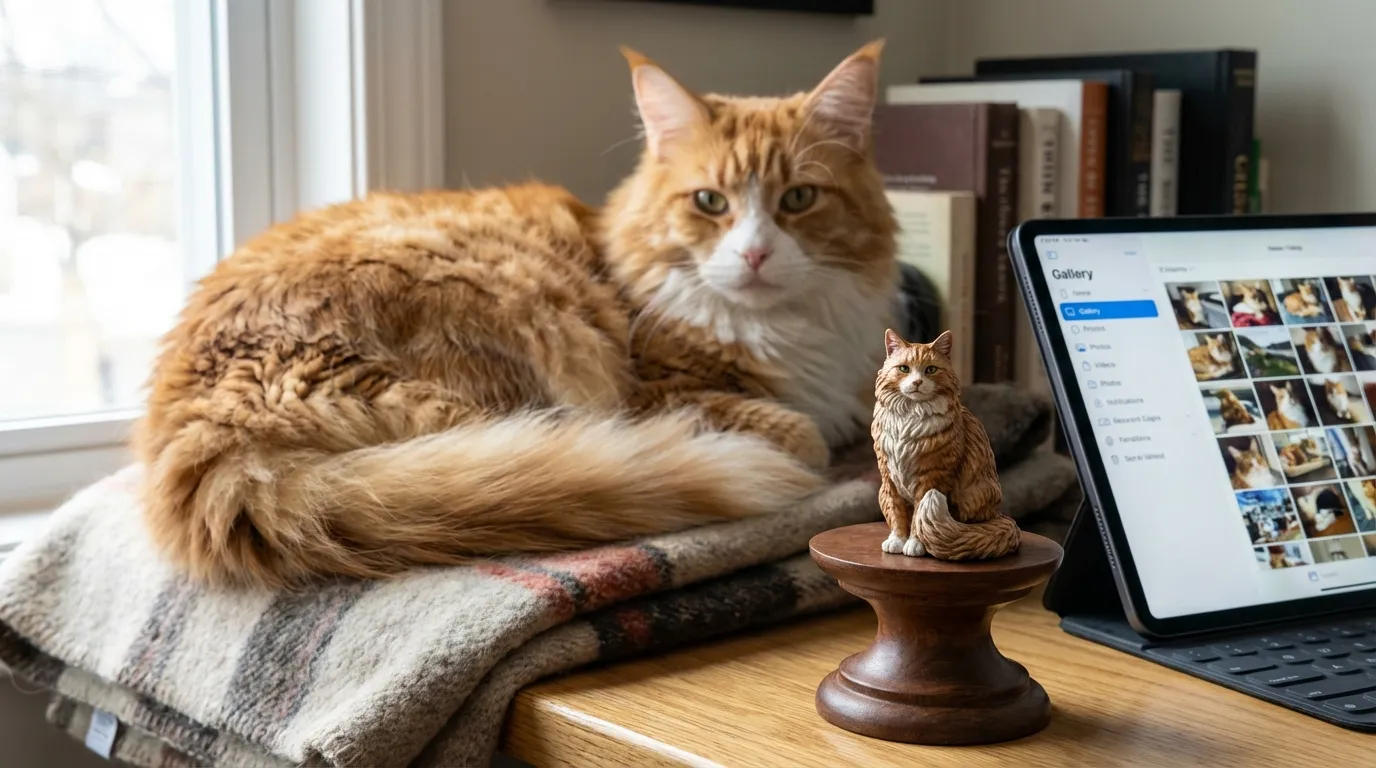
Some families plant a memorial tree, giving life back to the earth. Others commission paintings. In our work, we’ve seen a profound shift in how people handle this. We have worked with families who take that one perfect digital photo—the one where the Maine Coon’s lynx tips are standing straight up and their tail is fluffed in a question mark—and ask us to turn it into a custom figurine.
There is something about the tactile nature of a figurine that a photo cannot replicate. You can run your thumb over the curve of their back. You can put it on the mantle next to their ashes or their collar. It becomes a permanent, tangible tribute that doesn't rely on Wi-Fi or battery life. It anchors the memory in the physical world, which is exactly where you are trying to learn to live without them.
Handling the "It Was Just a Cat" Crowd
If you post about your loss on social media, 90% of the comments will be supportive. But there is always that disconnect with people who don't "get it." They see a cat. They don't see the 15 years of companionship, the personality that filled the room, the bond that was as deep as any human relationship.
Maine Coon owners often face a specific weirdness here because the breed is so distinct. People might say, "Why don't you just get another one?" as if you can replace a family member like a toaster.
You do not owe these people an explanation. You do not need to justify the depth of your grief. If someone leaves a dismissive comment, delete it. If a friend tells you to "move on," mute them for a while. Protect your peace aggressively. Your grief is the price of the love you shared, and it is valid, regardless of what anyone else thinks.
The Legacy of the Gentle Giant
Eventually, the algorithm will stop hurting. One day, a "Memory" will pop up—maybe a video of them chirping at a bird through the window—and instead of crying, you will smile. You will remember the sound of that chirp. You will remember how soft their fur was.
That is when you know the healing has really begun. The digital record of their life transforms from a source of pain back into what it was meant to be: a celebration.
Until then, be kind to yourself. Close the app if it hurts. Put the phone down. Walk outside. They aren't in the cloud; they are in your heart, and that is a server that never goes down.
Frequently Asked Questions
How do I stop Facebook from showing me pet memories?
You can curate your experience to avoid being ambushed. On Facebook, navigate to the "Memories" bookmark. Click on "Settings" or "Notifications." You will see options to "Hide Dates" or "Hide People." We recommend hiding the date range surrounding their passing, and perhaps the week leading up to it, so you aren't caught off guard during difficult anniversaries.Is it normal to feel relief after my sick cat dies?
Yes, and it is one of the most common yet least discussed emotions in pet grief. Maine Coons often suffer from chronic conditions that require intensive caretaking. Feeling relief that the daily struggle, medication schedules, and worry have ended is a natural biological response to the cessation of stress. It signifies that you are relieved their suffering is over, not that you are happy they are gone.What should I do with my deceased pet's Instagram account?
This is a personal decision. Some owners find comfort in maintaining the account as a digital memorial, posting occasionally on birthdays. Others find the pressure to "perform" grief for an audience exhausting. A middle ground is to make a final post explaining the loss, then log out for a few months. You can also use Instagram's "Download Your Information" feature to save all photos and captions to your computer, ensuring you have the memories even if you decide to delete the account later.How can I memorialize my Maine Coon without using social media?
Physical memorials often provide more comfort than digital ones because they engage your sense of touch and sight in the real world. Options include creating a shadow box with their collar and favorite toy, planting a memorial bush in the garden where they liked to watch birds, or commissioning a custom 3D figurine that captures their unique likeness. These items create a designated space in your home for their memory, separate from the noise of the internet.Honor Their Memory Forever
Your pet's story deserves to be preserved in a way that captures their unique spirit. A custom PawSculpt figurine transforms your cherished memories into a timeless keepsake—every whisker, every marking, every detail that made them irreplaceable.
Free instant AI preview • 3D artist preview within 7 days • 5 free revisions