
The Empty Lap: Evening TV Rituals Without Your Cuddly British Shorthair
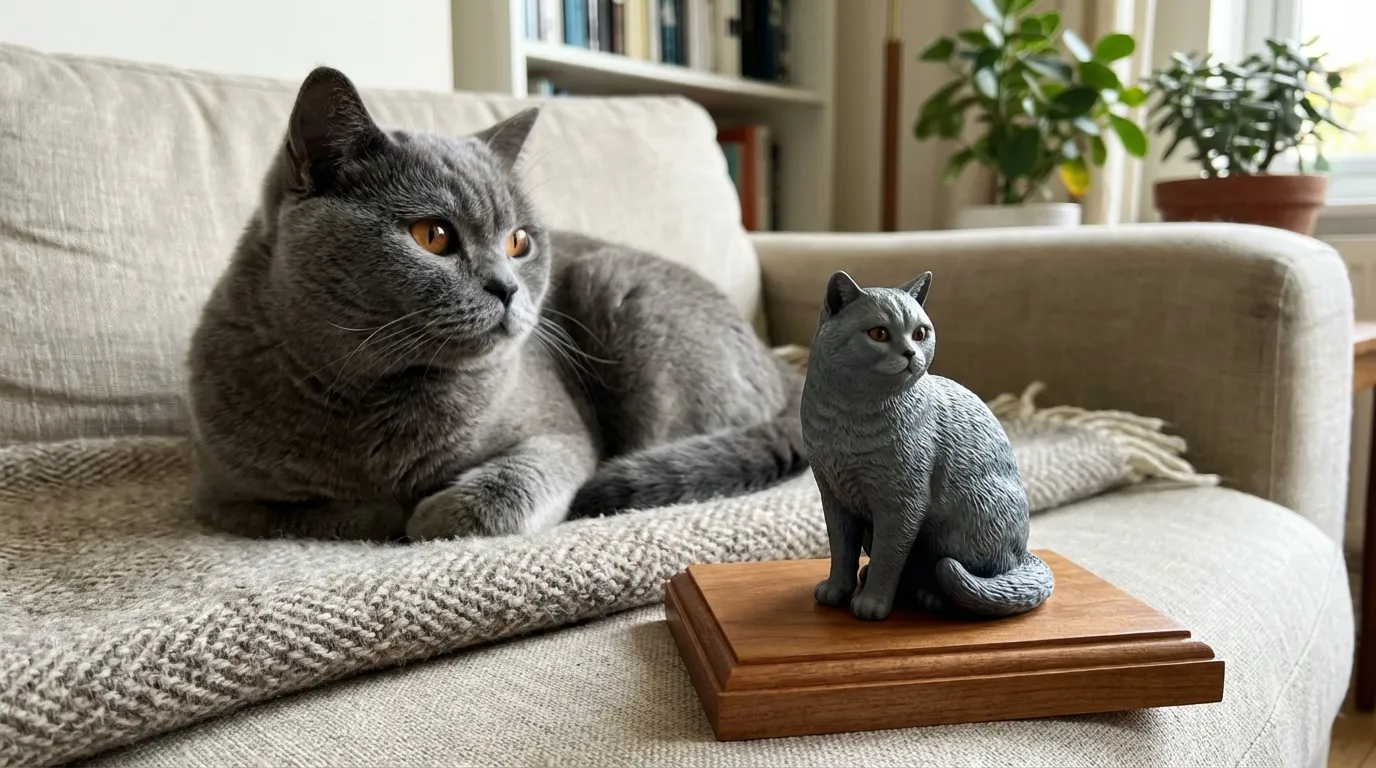
You press the power button on the remote, the screen flaring to life with the familiar blue glow of the 8:00 PM news. Instinctively, your right hand drops from the armrest to the cushion beside you, fingers curling in anticipation of sinking into that dense, plush "teddy bear" fur. But your knuckles hit only the cold, flat weave of the upholstery. The sudden lack of resistance sends a jolt through your arm that hits harder than the noise from the television. It’s muscle memory betraying you again, your body expecting the solid, warm anchor that used to define your evenings, only to find a void where your best friend used to hold court.
Quick Takeaways:
- The "Phantom Weight" is Real: Your body physically remembers the dense, stocky weight of your British Shorthair; this sensory mismatch causes genuine neurological distress.
- Rituals Anchor Grief: The evening TV routine was likely your primary bonding time; disrupting it feels like losing them twice.
- Tangible Comfort Helps: Replacing the physical sensation with a weighted blanket or a custom figurine can help bridge the sensory gap during those empty evening hours.
- It’s Okay to Change the Channel: If your old show triggers sadness, you have permission to build a completely new evening routine.
The Specific Physics of a British Shorthair Loss
We need to talk about the physics of this specific grief, because losing a British Shorthair isn't quite like losing other cats. We've heard from hundreds of families, and the owners of this breed describe a very specific sensation: the loss of "density."
British Shorthairs are the tanks of the cat world. They are cobby, muscular, and substantial. When a Siamese or a Rex leaves a room, they might leave a visual gap. But when a British Shorthair is gone, they leave a gravitational one. You were used to a solid 12 to 18 pounds of warmth pressing against your thigh or anchoring the other end of the sofa.
This is why the evening is so difficult. It’s a sensory deprivation issue. Your proprioception—your body's sense of where it is in space relative to other things—has been calibrated for years to account for that heavy, quiet presence. When you sit down and the cushion doesn't dip under their weight, your brain registers an error. It’s disorienting. It’s not just that you miss them emotionally; your body physically misses the counterweight.
The "Next-to-You" Void
There is a unique pain for owners of this breed because British Shorthairs are rarely lap cats. They are the masters of "nearby." They are the supervisors. They sit next to you, not on you.
This creates a specific visual habit. For years, your peripheral vision has been filled with that round, owl-eyed face looking up at you during commercial breaks. You didn't have to look down at your lap; you had to look to the side.
Now, that spot on the cushion is empty. And because they weren't on your lap, you can't just put a pillow on your knees to mimic the feeling. The emptiness is adjacent to you. It’s a co-pilot seat that’s suddenly vacant. We’ve found that many owners instinctively start piling throw pillows or blankets on "the spot" just to stop their eyes from constantly drifting to the emptiness. It’s a subconscious attempt to fill the visual gap that your brain keeps trying to process.
The Secret Guilt of the Clean Sofa
Here is the part of grief that almost no one talks about because it feels shameful to admit. But we're going to say it: There is a moment, perhaps a week or two in, where you look at your velvet sofa or your dark throw blanket, and you realize it’s clean.
British Shorthairs have that incredible double coat—dense, plush, and notorious for shedding. For years, your evening ritual probably included lint-rolling your clothes or accepting that everything you own would be covered in a fine layer of gray or blue down.
Then, one Tuesday, you realize you haven't had to vacuum the upholstery in days. You realize you can wear black leggings without looking like a fuzzy mess. And for a split second, you feel a tiny flicker of relief.
And immediately after that relief comes the guilt. It hits you like a physical blow. How could I be happy about a clean couch when my cat is dead? Am I a terrible person? Did I love them enough?
Please hear us on this: You are not a bad person. You are a human being recovering from caretaking. That flicker of relief isn't about wanting them gone; it's your brain acknowledging a reduction in workload. It is entirely possible to be devastated by the loss of your companion while simultaneously appreciating that a chore has been removed from your list. These two feelings can coexist. Don't let the guilt of the clean sofa consume you. It’s just lint. It’s not a measure of your love.
Reclaiming the 8 PM Hour
The evening TV ritual is often the hardest habit to break because it’s passive. You’re tired, your defenses are down, and you’re just sitting there. The silence can become deafening. British Shorthairs aren't vocal cats—they don't yowl for attention—but their "quiet" is a heavy, present quiet. The silence of an empty house is a thin, sharp quiet.
Here are a few strategies we’ve seen work for families trying to navigate this specific time of day:
Disrubt the Geography
If your cat always sat on the left cushion, do not sit on the right cushion and stare at the empty spot. For the next three weeks, sit in the armchair. Or lie on the floor. Or sit on the other end of the sofa. You need to break the physical expectation that they should be right there. By changing your physical position, you signal to your brain that this is a new routine, reducing the "error message" you get when you reach out and feel nothing.Introduce "Intentional" Weight
Since the loss of a British Shorthair is so tied to their physical density, replace it. A weighted blanket (15-20 lbs) draped over your legs or the cushion next to you can trick the nervous system into calming down. It mimics that "anchoring" sensation you’re missing.Create a Visual Anchor
Some people find comfort in photos, but others find 2D images flat and painful during these moments. This is where tangible memorials bridge the gap. We’ve worked with many British Shorthair families who commission a custom figurine specifically to place on the side table or the media console.Having a three-dimensional representation—one that captures that specific "cobby" posture and the roundness of the cheeks—gives your eyes a place to land. It’s not about pretending they are still there; it’s about acknowledging that they still hold a place in the room. When your peripheral vision seeks them out, it finds something beautiful and familiar, rather than just empty space.
When the Show Ends
There’s a reason you’re reading this article. It’s likely evening right now, or you’re dreading the evening coming. You’re wondering if you’ll ever be able to watch The Great British Baking Show without weeping because that was "your time" together.
The answer is yes, but not yet. And probably not in the same way.
The indentation on the sofa cushion will eventually rise back up. The stray hairs will eventually be vacuumed away. But the indentation in your evening routine—that space where a quiet, sturdy, golden-eyed presence used to be—that stays. And that’s okay. You don't have to "get over" the empty lap. You just have to learn how to sit comfortably with the memory of the weight that used to be there.
Frequently Asked Questions
Why does the grief feel worse in the evening?
Evenings are typically when we slow down. During the day, work and chores keep your mind occupied, but when you sit down to relax, your distractions vanish. Your defenses lower. For British Shorthair owners specifically, the evening was likely the primary "together time." The contrast between the noise of the day and the silence of the evening amplifies the feeling of loss.Is it normal to feel relief about less cleaning after pet loss?
Yes, and it is vital that you forgive yourself for this. British Shorthairs are heavy shedders. Acknowledging that you have less housework is a logical observation, not an emotional betrayal. It is a very common part of the "caregiver burnout" cycle that resolves when caretaking ends. It does not diminish your love.How can I stop looking at the empty spot on the sofa?
Your brain is a prediction machine; it predicts the cat will be there because the cat was there for years. To stop the painful "glitch," change the input. Rearrange the living room furniture. Swap the lamp to the other side. Sit in a different chair. If you change the environment enough, your brain is forced to build a new prediction model, which helps stop the automatic looking-for-them reflex.How long does the "phantom cat" sensation last?
This varies by person, but typically the acute phase—where you swear you see them out of the corner of your eye or feel the bed depress—lasts anywhere from three to six months. It takes time for your brain's "muscle memory" to rewire itself to the new reality of your home.Honor Their Memory Forever
Your pet's story deserves to be preserved in a way that captures their unique spirit. A custom PawSculpt figurine transforms your cherished memories into a timeless keepsake—every whisker, every marking, every detail that made them irreplaceable.
Free instant AI preview • 3D artist preview within 7 days • 5 free revisions