
Custom Figurine vs. Memorial Jewelry: The Turnaround Time Breakdown That Matters
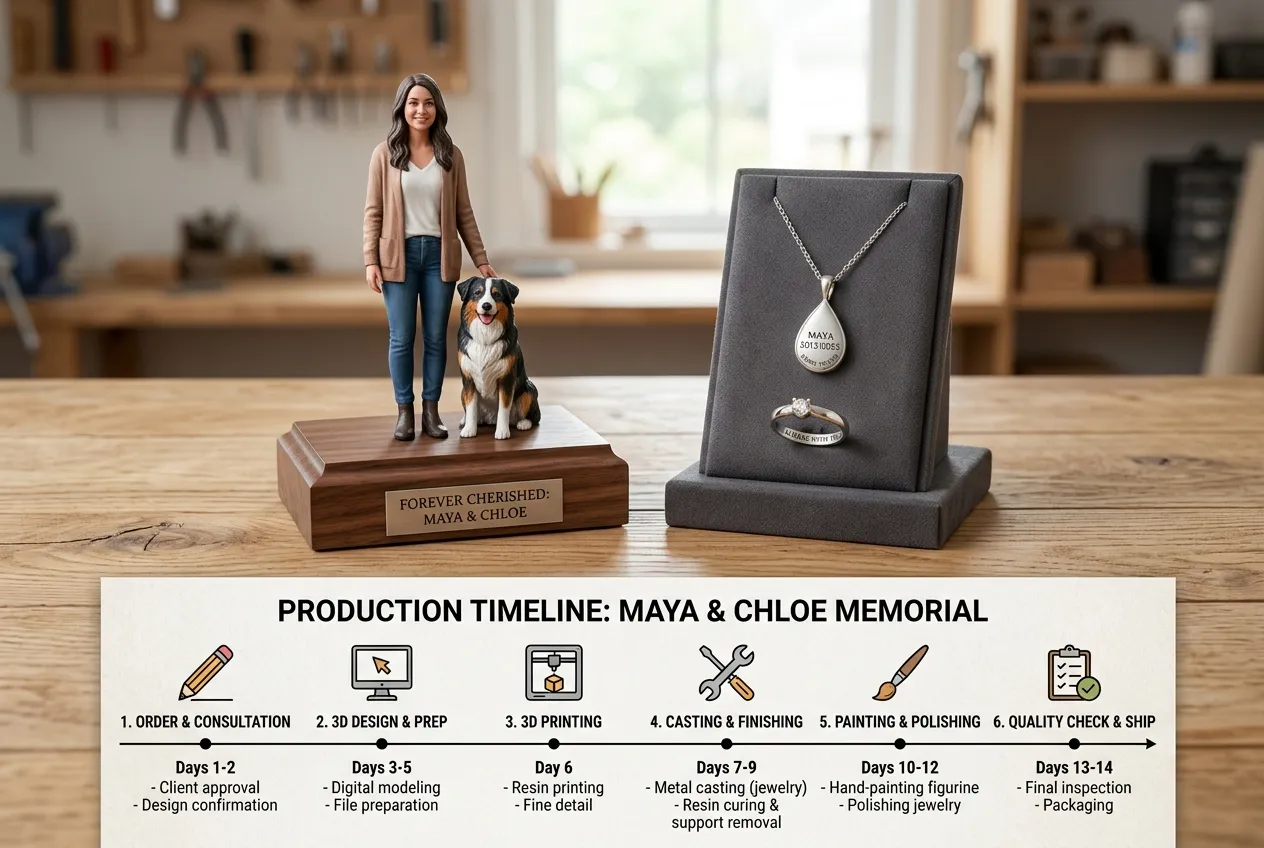
Research suggests scent is one of the strongest memory triggers in grief; at the park bench where their leash used to knock your knee, choosing a pet memorial can feel less like shopping and more like deciding how quickly you need their presence back.
Quick Takeaways
- Fast isn’t always kinder — choose the memorial that matches your stage of grief.
- Memorial jewelry feels private — a custom figurine offers daily visual presence at home.
- Turnaround time includes emotional labor — gathering ashes, fur, or photos takes energy.
- Previews reduce uncertainty — explore custom pet figurines at PawSculpt if seeing details early matters.
- Cost comparison should include use — ask where and how often you’ll interact with it.
The Turnaround Time Breakdown Most People Miss
Most articles compare custom figurine and memorial jewelry by listing price, material, and style. Useful, sure. But not enough.
Because the real question usually arrives at a raw hour. Your pet’s blanket still smells like warm fur and dust and that faint sun-baked sweetness from the porch. Their bowl is still by the wall. And you are not asking, “Which product is best?” You are asking, “What can I emotionally survive waiting for?”
That is the angle many buying guides miss.
Turnaround time is not just a production metric. It is a grief variable. It changes what you hold in the first week, what anchors you in the first month, and what becomes part of your long-term ritual after the sharpest pain softens.
We’ve worked with pet families in celebration and in mourning, and one pattern appears again and again: people often choose a memorial based on urgency, then later realize they really needed to choose based on form of presence.
A small example. One customer came to us after ordering memorial jewelry elsewhere. The jewelry mattered to her, and she wore it every day. But what she missed was the sight of her dog waiting by the entry table—the visual companionship of him. She wanted something for the room, not just her body. That difference changed everything.
So before we get into cost comparison, materials, and timing, hold onto this idea:
A fast keepsake is not automatically the right keepsake. The right keepsake is the one that meets the exact shape of your grief.
"The hardest wait isn’t production time. It’s the space between missing them and feeling them near again."
Turnaround time has three layers, not one
When people search “How long does memorial jewelry take?” or “How long does a pet figurine take?” they usually mean manufacturing. But there are really three clocks running:
- Decision time — how long it takes you to choose without second-guessing
- Preparation time — how long it takes to gather what the maker needs
- Production time — how long the item itself takes to create
That middle one—preparation time—is where grief quietly steals days.
If a jewelry maker requires ashes, fur, or engraving details, you may need to coordinate with a crematory, locate keepsake fur, or decide which words you can bear to see every day. That sounds simple on paper. It often isn’t.
If you’re ordering a figurine, the emotional labor shifts. You’ll likely need to choose photos that show markings, posture, and expression. This can take time too, especially if you keep stopping at that one picture from the rainy afternoon walk, the one where the ears are damp and the eyes look straight into you.
Different labor. Different ache.
A more honest timeline: what the process feels like
Here’s a practical way to compare the two memorial types beyond marketing language.
| Stage | Memorial Jewelry | Custom Figurine | What it feels like emotionally |
|---|---|---|---|
| Choosing the format | Fast if you already know pendant/ring style | Fast if you want a display piece | Decision fatigue often hits here |
| Gathering materials | May require ashes, fur, engraving info | Usually requires clear reference photos | Jewelry can feel heavier if remains are involved |
| Design clarification | Often limited by size and form | Often centers on markings, pose, expression | Figurines ask you to remember visual details |
| Production wait | Varies by maker and method | Varies by artist and printing workflow | Waiting can feel healing or unbearable |
| Receiving and using | Worn close, often private | Displayed openly, often shared | One becomes intimate; one becomes environmental |
The counterintuitive insight here? The memorial with the shorter production timeline can still feel longer if the inputs are emotionally harder to assemble.
That’s why “faster” should never be your only filter.
Custom Figurine vs. Memorial Jewelry: Presence, Privacy, and the Shape of Grief
A pet memorial is not only about remembrance. It is about where remembrance lives.
Memorial jewelry usually lives on your body. A figurine lives in your space. And your nervous system responds differently to those two forms of closeness.
This matters more than most comparison guides admit.
Memorial jewelry: portable, intimate, and sometimes too close
There are beautiful reasons people choose memorial jewelry. It can feel sacred. Quiet. Like carrying a pulse of their spirit against your skin.
For some people, especially in the first 30 days, that intimacy is exactly right. They want a private ritual—touching the pendant during meetings, holding the ring in the car, pressing fingers to the necklace when a wave of grief hits in the grocery store.
And there’s another practical truth: jewelry can be easier to keep near when your routine continues whether your heart is ready or not.
But here’s what people don’t say enough: wearable grief can be intense.
If the memorial includes ashes or fur, the emotional charge may be higher than expected. Some pet parents feel comfort immediately. Others feel pressure—afraid of losing it, damaging it, or wearing it on a day they already feel fragile. We’ve heard versions of this many times: “I loved the idea, but I wasn’t prepared for how loaded it felt.”
That doesn’t make it wrong. It makes it personal.
Custom figurines: visible companionship in a shared space
A custom figurine offers a different kind of solace. It doesn’t ask you to wear your grief. It lets you place it.
On a shelf by the books. On the desk where your cat used to sprawl over invoices. Near the framed paw print, the collar, the candle that still smells faintly of cedar and rain.
That environmental presence can be surprisingly stabilizing. You don’t have to remember to put it on. You don’t have to explain it to anyone unless you want to. It becomes part of the room’s emotional architecture.
One family we worked with placed their figurine in the kitchen because that was “his kingdom”—the exact patch of floor where he supervised breakfast. They told us the object changed the room from absence to acknowledgment. Not because it erased loss. Because it gave loss a form.
And that’s often what people need most.
"Sometimes healing begins when memory stops floating and finally has a place to land."
The overlooked question: Do you need touch, or do you need sight?
This is the question we wish more buyers asked before comparing cost comparison charts.
Do you need touch, or do you need sight?
If your grief shows up in restless hands, memorial jewelry may feel grounding. If your grief shows up as a haunted room—doorways, feeding stations, favorite window ledges—a figurine may serve you better because it restores visual presence.
This isn’t abstract. It affects daily life.
Try this test tonight:
- Notice where grief catches in your body
- If your hand reaches for your chest, neck, or pocket, jewelry may fit
- If your eyes keep drifting to one empty spot in the house, a figurine may fit
- If both are true, you may eventually want both—but not at the same time
That last part matters. Not at the same time.
The mistake most people make is ordering the most emotionally intense memorial first. What often helps more is choosing the memorial with the lowest emotional friction for your current state.
Myth vs. Reality
Myth: Memorial jewelry is always the faster, easier choice.
Reality: If it requires ashes, inscriptions, or tiny design decisions, the emotional prep can slow you down more than expected.
Myth: A custom figurine is only for display, so it’s less comforting.
Reality: Visible objects shape rituals. Seeing your pet’s likeness daily can regulate grief in a powerful, steady way.
Myth: Cost should decide it.
Reality: The better question is how often you’ll interact with the memorial over a year.
Turnaround Time in Real Life: What Delays Actually Happen
Let’s get concrete.
When people compare turnaround time, they often imagine a neat factory-style countdown. Order placed. Product made. Package arrives. Done.
Real life is messier.
A pet loss can make simple admin feel impossible. Emails sit unanswered. Photos remain unsorted. The cremation paperwork takes longer than expected. Family members disagree on which expression “looks most like her.” You keep opening your camera roll and then closing it because the sight of that blue blanket, still carrying the smell of shampoo and old treats, knocks the wind out of you.
So the meaningful comparison is not just “Which company ships sooner?” It is: Which process creates less friction for the version of you that exists right now?
Typical friction points with memorial jewelry
Memorial jewelry can involve several emotional bottlenecks:
- Obtaining ashes or fur if you don’t already have them accessible
- Choosing a small format where one tiny design decision feels huge
- Selecting engraving text when every word feels inadequate
- Fear of making a permanent mistake on something you’ll wear often
Small objects can carry enormous pressure. We think that’s worth saying plainly.
If your grief is fresh, the permanence of engraving can be unexpectedly hard. Dates, names, short phrases—these choices look simple on a website. In real life, they can take days.
And if your memorial jewelry includes cremains, there can be another layer: some people feel deeply comforted by that inclusion, while others need more time before they can engage with remains in that way. Neither response is wrong.
If pet loss is recent and intense, resources like the Association for Pet Loss and Bereavement can be genuinely grounding. Not because a website fixes grief, but because being understood lowers panic.
Typical friction points with custom figurines
A figurine has its own challenges, but they’re different.
- Photo selection matters
- Markings and pose details may require careful review
- You may revisit images repeatedly, which can be tender
- Display decisions come later—where it will live, what it will sit beside
But many families find this process more intuitive because photos already exist. You are working from life as it was, not from remains or inscription language. For some people, that feels gentler.
At PawSculpt, for example, the process centers around visual reference because the figurines are digitally sculpted by master 3D artists, then precision 3D printed in full color. The pet’s coat patterns and markings are reproduced directly in full-color resin, with a protective clear finish applied afterward. That means the emotional task is often about choosing the truest image—not translating your pet into abstract symbolism.
And honestly, that can be a relief.
What usually slows a figurine order down?
In our years working with pet families, these are the most common slowdowns for a figurine project:
- Only one usable photo exists
- The pet had complex markings and the angles don’t show both sides
- The family wants a very specific pose
- Multiple decision-makers are involved
- The buyer is ordering while actively grieving and needs extra time to approve details
None of these are dealbreakers. They just affect rhythm.
The good news is that figurine-based memorials often make room for collaborative remembrance. One sibling finds the side-profile photo. Another remembers the white patch on the back paw. Someone else says, “No, his ears sat a little wider.” That process can become a ritual in itself.
A practical photo checklist that saves time
If you’re leaning toward a figurine, this simple checklist helps more than most people realize:
| Photo Type | Why it matters | Best case | Common issue |
|---|---|---|---|
| Front view | Captures face shape and expression | Eyes visible, neutral light | Blurry nose-closeup selfie |
| Side view | Shows body profile and markings | Full body standing or sitting | Cropped torso |
| Back/three-quarter view | Confirms coat pattern placement | Natural daylight | Missing tail or saddle markings |
| Favorite personality shot | Helps artists understand spirit | Typical posture or look | Costume photo that hides features |
| Close-up detail | Useful for eyes, nose, collar details | Sharp and well-lit | Filtered image alters color |
The often-overlooked truth: the fastest order is usually the one with the clearest reference materials, not the one from the product category people assume is quicker.
Why “preview time” matters more than people think
This is one place where readers can save themselves heartache.
A memorial is emotionally loaded. The ability to see or confirm how your pet is being interpreted can matter as much as overall turnaround time. Not because you want control for control’s sake, but because grief makes uncertainty louder.
If seeing a concept or preview would settle your nerves, that should be on your checklist before buying. You can explore current details and workflow expectations on PawSculpt’s FAQ page, since service specifics can change.
That kind of transparency doesn’t just save time. It protects your energy.
Cost Comparison That Actually Reflects Value
Let’s talk money in a way that’s honest.
A cost comparison between memorial jewelry and a custom figurine can’t stop at the checkout page. If it does, it misses the real economics of comfort.
Because memorials are not just products. They are objects of repeated emotional use.
Think in “cost per interaction,” not sticker price
This is the counterintuitive insight most shopping guides skip.
Instead of asking, “Which costs less?” ask, “Which will I meaningfully interact with most over the next 365 days?”
A piece of jewelry may be worn daily—but only if it feels emotionally easy to wear. A figurine may sit in one room—but if you see it ten times a day and feel steadier each time, its value is not passive.
One family told us their figurine became the place everyone said goodnight to for months. That’s not decorative use. That’s ritual use.
And ritual changes value.
A simple framework for comparing memorial value
Use these four lenses:
- Frequency — how often will you see, touch, or use it?
- Intensity — will it comfort you or overwhelm you?
- Durability — can it live safely in your actual life?
- Shareability — is this for you alone, or your household too?
Here’s how the two often differ.
| Factor | Memorial Jewelry | Custom Figurine |
|---|---|---|
| Daily interaction | High if worn consistently | High if placed in a lived-in space |
| Emotional intensity | Often higher, especially with cremains | Often steady and visual |
| Risk/loss anxiety | Can be significant if worn outside home | Lower if displayed securely indoors |
| Household connection | Often personal and individual | Often communal and visible |
| Gift suitability | Intimate, best for one person | Strong option for families or shared spaces |
This is why the “cheaper” option can become the less-used option. And the more-used option often becomes the better value, even if the upfront price is higher.
Hidden costs people forget to count
We’re not talking exact pricing here—those details vary by maker and change over time. But there are hidden costs in this decision beyond the product itself:
- Shipping and handling for delicate or sentimental materials
- Replacement anxiety if the piece is lost or damaged
- Additional display purchases for home memorial setups
- Time spent collecting better photos or coordinating remains
- Emotional cost of choosing something that doesn’t fit how you grieve
That last one is real. Real enough that it belongs in every buyer’s guide.
A memorial that arrives quickly but doesn’t soothe you is expensive in a way spreadsheets don’t capture.
"The right memorial doesn’t just preserve memory—it changes the atmosphere around memory."
— The PawSculpt Team
If you’re buying as a gift, the rules change
Gift-givers often over-focus on aesthetics. We get why. You want something beautiful.
But if you’re buying for someone else, turnaround time and emotional format matter even more than looks.
A grieving person may not want to wear their loss publicly. They may not feel ready to handle cremains. They may also not want another generic sympathy gift that gets tucked into a drawer.
This is where a figurine can be especially thoughtful. It can honor a pet’s real look—the tilt of the ears, the exact tabby stripes, the white blaze on the chest—without asking the recipient to make immediate bodily intimacy part of their grief.
That said, memorial jewelry can be a wonderful choice if you know the recipient already wears symbolic pieces and values private touchstones.
Our honest take? If you are unsure, choose the memorial with lower emotional pressure and broader household meaning.
For readers thinking beyond immediate loss, the PawSculpt blog also explores keepsake ideas for celebrating living pets—because not every meaningful memorial begins after goodbye.
The Sacred Practicalities: What to Expect From Each Process
There is a spiritual layer to all of this, and we don’t think that’s sentimental fluff. We think it’s real.
A pet leaves behind more than belongings. They leave behind patterns of presence. The pause by the door at 5:30. The place on the rug that still seems occupied. The smell of rain on their fur after a late walk. The soft animal warmth that used to turn an ordinary room into a lived-in sanctuary.
Choosing between memorial jewelry and a custom figurine is, in part, choosing how you want to honor that lingering spirit.
But spirit still meets logistics. So let’s make the process feel less foggy.
What to expect with memorial jewelry
Memorial jewelry usually works best if:
- You want a private memorial ritual
- You prefer touch-based comfort
- You already have access to ashes, fur, or wording
- You’re comfortable with a small object carrying large meaning
It may be harder if:
- You feel anxious about losing valuable sentimental items
- You aren’t ready to interact with remains
- Tiny visual details matter deeply to you
- You want a memorial that supports the whole household
There’s no shame in any of that. Grief has preferences. And they are often very specific.
What to expect with a custom figurine
A figurine usually works best if:
- You want a visible home presence
- Your pet’s specific markings are central to your memory
- You need a memorial others in the home can also connect with
- You are soothed by seeing, not only touching
It may be harder if:
- You don’t have enough usable photos
- You need a keepsake you can carry everywhere
- You want an ultra-abstract or symbolic interpretation rather than likeness
At PawSculpt, the work is rooted in digital craftsmanship. Pets are hand-modeled digitally with care, then brought to life through advanced full-color 3D printing technology. Because color is printed directly into the resin material—not applied as a surface layer—the markings become part of the piece itself. You’ll still see the natural texture of 3D print grain under the protective clear coat, which many families appreciate because it feels real, not artificially flawless.
That authenticity matters. Perfectly polished is not always the same as emotionally true.
The sensory difference nobody talks about
This surprised us over the years.
People often assume memorials are mostly visual. But grief is profoundly sensory, especially around pets. The smell of a blanket. The mineral scent of the porch after rain where your dog used to sit. The slightly dusty, sun-warmed scent of the cat tree. The clean-soap smell after a bath mixed with something unmistakably them.
Jewelry can create a touch ritual that grounds those sensory memories.
Figurines can create a place ritual that gathers them.
One is portable sacredness. The other is environmental sacredness.
And if your home feels spiritually unsettled after loss—that strange sense that the energy is missing from a specific corner—a figurine often addresses that more directly.
If your pet is still living, timing feels different
Not every reader is grieving right now. Some of you are here because your dog is gray around the muzzle, or your cat has slowed down, and you can feel time becoming visible.
If that’s you, we’ll say something plain: ordering before a loss can be an act of love, not pessimism.
In some cases, choosing a memorial while your pet is still here reduces panic later. You have better photos. More emotional bandwidth. And the process can feel celebratory rather than crisis-driven.
This is especially true for custom figurines, where likeness depends on clear images and familiar posture. For breed-specific visual details, the American Kennel Club’s breed guide can even help some families identify hallmark features they want represented accurately.
That preparation isn’t morbid. It’s tender.
A grounded decision framework
If you need to decide this week, use this three-step filter:
- Name your current grief state
- Choose your needed form of comfort
- Assess your available energy
This is what practical compassion looks like. Not “pick the nicest object,” but pick the process your nervous system can handle.
Which Option Fits Your Timeline, Budget, and Emotional Capacity?
By now, you can probably feel that this isn’t a simple “A beats B” article. It shouldn’t be.
Different memorials serve different seasons.
Still, you may want a more direct answer. So here it is.
Choose memorial jewelry if…
Memorial jewelry may be the better fit if you:
- Need a close-to-body reminder
- Already know you’re comfortable with a wearable keepsake
- Want something discreet for work, travel, or private moments
- Prefer symbolism over a full visual likeness
- Have the emotional energy for small but permanent design choices
Micro-story: one customer’s daughter chose jewelry because she was leaving for college two weeks after the family dog passed. She needed something portable, something she could hold during homesick nights in a dorm room that smelled like detergent and unfamiliar air. For her, jewelry was right.
That’s the point. Right is contextual.
Choose a custom figurine if…
A custom figurine may be the better fit if you:
- Need your pet’s presence returned to a room
- Want to preserve markings, posture, and expression
- Are buying for a family rather than one person
- Prefer a memorial that does not require wearing or carrying
- Have good photos and want a highly recognizable likeness
Micro-story: we remember a family who set their cat’s figurine beside the windowsill herb pots she used to knock over. The room had smelled empty to them—yes, empty has a smell, like air with one note missing. Once the figurine arrived, that corner felt acknowledged again.
Not fixed. Acknowledged.
If turnaround time is your top concern
If you are choosing mainly by turnaround time, ask these questions before ordering anything:
- What materials will I need to submit?
- Can I gather them in the next 48 hours without distress?
- Will I have a chance to confirm details or previews?
- Is the process likely to comfort me while I wait—or make me feel worse?
- What happens if I need a little more time to make decisions?
Notice how none of those questions are about speed alone.
Because what actually helps most is not the shortest path. It’s the path with the least emotional turbulence.
If cost comparison is your top concern
If your main concern is budget, be honest about use:
- A less expensive keepsake you rarely engage with may not serve you well
- A higher-investment memorial used in daily ritual may carry more value
- Group gifting can make a shared-space memorial more accessible
- Not every meaningful option has to be purchased immediately
And yes, sometimes waiting is the best financial and emotional decision. We’re not huge fans of pressure buying in grief. If you’re unsure, create a temporary memorial first—a framed photo, collar, candle, favorite toy in a small sacred space—and revisit the permanent decision after a week or two.
That pause can save money and regret.
The balanced answer most readers need
If you want the simplest summary:
- Choose memorial jewelry for portability, privacy, and tactile comfort
- Choose a custom figurine for visual likeness, home presence, and shared remembrance
- Prioritize process friction over advertised speed
- Use cost comparison as a second filter, not the first
This is also where a company’s medium matters. PawSculpt’s figurines are not generic statues; they are full-color resin 3D prints shaped from your pet’s photos by experienced digital artists, then sealed with a protective finish. For families whose grief is tied to visual specificity—the exact caramel patch above one eye, the black-tipped ears, the white sock on one paw—that kind of likeness can be more healing than symbolic objects alone.
And if you’re still torn? You’re not indecisive. You’re trying to honor a bond that was never ordinary.
How to Make the Decision Without Regret
You do not need to be perfectly certain. You need to be honest.
That’s the real work here.
Not proving how deeply you loved them. Not choosing the “best” mourning object. Just noticing what your body, your home, and your spirit are asking for.
A no-regret checklist
Before you order, write down the answers to these five prompts:
- The moment I miss most is:
- What hurts most right now is:
- I want this memorial to help me:
- I have the energy to provide:
- I imagine using it:
This takes ten minutes. It can save you weeks of uncertainty.
Build a temporary sacred space first
If you’re overwhelmed, make a sacred space before buying anything permanent.
Place these together:
- A framed photo
- Collar or tag
- Candle
- Toy or blanket
- A small bowl of flowers, stones, or whatever feels true to your rituals
Sit there for five minutes in the evening. Notice whether you reach to touch something—or whether you mostly need to look.
That single observation will tell you a lot about whether memorial jewelry or a custom figurine is likely to comfort you more.
Give yourself permission to choose in stages
Here’s the final overlooked truth: memorial decisions do not have to be one-and-done.
Some people begin with jewelry and later add a display piece. Some create a figurine first, then choose a wearable keepsake on an anniversary. Some start with nothing permanent at all.
Grief changes shape. Your memorials can too.
And if you choose a figurine, spend time with your photos before submitting them. Look for the image that carries not just appearance, but presence—the posture that says them. If you’re considering a 3D likeness, browsing examples of memorial keepsakes and pet sculptures can help you understand what visual details matter most before you begin.
You are not late. You are not doing this wrong.
The right object will not replace your companion. But it can hold a doorway open between memory and daily life.
The leash may still be hanging by the door, still catching light like it expects movement. Let your next step be simple: decide whether you need something to carry or something to come home to. In that answer, your pet memorial usually reveals itself.
Frequently Asked Questions
How long does a custom figurine take compared to memorial jewelry?
There isn’t one universal answer because every maker has a different workflow. But in real life, the biggest time difference often comes from what you need to gather first. Memorial jewelry may require ashes, fur, or engraving choices, while a figurine usually depends on strong photos and any needed visual clarifications.
Is memorial jewelry or a custom figurine better after pet loss?
Better depends on the shape of your grief. If you need something private and wearable, memorial jewelry may feel grounding. If you need your pet’s presence restored to a room, a custom figurine often provides steadier daily comfort.
What photos work best for a custom pet figurine?
Use clear, natural-light photos that show your pet from the front and side, plus one image that captures personality. Avoid heavy filters, dark rooms, or close-up phone shots that distort proportions. If your pet had unique markings on the back, tail, or paws, include those too.
What should I compare besides cost when choosing a pet memorial?
Look at emotional friction, not just the total price. Ask how often you’ll interact with the memorial, whether you’re ready to provide ashes or sort photos, and whether you want something for your body or your space. That’s a more honest cost comparison than sticker price alone.
Can I order a pet memorial before my pet passes away?
Yes—and for many families, it’s actually gentler. You usually have better photos, more clarity, and more emotional bandwidth before a crisis. If the idea feels loving rather than frightening, it can be a deeply meaningful act of preparation.
Ready to Celebrate Your Pet?
Every pet has a story worth preserving. Whether you're honoring a beloved companion who's crossed the rainbow bridge or celebrating your furry friend's unique personality, a custom PawSculpt figurine captures those details that make your pet one-of-a-kind.
If you’ve been weighing pet memorial options and wondering whether a visible keepsake might feel more grounding than something wearable, this is a beautiful place to begin.
Visit pawsculpt.com to learn more about our process and guarantees