
Stuffed Animal vs. 3D Figurine: Which Pet Memorial Actually Lasts a Lifetime
You set the watering can down in the garden and wait for the sound that used to follow—the tag jingle, the paws on the path—and the question lands hard: for pet memorial durability, is a stuffed animal enough, or do you need something built to outlast grief’s roughest years?
Quick Takeaways
- Choose for touch and time — soft memorials comfort now, rigid keepsakes usually endure longer
- Judge the memory trigger — the best memorial recreates your pet’s shape, markings, and everyday presence
- Think about placement first — shelf, bedside, nursery, and sunlight all change durability
- Compare materials before emotion decides — custom pet figurines at PawSculpt show how full-color resin preserves details long-term
- Don’t ignore care habits — dusting, washing, sunlight, and handling matter more than most buyers expect
Stuffed Animal Comparison vs. 3D Figurine: the question most people ask too late
Most articles on pet memorials talk about comfort first. And that makes sense. In the first few days or weeks after a loss, people want something to hold. Something soft. Something that absorbs tears without asking anything back.
But here’s the angle we think gets missed: the memorial that feels best on day three is not always the one that serves you best in year three.
That difference matters.
We’ve worked with thousands of pet families, and one pattern shows up again and again. The first memorial purchase is often emotional and fast. The long-term memorial—the one people protect, display, and keep through moves, kids, redecorating, and time—gets chosen later, after the first wave passes. Sometimes much later.
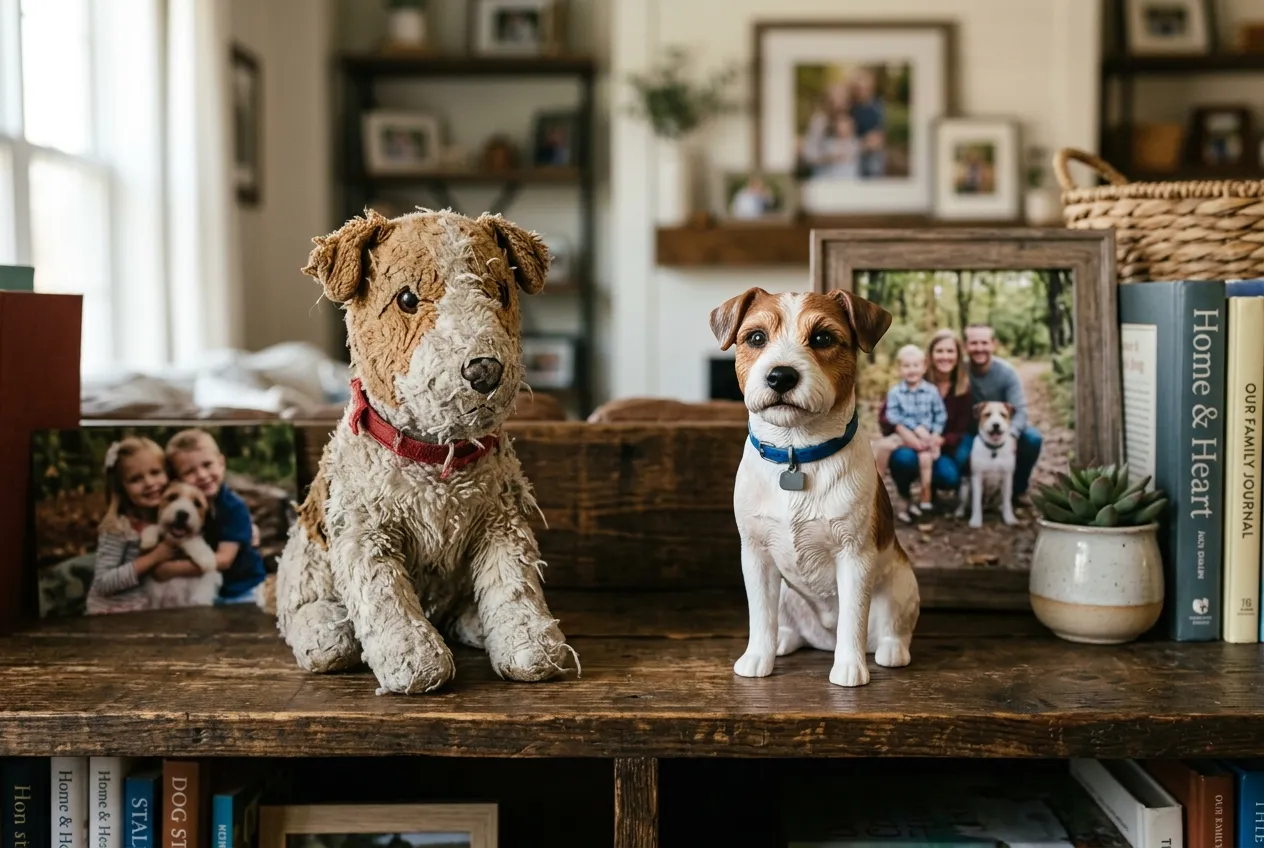
A family we worked with had both. They kept a plush version of their senior cat on the bed for the first month because they needed that softness at night. But the object that stayed with them on the bookshelf, then on a desk after a move, then in a new home years later, was the figurine. Why? It still looked like their cat. The ear tilt. The chest patch. The slightly serious face.
That’s the real test of a lasting memorial: not “Will this comfort me today?” but “Will this still feel true after everyday life returns?”
The overlooked part: grief changes what you need from an object
In the early stage of grief, your senses are on high alert. The house sounds wrong. The food bowl doesn’t clink. The collar doesn’t tap the wall. You hear the missing before you think about it.
A soft memorial often meets that stage well because it works like a transitional object. You can squeeze it. Hold it in bed. Carry it from couch to chair. That’s useful. We’re not dismissing it.
But over time, many people stop reaching for softness and start reaching for recognition. They want the exact white stripe on the nose. The tan patch over one eye. The compact sit. The alert ears. The memory shifts from “I need comfort” to “I need accuracy.”
That’s where a 3D printed figurine often becomes the standout option.
Durability is not just physical. It’s emotional.
This is the counterintuitive insight most guides skip: a memorial can stay intact physically and still fail emotionally.
A plush keepsake may remain on a shelf for years, but if it no longer resembles your pet in a convincing way, it starts to function more like a generic comfort item than a personal memorial. On the other hand, a figurine with your pet’s real markings and posture may become more meaningful over time because it continues to trigger specific memory.
So when people ask which memorial lasts a lifetime, we think there are two durability tests:
- Material durability — Will it resist wear, fading, crushing, and routine handling?
- Memory durability — Will it still feel unmistakably like your pet years from now?
The best answer depends on whether you need immediate softness, lasting likeness, or both.
"The memorial that lasts longest is the one that still feels unmistakably like them."
Pet memorial durability: what actually wears out, fades, or fails
Let’s get practical. Here’s what happens to memorial objects in real homes—not showroom homes, real ones. Homes with sunlight on one windowsill, dust on another, kids reaching up, cats jumping where they shouldn’t, and boxes packed fast during moves.
What usually happens to stuffed memorials over time
Stuffed animal memorials win on comfort. No question. They’re often the first thing people press to their chest when the house sounds too still. But they have a few weak points that don’t show up in product photos.
The common failure points are:
- Fabric wear at seams, paws, ears, and tails
- Flattening from hugging, leaning, or storage pressure
- Dust retention in plush fibers
- Color fading from sunlight or repeated cleaning
- Loss of shape accuracy over time
One customer told us her plush dog memorial looked sweet for about six months, then started looking “more like a toy dog than my dog.” That line stuck with us because it’s honest. The issue wasn’t that it fell apart. It was that the identity softened.
And that’s a real distinction.
What usually happens to figurines over time
A figurine has different tradeoffs. It won’t give you softness. It’s not the object you clutch during a hard night. But in a shelf-stable environment, a good figurine typically performs better on pet memorial durability.
A quality full-color resin figurine tends to resist:
- Compression and loss of form
- Routine dusting wear
- Fabric pilling or fuzzing
- Shape drift
- Everyday handling damage from normal display use
That doesn’t mean it’s indestructible. It’s still a display object. If it falls from a high shelf onto tile, that’s a risk. If a toddler uses it as a toy, same problem. Hard memorials need thoughtful placement.
But if your goal is long-term visual faithfulness, they usually age better.
A side-by-side view helps
Here’s our practical comparison table based on what we see families care about most.
| Factor | Stuffed Animal Memorial | 3D Figurine Memorial |
|---|---|---|
| Immediate comfort | Excellent for holding and sleeping nearby | Limited; better for viewing than cuddling |
| Shape retention | Can flatten or distort over time | Usually holds form well |
| Detail accuracy | Often simplified features | Better for markings, posture, and facial details |
| Dust and cleaning | Traps dust in fibers; cleaning can be tricky | Easier to dust gently |
| Display longevity | Best in low-handling spaces | Best for long-term shelf or desk display |
| Emotional role over time | Soothing at first, may become less specific | Often grows in meaning through visual recognition |
Worth noting: neither option is “better” in every circumstance. The standout here is fit. What job does the memorial need to do in your life?
The mistake most people make
They shop by category instead of by household reality.
If you know your memorial will live on a bed, travel between rooms, or be held often, a stuffed option makes sense. If you know you want something that stays visible year after year and still captures your pet’s exact look, a figurine deserves serious consideration.
That sounds obvious, but people often buy backwards. They choose softness because they’re grieving, then later realize what they wanted was permanence.
The sounds of daily life matter more than you think
Here’s another overlooked piece: memorial objects often become placeholders for the soundtrack of routine.
The leash hook doesn’t rattle anymore.
The nails don’t tap across the kitchen floor.
The collar tag doesn’t ring against the water bowl.
A stuffed animal can soothe the body. A figurine often restores the visual cue that helps your brain make peace with the missing sounds. That’s why some people place a figurine near the entryway, food station, or favorite window—not because it replaces the pet, but because it anchors a familiar part of the room.
And honestly, that can help more than people expect.
Which lasting memorial matches the stage of grief you’re actually in?
Not everyone needs the same object at the same time. This is where we’d be more opinionated than most guides: timing changes the right choice.
In the first 48 hours: softness often wins
The first two days are rarely about design. They’re about shock, logistics, and strange tiny moments. You wake up and listen for the shake of ears. You open a bag of treats by habit. You hear a car door outside and expect barking.
During that stage, a plush memorial or familiar blanket often helps because your nervous system is looking for regulation. Softness has a job.
If someone is buying a pet loss gift immediately after a loss, this is one of the few times we’d say a stuffed memorial may be the better first choice. It meets the body where the grief is.
After the first couple of weeks: likeness becomes more important
By week two or three, many people start sorting photos. They replay little details. The sound of snoring under the table. The sneeze after drinking water. The sideways sit. The “look” right before dinner time.
That’s often when buyers become more selective.
They don’t just want a symbol of a pet. They want their pet.
This is why a custom figurine often becomes our top pick for the longer arc of remembrance. If it’s digitally sculpted from your photos and precision 3D printed in full color, you’re preserving information that soft memorials usually simplify away.
The white whisker spots. The uneven sock markings. The exact ratio of head to chest. Those details are memory triggers.
Months later: the memorial becomes part of home design
This sounds practical because it is. Eventually, grief has to coexist with laundry, bills, work calls, and dinner.
At that stage, people usually want a memorial that can live in the room without feeling temporary or childlike—especially in adult spaces like a study, living room bookcase, or hallway table.
A figurine works well here because it functions as both memory object and display piece. It doesn’t need to be tucked away when guests visit. It can simply belong.
One of our customers placed her dog’s figurine near the window where he used to wait for her car. She told us the room stopped feeling interrupted. Not fixed. Just less interrupted. That’s a meaningful distinction.
"Grief softens, but the details you save are what keep love recognizable."
A quick grief-stage guide
This table can help you match the memorial to the moment you’re in.
| Timeframe | What people often need | Best-fit memorial type | Why it helps |
|---|---|---|---|
| First 48 hours | Physical comfort, something to hold | Stuffed memorial, blanket, pillow | Helps regulate emotion and sleep |
| First 2-6 weeks | Accuracy, story, photo sorting | Custom figurine, framed portrait | Turns memories into specific form |
| 2-6 months | Stable display, ritual, home integration | Figurine, shadow box, photo display | Supports daily remembrance without disruption |
| Long-term | Durability and ongoing identity | Figurine, engraved stone, album | Holds up through moves and time |
Myth vs. Reality
Myth: A softer memorial is always more healing.
Reality: In early grief, yes, sometimes. In long-term grief, recognition often heals more than softness.
Myth: A hard memorial feels too formal.
Reality: The right one can feel deeply personal because it preserves posture, markings, and expression.
Myth: You should choose one memorial and be done.
Reality: Many families need layers—something to hold now, something to keep for life.
This layered approach is worth considering. We’re not huge fans of forcing one object to do every job.
3D printed figurine quality: what determines whether it really lasts
Not all figurines are equal. That’s the part many comparison articles skip because “figurine” sounds like one thing. It isn’t.
There’s a major difference between a mass-market printed keepsake and a carefully modeled, full-color memorial built from strong reference photos.
The first filter: how the color is made
This is a big one. If color sits on top of an object as a surface treatment, wear can become a concern in a different way than if color is integrated into the material itself.
With PawSculpt, the figurines are digitally sculpted by master 3D artists, then precision 3D printed in full color. The result is a full-color resin print where color is part of the material itself, printed voxel-by-voxel, not added afterward with manual coloring. A clear protective coat is applied as the final finishing step.
Why does that matter? Because for a memorial, color integrity is part of identity. A black ear patch that shifts, a pink nose that dulls, or a chest blaze that loses definition can change the emotional effect of the piece.
That integrated full-color approach is one reason many pet parents see a well-made figurine as a stronger long-term choice.
The second filter: likeness depends on photos more than people realize
This surprises buyers all the time. The quality of the final memorial often depends less on how expensive the category sounds and more on the quality of the photos submitted.
We’d rank photo quality above almost every other input.
The best reference images usually have:
- Natural lighting
- Sharp focus on the face and body
- True-to-life color
- Multiple angles
- A posture your pet naturally held
The mistake most people make is sending one adorable but low-angle close-up from the couch. Cute? Absolutely. Useful for accurate modeling? Not enough.
Here’s a quick table to show what helps most.
| Photo Type | Why it matters | Best practice | Common mistake |
|---|---|---|---|
| Front face view | Captures expression and eye spacing | Eye-level, natural light | Flash flattening features |
| Side profile | Shows snout length and ear shape | One clean profile shot | Fur blocking outline |
| Full-body standing or sitting | Defines posture and proportions | Include paws and tail | Cropped legs or tail |
| Close-up of markings | Preserves unique spots/patches | Sharp image of chest, paws, face | Filters changing color |
| Favorite expression | Adds personality | Use a familiar calm look | Open-mouth blur mid-motion |
If you’re planning a figurine, gather photos before you’re exhausted. Ideally, collect 8 to 15 solid images. More isn’t always better. Better is better.
The third filter: where it will live
A figurine’s lifespan depends heavily on placement. This is practical, but it’s the kind of practical point people forget until after the purchase.
Best places for display:
- A bookshelf away from direct edge traffic
- A desk corner with low bump risk
- A memorial shelf at adult eye level
- A cabinet with open visibility but some protection
Less ideal spots:
- Windowsills with intense all-day sun
- Narrow entry tables where bags get dropped
- Nursery shelves within grabbing range
- Bathroom counters with humidity swings
This isn’t about being precious. It’s about giving a memorial a realistic shot at lasting decades.
What to expect from a custom figurine process
People often want specifics like exact turnaround days or revision numbers. We won’t make those up because service details can change, and they should. The reliable move is to check the current information directly on the PawSculpt FAQ page.
But broadly, the process usually looks like this:
- You submit photos that show markings, body shape, and expression.
- Artists build a digital model based on those references.
- You review a preview and request adjustments if needed.
- The figurine is printed in full-color resin using advanced 3D printing technology.
- A clear protective finish is applied to protect the surface and sheen.
That sequence matters because it means the likeness is being interpreted with care before printing, not guessed at after the fact.
Our strongest editorial take
If your priority is pet memorial durability plus true visual resemblance, a quality full-color figurine is usually the better long-haul investment than a stuffed keepsake.
Not because it’s fancier. Because it’s better suited to the job.
"The memorials families keep closest over the years are usually the ones that preserve the little specifics—the crooked sit, the mismatched paws, the familiar face."
— The PawSculpt Team
Stuffed animal comparison: where plush memorials shine, and where they disappoint
Let’s give stuffed memorials a fair review, because they do serve a real purpose.
Where plush memorials genuinely help
Their best use is physical comfort.
If you’re buying for a child, a partner who sleeps lightly, or someone who needs something to hold during the first stretch of grief, plush can be deeply effective. There’s no learning curve. No special placement. You just pick it up.
A grandmother we heard from kept a stuffed version of her terrier on the couch for weeks because her hands kept reaching toward the empty cushion at 8 p.m.—the hour he always climbed up beside her. That use case makes perfect sense.
Stuffed memorials also tend to work well for:
- Kids who process grief through touch
- Travel between rooms
- Bedside comfort
- Temporary support right after loss
And sometimes that’s enough. Truly.
Where they often fall short as a lasting memorial
The problem is not that plush memorials are bad. It’s that people often expect them to do a job they aren’t built for.
Three common disappointments show up:
1. They lose specificity
Even custom plush designs usually simplify anatomy and markings. Ears get rounded. Fur texture becomes generalized. Eye placement gets cute rather than exact.
That can feel comforting at first. But over time, some people start noticing what’s missing more than what’s present.
2. They age like fabric products
Fabric lives a harder life than display resin. It catches dust, absorbs household smells, and can become worn in the spots people touch most. If it gets washed, shape and texture can shift. If it doesn’t, it can feel stale.
That’s especially relevant in homes with smoke, cooking grease, or high humidity.
3. They can drift into “toy” territory
This is the emotional downside few people say out loud. If the memorial starts reading like a generic stuffed animal, it may stop feeling sacred. Children may play with it. Guests may not recognize it as a memorial. You may eventually move it to a closet because it no longer fits the room.
Again, not always. But often enough that it’s worth naming.
The commonly overlooked aspect: plush is high-contact, which means high-wear
People assume soft means safe. In reality, soft often means touched more. More hugging, more sleeping with it, more carrying, more washing, more shape loss.
So the very quality that makes plush comforting also makes it vulnerable.
That’s the part many buyers miss.
A blunt recommendation by situation
Here’s our no-nonsense take.
Choose a stuffed memorial if:
- You need immediate tactile comfort
- The recipient is a child
- The memorial will be used privately, not displayed permanently
- You accept that wear is part of its life
Choose a figurine if:
- You want visual accuracy
- You care about display longevity
- You want something that still feels adult and intentional years later
- Your pet’s markings and posture were a big part of their identity
If you’re torn, the best combo is often plush first, figurine second.
That sequence works surprisingly well.
Lasting memorial decisions: how to choose without regret
This is where people get stuck. Not on the difference between categories, but on the fear of choosing wrong.
So let’s simplify it.
Ask these five questions before you buy anything
1. What am I going to do with it on a hard day?
Be honest here.
Will you hold it? Sleep beside it? Press it to your chest in the first month? If yes, plush may be the right immediate memorial.
Or will you sit across from it with coffee and feel steadied by seeing your pet’s actual face and markings? If yes, a figurine may serve you better.
2. Where will it live for the next five years?
Not the first week. The next five years.
A shelf in your office?
Your nightstand?
A child’s room?
The mantle?
A moving box every year?
Physical environment predicts durability better than emotion does.
3. What details would break your heart to lose?
Some pets are remembered by texture. Others by shape. Others by color.
For one family, it’s the rabbit-soft fur around the ears. For another, it’s the one white toe. For another, it’s the broad chest and slightly bent tail.
If your answer involves precise visual details, that strongly favors a figurine.
4. Who else shares this memorial space?
This matters more than people think.
If toddlers, visiting nieces, active cats, or rambunctious dogs have access, a delicate display piece needs secure placement. If the memorial has to survive communal handling, a stuffed object may be more practical in the short term.
5. Do I want comfort, tribute, or both?
This single question clears up a lot.
- Comfort points toward plush
- Tribute points toward figurine
- Both means stagger the purchases or combine formats
A practical decision matrix
Use this if your brain feels foggy.
| Your priority | Best option | Why |
|---|---|---|
| Sleep comfort and holding | Stuffed memorial | Softness and physical reassurance |
| Shelf display for years | 3D figurine | Better shape and detail retention |
| Accurate markings and pose | 3D figurine | More realistic visual capture |
| Child-friendly grief support | Stuffed memorial | Easier tactile bonding |
| Adult memorial in shared living space | 3D figurine | Reads as tribute, not toy |
| Immediate support plus long-term keepsake | Both, in sequence | Meets different emotional needs over time |
What actually helps more than price comparison
Most people compare memorials by price first. We get why. But honestly, use pattern is more important than sticker shock.
A lower-cost item that no longer feels like your pet in six months is not necessarily the better value. A more durable item that stays visible and meaningful for years often earns its place more fully.
This is especially true if you’re buying one serious memorial rather than several small ones that don’t quite land.
One approach we often recommend
Create a two-part memorial plan:
- Immediate comfort object for the first few weeks
- Long-term anchor piece for lasting display
That could mean a blanket plus a figurine. A plush plus a framed photo. A garden stone plus a custom sculpture. Not every memory needs to sit in one object.
And if you’re considering a figurine, reviewing examples of custom pet figurines can help you decide whether visual accuracy matters as much to you as you think it does. For many people, it matters more.
"The right memorial doesn’t replace your pet. It steadies the room they changed."
What makes PawSculpt different in the long run
We’re selective about recommending products in this space because grief purchases can be vulnerable purchases. People deserve clarity, not hype.
So here’s the grounded version.
Why full-color resin matters for memory
PawSculpt’s approach uses advanced full-color 3D printing technology to reproduce your pet’s features directly in resin. The color is part of the material, not something added manually later. A protective clear coat is applied afterward for durability and sheen.
That matters for a memorial because markings aren’t decoration. They’re identity.
The black freckle on the muzzle.
The faded apricot ears.
The cream chest swirl.
The pink-and-charcoal nose.
When those things are built into the material itself, the memorial tends to hold onto what makes your pet recognizable.
Why digital modeling matters more than “cute style”
Some memorial products lean heavily into stylization. Bigger eyes, simplified paws, softened anatomy. That can be charming. But it’s not always what grieving people want.
PawSculpt figurines are hand-modeled digitally with care, then brought to life through full-color 3D printing. For families looking for a serious memorial, that digital craftsmanship is a strength because it allows artists to preserve real proportions and pet-specific details.
We’ve seen this matter most with pets who had distinctive markings or strong expressions. Think tuxedo cats, merle coats, tri-color beagles, bulldogs with asymmetrical faces, or senior dogs with that unmistakable “wise” posture.
A realistic note on texture and finish
We’ll be real: if you expect a perfectly smooth, factory-flat surface, that’s not the point of this kind of object. Quality 3D prints often show a natural fine grain or subtle print texture, protected by a clear finish.
And honestly, we like that.
It feels authentic. Not fake-perfect. Not mass-produced. More like a true object with presence.
Who PawSculpt is especially good for
In our view, PawSculpt is strongest for people who want:
- A lasting memorial that can live on display for years
- Faithful coat markings and coloration
- A keepsake that feels personal without feeling childish
- A tribute for either a pet who has passed or a living pet you want to celebrate now
If you’re in the research stage, the PawSculpt blog is worth browsing because it helps people think through memorial choices, photo selection, and display ideas without rushing the decision.
When PawSculpt might not be your first choice
We should say this clearly: if your main need is something to hug in bed tonight, a figurine is not the first tool for that job.
That’s not a flaw. It’s just the wrong use case.
The better comparison is this: a stuffed memorial helps with touch, while a PawSculpt figurine helps with presence. Different jobs. Different strengths.
How to make any pet memorial last longer, whichever one you choose
Even the best memorial will age poorly if it’s placed badly or cared for casually. So let’s end the comparison with useful maintenance advice—because durability isn’t just about buying the right item. It’s about living with it well.
If you choose a stuffed memorial
Do these things early:
- Pick a main location instead of carrying it everywhere
- Keep it out of direct sunlight
- Avoid frequent washing unless the maker specifically recommends it
- Use clean hands if it’s light-colored plush
- Store seasonally in a breathable cotton bag, not compressed plastic
- It can be hugged.
- It is not a general toy bin toy.
That simple boundary preserves both meaning and shape.
If you choose a figurine
Best practices are pretty simple:
- Display it at stable height
- Dust gently with a soft, dry cloth
- Keep it away from repeated moisture exposure
- Avoid prolonged harsh direct sunlight
- Don’t place it on a wobbly shelf or crowded ledge
And during a move? Wrap it like art, not like kitchenware. Tissue first, then padding, then a snug box.
For both types: create a context, not just an object
This is the final overlooked insight. Memorials last longer emotionally when they’re given a small ritual or setting.
That could be:
- A shelf with one framed photo and a collar
- A garden corner near a wind chime
- A desk space beside the leash tag
- A yearly remembrance spot with a candle
The object matters. But the placement story matters too.
One family we worked with placed a figurine beside the old treat jar—not because the jar still served a purpose, but because the soft click of that lid was the sound their dog came running to for twelve years. That tiny scene kept the memory alive in a way no generic memorial could.
If you’re struggling heavily with grief, especially if daily functioning feels impaired for weeks, it can help to reach out to pet loss support resources like the Association for Pet Loss and Bereavement. And if surviving pets are showing behavior changes after a loss, the ASPCA’s pet care guidance is a solid starting point for practical support while you check in with your veterinarian.
How to decide today, without overthinking it
Stand in the room where you miss your pet most.
Maybe it’s the back door where the collar used to jingle against the frame. Maybe it’s the kitchen where the nails used to click-click-click before dinner. Maybe it’s the garden, where you still half-listen for movement in the grass.
Then ask one clean question: Do I need something to hold, or something to keep?
If you need something to hold right now, choose softness and don’t apologize for it. Grief is physical.
If you need something to keep—something that still looks like your pet after the first hard season passes—choose the memorial built for form, detail, and years. That’s usually where a carefully made figurine wins the stuffed animal comparison.
And if you need both, that’s not indecision. That’s wisdom.
The best memorial isn’t the one that sounds most comforting in a product description. It’s the one that still meets you, faithfully, when the house is different and life has moved forward anyway.
Frequently Asked Questions
Is a stuffed animal or a 3D figurine better for pet memorial durability?
If your main goal is long-term display durability, a 3D figurine usually performs better. It holds shape, preserves markings more accurately, and tends to be easier to care for over time. A stuffed animal is better for immediate comfort, but it’s more likely to flatten, collect dust, or lose its specific resemblance.
What photos work best for a custom 3D pet figurine?
The best set includes a clear front view, side profile, and full-body image in natural light. If your pet had a special marking—a chest patch, one white paw, a dark ear—include a close-up of that too. Sharp, true-color photos matter much more than fancy filters or dramatic angles.
Do 3D printed pet figurines fade over time?
A well-made 3D printed figurine in full-color resin is designed for long-term display, especially if you keep it out of harsh direct sunlight and away from repeated moisture. No memorial item is immune to rough treatment, but good placement goes a long way. Think bookshelf, desk, or memorial shelf—not a busy windowsill or unstable ledge.
Is a stuffed animal a good pet loss gift?
Yes—especially in the early days after a loss, when someone may need something soft and comforting. It can be an especially thoughtful choice for children or anyone who processes grief through touch. Just know that it may serve best as a first gift, while a more durable memorial comes later.
How should I care for a pet memorial figurine?
Keep it in a stable place where it won’t be bumped, and dust it gently with a soft dry cloth. Avoid prolonged direct sun, excess humidity, and crowded shelf edges. During a move, wrap it carefully like a display object, not like a toy.
Ready to Celebrate Your Pet?
Every pet has a story worth preserving. Whether you're honoring a beloved companion who's crossed the rainbow bridge or celebrating your furry friend's unique personality, a custom PawSculpt figurine captures those details that make your pet one-of-a-kind. If you're weighing pet memorial durability, this is the kind of keepsake designed to stay recognizable long after softer options have changed.
Visit pawsculpt.com to learn more about our process and guarantees