
The First Anniversary Without Your Dachshund: Where Grief Ends and Gratitude Begins
She was rearranging the living room bookshelf when her hand closed around a small rubber ball—wedged behind a photo frame, coated in dust and tiny tooth marks—and the first anniversary without her dachshund hit like a door swinging open into a room she thought she'd locked. That's the thing about the first anniversary of a pet's death: it doesn't arrive on the calendar date. It ambushes you on a Tuesday, through a rubber ball.
Quick Takeaways
- Grief doesn't follow a schedule — the one-year mark is a cultural milestone, not an emotional one, and your timeline is yours alone
- Guilt and relief can coexist — feeling both doesn't diminish your love; it proves the depth of it
- Rituals create sacred anchors — small, intentional acts on the anniversary carry more weight than grand gestures
- Physical objects hold spiritual energy — a custom pet figurine or keepsake gives grief a place to land and love a place to live
- Moving forward isn't betrayal — honoring your dachshund's legacy means letting their joy reshape yours
The Myth of the One-Year Mark: What Nobody Tells You About Dachshund Loss Anniversaries
Here's what the grief industry won't say out loud: the one-year anniversary of pet loss is mostly a construct. It's a date circled on a calendar that society has decided should mean something—closure, healing, "getting over it." And if you're sitting here approaching that date with your dachshund's absence still pressing against your ribs like a physical weight, you might feel like you've failed some invisible test.
You haven't.
We've worked with thousands of pet families at PawSculpt, and the pattern we see over and over is this: the anticipation of the anniversary is almost always worse than the day itself. The two weeks leading up to it? That's where the real turbulence lives. Your body remembers before your mind catches up. You start sleeping differently. Food tastes wrong. You snap at people for no reason.
The day itself often arrives with a strange, almost eerie calm.
But here's the counterintuitive part—the part you won't find in those gentle pastel grief guides that populate the first page of Google: the second year is frequently harder than the first. Year one carries a kind of protective shock. A numbness that functions like emotional novocaine. Year two? The novocaine wears off. The nerves are exposed. And nobody warns you because everyone assumes you should be "better" by then.
So if you're reading this at the one-year mark and thinking, "Why don't I feel resolved?"—that's not a malfunction. That's the architecture of deep love doing exactly what it does.
Why Dachshund Loss Hits Different
We'll be real: every pet loss is devastating. But dachshund owners carry a particular kind of grief, and it has everything to do with the breed's almost supernatural ability to become your shadow.
Dachshunds don't just live in your house. They live in your rhythm. They burrow under your blankets at 10:47 PM every single night. They position themselves at the exact spot in the kitchen where you'll trip over them while cooking. They develop opinions—strong, vocal, absurdly dramatic opinions—about everything from the mailman to the specific corner of the couch that belongs to them.
When that presence vanishes, you don't just lose a pet. You lose a co-author of your daily life.
The American Kennel Club describes dachshunds as "curious, friendly, and spunky," but anyone who's loved one knows those words barely scratch the surface. They're stubborn philosophers. Tiny, elongated comedians. And their absence leaves a silence that's shaped exactly like them—low to the ground and impossibly long.
"Grief doesn't shrink over time. You grow around it. The love stays the same size."

The Emotions Nobody Admits: Guilt, Relief, and the Cruelest Trick Grief Plays
Let's talk about the thing that's probably been eating at you for months.
That wave of relief you felt when their suffering ended. Maybe it was at the vet's office. Maybe it was at home, in the quiet after their last breath. And for one fraction of a second—maybe two—you felt something lift. The weight of watching them decline. The exhaustion of medicating, monitoring, hoping, dreading.
And then the guilt crashed in like a wave behind it.
"How could I feel relieved? What kind of person feels relief when their best friend dies?"
The kind of person who loved them enough to carry the unbearable weight of their suffering on top of their own. That's who. Relief and grief are not opposites. They're twins born from the same source—a love so deep it couldn't stand to watch pain continue.
This is one of grief's cruelest tricks: it takes your most compassionate impulse and repackages it as evidence of your failure.
The Second-Guessing Spiral
If you chose euthanasia for your dachshund, there's a specific form of torment that lives in the question: Did I do it too soon? Did I wait too long?
We've seen this in hundreds of families we've worked with. The timing question becomes an obsession. You replay the last good day. You wonder if there would have been another one. You scrutinize the vet's words for clues you might have missed.
Here's what a veterinarian once told one of our customers, and it's the truest thing we've heard on the subject: "If you're asking whether it was the right time, it means you were paying close enough attention to even ask the question. That's love. That's not failure."
The families who don't care don't agonize. You're agonizing because you cared with everything you had.
The Loneliness of Dachshund Grief
There's another emotion that rarely gets named: feeling judged for the intensity of your grief. Someone at work says, "It was just a dog." A family member suggests you "get another one." A friend changes the subject because they don't know what to say.
And suddenly you're grieving in isolation, which compounds everything.
Dachshund owners often describe feeling particularly misunderstood because the bond was so physically intimate. This was a dog that slept under your chin. That followed you to the bathroom. That knew your moods before you did. Explaining that to someone who's never experienced it is like describing color to someone who's never seen light.
You are not overreacting. The bond was real. The grief is proportional. And anyone who suggests otherwise simply doesn't have the frame of reference to understand.
| Emotion | What It Feels Like | Why It's Normal |
|---|---|---|
| Relief after euthanasia | A brief lightness followed by crushing guilt | You were exhausted from caregiving; relief reflects compassion, not indifference |
| Anger at the vet | Irrational blame, replaying conversations | Your mind needs somewhere to direct the pain; anger is grief wearing a mask |
| Jealousy of other dog owners | Resentment when you see dachshunds in public | Your brain is registering what's been taken; this fades but takes time |
| Guilt about moving on | Feeling like laughter or joy is a betrayal | Joy doesn't erase love; your dachshund would have wanted you on the floor, playing |
| Fear of forgetting | Panic that their face or bark is fading from memory | Memory shifts from sharp detail to deep knowing; the essence stays |
The Pet Grief Timeline at One Year: What's Actually Happening Inside You
Most grief timelines you'll find online are neat, linear progressions. Denial, anger, bargaining, depression, acceptance—lined up like dominoes. Clean. Orderly. Completely divorced from reality.
Real pet grief at the one-year mark looks more like weather. Some days are clear. Some days a storm rolls in from nowhere. And some days you're standing in sunshine while it's raining on your face, and you can't explain it to anyone, including yourself.
Here's what we've observed across the thousands of memorial orders that come through our studio:
Months 1-3: The Fog
Everything feels muted. Colors look duller—literally. (There's research suggesting grief affects visual processing.) You operate on autopilot. You still listen for the click of nails on hardwood. You still glance at the spot by the door where they waited for you.
Months 4-6: The Ambush Phase
The fog lifts, and what's underneath is raw. This is when the ambushes start—a rubber ball behind a bookshelf, a stray hair on a sweater you haven't worn since last winter, the specific golden light that used to fall across their sleeping spot at 4 PM. These aren't setbacks. They're your nervous system processing what your conscious mind has been holding at arm's length.
Months 7-9: The Negotiation
You start to feel moments of genuine lightness, and immediately feel guilty about them. You laugh at something and then catch yourself. This is the phase where many people start considering whether to get another dog—and then feel like traitors for even thinking it.
Months 10-12: The Integration
The grief doesn't leave. It changes shape. It becomes less like a wound and more like a scar—still there, still sensitive to pressure, but no longer bleeding. You start to hold the sadness and the gratitude in the same hand without dropping either one.
"The opposite of grief isn't happiness. It's gratitude. And they can share the same breath."
Myth vs. Reality: What the Grief Industry Gets Wrong
Myth: You should feel "better" by the one-year anniversary.
Reality: The one-year mark is arbitrary. Grief doesn't check calendars. Many pet owners report that months 13-18 are when the deepest processing actually happens, because the protective shock of "firsts" (first holiday, first birthday, first spring without them) has worn off.
Myth: Crying less means you're healing.
Reality: Crying less often means you've gotten better at compartmentalizing, not that the grief has diminished. True integration looks like being able to say their name with a smile and tears—simultaneously. That's not weakness. That's emotional complexity.
Myth: Getting a new dog means you've moved on.
Reality: Getting a new dog means you've decided that the love your dachshund taught you is too valuable to lock away. It's not replacement. It's reinvestment. And the anxiety you feel about it—the worry that you're betraying your dachshund's memory—is itself proof that the bond remains sacred.
Sacred Rituals for the First Anniversary: Creating a Dachshund Memorial Tribute
Here's where we shift from what you're feeling to what you can do. Because grief without ritual is just pain without a container. And your dachshund's spirit—that stubborn, burrowing, opinionated little spirit—deserves a container worthy of what they gave you.
The word "ritual" might sound heavy. It's not. A ritual is simply an intentional act performed with attention. It's the difference between accidentally glancing at a photo and deliberately sitting down with that photo, holding it, and saying their name out loud.
The Power of Speaking Their Name
This is the simplest and most overlooked ritual: say their name out loud on the anniversary. Not in your head. Out loud. To the empty room, to the sky, to their favorite spot on the couch.
There's something that happens when you vocalize a name that thinking it silently can't replicate. It vibrates in your chest. It fills the space they used to fill. It's an act of summoning—not their body, but their presence. Their energy.
One of our customers told us she stands at her back door every anniversary morning and calls her dachshund's name into the yard, the way she used to call him in from his last patrol of the evening. "It sounds crazy," she said. "But for about three seconds, I swear I can feel him running toward me."
It doesn't sound crazy at all.
Building an Anniversary Altar
You don't need to be religious or spiritual to create a sacred space for your dachshund's memory. An altar is just a dedicated spot where their legacy lives visibly in your home.
What to include:
- Their collar or harness — the one that still smells like them if you're lucky
- A photo from their best day — not the last day, not the sick day, the best day
- Their favorite toy — the one they chose, not the one you bought
- A candle — light is the oldest ritual technology humans have; it transforms a moment from ordinary to intentional
- Something that represents their personality — a tiny blanket for the burrower, a squeaky toy for the vocal one
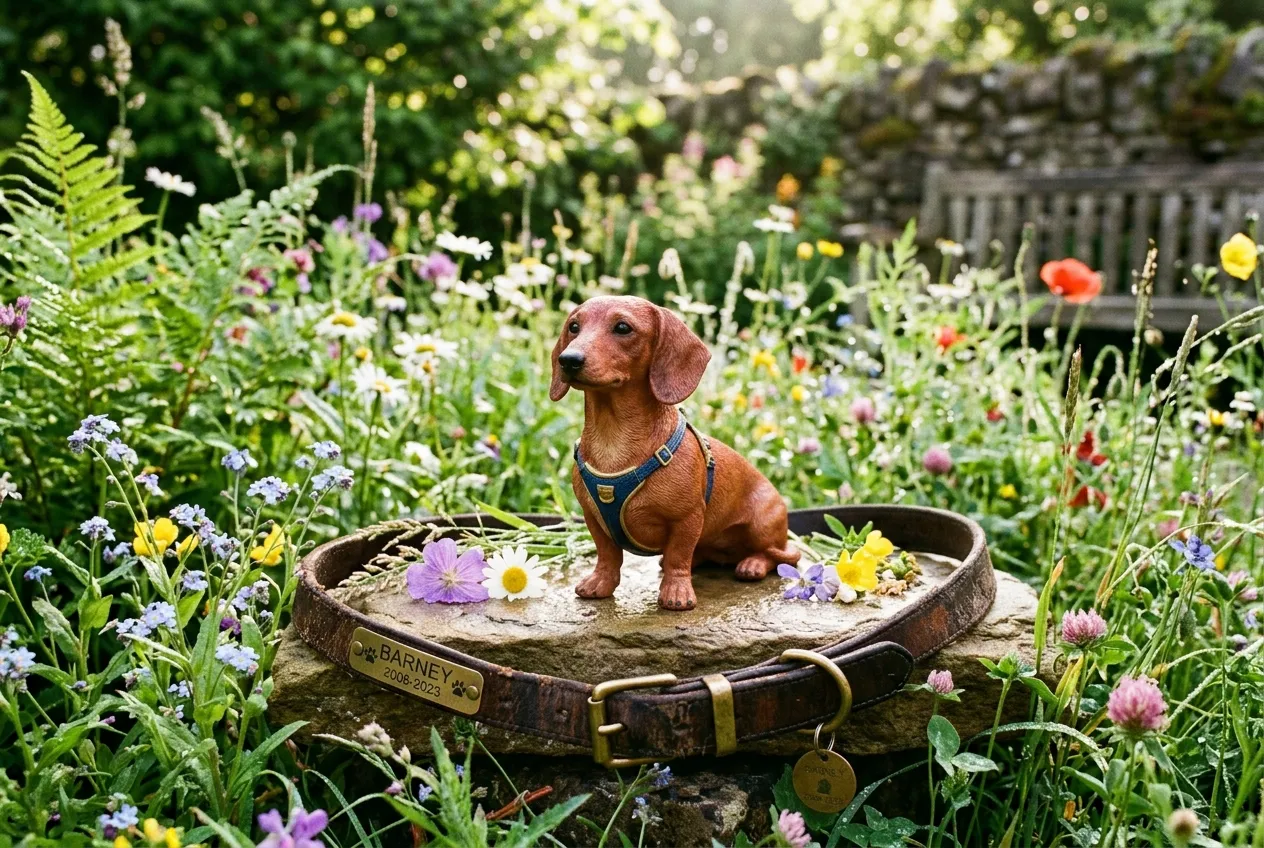
Some families add a custom 3D-printed figurine that captures their dachshund's exact coloring and posture—the way they looked mid-stride or curled in their signature sleeping position. There's something about a three-dimensional, tangible object that photographs can't quite replicate. You can hold it. Turn it in the light. See the shadow it casts. It occupies real space in the real world, the way they did.
"We've learned that grief needs something to hold onto—literally. A physical object becomes an anchor for love that has nowhere else to land."
— The PawSculpt Team
The Anniversary Letter
Write your dachshund a letter. Not a social media post (though those are fine too). A private letter. On paper, with a pen.
Tell them what's happened since they left. Tell them about the weird Tuesday when you found the rubber ball. Tell them you still buy the wrong brand of treats by accident. Tell them about the guilt, the relief, the anger, the love. Tell them everything you'd say if they walked through the door right now, ears dragging, tail going like a metronome.
Then decide what to do with it. Some people keep them in a box. Some burn them (fire is another ancient ritual technology—transformation through release). Some bury them in the yard.
The act of writing is the point. The destination of the letter is secondary.
The Dachshund Memorial Walk
If your dachshund had a favorite route—and every dachshund has a favorite route, usually one they selected themselves through sheer force of stubbornness—walk it on the anniversary.
Walk it at their pace. Which, if your dachshund was anything like the ones we hear about daily, means stopping to investigate every single thing at nose level. Take your time. Let yourself feel the specific quality of light on that path. Notice what's changed and what hasn't.
Bring a friend if you want company. Go alone if you want communion.
| Memorial Ritual | Time Needed | Emotional Weight | Best For |
|---|---|---|---|
| Speaking their name aloud | 2 minutes | Gentle but powerful | Anyone, anywhere, anytime |
| Anniversary altar | 30-60 minutes to create | Grounding, visual | Those who need a physical focal point |
| The anniversary letter | 20-45 minutes | Deep, cathartic | Those who process through words |
| Memorial walk | 30-90 minutes | Bittersweet, embodied | Those who shared outdoor rituals with their dog |
| Cooking their favorite "people food" treat | 15-30 minutes | Warm, sensory | Those whose dachshund was a kitchen companion |
| Donating to a dachshund rescue | 10 minutes | Purposeful, legacy-building | Those who need to channel grief into action |
Where Grief Ends and Gratitude Begins: The Shift Nobody Can Rush
The title of this piece promises to tell you where grief ends and gratitude begins. Here's the honest answer: they don't have a border. There's no checkpoint where you hand in your grief badge and receive a gratitude passport.
What actually happens is more like a slow dissolve. A crossfade, if you think in film terms. The grief doesn't exit stage left so gratitude can enter stage right. They overlap. They coexist. They become the same thing, viewed from different angles.
The moment you realize you're smiling at a memory instead of crying—and then realize you're doing both—that's the crossfade happening in real time.
The Gratitude Practice That Actually Works
Forget generic gratitude journals. Here's something specific that we've seen transform how dachshund owners move through the anniversary:
Write down five things your dachshund taught you that you still use every day.
Not sentimental things (though those count too). Practical things. Behavioral things. Ways they literally changed how you move through the world.
Examples from families we've worked with:
- "She taught me to be stubborn about the things that matter and completely unbothered by the things that don't."
- "He taught me that the best naps happen in sunbeams, and I still chase the light across my living room floor."
- "She taught me that enthusiasm is never embarrassing. She greeted me like I'd been gone for years every single time I came back from checking the mail."
- "He taught me that warmth is worth pursuing—literally. He found every warm spot in the house. Now I do too."
These aren't just memories. They're living legacies. Your dachshund's spirit isn't gone. It's embedded in your habits, your instincts, your daily choices. That's not metaphor. That's real, observable behavioral change that persists long after the source of it has left.
The Spiritual Contract Between You and Your Dachshund
Look, we're not going to tell you what to believe about what happens after. That's yours. But here's a framework that resonates with many of the families we serve:
The relationship between you and your dachshund was a spiritual contract. They agreed to give you everything—every ounce of loyalty, every ridiculous burst of joy, every warm body pressed against yours on cold nights—in exchange for one thing: that you would carry their light forward after they were done carrying it themselves.
Grief is part of honoring that contract. But so is joy. So is laughter. So is eventually—when you're ready, on your timeline, nobody else's—opening your heart to another animal who needs what you have to give.
Your dachshund didn't teach you to love so you could stop loving. They taught you to love so you could do it better, with more depth, more patience, more willingness to be completely, vulnerably, absurdly devoted to a twelve-pound creature with an attitude problem and the world's most expressive eyebrows.
Practical Steps for Navigating the Anniversary Day
Enough philosophy. Let's get tactical. Here's a framework for the actual day—hour by hour if you need it—based on what we've seen work for hundreds of families.
The Week Before
- Tell someone the date is coming. Don't white-knuckle it alone. Text a friend: "Thursday is one year since I lost [name]. I might be weird that day." Giving people a heads-up lets them show up for you without you having to ask in the moment.
- Decide in advance whether you want to be alone or with people. Don't leave this to the day-of. Grief makes decisions feel impossible. Make this one early.
- Gather your materials. If you're doing any of the rituals above—altar, letter, walk—get everything ready. The last thing you need on an emotional day is a trip to the store for candles.
The Morning Of
Start slow. Don't schedule a 9 AM meeting. Don't try to "push through" and act normal. Give yourself the first hour. Make their favorite morning routine yours for the day—if they always sat with you during coffee, sit with their photo during coffee.
Midday
This is often when the energy shifts. The morning's tenderness gives way to something restless. Channel it. Do something physical. The memorial walk. A drive to a place you went together. Movement processes grief in ways that sitting still cannot.
Evening
End with light. Literally. Light a candle. Sit with it. Let the flame be the last image of the day—something warm, something alive, something that casts their shadow back into the room one more time.
The Day After
This is the one nobody talks about. The day after the anniversary can feel strangely hollow. The buildup is over. The ritual is done. And you wake up and think, "Now what?"
Now you keep going. Not "moving on"—that phrase can burn in a fire. Moving forward. With them woven into the fabric of who you are. With their legacy alive in your habits, your warmth, your stubborn insistence on finding the sunbeam.
Creating a Lasting Dachshund Memorial: Options That Honor Their Spirit
Not every memorial needs to be elaborate. Some of the most powerful ones are almost invisible to anyone who doesn't know what they're looking at.
The Subtle Memorials
- A specific plant in the garden — something low to the ground, because of course
- A small engraved tag on your keychain — their name, always with you
- A donation in their name to a dachshund rescue organization
- A daily habit maintained in their honor — the evening walk, even without them
The Visible Memorials
- A framed photo in their favorite spot — not tucked away in a bedroom, but right where they lived
- A custom figurine that captures their exact proportions, coloring, and attitude — companies like PawSculpt use advanced full-color 3D printing to reproduce your dachshund's unique markings directly in resin, down to the specific red-brown of their coat or the particular pattern of their dappling. The color is embedded in the material itself, not applied on top, which means it won't fade or chip. It's the kind of thing that makes visitors say, "That looks exactly like them," which is—honestly—one of the most healing sentences you can hear.
- A shadow box with their collar, a photo, and a small memento
The Living Memorials
- Fostering a dachshund in their name when you're ready
- Volunteering at a local rescue
- Mentoring a new dachshund owner — passing forward what your dog taught you
The best memorial is the one that feels right to you. Not the one that looks best on Instagram. Not the one that costs the most. The one that makes you feel their presence when you look at it, touch it, or do it.
| Memorial Type | Cost Range | Longevity | Emotional Impact | Maintenance |
|---|---|---|---|---|
| Garden plant | $10-50 | Seasonal/perennial | Gentle, growing | Watering, care |
| Engraved keychain tag | $15-40 | Years | Subtle, constant | None |
| Framed photo display | $20-80 | Decades | Visual, immediate | Dusting |
| Custom 3D-printed figurine | Varies (visit site) | Lifetime (UV-resistant) | Profound, tangible | Minimal |
| Shadow box | $30-100 | Decades | Rich, layered | None |
| Rescue donation | Any amount | Ongoing impact | Purposeful, legacy | Recurring optional |
The Question of Another Dog: Navigating the Anxiety
We'd be leaving out the biggest elephant in the room if we didn't address this: the question of whether to get another dachshund.
Some of you are already there. Some of you can't even think about it without your chest tightening. Both responses are completely valid.
Here's what we want to name directly, because almost nobody does: the anxiety about getting another pet is often less about the new animal and more about what it means for the old one. It feels like replacement. Like erasure. Like admitting the grief is "over" when it isn't.
It's none of those things.
Getting another dog—dachshund or otherwise—is an act of faith in the love your first dog built in you. It's saying, "What you gave me was so good that I refuse to let it go unused."
But the timing is yours. Not your partner's. Not your family's. Not the well-meaning friend who keeps sending you rescue listings. Yours.
A few honest signals that you might be ready:
- You see a dachshund in public and feel warmth before you feel pain
- You catch yourself researching breeders or rescues without meaning to
- The empty space in your home feels like an invitation rather than a wound
- You dream about your dachshund and wake up smiling instead of crying
And a few signals that you're not there yet (and that's fine):
- The thought triggers panic or intense guilt
- You're doing it to "fix" the grief rather than expand the love
- Someone else is pressuring you and it doesn't feel right in your body
- You can't look at dachshund photos without spiraling
There's no deadline. Your dachshund's legacy isn't diminished by waiting. It's honored by your honesty about what you need.
The Light That Remains: Finding Your Dachshund in Everything
Here's something that might sound strange, but every dachshund owner we've talked to nods when we say it: your dachshund is still teaching you things.
The patience you developed during their stubbornness? You're using it at work. The tenderness you practiced during their illness? You're offering it to friends going through hard times. The ability to find joy in absurdly small things—a sunbeam, a warm blanket, the specific satisfaction of a good stretch? That's dachshund wisdom, alive in your nervous system.
They're not gone. They're distributed. Scattered through your days like those stray hairs you still find on sweaters months later. Each one a tiny, physical reminder that they were here, they were real, and they changed the molecular structure of your life.
The first anniversary without your dachshund isn't an ending. It's not even a milestone, really. It's a single point on a line that extends in both directions—backward into every memory, forward into every way they shaped who you're becoming.
That rubber ball behind the bookshelf? It's not a relic of something lost. It's evidence of something that happened. Something real and warm and ridiculous and sacred. Something that left tooth marks on the world that will never fully smooth out.
And honestly? You wouldn't want them to.
Your dachshund's legacy isn't in the past. It's in the sunbeam you chase across the living room floor. It's in the stubbornness you bring to things that matter. It's in the way you love—completely, absurdly, without reservation—because a twelve-pound dog with a long body and a longer attitude showed you how.
That's not grief. That's gratitude. And they've been the same thing all along.
Frequently Asked Questions
How long does grief last after losing a dachshund?
There's no expiration date. The intense, daily grief that makes it hard to function typically eases within 6-12 months, but waves of sadness can surface for years—triggered by a smell, a sound, or a rubber ball behind a bookshelf. The grief doesn't disappear. It integrates. It becomes part of your emotional landscape rather than dominating it. If your grief feels unmanageable beyond 12 months, speaking with a therapist who specializes in pet loss (yes, they exist, and they're worth every penny) can help.
Is it normal to feel guilty after putting my dachshund to sleep?
Completely normal, and far more common than people admit. The guilt usually stems from the impossible nature of the decision—you're asked to choose the timing of your best friend's death, and no timing ever feels right. The fact that you're questioning it means you took the decision seriously. That's love, not failure.
What should I do on the first anniversary of my pet's death?
Whatever feels true to you. Some families create rituals—lighting a candle, walking a favorite route, writing a letter. Others keep the day quiet and private. There's no wrong approach. The only thing we'd gently discourage is pretending the day doesn't matter. Acknowledge it, even if just to yourself. Your dachshund's anniversary deserves to be marked, not ignored.
When is it okay to get another dachshund after losing one?
When your body says yes, not just your mind. You'll know because seeing dachshunds will start to feel like warmth instead of a knife. There's no minimum waiting period, and getting another dog isn't betrayal—it's reinvestment of the love your first dachshund built in you. But if the thought triggers panic or guilt, honor that signal. You're not ready yet, and that's perfectly fine.
Why does the second year of pet loss sometimes feel harder than the first?
Because the first year carries a kind of emotional novocaine—the shock of "firsts" (first holiday without them, first birthday) creates a protective buffer. By year two, that buffer dissolves. You're feeling the full weight without the cushion. And because everyone around you assumes you've moved on, you're often feeling it alone. This is normal, and it doesn't mean you're going backward.
How can I create a meaningful dachshund memorial at home?
Start with what you already have—their collar, a favorite toy, a photo from their best day. Arrange these in a dedicated spot where you'll see them daily. Some families add a candle for ritual lighting, a small plant, or a custom figurine from PawSculpt that captures their dachshund's exact coloring and personality in full-color resin. The best memorial is the one you'll actually interact with, not the one that looks most impressive.
Ready to Honor Your Dachshund's Legacy?
The first anniversary of a pet's death is a threshold—not an ending, but a doorway into a new kind of relationship with your dachshund's memory. If you're looking for a way to give that love a permanent, tangible home, a custom PawSculpt figurine captures the exact details that made your dachshund yours—their coloring, their posture, their unmistakable attitude—in museum-quality full-color resin that lasts a lifetime.
Visit pawsculpt.com to see how it works and explore your options