
The Weight of a Quiet House: How Your Mind Replays Your Golden Retriever's Last Morning

A 2022 survey by the Human Animal Bond Research Institute found that 87% of grieving pet owners reported intrusive replay memories—not of the good years, but of the final 24 hours. For golden retriever owners specifically, that number ticked even higher. The breed's expressiveness, that constant eye contact, those deliberate sighs—means the last morning carries a weight that's almost cinematic in its clarity. And if you're here reading this, you probably already know exactly which morning I'm talking about. The golden retriever loss grief you're carrying isn't abstract. It has a timestamp.
Quick Takeaways
- Your brain's fixation on the last morning is neurologically normal—not a sign you're stuck or broken
- Silence after losing a dog is a sensory trigger, not just an absence—and there are concrete ways to manage it
- Guilt about the final hours is the most common hidden emotion—and it responds to a specific reframing technique
- Physical memorials like custom pet figurines can interrupt the replay loop—giving your brain a new anchor point
- The 6-week mark is when grief often intensifies, not fades—knowing this timeline helps you prepare
Why Your Brain Won't Let Go of That Last Morning
Here's something most grief resources won't tell you: your brain isn't replaying your golden retriever's last morning because you're dwelling. It's doing it because that's literally how your threat-detection system processes unresolved events.
The amygdala—the part of your brain responsible for emotional memory—flags experiences with high emotional charge and stores them differently than regular memories. They get encoded with more sensory detail, more vividness, more "replay value." It's the same mechanism behind flashbacks in PTSD, just operating at a lower intensity.
So when you keep hearing the sound of their nails on the kitchen floor that last time, or you can't stop picturing the way they looked up at you from their bed—that's not weakness. That's neuroscience.
The Golden Retriever Problem (It's Real)
Golden retrievers make this worse, and there's a reason. The breed was developed for close human cooperation—retrieving game, working alongside hunters, reading human cues. Centuries of selective breeding produced a dog that maintains sustained eye contact more than almost any other breed. The American Kennel Club describes them as "devoted" and "eager to please," but what that translates to in daily life is a dog that watches you. Constantly.
That watching creates a feedback loop. You looked at them; they looked at you. Thousands of times a day, for years. Your brain built an expectation pattern around that mutual gaze, and now that pattern is broken. The replay isn't random—it's your brain searching for the last frame of a sequence it ran millions of times.
We've worked with thousands of pet families at PawSculpt, and golden retriever owners consistently describe their grief differently than owners of other breeds. It's not more or less—it's more visual. More about the face. The eyes. The expression in that last look.
What the Replay Actually Contains
Let's break this down, because understanding the structure of the replay helps you work with it instead of against it.
Most owners report their replay loop contains three distinct elements:
| Replay Element | What It Sounds/Looks Like | Why Your Brain Holds It |
|---|---|---|
| The last normal moment | Hearing them drink water, the jingle of tags, a sigh from their spot on the floor | Your brain is trying to pinpoint "when things changed" |
| The decision point | The car ride, the waiting room, the conversation with the vet | Unresolved decision-making triggers review loops |
| The final sensory detail | The weight of their head, the last exhale, the sudden quiet | High-emotion moments get encoded in HD |
That third one—the sudden quiet—is what most people describe as the hardest. Not a sound, but the removal of sound. The absence of the collar jingle. The missing click-click-click of nails on hardwood. The house's HVAC system suddenly audible because there's no panting layered over it.
"Grief isn't the presence of sadness. It's the absence of a sound you didn't know you were always hearing."
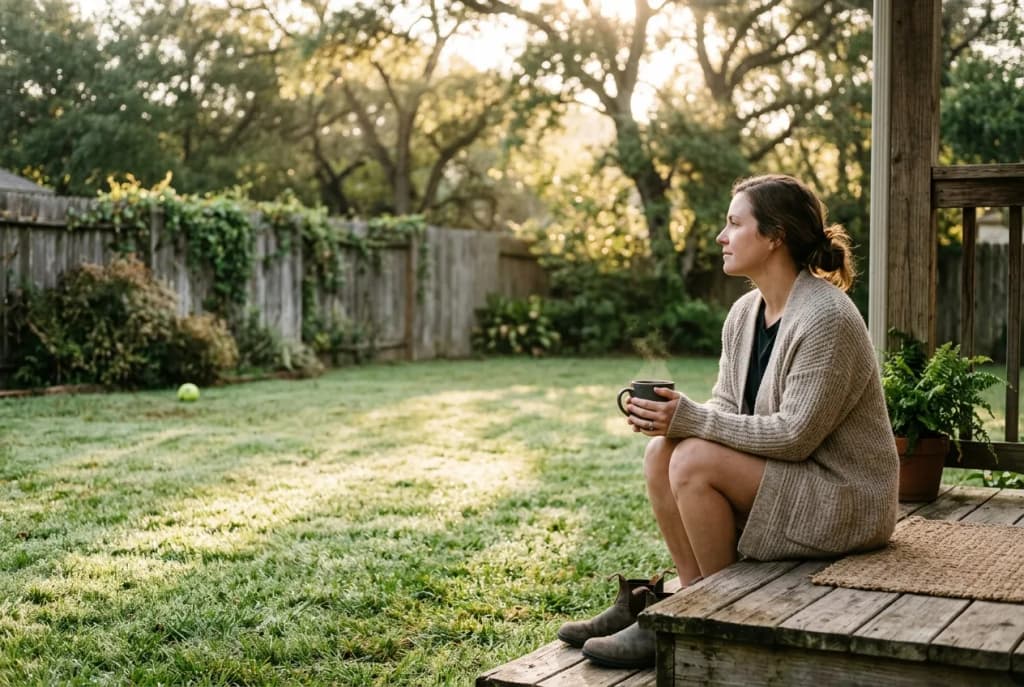
The Silence After Losing a Dog Is a Sensory Event
Let's talk about that silence, because it's doing more to you than you realize.
When you lived with your golden retriever, your auditory environment had a baseline texture. The thump of a tail against a couch cushion. The groan when they stretched. The bark at the mail carrier at 2:15 every afternoon (golden retrievers are nothing if not punctual about perceived threats). That rhythmic panting that became white noise while you worked.
You stopped consciously hearing those sounds years ago. Your brain filed them under "ambient normal." But your nervous system never stopped tracking them. They were part of your felt sense of safety—the background hum that told your body "everything is okay, you're home, you're not alone."
Now they're gone. And your nervous system doesn't interpret that as "the dog isn't here." It interprets it as "something is wrong." That low-grade anxiety you're feeling? The restlessness? The way you keep turning toward the door? That's not grief in the poetic sense. That's your autonomic nervous system responding to an environmental change it reads as a threat.
The Backyard Problem
Here's one that catches people off guard. You walk into your backyard—maybe to take out the trash, maybe to water plants—and the wrongness hits you like a wall.
No nose pushing past your leg to get out first. No sound of paws on the deck. No squeaky toy being dropped at your feet with that look that says "I know you just got out here, but have you considered throwing this?"
One family we worked with told us they couldn't use their back door for three weeks. They started taking the trash out through the garage. It wasn't a conscious decision—their body just started routing around the trigger. That's how powerful the silence after losing a dog really is. It reshapes your physical patterns in your own home.
Counterintuitive Insight: Don't Fill the Silence Too Fast
Most well-meaning advice says to play music, turn on the TV, get a sound machine. And look, if that helps you sleep, go for it. But here's what we've learned from years of conversations with grieving pet owners: filling the silence too quickly can actually delay processing.
Your brain needs to complete the "search" it's running. It's scanning for those sounds, and when it doesn't find them, it needs to eventually update its model of reality. If you mask the absence with constant noise, you're essentially hitting "pause" on that update. The grief doesn't go away—it just waits.
A better approach, based on what we've seen work:
- Allow 15-20 minutes of quiet per day where you consciously acknowledge the missing sounds
- Name what you're not hearing out loud ("I'm not hearing you drink water right now, and I miss it")
- After the acknowledgment, then add sound—a playlist, a podcast, whatever you want
This sounds almost absurdly simple. But the naming part—the verbal acknowledgment—gives your brain the "completion signal" it's looking for. You're not ignoring the absence. You're confirming it. And that confirmation is what allows the replay loop to gradually release.
The Guilt No One Talks About (But Almost Everyone Feels)
Okay. Here's where we need to get honest, because this is the part most pet grief articles skip or sugarcoat.
Many golden retriever owners feel crushing guilt about the last morning. Not vague, general guilt. Specific, pointed, keeps-you-up-at-3am guilt. And it usually takes one of these forms:
- "I should have known sooner that something was wrong"
- "I should have spent that last morning differently—why did I check my phone?"
- "Did I wait too long? Did I not wait long enough?"
- "They looked at me in the vet's office and I couldn't tell if they understood"
- "I felt relief when it was over, and what kind of person feels that?"
That last one. Let's sit with it for a second.
That wave of relief you felt when their suffering ended doesn't make you a monster. It makes you someone whose nervous system had been running a sustained stress response—possibly for weeks or months of decline—and finally got a signal that the crisis was over. Relief is a physiological event, not a moral judgment. Your body exhaled. That's all that happened.
But here's grief's cruelest trick: the guilt that follows the relief. Your brain goes, "Wait, I feel better? My dog just died and I feel better? Something is wrong with me." And then you spiral. The guilt about the relief becomes worse than the original grief, because now you're grieving and questioning your own character.
"Relief at the end of suffering is not betrayal. It's the last act of empathy—your body finally releasing the pain it was carrying alongside theirs."
The Second-Guessing Spiral
Here's the specific pattern we see over and over. It usually starts around day 3-5 after the loss:
Phase 1: "Did I make the right call?" You replay the vet's words. You Google your dog's condition. You read forums. You find one person who says their dog recovered from the same thing, and your stomach drops.
Phase 2: "I should have tried harder." You calculate what another treatment would have cost. You wonder if a different vet would have had a different opinion. You think about the specialist you didn't call.
Phase 3: "They trusted me and I let them down." This is where it gets really dark. Golden retrievers' expressiveness works against you here—you can picture their face so clearly, and your brain starts assigning emotions to that expression that may or may not have been there.
Here's what's actually true: veterinary professionals report that owners almost universally make the timing decision within the appropriate window. The "too early vs. too late" question that tortures you? In most cases, the answer is "you were right on time, give or take a day." The fact that you were agonizing over the decision is itself evidence that you were paying close attention.
A Reframing That Actually Works
Instead of trying to convince yourself you made the right decision (your brain will just argue back), try this reframe:
"I made that decision with the information I had, the love I felt, and the guidance of a professional. I don't need to have been perfect. I needed to have been present. And I was."
Write it down. Put it on your bathroom mirror. Read it at 3am when the spiral starts. It won't fix everything, but it gives your brain a landing spot instead of an endless loop.
The 6-Week Cliff (And Why Grief Gets Worse Before It Gets Better)
Most people expect grief to follow a downward slope—bad at first, gradually better. The reality looks more like a heart monitor: spikes, dips, plateaus, and one particularly brutal drop that tends to hit around the 6-week mark.
Why 6 weeks? A few converging factors:
| Timeline | What Happens | Why It Hurts |
|---|---|---|
| Week 1-2 | Shock and logistics buffer the pain; friends check in frequently | You're busy and supported |
| Week 3-4 | Routine returns; the "new normal" starts forming | The absence becomes structural, not just emotional |
| Week 5-6 | Support drops off; people assume you're "over it"; seasonal/routine triggers accumulate | You're grieving alone now, and the world has moved on |
| Month 3-6 | Grief becomes intermittent but intense; "ambush grief" episodes | A sound, a smell, a date on the calendar hits without warning |
That 5-6 week window is when we hear from the most families. It's when someone Googles "golden retriever memorial" at midnight because they need to do something with this feeling. The initial shock has worn off, the casseroles have stopped arriving, and you're standing in your kitchen at 6am realizing that you still glanced at the food bowl that isn't there anymore.
The Isolation Factor
Here's something that compounds the 6-week cliff: feeling judged for still grieving.
"It was just a dog" is a sentence that has ended friendships. And even when people don't say it out loud, you can feel it in the slight shift of their expression when you bring up your golden retriever for the "too-many-eth" time. The way they change the subject. The gentle suggestion that maybe you should "get out more."
This isolation is real, and it's one of the most damaging aspects of pet loss. You start self-censoring. You stop mentioning your dog. You grieve in private, which means you grieve without witnesses, which means your brain starts to wonder if the grief is even legitimate.
It is. Full stop.
The AVMA recognizes pet loss as a significant bereavement event. Your grief is not an overreaction. The people who don't understand simply haven't had the kind of bond you had—and honestly, that's their loss, not yours.
"We've learned that grief doesn't need an audience to be real—but it does need an anchor. Something you can hold, look at, return to when the world tells you to move on."
— The PawSculpt Team
Myth vs. Reality: What Actually Helps After Losing a Golden Retriever
Let's bust a few things wide open, because there's a lot of well-intentioned bad advice floating around.
Myth #1: "Getting a new dog will help you heal faster."
Reality: Bringing a new dog into a grief-stricken household within the first 2-3 months can actually complicate the grieving process. You end up comparing the new dog to the old one (unfairly, and you know it, which creates more guilt). The new dog picks up on your emotional state and may develop anxiety. And you miss critical bonding time because you're still mentally elsewhere.
The better timeline? Most behavioral experts suggest waiting until you can think about your lost dog and feel warmth before sadness—not instead of sadness, but before it. That shift usually takes 3-6 months, sometimes longer. There's no rush. And the anxiety about whether you'll ever be ready for another pet? Totally normal. It doesn't mean you won't be. It means you're taking the decision seriously, which is exactly what a good pet owner does.
Myth #2: "You need to remove their things right away to move on."
Reality: Nope. Keeping the bed, the leash, even the half-chewed toy in the corner isn't "holding on unhealthily." It's allowing your nervous system to adjust gradually. Think of it like a dimmer switch instead of a light switch—you're slowly reducing the environmental cues rather than ripping them all away at once.
What does help is making it a conscious choice. Instead of leaving everything exactly as it was indefinitely, set a loose intention: "I'll reassess in a month." That gives you permission to keep things and permission to eventually change them, without pressure in either direction.
Myth #3: "Grief has stages, and you'll move through them in order."
Reality: Kübler-Ross herself said the "five stages" were never meant to be linear or universal—they were observations about patterns in terminally ill patients, later (somewhat controversially) applied to all grief. In practice, pet grief is more like weather. You might have a sunny Tuesday followed by a devastating Wednesday triggered by finding a single golden hair on your black coat.
The more useful framework: grief comes in waves, and the waves get further apart over time. They don't necessarily get smaller. You might ugly-cry in a pet store parking lot eight months from now with the same intensity as week one. But it'll happen less often. That's the actual trajectory.
Building an Anchor: Why Physical Memorials Change the Grief Loop
Here's where the data-driven part of my brain gets genuinely excited, because there's a mechanism here that most people don't understand.
Remember that replay loop we talked about? Your brain cycling through the last morning, the last look, the last sound? That loop persists partly because your brain doesn't have a resolution image—a positive, tangible endpoint to attach to the memory sequence.
Photos help, but they're flat. They live on screens, which your brain already associates with transient, disposable content (thanks, social media). What research on grief and material objects suggests is that three-dimensional, tactile memorials create stronger "anchor points" because they engage more sensory channels simultaneously. You can see them, touch them, pick them up, place them somewhere meaningful.
This is why some families plant trees. Why some get tattoos. Why some commission custom 3D pet figurines that capture their golden retriever's specific expression—the head tilt, the slightly open mouth, the feathered ears.
The point isn't the object itself. The point is giving your brain somewhere to land instead of looping. When the replay starts, you can look at something physical and think, "There they are. Not the last morning version. The real version. The whole version."
What Makes a Memorial Effective (A Framework)
Not all memorials work equally well for interrupting the grief loop. Here's what we've observed matters:
| Factor | Why It Matters | Examples |
|---|---|---|
| Specificity | Generic memorials don't anchor to your dog; they anchor to the concept of loss | A figurine with your dog's exact markings vs. a generic "golden retriever" ornament |
| Dimensionality | More sensory channels = stronger memory anchor | 3D object you can hold > flat photo > digital image |
| Placement | Location determines how often the anchor activates | Visible daily spot (shelf, desk) > stored in a box > digital folder |
| Positive association | The memorial should evoke the life, not the death | Captures a happy pose/expression > memorial plaque with dates |
PawSculpt's approach—where master digital sculptors work from your photos to create a full-color resin figurine through precision 3D printing—hits all four factors. The color is printed directly into the resin material, voxel by voxel, which means your golden retriever's specific shade of gold, the darker ears, the pink nose, the individual markings are all captured in the material itself, not painted on top. A clear coat protects everything and gives it a subtle sheen.
But here's the thing—a figurine is one option. What matters is that you choose something specific, dimensional, and positive. A shadow box with their collar and a favorite photo. A garden stone with their paw print. A commissioned illustration. The mechanism is the same: give your brain an anchor that isn't the last morning.
Coping With Golden Retriever Death: The Practical Stuff Nobody Mentions
Let's get tactical for a minute, because you're probably tired of being told to "be gentle with yourself" (true but unhelpful) and ready for some actual moves you can make.
The First 48 Hours
- Tell your workplace. Seriously. More companies than you'd expect have pet bereavement acknowledgments, even if informal. At minimum, your manager knowing why you're off your game prevents misunderstandings.
- Decide about the body now, not later. Cremation, burial, or other arrangements—make this decision while you're still in "logistics mode" (the first 24 hours). Waiting until the shock wears off makes it exponentially harder.
- Text, don't call. If you need to tell people, texting lets you control the interaction. You deliver the news without having to manage someone else's reaction in real time.
Week 1-2
- Photograph their things before moving anything. Even if you're not ready to move anything (and you don't have to be), take photos of their bed in its spot, their bowl, their favorite corner. These environmental photos become surprisingly meaningful later.
- Write down three sounds. Specific ones. The particular pitch of their bark. The sound their tail made on the couch. The way they sighed before falling asleep. Memory fades faster than you think, and sounds go first.
- Let yourself be ambushed. You'll be fine at the grocery store and then see a golden retriever in the parking lot and lose it. This is normal. It's not a setback. It's your brain processing in real time.
Month 1-3
- Create a "grief playlist." Not sad songs—songs that remind you of your dog. The song that was playing when you brought them home. The one you sang to them (don't pretend you didn't). Music accesses memory differently than visual cues, and having a dedicated playlist gives you a controlled way to access those memories when you choose to.
- Consider a memorial project. This is the window where most people feel ready to channel grief into something constructive. A photo book. A donation to a golden retriever rescue in their name. A custom figurine that captures their personality. The act of creating something shifts your brain from passive replay to active remembrance.
- Watch for "anniversary loading." Your brain will start pre-grieving as dates approach—their birthday, the adoption anniversary, the date they died. Knowing this is coming helps you plan around it instead of being blindsided.
When Your Other Pets Grieve Too
If you have other animals in the house, you're dealing with a second layer of grief that's easy to overlook because you're drowning in your own.
Dogs and cats absolutely notice when a household member disappears. They may not understand death conceptually, but they understand absence. Common signs in surviving pets:
- Searching behavior: checking the deceased pet's favorite spots, standing at doors, sniffing their bed
- Appetite changes: eating less (or stress-eating more)
- Vocalization changes: more whining, barking at nothing, or going unusually quiet
- Clinginess: following you room to room, not wanting to be alone
- Sleep disruption: restlessness, sleeping in unusual spots (often the deceased pet's spot)
The counterintuitive move here: don't overcompensate with extra attention. A sudden flood of affection and treats can actually increase anxiety in surviving pets because it signals to them that something is wrong. Instead, keep routines as consistent as possible. Same feeding times. Same walk schedule. Same rules. Routine is the most powerful anti-anxiety tool for animals.
If behavioral changes persist beyond 2-3 weeks, or if a surviving pet stops eating for more than 48 hours, that's vet territory. Don't Google it—call your vet.
The Fear of Forgetting (And Why It's Almost Never Justified)
Let's close the loop on one more hidden emotion that golden retriever owners carry: the terror that you'll forget them.
Not forget that they existed—forget the details. The exact color of their eyes. The way their fur smelled after rain (that specific wet golden retriever smell that's somehow both terrible and wonderful). The weight of their head on your lap. The particular rhythm of their breathing when they slept.
This fear usually peaks around month 2-3, when you realize you had to think for a second before remembering which ear had the slightly darker patch. And that moment of hesitation feels like betrayal.
Here's the reality: you will lose some details. That's not a failure of love—it's a feature of human memory. Brains aren't hard drives. They're pattern-recognition systems that prioritize emotional essence over pixel-perfect accuracy. You might forget which ear was darker, but you'll never forget how it felt when they leaned against your leg. The emotional memory is stored differently—deeper, more durably—than the visual specifics.
But if preserving those visual details matters to you (and it's okay if it does), act sooner rather than later:
- Record a voice memo describing their appearance in detail. Right now. Today.
- Ask friends and family to send you every photo and video they have. People take pictures of your dog that you've never seen.
- Write down their quirks. The weird thing they did with their paw. The food they begged for. The spot they always scratched on the doorframe. These behavioral details are the first to fade and the most irreplaceable.
This is also, honestly, where something like a physical figurine earns its keep. A photograph captures a moment. A three-dimensional replica captures a presence. When the visual details start to soften in your memory, having something you can pick up and turn in your hands—something that shows their exact proportions, their coloring, their stance—acts as a memory refresh button. It's not about replacing the memory. It's about reinforcing it.
Coming Back to the Backyard
Remember that backyard we talked about? The one that felt wrong without a nose pushing past your leg?
Here's what happens, eventually. Not on a schedule, not on anyone else's timeline, but eventually: you'll walk out that back door and the wrongness will still be there, but it'll be joined by something else. A warmth. A specific memory—not the last morning, but a random Tuesday when they chased a squirrel they were never going to catch and looked back at you with that ridiculous golden retriever grin, tongue out, tail going, pure unfiltered joy.
That memory was always there. It was just buried under the replay loop. As the loop loosens its grip—through time, through processing, through anchoring your grief to something tangible—the other memories start surfacing. The good ones. The funny ones. The ones that make you laugh and cry at the same time.
Coping with golden retriever death isn't about getting over it. It's about getting through the replay to the full archive. Your dog's life wasn't their last morning. It was thousands of mornings. And your brain will get there. It just needs you to stop fighting the process and start working with it.
The quiet house won't always feel like an emergency. One day, it'll just feel like a house that's holding space for everything that happened in it. And that's enough.
Frequently Asked Questions
How long does grief last after losing a golden retriever?
There's no expiration date on this, and anyone who gives you a specific number is guessing. Most owners experience the most intense grief for 2-6 months, with "ambush grief" episodes continuing for a year or longer. The waves get further apart over time—that's the real measure of progress. Not the absence of grief, but the increasing space between the waves.
Is it normal to feel guilty after putting a dog to sleep?
Incredibly normal—and incredibly underreported. Guilt is the most common hidden emotion after euthanasia, especially the guilt that follows any sense of relief. Veterinary professionals consistently confirm that owners agonizing over timing almost always made the call within the appropriate window. The agonizing itself is evidence of how carefully you were paying attention.
Why does my house feel so wrong after my dog died?
Your nervous system was using your dog's ambient sounds—panting, collar jingling, nails on the floor—as background safety signals. When those sounds disappear, your autonomic nervous system reads the change as a potential threat, triggering low-grade anxiety and restlessness. It's not just emotional. It's physiological.
Should I get a new dog right away after losing one?
The short answer is: probably not right away. Most experts suggest waiting until memories of your lost dog bring warmth before they bring pain—a shift that typically takes 3-6 months. Getting a new dog while still in acute grief can lead to unfair comparisons, bonding difficulties, and compounded guilt.
How do I help my surviving pets cope with the loss?
Routine is your best tool. Same feeding times, same walk schedule, same household rules. Resist the urge to flood them with extra treats and attention—sudden behavioral changes from you can actually increase their anxiety. If a surviving pet stops eating for more than 48 hours or shows persistent behavioral changes beyond 2-3 weeks, consult your vet.
Is it normal to replay my pet's last moments over and over?
Completely normal. Your amygdala encodes high-emotion events with heightened sensory detail, which creates involuntary replay loops. This isn't a sign of pathological grief—it's your brain trying to process and file an unresolved emotional event. The loops typically loosen over weeks to months, especially when you give your brain an "anchor point" to land on instead.
Ready to Honor Your Golden Retriever's Memory?
Some grief needs an anchor—something you can see, touch, and return to on the hard days. A custom PawSculpt figurine captures your golden retriever exactly as they were: their specific coloring, their favorite pose, the expression that was uniquely theirs. It's not about replacing memory. It's about reinforcing it with something real.
Visit pawsculpt.com to see how the process works and explore your options for coping with golden retriever loss grief in a way that lasts