
Why the First Week After Losing Your Golden Retriever Feels Like Time Stopped
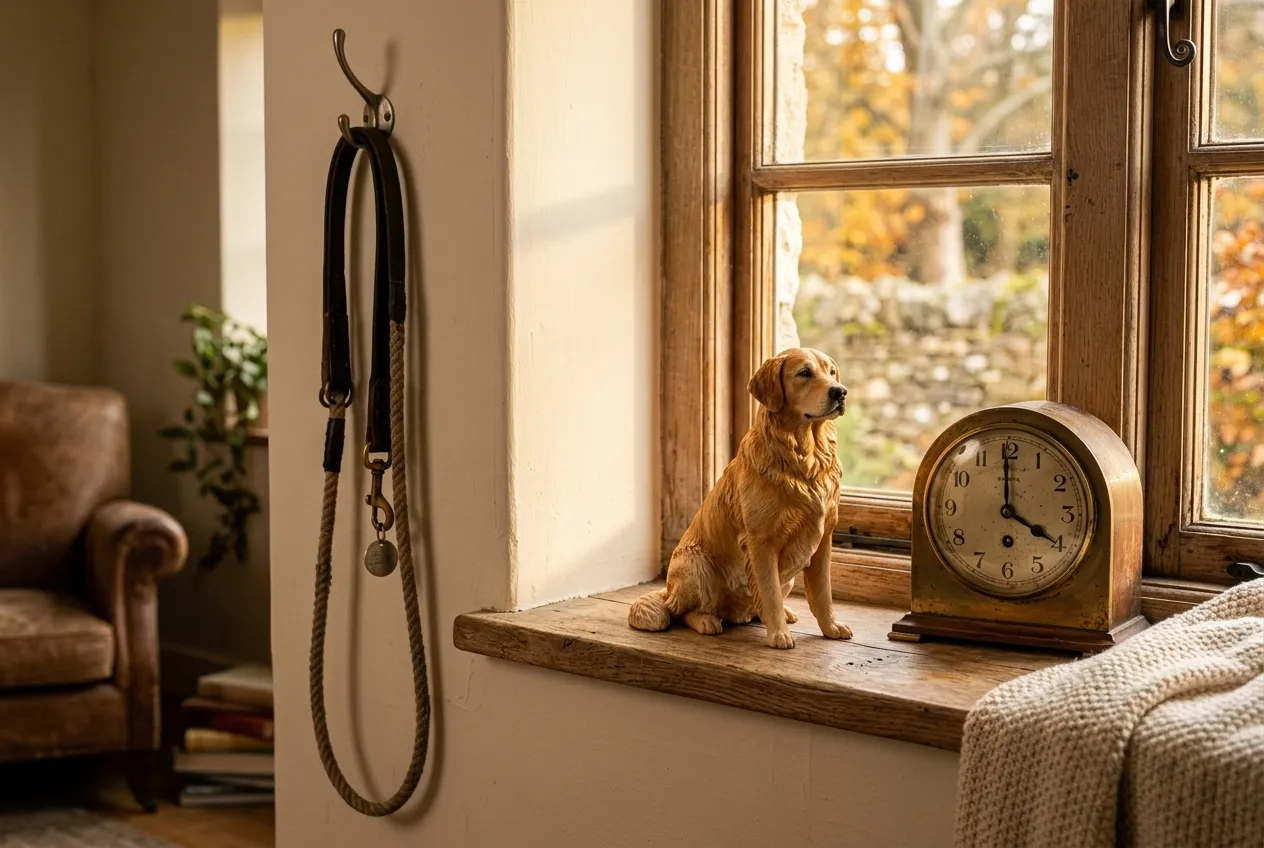
"Grief is not a sign of weakness, nor a lack of faith. It is the price of love." — Colin Murray Parkes
The golden retriever loss first week hits at 6:47 AM—when pale morning light slides across the bedroom floor and lands on a dog bed that still holds the shape of a body no longer there. The dent in the cushion. The single blonde hair catching the sun like a filament of gold wire.
That's where time stops.
Quick Takeaways
- Time distortion during pet grief is neurologically real — your brain is not broken, it's recalibrating
- The first 72 hours follow a predictable pattern — knowing the sequence helps you navigate it
- Surviving pets grieve too, but not how you think — watch for behavioral shifts, not human sadness
- Physical anchors accelerate healing more than reflection alone — tangible memorials like custom pet figurines give grief a place to land
- Guilt about relief is the most common unspoken emotion — and it says nothing bad about you
The Neuroscience Behind Why Time Warps After Losing a Golden Retriever
Here's something most grief resources won't tell you: the time distortion you're feeling isn't metaphorical. It's a measurable neurological event.
When you lose a pet—especially a golden retriever who structured your entire daily rhythm with walks, feedings, and that 5 PM living room greeting—your brain loses what neuroscientists call temporal landmarks. These are the recurring events your internal clock uses to organize each day.
Think of it like this. Your brain doesn't track time with a stopwatch. It tracks time through events. Morning walk. Breakfast kibble hitting the bowl. The 3 PM repositioning from the sunny patch in the kitchen to the shaded spot by the couch. The bark at the mail carrier at 4:15.
Remove all of those events at once, and your brain has nothing to mark the hours against.
The result? Monday feels like it lasts 72 hours. You look up from the couch and can't tell if it's been 20 minutes or three hours. You walk into the kitchen and forget why. The day stretches, folds, repeats.
This isn't grief making you dramatic. This is your hippocampus—the part of your brain responsible for time perception and memory encoding—losing its reference points. Studies from the human-animal bond literature suggest that pet owners who lived with a single pet experience this more intensely than multi-pet households, precisely because the entire temporal architecture of the home revolved around one animal.
Golden retriever owners get hit especially hard. And there's a structural reason why.
Why Golden Retrievers Create Deeper Temporal Anchoring
Goldens are, by breed temperament, ritualistic. They don't just participate in your routine—they enforce it. The American Kennel Club describes them as eager-to-please and highly attuned to household patterns. Any golden owner will tell you that's an understatement.
Your golden didn't just eat at 7 AM. Your golden stood at the food bowl at 6:58 AM, staring at you. Your golden didn't just walk at 5 PM. Your golden brought the leash at 4:45 PM and dropped it on your lap.
That level of behavioral consistency creates what we'd call a high-density temporal map—your brain has more reference points per hour, which makes the absence louder, more disorienting. Compare this to a cat, who might check in with you three or four times a day. A golden checks in 30 to 40 times. Every single one of those check-ins was a timestamp your brain relied on.
So when people say the first week after losing a golden retriever feels like time stopped, they're describing something precise. Time didn't stop. Your clock lost all its numbers.
| Time Period | What Your Brain Is Doing | What It Feels Like |
|---|---|---|
| Hours 0–12 | Acute stress response; cortisol spike blocks normal time processing | Shock, numbness, surreal calm |
| Hours 12–48 | Hippocampus searching for missing temporal landmarks | Time stretching, confusion, disorientation |
| Days 3–5 | Brain begins creating new (incomplete) routines | Sudden waves of grief between odd periods of normalcy |
| Days 5–7 | Emotional processing begins layering over the cognitive disruption | Deep sadness mixed with strange clarity |
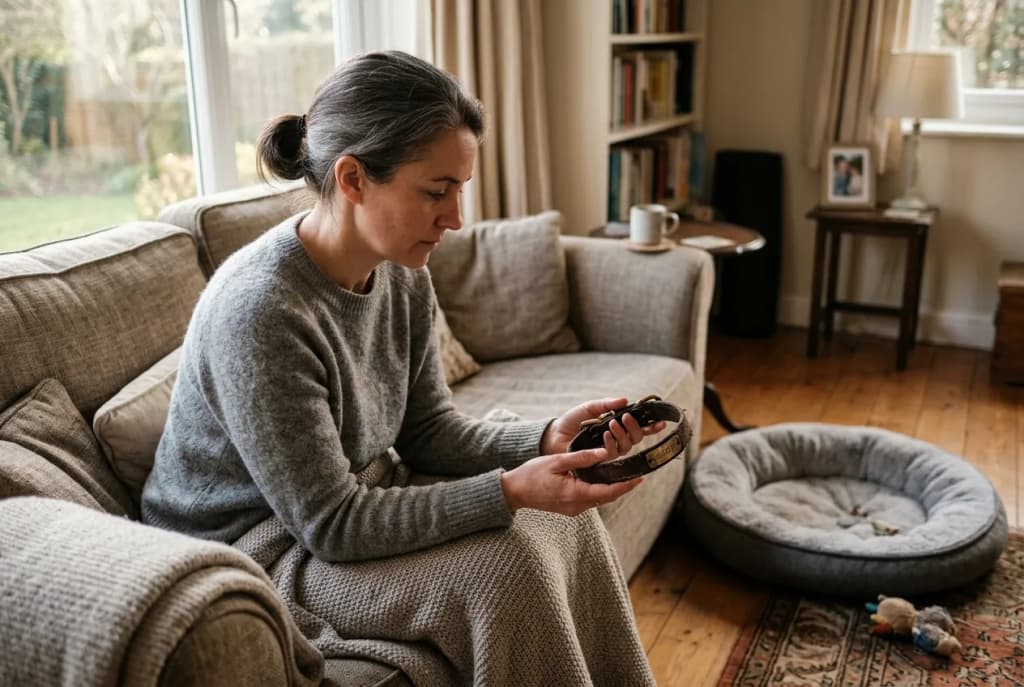
What Actually Happens in the First 72 Hours (And What No One Warns You About)
Most grief guides give you the five stages and send you on your way. That framework was designed for terminal illness in humans, not for the abrupt loss of an animal companion. The reality of the first 72 hours is more specific and, frankly, weirder than any stage model captures.
Hour 0–6: The Administrative Fog
The first thing that happens isn't crying. For most people, the first thing that happens is logistics.
You're standing at the vet's office or sitting on your living room floor, and someone is asking you about cremation options or whether you want a paw print. You're making decisions about remains while your brain hasn't caught up to the fact that the word "remains" now applies to your dog.
One family we worked with described this phase as "watching myself from the ceiling." Another said they drove home from the vet, walked in the front door, and immediately started vacuuming—because the house was covered in golden fur and they didn't know what else to do.
This is normal. The administrative fog is your brain's way of giving you something to do while it processes something it can't yet absorb.
Practical step: Don't make permanent decisions in this window. If the vet asks about cremation, memorial options, or anything that costs money, it's completely fine to say "I need 24 hours." You're not being difficult. You're being wise.
Hour 6–24: The Phantom Presence
This is the phase that catches people off guard.
You hear the collar jingling. You feel the weight at the foot of the bed. You turn toward the door because you're sure—absolutely certain—that you just heard nails on hardwood.
Phantom pet presence is so common among golden retriever owners that it's almost universal in the first 24 hours. The visual component is particularly strong: you'll catch a flash of golden-blonde in your peripheral vision—a throw pillow, a shaft of afternoon light, a neighbor's dog passing the window—and for half a second, your body responds before your brain corrects.
The thing no one warns you about? It feels good. For that half-second, everything is normal. And then the correction hits, and the loss re-enters like a door slamming.
"Grief doesn't arrive all at once. It re-arrives—every time you turn a corner and they're not there."
Hour 24–72: The Guilt Spiral
Here's where we need to talk about the emotion that most grief resources either skip entirely or handle with kid gloves.
Relief.
If your golden was elderly, sick, or in pain—if you made the euthanasia decision—there's a very high probability that somewhere in the first 24 to 72 hours, you feel relief. Maybe it's a full breath you didn't realize you'd been holding for weeks. Maybe it's the absence of the 2 AM anxiety check, when you'd wake up and listen for breathing. Maybe it's simply that the terrible waiting is over.
And then the guilt hits. Because what kind of person feels relieved that their dog is dead?
We'll be real with you: almost every kind. The relief isn't about wanting your dog gone. It's about the end of suffering—theirs and yours. The hypervigilance of caring for a declining pet takes a physical toll that you don't fully register until it lifts. The guilt that follows is grief's cruelest mechanism, because it takes an act of love—choosing to end suffering—and reframes it as selfishness.
It isn't selfish. It's the last generous thing you did for them.
If you're in this spiral right now, here's a concrete exercise: Write down three things your dog would have had to endure if you'd waited another week. Not to punish yourself. To remind yourself what you spared them from. Put the list somewhere you can find it, because the guilt spiral will come back on day 4 or 5, and you'll need the list again.
The Golden Retriever-Shaped Hole: Why This Breed's Loss Hits Differently
Not all pet loss is the same. This isn't a ranking—it's a recognition that different breeds create different attachment architectures, and golden retrievers build an unusually comprehensive one.
Here's the framework we've developed after working with thousands of pet families:
| Attachment Dimension | How Goldens Score | Why It Matters in Grief |
|---|---|---|
| Physical contact frequency | Very high (lean, rest head, sleep touching) | Your body misses the contact before your mind processes the loss |
| Emotional co-regulation | Very high (bred for sensitivity to human mood) | You lose a real-time emotional support system |
| Routine structuring | Very high (meal times, walk times, greeting rituals) | Every daily transition now has a gap |
| Social facilitation | High (goldens attract strangers, neighbors, kids) | Your social network shrinks with the dog |
| Household sound profile | High (collar, nails, sighing, repositioning) | The house sounds wrong at a frequency level |
That last dimension—the sound profile—is the one people don't expect. Your house sounds different without a golden retriever in it. Not just quieter. Different. The acoustic signature of your home has changed. The absence of the collar jingle, the soft thud of a body lying down, the particular huff your golden made before falling asleep—your auditory environment has been fundamentally altered, and your brain flags it as wrong a hundred times a day.
"The hardest part of creating memorial figurines isn't getting the colors right—it's capturing the posture. The way a golden rests their chin on their paws tells you everything about who they were."
— The PawSculpt Team
The Social Loss Nobody Talks About
Your golden retriever was a social connector. If you walked the same route daily, you had a network—the neighbor who always pet your dog, the kids at the park, the other dog owners you'd chat with. That network dissolves when the dog does.
We've heard from families who said they stopped walking their usual route entirely. Not because it was too painful (though it was), but because they couldn't handle the question: "Where's [dog's name]?"
This is a real, measurable social loss layered on top of the emotional one. And it contributes to another emotion people rarely admit: isolation. You're grieving a companion, but you're also grieving the community that came with them.
Counterintuitive advice: Walk the route anyway—but do it at a different time. Same path, shifted by an hour or two. You'll get the physical benefit and the environmental familiarity without the high probability of running into the people who'll ask the question you're not ready to answer. Give yourself two weeks. Then go back to your normal time when you're ready for those conversations.
What We Wish We Knew Sooner
Candid insights our team has gathered from years of working with grieving pet families:
- You'll reach for them. The leash on the hook. The treat jar. The back door. Your muscle memory takes weeks to update. Don't fight it—just notice it and let it pass.
- Day 4 is often harder than Day 1. The shock has worn off. The casseroles have stopped arriving. People have moved on. You haven't. This is the day to call someone.
- Photos will hurt before they help. Give it 10–14 days before scrolling through your camera roll. In the first week, photos re-trigger the acute loss response instead of providing comfort.
- Your other pets aren't "fine." They're adapting, but they're not fine. (More on this below.)
- The bed is the hardest place. The bedroom—where your golden slept beside you, at your feet, or on the floor next to your side—is where grief concentrates at night. Consider temporarily rearranging the room.
Grief After Losing a Golden Retriever: What Your Surviving Pets Are Actually Doing
If you have other animals in the house, you've probably been watching them closely. And you've probably been confused by what you're seeing.
Here's what most people get wrong: they look for human grief behaviors in animals. They expect the cat to mope. They expect the other dog to look sad. They expect visible mourning.
What actually happens is more subtle and, honestly, more interesting. Veterinary behaviorists have identified three primary response patterns in surviving pets:
Pattern 1: The Search
The surviving pet checks the deceased pet's usual spots—bed, crate, favorite window—repeatedly for the first 48 to 72 hours. This looks like restlessness, not sadness. The animal isn't mourning; it's data-gathering. It's checking whether the missing member has returned.
What to do: Don't remove the deceased pet's belongings immediately. The surviving pet needs to complete the search behavior before it can adapt. Give it 5 to 7 days.
Pattern 2: The Appetite Shift
About 36% of surviving dogs and a smaller percentage of cats will show a measurable change in eating behavior—usually eating less, but sometimes eating more. This isn't emotional eating. It's a stress response mediated by cortisol. The household dynamic has changed, and the surviving animal is physiologically responding.
What to do: Maintain exact feeding times. Don't offer extra treats to compensate. Consistency is the signal that the environment is still stable.
Pattern 3: The Velcro Effect
This is the most commonly reported: the surviving pet suddenly becomes your shadow. Following you room to room. Sleeping closer. Demanding more physical contact.
Most people interpret this as "they miss their friend and need comfort." More accurately, it's social restructuring. In a multi-animal household, social bonds are distributed. When one member disappears, the remaining animal redirects its social needs to the surviving humans. It's not comfort-seeking—it's bond-reallocation.
What to do: Accept it. But set gentle boundaries if it becomes anxious (whining when you leave the room, refusing to eat unless you're present). Those are signs the attachment is becoming anxious rather than secure, and a quick call to your vet or a behaviorist can help recalibrate.
Pet Loss Time Distortion: Practical Strategies for Getting Through Each Day
Knowing why time feels warped doesn't fix the warp. Here's what does.
We've organized these by the three phases of the first week, because what helps on Day 1 is actively unhelpful on Day 5.
Days 1–2: Structure the Unstructured
Your daily architecture collapsed. You need a temporary scaffold.
- Set five alarms on your phone. Not for tasks—just for time awareness. Label them: "Morning," "Late Morning," "Afternoon," "Evening," "Night." When they go off, notice where you are and what you're doing. This interrupts the time-warping loop.
- Eat at fixed times even if you're not hungry. Your golden ate on a schedule. You probably did too, anchored to theirs. Keep the meal times. Change the food if you want—but keep the times.
- Go outside at the time you would have walked them. You don't have to walk the route. Stand on the porch. Sit on the steps. But be outside at that time. Your body expects it.
Days 3–4: Allow the Waves
The scaffolding gives you enough stability to start feeling. This is where the waves come.
- Name them out loud. "I'm angry right now." "I feel guilty." "I miss the weight of him on my feet." Naming an emotion reduces its intensity by roughly 40%—this is well-documented in affect labeling research from the NIH.
- Don't scroll photos yet. We mentioned this above, but it bears repeating. Day 3 is not the day. Your brain needs more distance before images become comfort instead of re-injury.
- Let people help, but only specific people. You know who gets it and who doesn't. The friend who says "it was just a dog" is not your Day 3 person. The friend who once cried over their own pet? Call that one.
Days 5–7: Begin the Small Shifts
By the end of the week, your brain is starting to accept the new temporal landscape—grudgingly, incompletely, but it's starting.
- Pick one item to move. The leash. The food bowl. The toy basket. Not all of them. One. Moving one item gives you agency without overwhelming you.
- Consider a physical anchor. This is where tangible memorials become genuinely therapeutic, not just sentimental. A framed photo, a paw print casting, a custom 3D-printed figurine that captures their exact markings and posture—these objects give your brain something to locate the love. Grief needs a place to land. Abstract memory isn't enough for most people; they need something in their hands.
- Write three things. Three specific memories. Not "he was a good dog." Specific. "He once stole an entire rotisserie chicken off the counter and ate it behind the couch while making direct eye contact." Specificity protects against the fear of forgetting, which—if you're feeling it—is completely normal and almost universal.
"You don't stop loving them. You just learn to carry the love differently."
The Fear of Forgetting (And Why It Peaks in Week One)
This one needs its own section because it's the most common unspoken fear we encounter. More common than guilt. More common than anger.
The fear that you'll forget what they looked like.
Not in photos. In your mind. The exact shade of their coat where it lightened around the muzzle. The way the fur feathered behind their ears. The precise amber of their eyes in late-afternoon light—that particular golden-hour golden that you can picture right now but are already terrified of losing.
This fear is especially acute in the first week because your brain is still transitioning from "present companion" to "stored memory," and during that transition, the mental image flickers. Sometimes it's vivid. Sometimes it's frustratingly blurry. That inconsistency is terrifying.
Here's the counterintuitive truth: you won't forget. But you will lose resolution. Over months and years, the mental image softens. The specific shade becomes approximate. The exact tilt of the head generalizes.
This is why physical representations matter beyond sentiment. A high-resolution photo, a detailed memorial piece, a figurine that preserves the precise color distribution of their coat—these aren't just keepsakes. They're external memory storage. They protect the details that your biological memory will naturally degrade.
It's one of the reasons we see families come to PawSculpt specifically during the first few weeks. Not because they've processed the grief—but because they're racing against the fear of forgetting. The full-color 3D printing process we use captures coat patterns, markings, and color variations directly in resin—voxel by voxel—so the details are preserved at a level your memory alone can't sustain. (If you're curious about how it works, the site walks through the full process.)
We don't bring this up to sell you something in your worst week. We bring it up because the fear of forgetting is real, and knowing that external tools exist to combat it can reduce the panic.
The Emotions Nobody Admits to Feeling
We touched on guilt and relief earlier. But the emotional landscape of the first week is more complex than that. Here are the feelings people almost never talk about—and every single one is normal.
Anger
Not at fate. Not at the universe. At the vet. At a family member who "didn't seem sad enough." At the neighbor who let their (healthy, alive) golden retriever run through your yard the day after. At yourself, for the time you got annoyed when they tracked mud through the house.
Anger is grief looking for a target. It doesn't need a logical one.
Jealousy
You're scrolling social media and someone posts a video of their golden retriever puppy. Your chest tightens. You feel something ugly.
That ugly feeling is jealousy, and it's shockingly common in the first week. You're not a bad person for feeling it. You're a person in acute loss being confronted with what you no longer have. Unfollow, mute, or log off entirely. There's no honor in exposing yourself to triggers during the first seven days.
Shame About Grief Intensity
"It's a dog. I didn't cry this hard when my uncle died."
If that thought has crossed your mind, you're in vast company. And here's why it happens: your golden retriever was likely the most consistent daily presence in your life. More than your spouse (who goes to work). More than your kids (who go to school). Your dog was always there. The grief intensity corresponds to the contact hours, not to some imagined hierarchy of worthiness.
You're not broken for grieving a dog more than a person. You're responding to attachment density.
Anxiety About Getting Another Pet
This one usually shows up around Day 5 or 6, and it comes in two contradictory forms:
- "I want another dog immediately" — followed by guilt that you're trying to replace them.
- "I will never get another dog" — followed by the realization that you can't imagine life without one.
Both are valid. Neither needs to be decided this week. Or this month.
The only piece of actionable advice here: Don't bring a new animal home in the first 30 days. Not because it's disrespectful to the deceased pet—it isn't—but because your surviving household members (human and animal) need time to establish a new normal before introducing another variable. Thirty days is the minimum most behaviorists recommend.
Golden Retriever Memorial Options: A Practical Comparison
When you're ready—and "ready" might mean Day 3 or Day 30, there's no rule—here's an honest comparison of the most common memorial approaches.
| Memorial Type | Cost Range | Emotional Impact | Permanence | Effort Required |
|---|---|---|---|---|
| Cremation urn | $$ | Medium — meaningful but passive | High | Low |
| Paw print casting | $ | High initially, fades over time | Medium (fragile) | Low (often done at vet) |
| Custom portrait painting | $$–$$$ | High — captures personality | High | Medium (finding an artist) |
| Memorial garden stone | $ | Medium — weather-dependent | Medium | Low |
| Full-color 3D figurine | $$–$$$ | Very high — three-dimensional, lifelike | Very high (UV-resistant resin) | Low (submit photos, review digital preview) |
| Photo book | $ | High — comprehensive | Medium | High (curation takes time) |
| Donation in pet's name | Varies | Medium — meaningful but abstract | N/A | Low |
We're obviously biased toward the figurine category—it's what we do. But honestly? The best memorial is the one you'll actually look at. A beautiful urn in a closet serves no one. A photo book you assembled with care but never reopen doesn't either. Pick the option that will live in your daily line of sight.
The Bedroom Problem: Why Nights Are Hardest
We mentioned this in the sidebar, but it deserves expansion.
The bedroom is where golden retriever loss concentrates. Because the bedroom is where the most intimate routines lived. The specific weight distribution on the bed. The sound of breathing in the dark. The warmth against your legs in winter. The thump of a tail when you shifted positions at 2 AM—their way of saying still here, still here, still here.
Now the bed feels too big. The room feels too cold. You wake at 3 AM and reach down to the floor and there's nothing.
Practical solutions that actually work:
- Sleep in a different room for the first three nights. The couch, a guest room—anywhere that doesn't carry the specific sensory associations. This isn't running from grief. It's managing the acute phase of sensory-trigger overload.
- Add a weighted blanket. It sounds trivial. It isn't. The pressure partially mimics the sensation of a 65-pound dog leaning against your legs. Multiple families have told us this was the single most helpful physical change they made.
- Move the dog bed out of the bedroom by Day 5. Not out of the house—just out of the room where you sleep. The bedroom needs to become functional again, and visual triggers in a dark room hit harder than anywhere else in the house.
What Week Two Looks Like (A Brief Preview)
The first week gets all the attention. But week two is where the real work begins, and knowing what's coming helps.
- The support drops off. People stop checking in. The flowers wilt. The texts thin out. This is the week to proactively reach out to your one or two trusted people, not wait for them to come to you.
- You start functioning—and feel guilty about it. You laugh at something on TV and then feel awful. You go back to work and have a normal conversation and then sit in your car afterward feeling like a traitor. This is guilt about moving on, and it's completely, utterly normal.
- The small rituals emerge. You'll develop new ones. Maybe you touch the urn on the way out the door. Maybe you say good morning to the figurine on the shelf. Maybe you look at one photo each morning—just one. These micro-rituals aren't silly. They're your brain building a new temporal architecture with the love still in it.
The One Thing That Helps More Than Anything Else
We've talked about structures, exercises, timelines, and brain chemistry. But the single most protective factor against complicated grief after losing a golden retriever is deceptively simple:
Tell the stories.
Not just to yourself. Out loud. To someone who'll listen. Tell them about the time your golden ate an entire stick of butter and looked proud. Tell them about the specific bark—the one that meant "the squirrel is back." Tell them how your dog somehow always knew when you were crying and would come press their forehead against your knee.
Specificity is the antidote to forgetting. And speaking memories out loud transfers them from fragile, degrading biological storage into shared human experience—where they get reinforced, expanded, and protected every time someone says, "Tell me that story again."
The first week after losing your golden retriever feels like time stopped because, in a very real neurological sense, it did. Your internal clock lost its reference points. Your daily architecture lost its architect.
But here's what the time distortion also means: your golden retriever was so woven into the fabric of your days that their absence restructured time itself. That's not just grief. That's evidence of a life fully shared.
The clock will start again. Not the same clock. Not the same numbers. But it will start.
And when it does, the golden light in the bedroom at 6:47 AM—the one that used to catch a single blonde hair on the pillow—will still be there. You'll look at it, and you'll remember everything.
You won't forget.
Frequently Asked Questions
How long does grief last after losing a golden retriever?
The acute phase—time distortion, phantom presence, intense waves—typically runs 2 to 4 weeks, with the first week being the most disorienting. Residual grief waves continue for months but become shorter, less frequent, and more manageable. There's no fixed endpoint, and anyone who gives you one is oversimplifying.
Is it normal to feel guilty after putting your golden retriever down?
Completely normal, and far more common than people admit. The relief-guilt cycle is the single most reported emotional pattern after euthanasia. It doesn't mean you made the wrong decision. It means you're processing the weight of a decision made from love under impossible conditions.
Why does losing a pet sometimes feel worse than losing a person?
It comes down to contact density. Your golden retriever was with you more hours per day than almost any human in your life. Grief intensity tracks with the volume of shared daily moments, not with some hierarchy of who "should" matter more. There's no should.
Should I get another dog after my golden retriever dies?
Not this week. Most veterinary behaviorists recommend a minimum 30-day waiting period—not out of respect for the deceased pet, but to let your household (including surviving pets) stabilize before introducing new social dynamics. When you're ready, you'll know. And it won't be a replacement. It'll be a new relationship.
How do I help my other pets after losing a companion animal?
Keep routines rigid—same feeding times, same walk schedule. Leave the deceased pet's belongings in place for 5 to 7 days to allow the surviving pet to complete its search behavior. Watch for the velcro effect (excessive clinginess) and appetite changes. If either persists beyond 10 days, check in with your vet.
What is the best way to memorialize a golden retriever?
The best memorial is the one that stays in your daily line of sight. A beautiful urn in a closet doesn't serve its purpose. Consider options that integrate into your living space: a figurine on the bookshelf, a framed photo in the hallway, a garden stone by the back door. Visibility is what keeps memory active.
Ready to Honor Your Golden Retriever's Memory?
The first week after losing a golden retriever reshapes everything—your mornings, your evenings, the sound of your home. A PawSculpt figurine won't undo the grief, but it can give the love somewhere to live. Digitally sculpted by master 3D artists and precision-printed in full-color resin, every figurine preserves the exact coat patterns, markings, and posture that made your golden irreplaceable.
Visit pawsculpt.com to see the process, explore examples, and learn about current service details