
The Counter-Intuitive Reason One Month After Losing a Ragdoll Feels Harder
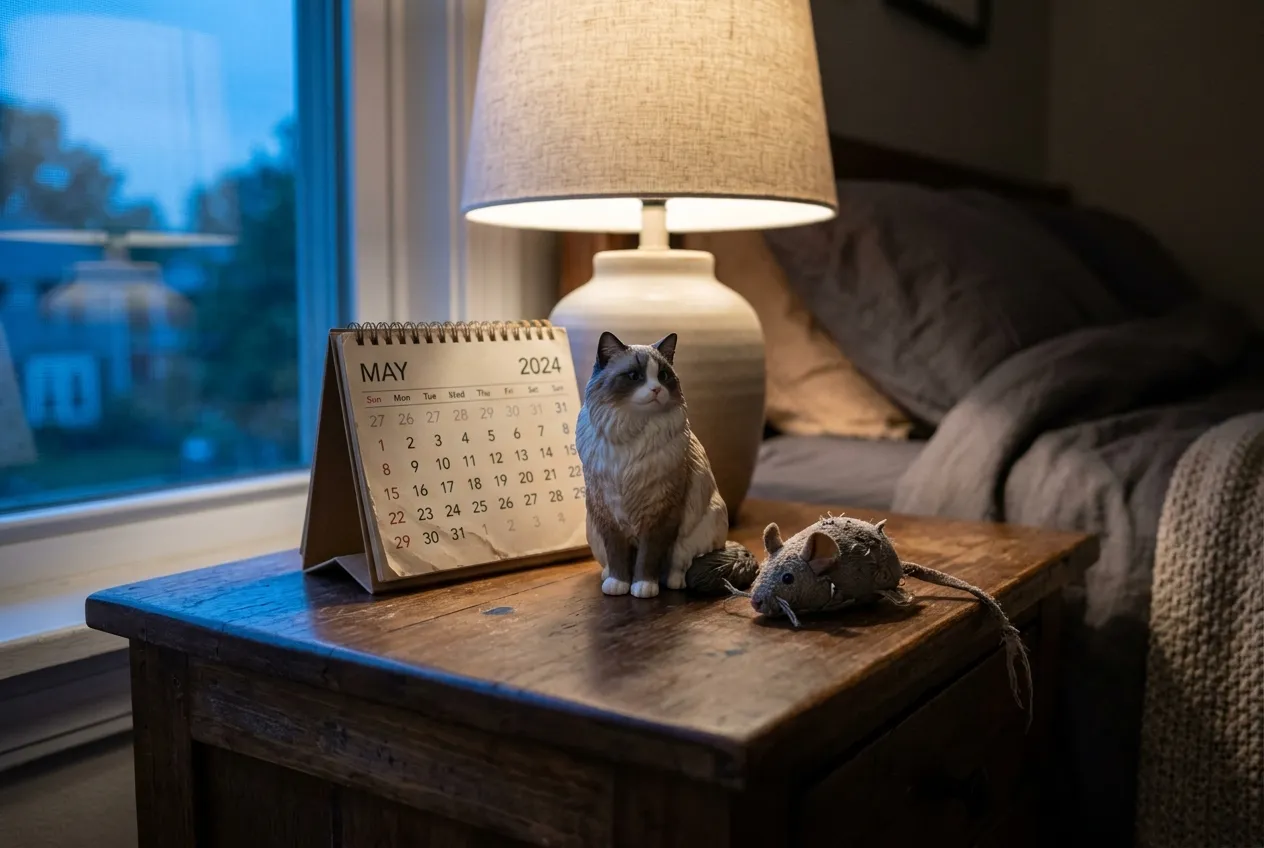
Three years ago, the kitchen counter held two coffee mugs and a cat food bowl—always in that order, left to right. Now, one month after pet loss, the counter holds two mugs and a gap where the bowl was, and somehow that six-inch stretch of empty granite screams louder than anything in the house.
Quick Takeaways
- Grief often intensifies around the one-month mark — this is neurologically normal, not a sign you're "doing it wrong"
- Your brain's "search mode" is the hidden engine behind why delayed grief hits harder than the initial shock
- Routine disruptions matter more than big milestones — it's the 5 a.m. feeding alarm, not the empty bed, that breaks you
- Physical anchors can interrupt the grief spiral — tangible keepsakes like custom pet figurines give your hands something to hold when your arms feel empty
- The counter-intuitive move is to lean into the pain at one month rather than pushing past it
Why the Ragdoll Cat Grief Timeline Doesn't Follow the Script
Here's what nobody warns you about: the first week after losing a Ragdoll is almost manageable. Almost. You're surrounded by casseroles and sympathy texts. Your body floods with adrenaline. You're busy—canceling vet appointments, washing the last blanket, deciding what to do with leftover medication.
Then the world moves on. And you don't.
The one-month mark is where grief shape-shifts. It stops being that sharp, clean wound and becomes something murkier. Duller. Heavier. Most grief timelines you'll find online describe a neat downward slope—shock, then sadness, then gradual acceptance. But the Ragdoll grief timeline (and honestly, the grief timeline for any deeply bonded pet) looks more like a seismograph during an earthquake.
Here's the counter-intuitive truth that most articles miss: grief doesn't build from the moment of loss. It builds from the moment your nervous system stops protecting you. And for most people, that's around week three or four.
The reason is neurological, not emotional. During acute loss, your brain enters a survival mode that researchers sometimes call "searching behavior." Your mind knows your Ragdoll is gone. But your nervous system—the ancient, reptilian part—keeps scanning for them. Every soft thump from another room. Every shadow in peripheral vision that's the right shade of seal-point or blue.
At one month, your nervous system finally starts to give up the search. And that's when the real grief arrives.
| Week After Loss | What Your Brain Is Doing | What It Feels Like |
|---|---|---|
| Week 1 | Adrenaline response, denial buffer active | Numb, busy, "handling it" |
| Week 2 | Searching behavior peaks | Startling at sounds, phantom fur-brushes |
| Week 3 | Search mode begins failing | Irritability, fatigue, anger |
| Week 4+ | Nervous system accepts absence | Deeper sadness, delayed grief crashes |
That table isn't from a textbook. It's from watching thousands of pet families walk through this exact corridor and tell us, again and again, the second month was worse than the first day.

The Ragdoll-Specific Factor Nobody Talks About
Ragdolls are different. You know this. You lived it.
A Ragdoll doesn't just sit in the room with you—they drape across your life. They follow you from kitchen to bathroom to bed like a blue-eyed shadow. They go limp in your arms with a trust so absolute it borders on reckless. They make eye contact that feels, honestly, like being seen.
So when a Ragdoll dies, the absence isn't localized. It's everywhere. It's in every room, every transition between rooms, every time you sit down and nothing warm lands in your lap within thirty seconds.
"Grief doesn't arrive all at once. It moves in when the adrenaline moves out."
Most articles about pet loss treat all cats as roughly interchangeable. They're not. The Ragdoll cat grief timeline hits differently because the bond was differently structured. Your Ragdoll wasn't independent. They chose dependence. They chose you, over and over, dozens of times a day. And each of those micro-choices—following you to the kitchen, flopping at your feet while you cooked, chirping when you came home—created a neural pathway in your brain.
At one month, those pathways are still firing. Your brain still expects the weight on your chest at 2 a.m. Still expects the chirp at the door. And every time the expectation fires and nothing answers, your brain registers it as a tiny loss. Not one big death—but hundreds of tiny ones, every single day.
That's why grief gets worse. You're not losing your cat once. You're losing them over and over, in every room they used to fill.
The Emotions You're Not "Supposed" to Feel (But Absolutely Do)
Let's talk about the ugly stuff. The feelings that make you wonder if something is wrong with you.
Guilt is the loudest. It barges in and sets up camp. Did you wait too long? Did you not wait long enough? Should you have tried the other medication, the specialist three hours away, the experimental treatment you read about at midnight on your phone while they slept on the pillow next to you?
The guilt is almost universal, and it's almost always disproportionate to reality. You made decisions under impossible conditions with incomplete information while your heart was shattering. That's not negligence. That's love under pressure.
But here's the feeling that really ambushes people—the one that arrives around the one-month mark and makes them feel like monsters:
Relief mixed with grief.
Maybe your Ragdoll was sick for months. Maybe the last weeks involved subcutaneous fluids, pill pockets, and cleaning up things you'd rather not name. Maybe you haven't slept a full night in weeks. And when it was over—when they were finally still and the suffering had stopped—you felt a breath of relief before the grief wave hit.
That relief doesn't make you a bad person. It makes you someone who was carrying an impossible weight and finally set it down. The guilt that follows the relief? That's one of grief's cruelest tricks. It takes your compassion—the very thing that made you suffer alongside your cat—and weaponizes it against you.
Personal Aside: We'll be real with you. Our team talks about this a lot internally. When families reach out to us a month or two after a loss, they almost always apologize—for crying on the phone, for sending too many photos, for "still" being upset. Still. As if one month is too long to grieve a creature who loved you for a decade. We want to be very clear: there is no "still." There is no deadline. Your grief is not an inconvenience.
The Fear of Forgetting
Around the one-month mark, something cruel happens to memory. The hyper-vivid images from the final days start to soften. And the older, happier memories—the kitten days, the sunbeam naps, the first time they purred in your arms—start to feel further away. Like photographs left in sunlight, the colors begin to fade at the edges.
This triggers a specific panic: the fear that you'll forget them.
Not the big things. You won't forget their name or their color. But the small things—the exact weight of them on your lap, the specific frequency of their purr, the way the light caught the silver tips of their fur in late afternoon—those feel fragile. Slippery.
This fear is more common than you'd think, and it drives a lot of the behavior that people don't understand from the outside. The obsessive scrolling through old photos. The keeping of the food bowl. The inability to vacuum the last patch of fur from the couch.
You're not being morbid. You're trying to hold onto the texture of a life that's becoming abstract. That's not pathological. That's sacred.
"We've seen families heal by holding something tangible. Grief needs an anchor—something your hands can hold when your heart can't hold on."
— The PawSculpt Team
Why Delayed Grief After Pet Loss Hits Like a Second Wave
Here's where the science and the spiritual converge.
The Association for Pet Loss and Bereavement recognizes that delayed grief in pet loss is not only normal—it's the most common pattern. The initial shock creates a buffer. A psychic novocaine. And when it wears off (usually between weeks 3 and 6), you feel everything you were protected from feeling before.
But there's another layer that most grief resources completely overlook: the social withdrawal of support.
At one week, people check on you. At two weeks, some still remember. At one month? The world has moved on. Your coworkers have stopped asking. Your family has stopped tiptoeing around the topic. And if you bring it up, you can feel the temperature in the room shift. The slight pause. The careful eyes.
Feeling judged for your grief intensity is one of the most isolating experiences in pet loss. And Ragdoll owners get a double dose of it, because the bond was so unusually close that people who've never experienced it simply don't have a frame of reference.
"It was just a cat." Four words that can make you feel like you're standing alone on an ice floe.
Here's what we want you to know: your grief is proportional to your love. And if your love was enormous—if it was the kind of love that reorganized your daily life, that made you talk to your cat like a roommate, that gave you a reason to come home—then your grief will be enormous too. That's not weakness. That's physics. Equal and opposite.
| What You're Feeling | What It Actually Means | What Helps |
|---|---|---|
| Relief after their passing | You prioritized their comfort over your need to keep them | Self-compassion journaling |
| Guilt about the timing | You cared enough to agonize over the decision | Talking to your vet for reassurance |
| Anger at people who "don't get it" | Your bond was real and deep | Connecting with pet loss communities |
| Fear of forgetting details | You're losing the sensory texture of daily life with them | Creating tangible anchors—photos, keepsakes, memorial figurines |
| Jealousy seeing other people's cats | Your nervous system is still searching | Acknowledging the feeling without acting on it |
The Neuroscience of the Empty Kitchen Counter
Let's go back to the kitchen. Back to the counter.
Your brain has a concept called predictive coding. Every time you walk into a familiar room, your brain doesn't actually see the room fresh. It predicts what should be there based on thousands of previous entries, and then checks reality against the prediction. When the prediction matches, you feel comfort. Home. Safety.
When the prediction doesn't match—when the food bowl is gone, when no cat appears at the sound of the can opener, when the water fountain sits unplugged in the corner—your brain registers a prediction error. And prediction errors feel, neurologically, like a small alarm going off. Danger. Something wrong. Pay attention.
At one month, you've entered that kitchen roughly 90 times since your Ragdoll died. And every single time, your brain has predicted their presence and been wrong. Ninety small alarms. Ninety micro-losses.
This is why grief gets worse before it gets better. Not because you're weak, not because you're wallowing. Because your brain is literally re-learning the architecture of your home without them in it.
Some people try to speed this up by removing all traces. Washing the blankets. Donating the toys. Cleaning aggressively, as if scrubbing hard enough could sand the pain smooth.
The counter-intuitive move? Don't rush the removal. Let the food bowl sit a few more weeks if you need to. Your brain needs transition time, not a clean break. A clean break is what happened when they died. You don't need another one.
"The house doesn't get quieter when they leave. It gets louder."
Rituals That Actually Help at the One-Month Mark
Generic grief advice usually sounds like: "Take care of yourself. Drink water. Be gentle." Which—sure. Fine. But it's about as useful as telling someone lost in the woods to "go toward civilization."
Here are specific things that actually work around the one-month milestone, based on what we've seen help real families:
1. The 5-Minute Nightly Ritual
Set a timer. Five minutes. Every night at the time you used to do your Ragdoll's evening routine—feeding, brushing, the lap sit—spend those five minutes doing something intentional in their memory. Look at one photo. Write one sentence about them. Light a candle. Say their name out loud.
Why this works: It gives your searching brain a designated time and place to grieve, which actually reduces the ambush grief that hits randomly during the day.
2. The Memory Anchor Strategy
Your fear of forgetting is real and valid. So fight it actively.
Write down three sensory details about your Ragdoll that only you would know. Not their breed or color—the stuff that wouldn't appear in any photograph:
- The specific sound of their purr (was it a rumble? A chirp? A motor?)
- The weight of them in your arms (heavy for their size? Surprisingly light?)
- Their temperature preference (did they seek warmth or cool tile?)
Put these somewhere permanent. A note in your phone. A journal. An email to yourself.
Why this works: It converts fragile sensory memory into durable written memory. You won't forget these details because they'll exist outside your brain.
3. The Physical Anchor
This is where tangible keepsakes become more than sentimental. They become neurological tools.
When your brain runs its predictive coding and expects to feel fur and finds nothing, it helps—genuinely, measurably helps—to have something physical to redirect toward. A clay paw print. A framed photo at eye level. A custom 3D-printed figurine that captures the exact markings and posture of your specific cat, not a generic Ragdoll, but yours, with the slightly crooked tail or the one ear that folded differently.
PawSculpt's figurines are created through a process that starts with digital sculpting by experienced 3D artists, then precision-printed in full-color resin—meaning the color is embedded directly in the material, not applied on top. The result captures the specific seal-point gradient, the blue eyes, the exact pattern of your Ragdoll's coat. For details on the process and options, visit pawsculpt.com.
Why this works: Physical objects give grief a landing place. They transform an absence into a presence. Not a replacement—a memorial. A sacred object that says: this was real, this mattered, and I will not let it disappear.
4. The "Tuesday Morning" Protocol
Nobody tells you about Tuesday mornings. Or Wednesday afternoons. Or whatever your specific mundane-moment trigger is.
The big moments—the anniversary, the birthday, the holidays—you brace for those. You see them coming. But the ambush grief hits on ordinary days. You're pouring coffee and you glance down expecting to see them weaving between your ankles. You're watching TV and your hand drops to the cushion beside you, searching for fur that isn't there.
The protocol: When the ambush hits, don't fight it. Don't redirect. Give yourself exactly 90 seconds of full surrender. Let the wave come. Breathe into it. Then—and this is important—do one small physical action. Stand up. Pour water. Open a window. Touch something cold.
Why this works: Neuroscience research suggests that most emotional waves peak and begin subsiding within 90 seconds if you don't resist them. The physical action afterward helps your nervous system shift from emotional processing back to present-moment awareness. According to resources from the ASPCA's pet loss support, grounding techniques like these are consistently recommended for managing acute grief episodes.
| Ritual | Time Required | Best For | Difficulty |
|---|---|---|---|
| 5-Minute Nightly Ritual | 5 min/day | Reducing ambush grief | Easy |
| Memory Anchor Writing | 15 min (once) | Fighting fear of forgetting | Easy |
| Physical Anchor (keepsake) | Varies | Long-term memorial | Moderate |
| 90-Second Surrender | 90 sec (as needed) | Acute grief waves | Hard at first |
The Spiritual Architecture of the One-Month Threshold
There's a reason so many cultures mark the one-month anniversary of a death. In Judaism, the sheloshim (thirty-day mourning period) ends. In many Buddhist traditions, the 49th day marks a transition. In Korean jesa customs, the first month carries its own rituals.
These aren't arbitrary. These traditions recognized—centuries before neuroscience caught up—that something shifts around the one-month mark. The spirit of the relationship transforms. It stops being about acute absence and starts being about legacy. About integration. About figuring out how to carry the love forward when the being who generated it is no longer physically here.
Think of it this way: for the first month, your Ragdoll's spirit (and you can define "spirit" however feels right to you—energy, memory, love, presence) is still tangled up with the pain of losing them. The grief is so loud that it drowns out the love.
At one month, the frequencies begin to separate. The grief is still there—make no mistake. But you start to hear the love underneath it again. Faintly. Like a radio station that was always playing, just buried under static.
This is the sacred work of the one-month threshold: learning to tune into the love signal while the grief static is still blaring.
Some people do this through prayer. Some through meditation. Some through the simple, quiet act of sitting in their Ragdoll's favorite sunbeam and breathing. There is no wrong method. There is only presence—your willingness to sit in the place where the bond still lives and say, I'm still here. I still feel you.
And that's not woo-woo nonsense. That's a person honoring a contract. Because the bond between you and your Ragdoll was a contract—an unspoken agreement that said: I will care for you, and you will teach me what it means to be loved without conditions. Death ends the first half of that contract. It doesn't end the second.
What Actually Happens After the One-Month Mark
Grief doesn't end at a month. But it does begin to change shape. Here's what to realistically expect:
Months 2-3: The ambush grief episodes become less frequent but not less intense. You might go a full day without crying, then lose it in the pet food aisle at the grocery store because you turned the corner and saw their brand. This is normal. This is your brain re-mapping.
Months 3-6: You'll start to notice the grief has shifted from searching to missing. There's a difference. Searching is active, panicked, scanning. Missing is quieter. Deeper. It has a warmth to it that searching doesn't.
Months 6-12: The love and grief begin to coexist. Not comfortably—not yet. But they learn to share the same space. You'll be able to look at photos and smile before you cry, instead of the other way around.
After a year: The grief becomes a room in your house rather than the whole house. You can visit it when you need to, and leave it when you need to. The love, meanwhile, has integrated into your identity. You're different because of this Ragdoll. Softer, maybe. More patient. More aware of how temporary and precious warmth is.
"Love and grief are the same thing, seen from different sides of the door."
The Question of Getting Another Cat
This deserves its own moment, because the anxiety about getting another pet is one of the most complicated emotions in the entire grief timeline.
Some people feel ready quickly and then feel guilty about it—as if loving a new cat betrays the old one. Others can't imagine it for years and then feel guilty about that—as if they're denying themselves joy that their Ragdoll would have wanted them to have.
Here's the truth: there is no right timeline. There is no betrayal in either direction. A new cat doesn't replace the old one any more than a second child replaces the first. Love is not a zero-sum resource. Your heart didn't hit capacity with your Ragdoll. It expanded.
When you're ready—and you'll know, because the idea will feel like possibility instead of panic—you'll be ready.
The Counter-Intuitive Reason, Fully Revealed
So here it is. The reason one month after losing a Ragdoll feels harder than the day it happened.
It's not because you're broken. It's not because you're grieving "wrong." It's not because you loved too much.
It's because at one month, the anesthesia wears off and the surgery begins.
The first weeks were the anesthesia—shock, adrenaline, the numbness of the unbelievable. Month one is when the real reconstructive work starts. Your brain is literally rewiring. Every habit, every expectation, every neural pathway that included your Ragdoll is being rewritten. That's not just emotional pain—it's neurological renovation. And renovation is always messier in the middle than at the beginning.
The beginning is demolition. Fast. Dramatic. Visible.
The middle is where you're living in dust and noise with no clear picture of what the finished room will look like.
But here's what we can tell you from the other side: the room gets finished. Not the same as before. Not better. Not worse. Different. A room that holds both the ghost of the old layout and the shape of the new one. A room with light in unexpected places.
Your Ragdoll built that room with you. The renovation won't destroy what they created. It will integrate it into something you haven't imagined yet.
And the food bowl gap on the counter? One day it won't scream. One day it'll hum. Quietly. Like a purr you have to lean in to hear.
But you'll hear it.
Frequently Asked Questions
Why does grief feel worse one month after losing a pet?
Your brain spends the first weeks in a protective shock state—flooding you with adrenaline and keeping you busy with logistics. Around the one-month mark, that buffer dissolves. Your nervous system stops its "searching behavior" (scanning for your pet in every room) and begins accepting their absence. This transition from searching to accepting is what makes delayed grief after pet loss feel heavier than the initial shock. You're not regressing. You're finally feeling what your brain shielded you from.
Is it normal to feel relief after a pet dies?
Absolutely. If your pet was ill, in pain, or declining, that breath of relief when their suffering ended is one of the most human responses imaginable. It means you were carrying their pain alongside your own—and you finally set it down. The guilt that chases the relief is common but unfounded. Relief and love are not opposites. They lived in the same breath.
How long does Ragdoll cat grief last?
Because Ragdolls form such unusually close, dependent bonds with their owners—following you room to room, going limp in your arms, making constant eye contact—the grief tends to be particularly pervasive. Most Ragdoll owners report the most intense phase lasting 3-6 months, with a gradual shift toward integrated grief (where love and loss coexist) over 6-12 months. But there's no expiration date. Grief lasts as long as it needs to.
What actually helps with delayed grief after pet loss?
Skip the generic "be gentle with yourself" advice. Concrete strategies work: establish a 5-minute nightly ritual at the time you used to do their evening routine. Write down three sensory details only you would know. Use the 90-second surrender technique when ambush grief strikes—let the wave fully hit for 90 seconds, then do one small physical action to ground yourself. Physical keepsakes—paw prints, photo displays, custom figurines—give your brain a tangible anchor to redirect toward.
When is it okay to get another cat after losing one?
When the thought feels like an open door rather than a wall. Some people are ready in weeks, others in years, and both are valid. A new cat doesn't overwrite the old one. Love isn't a limited resource that runs out. If you feel ready and then feel guilty about feeling ready, that guilt is just your love for your first cat checking in. It doesn't mean you're wrong.
Is it normal to feel guilty about the decisions I made for my pet?
Nearly every pet owner we've worked with carries some version of this guilt. Did I wait too long? Not long enough? Should I have tried something else? The truth is, you made the most compassionate decision you could with the information you had, while your heart was breaking. That's not negligence—that's love operating under battlefield conditions. If the guilt feels unbearable, talking to your veterinarian about the medical realities can provide enormous relief.
Ready to Honor Your Ragdoll's Memory?
The bond you shared wasn't ordinary—and the way you remember them doesn't have to be, either. Whether you're navigating the raw reality of one month after pet loss or looking for a way to anchor their memory in something you can hold, a custom PawSculpt figurine captures the details that made your Ragdoll yours. The exact coat pattern. The specific eye color. The posture they struck a thousand times on your kitchen counter.
Visit pawsculpt.com to explore the process, see examples, and learn how our team brings your pet's likeness to life in full-color resin