
For the Friend Who Just Lost Their Persian Cat: A Gift That Says What Words Cannot
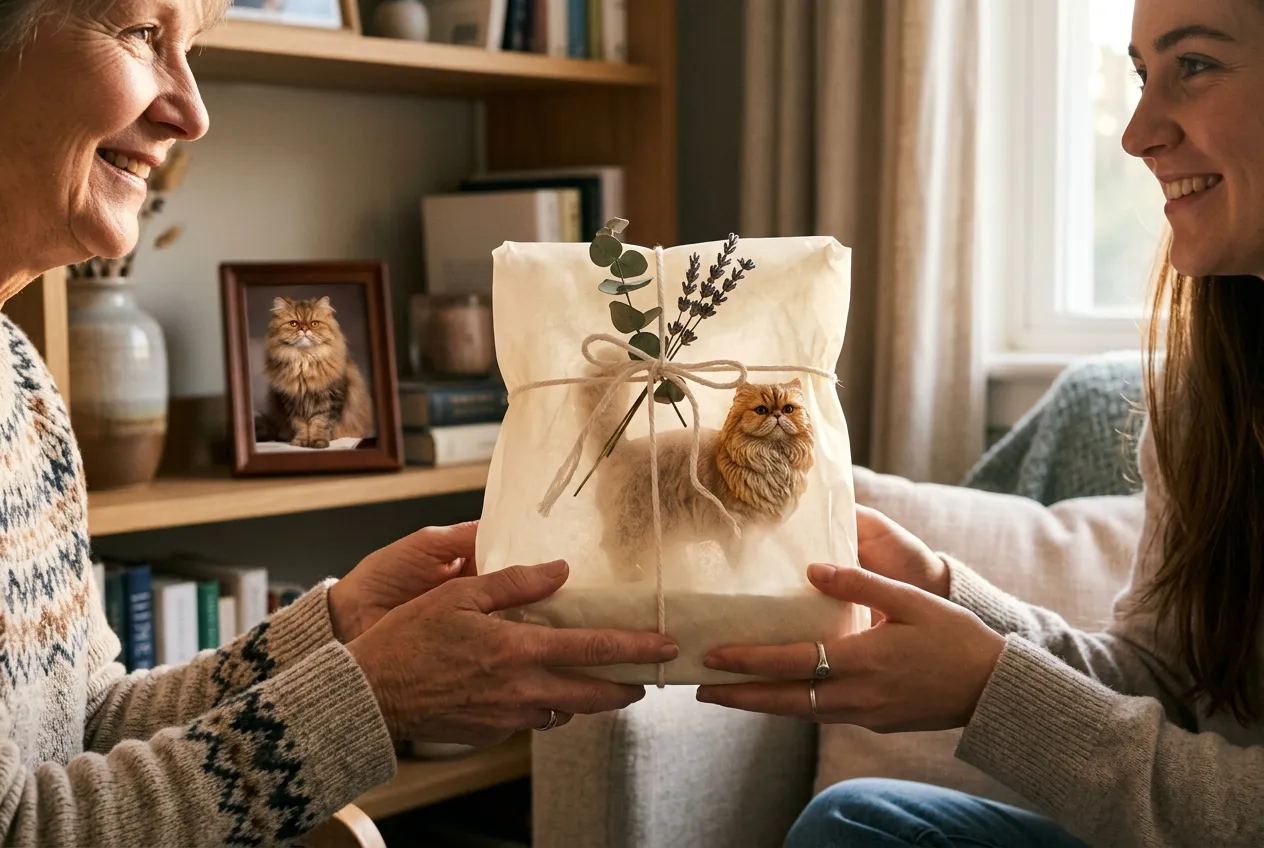
Her pillow still has the indent. You noticed it this morning—that small, circular dip on the left side of your bed where she curled every single night—and your hand went to it before you could stop yourself. Cool cotton where warm fur should be. If you're reading this, someone you love just lost their Persian cat, and you're searching for a sympathy gift for cat loss that actually means something. You're in the right place.
Quick Takeaways
- Skip the generic sympathy card — tangible, personalized gifts carry more emotional weight for grieving pet owners
- Timing matters more than price — a thoughtful gift within the first two weeks lands deeper than a grand gesture months later
- Match the gift to the griever — not every cat owner mourns the same way, and the best gifts honor their specific bond
- Physical keepsakes like custom pet figurines give grief an anchor — something to hold when the absence feels too big
- Don't avoid their cat's name — the most meaningful gifts reference the pet directly and specifically
Why Persian Cat Loss Hits Different (And Why Generic Sympathy Falls Flat)
Here's something most gift guides won't tell you: losing a Persian cat is not the same as losing other pets. That's not a ranking of grief—all pet loss is devastating. But the texture of the loss is different, and understanding that difference is what separates a gift that lands from one that gets politely shelved.
Persians are proximity cats. They don't bolt around the house chasing laser pointers (well, most don't). They occupy space. They claim a corner of the couch. They sit on the bathroom counter while you get ready. They follow you from room to room—not frantically, but with this calm, deliberate presence that becomes the rhythm of your entire home.
So when a Persian dies, the loss isn't just emotional. It's spatial. The house feels architecturally wrong. There's too much room on the bed. The windowsill looks bare. The spot next to the heating vent is just... a spot now.
Your friend is navigating that right now. Every room has a ghost-shaped gap in it.
"Grief doesn't just live in your heart. It lives in the empty spaces your pet used to fill."
Most sympathy gifts for cat loss ignore this entirely. They address the sadness—which is valid—but they miss the disorientation. The best gift you can give isn't just something that says "I'm sorry." It's something that fills one of those gaps, even a little.
That's the lens we're using for every recommendation in this guide. Not "what's a nice thing to buy someone who's sad" but "what helps someone whose home suddenly feels like it belongs to a stranger."

The Counterintuitive Truth About Timing Your Gift
Most people wait. They think, "I'll give them space first. I don't want to overwhelm them." And look—that instinct comes from a good place. But here's what we've learned from working with thousands of grieving pet families: the first 72 hours are when people feel the most invisible.
Everyone texts "so sorry for your loss" on day one. By day four, the messages slow. By week two, the world has moved on. Your friend hasn't.
The sweet spot for a sympathy gift? Days 3 through 14. Early enough that they know you're still thinking about them. Late enough that the initial shock has softened into something they can actually receive.
Here's what a real morning looks like during that window:
She wakes up at 6:15, same as always, because her body still expects the soft weight of a Persian landing on her chest. She makes coffee. She almost sets down the second bowl of water by the kitchen island. She checks her phone—nothing new. Then your package arrives. It has the cat's name on it. She sits on the kitchen floor and cries, but it's the good kind. The kind that means someone remembered.
That's the gift you want to be.
| Timing | Emotional State | Best Gift Type | Why It Works |
|---|---|---|---|
| Day 1-2 | Shock, numbness | Simple card or flowers | Doesn't require emotional processing |
| Day 3-7 | Raw grief, isolation | Personalized keepsake | Shows you remember the specific pet |
| Week 2-3 | Loneliness, "everyone forgot" | Tangible memorial gift | Fills the silence others have left |
| Month 1-3 | Waves of grief, adjustment | Experience or lasting tribute | Supports long-term healing |
| 6+ months | Quiet ache, anniversaries | Meaningful remembrance piece | Honors the ongoing bond |
Notice how the gift type shifts? That's intentional. A bouquet of lilies on day one is kind. A custom memorial piece at week two is transformative.
A Persian Cat Memorial Gift Guide That Actually Helps
Let's get specific. Every item here was chosen through one filter: does this acknowledge the unique, spatial, presence-based bond that Persian cat owners share with their cats? If it just says "sorry" in a pretty way, it didn't make the list.
1. A Custom 3D-Printed Pet Figurine
Who it's for: The friend who keeps saying "I just want to see her again."
Budget: Varies — visit the provider's website for current options.
This is the gift that stops people mid-sentence. A custom pet figurine captures the exact pose, coloring, and expression of their specific Persian—not a generic long-haired cat, but their cat. The one with the slightly crooked ear or the orange patch above the left eye.
What makes this option stand out is the technology behind it. Companies like PawSculpt use full-color 3D printing where the color is embedded directly into the resin material, voxel by voxel. That means your friend's Persian's distinctive smoke-gray coat or those copper eyes aren't painted on—they're part of the figurine itself. The result is a piece with vibrant, UV-resistant color that won't chip or fade.
Pro tip: Gather 4-6 clear photos of the cat from different angles before ordering. Include at least one that shows the cat's favorite resting pose—Persians are all about their signature lounge.
2. A Weighted Stuffed Animal in Similar Size
Who it's for: The friend who misses the physical weight of their cat.
Budget: $30-$75
This one surprises people, but it's rooted in something real. Persian cats are dense, heavy cats—typically 7 to 12 pounds of solid, warm presence. When that weight disappears from your lap or your chest at night, your body notices. A weighted plush (not a replica, just something soft and heavy) can ease that phantom-limb feeling.
Look for one in a similar weight range to their cat. Some companies make custom-weighted options. It's not about replacing the cat. It's about giving the nervous system something to hold.
Pro tip: This gift works best when paired with a note that says something like, "For the nights that feel too light." Don't overthink it.
3. A Personalized Garden Stone or Planter
Who it's for: The friend with outdoor space who processes grief through doing.
Budget: $25-$60
Persians are indoor cats almost exclusively, but here's the twist—a garden memorial creates a new space for the cat's memory rather than trying to fill the old ones. That distinction matters psychologically. Instead of staring at the empty windowsill, your friend can tend to something living that carries their cat's name.
Choose a stone with the cat's name and years, or a planter they can fill with cat-safe herbs like catnip or valerian (a quiet nod to the cat's species).
Pro tip: Avoid stones that say "Rainbow Bridge" unless you know your friend connects with that imagery. Not everyone does, and a mismatched sentiment can feel jarring.
4. A Custom Illustration or Portrait
Who it's for: The friend who's visual and loves art on their walls.
Budget: $40-$200+ depending on the artist
A good pet portrait captures personality, not just appearance. For Persians, that means the artist needs to understand the attitude—the regal, slightly unimpressed gaze, the way they sit like they're posing for a Renaissance painting without trying.
Commission from an independent artist (Etsy has thousands) and request a style that matches your friend's home aesthetic. Watercolor for minimalists. Bold digital art for modern spaces. Charcoal for the classic crowd.
Pro tip: Ask the artist if they can include a small detail from the cat's life—a favorite toy, the specific window they sat in, their food bowl. Details turn a portrait into a story.
5. A Charitable Donation in the Cat's Name
Who it's for: The friend who'd feel uncomfortable receiving a physical gift.
Budget: $25-$100
Some people grieve outward. They need to do something. A donation to a Persian cat rescue or a feline health research fund—made in their cat's name—channels grief into purpose. The ASPCA is a solid choice, or look for breed-specific rescues that focus on Persian and flat-faced cat welfare.
You'll typically receive a card or certificate acknowledging the donation, which you can pass along.
Pro tip: Pair this with a handwritten note explaining why you chose this specific organization. "I donated to a Persian rescue because Cleo deserved a legacy" hits harder than a generic donation receipt.
6. A Memory Book or Grief Journal
Who it's for: The friend who processes through writing.
Budget: $15-$40
Not a scrapbook (those require energy your friend doesn't have right now). A guided grief journal with prompts specifically designed for pet loss. Prompts like "Describe your cat's morning routine" or "What sound do you miss most?" give structure to feelings that otherwise just swirl.
The best ones leave room for photos, ticket stubs, or even a small bag of fur if your friend saved some.
Pro tip: Write the first entry yourself. Something like, "I remember when you first told me about [cat's name]. You said..." This breaks the blank-page barrier and shows you were paying attention all along.
"The most powerful gifts aren't the most expensive ones. They're the ones that prove you were listening."
— The PawSculpt Team
Gift Comparison: Finding the Right Match
Not sure which direction to go? This table maps each gift to the type of griever and the kind of comfort it provides.
| Gift | Budget Range | Best For | Type of Comfort | Effort Level |
|---|---|---|---|---|
| Custom 3D figurine | Varies (check provider) | Visual grievers, "I want to see them" | Tangible presence | Low (you provide photos) |
| Weighted stuffed animal | $30-$75 | Physical grievers, "I miss holding them" | Sensory/body comfort | Low |
| Garden stone/planter | $25-$60 | Active grievers, "I need to do something" | Purpose and ritual | Medium |
| Custom portrait | $40-$200+ | Art lovers, aesthetic-driven | Visual beauty and memory | Medium (artist selection) |
| Charitable donation | $25-$100 | Outward processors, "make it mean something" | Legacy and purpose | Low |
| Grief journal | $15-$40 | Writers, internal processors | Emotional processing | Medium (write first entry) |
Here's the thing most gift guides miss: you can combine two of these. A grief journal paired with a donation. A garden stone now, and a custom figurine ordered for the one-month mark. Layering gifts across the timeline we discussed earlier creates a sustained feeling of being held through the worst of it.
What NOT to Give (The Mistakes Well-Meaning People Make)
We need to talk about this because the wrong gift doesn't just miss—it can actually hurt. And the people who give bad sympathy gifts are almost always people who care deeply but don't understand cat grief specifically.
Don't give a new cat or kitten. Not now. Not as a surprise. Ever. This is the number one mistake, and it comes from the (understandable) logic that "a new pet will help them heal." It won't. Not yet. It tells the griever that their cat is replaceable, even if that's not what you mean. If they want another cat eventually, they'll get there on their own timeline.
Don't give generic "pet loss" gifts that could apply to any animal. A keychain that says "Forever in My Heart" with a generic paw print? It's fine. It's also forgettable. Your friend didn't lose a generic pet. They lost a specific Persian with a specific name and specific habits. Honor that specificity.
Don't give food baskets or wine unless you know their taste. Grief makes people's appetites unpredictable. Some people stop eating. Some people can't stop. A basket of artisanal crackers sitting untouched on the counter just becomes another object in a house full of objects that don't matter anymore.
Don't give anything that requires immediate assembly or effort. No 1,000-piece puzzles. No DIY memorial kits with seventeen steps. Your friend is exhausted. The gift should arrive ready to comfort, not ready to become a chore.
And please—don't give anything with a deadline. "Plant these memorial seeds within 30 days!" is the last thing someone in acute grief needs. No pressure. No expiration dates. Grief doesn't have a schedule, and neither should your gift.
The Gift That Isn't a Gift: What to Say (And What to Never Say)
Sometimes the most important thing you give isn't an object. It's words. But the wrong words can land like a brick, so let's be precise here.
Never say:
- "She's in a better place." (Their lap was the best place, and they know it.)
- "It was just a cat." (Walk away. Immediately.)
- "At least she lived a long life." (Length doesn't soften loss.)
- "You can always get another one." (See the section above.)
- "I know how you feel." (You don't. Even if you've lost a pet, you don't know this specific grief.)
Instead, say:
- "I loved the way [cat's name] used to [specific thing]." Use the cat's name. This matters more than you think.
- "I'm not going to pretend I know what to say. I just want you to know I'm here."
- "Tell me about her." Then listen. Really listen.
- "There's no timeline on this. Take whatever time you need."
If you're writing a card to accompany your gift, keep it short. Three to four sentences maximum. Name the cat. Reference one specific memory or trait. Say you love them. Done.
Here's a template that works:
"Dear [friend], I keep thinking about [cat's name] and the way she [specific habit—sat on your laptop, judged everyone from the top of the fridge, purred like a small engine]. She was so loved, and that's because of you. I'm here whenever you need me, even if 'need' just means sitting together and saying nothing."
That's it. That's the whole card.
The Science of Why Physical Keepsakes Help With Pet Grief
Let's get into something most gift guides skip entirely: why tangible objects actually help the grieving brain.
When someone loses a pet, the brain enters a search mode. This isn't metaphorical—it's neurological. The brain has spent years encoding the pet's presence as part of its environmental map. The sound of paws on hardwood. The weight on the bed at 11 PM. The shape in the peripheral vision near the food bowl. When those inputs suddenly stop, the brain keeps scanning for them. That's why your friend "sees" their cat in the hallway. That's why they hear phantom meows.
A physical keepsake—especially one that captures the pet's specific appearance—gives the brain something to land on. It doesn't stop the scanning entirely, but it provides an anchor point. "She's not here, but this is here. This is real. This is something I can touch."
This is why a custom pet memorial figurine can be so powerful. It's three-dimensional. It occupies space. It sits on the nightstand or the mantle and it takes up room in a house that suddenly has too much of it. For Persian cat owners especially—people whose cats were defined by their physical presence—a figurine that captures the exact fluff, the exact face shape, the exact coloring provides something that photos alone can't: dimension.
The Association for Pet Loss and Bereavement recognizes that tangible memorials play a meaningful role in the grieving process. Having something physical to direct your love toward—something you can pick up, hold, place carefully back down—gives grief a container. And grief with a container is grief that can eventually soften.
"You don't get over losing them. You just learn to carry the love differently."
A Note on Grieving Persian Cat Owners Specifically
We've worked with a lot of cat families at PawSculpt, and Persian owners share a few patterns worth knowing if you're choosing a gift.
They often have extensive photo libraries. Persians are photogenic and their owners know it. This means photo-based gifts (figurines, portraits, photo books) are especially easy to execute well. Your friend probably has hundreds of high-quality images already.
They tend to anthropomorphize more than average. Persian cats have expressive, almost human-like faces due to their flat features and large eyes. Owners frequently describe their Persians as having "opinions," "moods," and "judgments." A gift that honors the cat's personality—not just their appearance—will resonate deeply.
They're often detail-oriented about grooming and care. Persian owners invest significant time in daily brushing, eye cleaning, and coat maintenance. That daily ritual is now gone, and the absence of routine can be as painful as the absence of the cat. Consider gifts that gently create a new small ritual—lighting a memorial candle, tending a plant, journaling.
They may feel guilt. Persians are prone to specific health issues—polycystic kidney disease, respiratory problems, dental disease. Owners sometimes carry guilt about whether they did enough, caught symptoms early enough, made the right call at the end. Your gift should never inadvertently trigger this. Avoid anything that references the cat's health or cause of death. Focus entirely on the life, not the loss.
When the Gift Arrives: What Happens Next
You've chosen the gift. You've written the card. You've timed it right. Now what?
Don't expect a thank-you right away. Your friend might not respond for days. They might send a single heart emoji at 2 AM. They might call you sobbing three weeks later. All of these responses are normal. The gift did its job regardless of the reply.
Check in at the one-month mark. This is when most people have stopped asking how your friend is doing. Send a text. Keep it simple: "Thinking about you and [cat's name] today." That's enough. That's everything.
Be prepared for the anniversary. The first anniversary of a pet's death is brutal, and almost nobody remembers it except the owner. Put it in your calendar now. Send a message. If you gave a figurine or a portrait, reference it: "I hope [cat's name]'s figurine is keeping you company today." This tells your friend that the gift wasn't a one-time gesture—it was a commitment to remembering alongside them.
And here's the counterintuitive part: let them talk about their cat forever. Not just in the first week. Not just in the first month. Forever. Two years from now, if they mention their Persian in conversation, don't change the subject. Don't look uncomfortable. Say, "Tell me that story again." Because the worst part of pet loss isn't the grief. It's the moment when you realize nobody wants to hear about your cat anymore.
Be the person who always wants to hear about their cat.
The Gift of Presence (Your Most Powerful Tool)
We've spent this entire guide talking about objects. But we'll be real with you—the single most impactful gift for a grieving pet owner is your presence. Physical, if possible. A phone call if not. A voice memo if that's all you can manage.
Show up at their door with takeout and zero expectations. Sit on their couch. Let them cry or let them talk about something completely unrelated. Don't fill every silence. Some silences are the most honest conversation two people can have.
If you can't be there physically, send a voice memo instead of a text. Hearing a familiar voice activates different neural pathways than reading words on a screen. It's warmer. It's closer. It's the auditory equivalent of a hand on the shoulder.
And if you're reading this guide because you're far away, or you're not sure your relationship is "close enough" for a visit—send the gift. That's why you're here. A thoughtful persian cat memorial gift, chosen with care and sent with love, can cross any distance. It says what your voice can't say from 500 miles away: I see your pain. I remember your cat. You are not alone in this.
That's not a small thing. That's everything.
Closing: Back to the Bedroom
Remember that pillow indent? The one your friend found this morning?
Someday—not today, not next week, but someday—she'll smooth it out. She'll fluff the pillow and the indent will disappear and she'll be okay with that. Not because she's forgotten, but because the memory has found other places to live. In a figurine on the nightstand. In a garden stone by the back door. In a journal entry she wrote at midnight. In the card you sent with her cat's name on it.
You can't fix grief. You can't rush it or organize it or make it make sense. But you can give it somewhere to land. You can give it shape and weight and color—literally, if you choose a keepsake that captures the exact copper of those Persian eyes.
The best sympathy gift for cat loss isn't the most expensive or the most elaborate. It's the one that says: I know who you lost. Not just a cat. Her. The specific, irreplaceable, fur-covered weirdo who owned your whole heart.
Go be the friend who remembers her name.
Frequently Asked Questions
What is the best sympathy gift for someone who lost a cat?
The most meaningful gifts are personalized ones that reference the specific cat—not generic pet loss items. Custom figurines, commissioned portraits, engraved garden stones with the cat's name, or even a heartfelt card that mentions a specific memory of the cat all outperform generic sympathy gifts. The key is specificity: show that you knew and remembered their cat.
How long does grief last after losing a Persian cat?
There's no expiration date on pet grief. The acute phase—where it's hard to function normally—typically lasts two to six weeks. But waves of sadness can surface for months or even years, especially around anniversaries or when encountering reminders. Persian owners often report that the loss of daily grooming routines extends the adjustment period. All of this is normal.
Is it appropriate to give a gift after someone loses a pet?
Yes, and it's more appreciated than most people realize. The ideal window is 3 to 14 days after the loss. By that point, the initial flood of condolences has dried up, and your friend is starting to feel invisible in their grief. A thoughtful gift during this window says "I'm still here, and I still remember."
Should I mention the cat's name in a sympathy card?
Always. This is one of the simplest and most powerful things you can do. Using the cat's name validates the bond and shows that you saw the pet as an individual. Pair the name with a specific memory or trait—"I loved how Cleo always sat on your laptop during video calls"—and you've written a card they'll keep forever.
What should you not say to someone who lost their cat?
Avoid "it was just a cat," "you can get another one," "at least she lived a long life," and "I know how you feel." These phrases minimize the loss, even when well-intentioned. Instead, say the cat's name, share a specific memory, and simply say "I'm here." Sometimes the most helpful thing is admitting you don't know what to say.
What is a custom pet figurine and how is it made?
A custom pet figurine is a three-dimensional replica of your specific pet, created from photographs you provide. At PawSculpt, master digital sculptors model the figurine based on your photos, then it's produced using full-color 3D printing technology. The color is embedded directly into the resin material—not applied afterward—resulting in vibrant, durable detail that captures your pet's unique markings and expression. Visit pawsculpt.com for full details on the process.
Ready to Honor a Beloved Persian?
When words fall short, a lasting keepsake speaks. If someone you love is grieving their Persian cat, a custom PawSculpt figurine captures every detail that made that cat irreplaceable—the flattened nose, the plume of a tail, those knowing eyes. It's more than a sympathy gift for cat loss. It's proof that their cat was real, was loved, and will be remembered.
Visit pawsculpt.com to see how it works, explore options, and start preserving the memory of a pet who deserved to be remembered forever.