Grooming for the Camera: Prepping Your Ragdoll Cat for a 3D Model
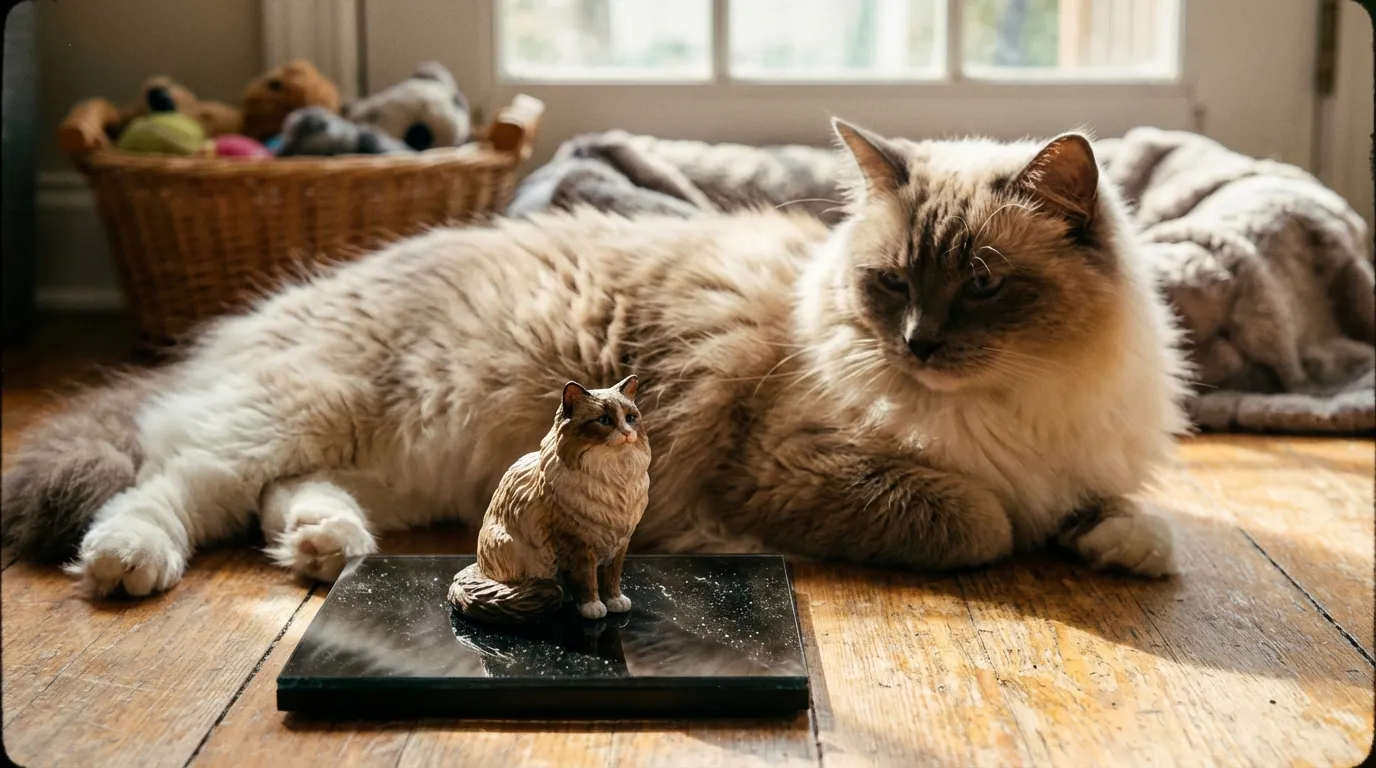
Does standing in the grooming aisle of your local pet store, staring at twenty different slicker brushes, make you feel like you're preparing for a tactical mission rather than a simple brush-out? When you’re prepping a Ragdoll cat for a permanent keepsake, the stakes feel higher than just a routine comb-through because you aren't just tidying up—you're revealing the architecture of your pet.
In this guide, we’ll cover specific cat grooming tips to reveal your Ragdoll's true structure for the perfect reference photo, ensuring their custom figurine looks exactly like them.
The "Cloud with Eyes" Problem
We see it all the time in the studio. A customer sends us a photo of their beloved Ragdoll, Mochi. Mochi is beautiful, stunningly fluffy, and... completely shapeless. From a sculptor's perspective, he looks like a toasted marshmallow with blue eyes.
Here is the counterintuitive truth about pet photography prep for 3D modeling: We don't need maximum fluff; we need structural definition.
When you groom for a show, you want volume. When you groom for a sculptor, you want clarity. If the fur is too lofted, our artists have to guess where the shoulder blade ends and the neck begins. And guessing is the enemy of accuracy.
"A great reference photo doesn't just show the fur; it reveals the cat living inside the coat."
For a breed like the Ragdoll cat, known for that silky, rabbit-like texture and semi-longhair coat, the goal is to smooth the coat down enough to show the musculature underneath, while still capturing that signature plume of a tail.
Tools That Reveal, Not Just Detangle
Most owners grab a slicker brush and call it a day. But to get that "studio ready" look that translates into a high-fidelity 3D model, you need a slightly different toolkit.
We’ve tested countless tools while advising customers on their reference shots. Here is the breakdown of what actually works for structural definition:
The Essential Grooming Toolkit
| Tool Type | Standard Use | The "Sculptor's Secret" Use |
|---|---|---|
| Greyhound Comb | Removing mats | Use the wide-tooth end to separate the "ruff" from the chest, creating visual depth. |
| Boar Bristle Brush | Shining the coat | smoothing flyaways flat against the body to reveal the spine's curve. |
| Matte Spray | Detangling | Lightly misting the pantaloons (hind legs) to reduce static and show leg shape. |
| Slicker Brush | General brushing | Avoid deep fluffing right before the photo; it creates a "halo" effect that blurs edges. |
Pro Tip: If your Ragdoll has a particularly dense undercoat, skip the bath right before the photo session. Freshly washed hair is often too "flyaway." Day-old hair settles better and shows the body's contours more clearly.
Mapping the Anatomy: A Grooming Strategy
You aren't just brushing hair; you are mapping geography for our artists.
1. The Majestic Ruff
The neck ruff is the crown jewel of a Ragdoll, but it can easily swallow their head in photos. Instead of brushing it upward (which makes the head look like it's floating), brush it outward and slightly down.We had a client, Sarah, whose Ragdoll, Barnaby, had a massive ruff. In her first photos, his chin disappeared entirely. We asked her to use a damp cloth to gently flatten the hair directly under the chin while fluffing the sides. Suddenly, Barnaby had a jawline again. That tiny detail allowed our sculptors to capture his regal expression perfectly.
2. The Pantaloons and Tummy
This is where cat grooming tips usually fail to address 3D modeling needs. The long fur on the hind legs (pantaloons) often merges with the stomach fur, making the cat look like a hovercraft.Use a metal comb to create a clear separation line between the belly fur and the leg fur. You want to create a "shadow gap." If the camera can see that gap, our 3D printers can replicate it.
3. The Tail Plume
This is the one area where you do want volume. A Ragdoll's tail should look like a soft, flowing fountain. Brush it gently against the grain to separate the hairs, then smooth the very top layer back down. This gives it volume without it looking messy."The hardest part of sculpting long-haired breeds isn't the hair itself—it's finding the anatomy hidden underneath it."
— The PawSculpt Team
Lighting: The Invisible Grooming Tool
You can groom for hours, but if your lighting is flat, the texture disappears.
Avoid using the direct flash on your phone. Flash flattens images, turning all that beautiful grooming work into a single block of color. Instead, position your Ragdoll near a window with side lighting.
Side lighting creates micro-shadows in the fur. These shadows are data. They tell our sculptors, "Here is a tuft," "Here is a swirl," "Here is where the hip bone presses against the skin."
According to photography experts at the American Kennel Club, natural light is critical for capturing accurate coat colors and textures, a principle that applies perfectly to cats as well. The nuances of a Ragdoll's colorpoint pattern—the subtle gradation from cream to chocolate or blue—require soft, natural light to be interpreted correctly by our painters.
Managing the "Ragdoll Flop" During Prep
We know the struggle. You get the brush out, you start working on the flank, and your Ragdoll does what Ragdolls do best: they go boneless.
While the "flop" is adorable, it’s a nightmare for grooming the belly and legs.
The Solution: High-value treats and short bursts.
Don't try to do the full "show groom" in one sitting. It stresses the cat and creates static electricity in the coat.
- Session 1 (5 mins): Comb out the undercoat to remove loose hair.
- Break: Playtime.
- Session 2 (5 mins): Structural brushing (smoothing the body, fluffing the tail).
- Immediate Photo: Have your phone ready.
If your cat is particularly squirmy or anxious about grooming, the ASPACA provides excellent resources on low-stress handling techniques. A relaxed cat holds their body naturally; a tense cat hunches, which changes their silhouette and makes the resulting figurine look stiff.
Why This Effort Matters
You might be thinking, "Can't the artists just fix it?"
We can do amazing things at PawSculpt. We can fix red-eye, we can reconstruct a missing ear tip, and we can infer a lot from blurry photos. But we can't invent personality.
The way your cat's fur breaks over their shoulder when they turn to look at you? That's specific to them. The way their ruff parts in the middle? That's their signature.
By taking the time to groom for structure, you aren't just helping us make a model. You are ensuring that when you unbox that figurine three weeks from now, you don't just see a cat. You see your cat.
"Grooming isn't a chore—it's the language of trust between you and your Ragdoll."
The Final Polish
Before you snap those reference photos, do a final "eye check." Look at your cat through your phone screen, not just with your eyes.
- Can you see the curve of the shoulder?
- Is the chin distinct from the neck?
- Are the paws visible, or are they buried in slippers?
If the answer is yes, you've done your job. Now, capture that moment. Because while the grooming session lasts twenty minutes, the memory you're preserving is forever.
Frequently Asked Questions
How many photos do I need for a custom cat figurine?
We generally recommend providing at least 3-4 photos: a front view (face level), a side profile (showing the full body length), a back view (for tail and markings), and a close-up of the face to capture eye color and expression. For fluffy breeds like Ragdolls, an additional angled shot that shows the depth of the chest is incredibly helpful for our sculptors.Should I bathe my Ragdoll before taking reference photos?
It might sound counterintuitive, but ideally, no. Freshly bathed fur tends to be overly fluffy, static-charged, and "flyaway," which creates a soft halo effect that obscures the actual body shape. A coat that hasn't been washed for a few days often settles better, lying flatter against the musculature and revealing the cat's true structure.My cat has passed away and I don't have perfect groomed photos. Can you still help?
Absolutely. This is a very common situation. Our master sculptors are experts at visual reconstruction. We can use multiple imperfect photos—even blurry ones or videos—to piece together a complete likeness. We combine your images with our deep knowledge of Ragdoll anatomy to fill in the gaps and recreate your pet faithfully.What if my Ragdoll has a unique coat pattern?
Ragdolls often have intricate colorpoint patterns that are unique to them. Detailed photos are key here. Make sure to take close-ups of specific markings—like an asymmetrical blaze on the nose or specific "mittens" on the paws—so our painters can replicate them exactly. If you can't get a photo, a written description of these quirks is also very useful.Ready to Celebrate Your Pet?
Every pet has a story worth preserving. Whether you're honoring a beloved companion who's crossed the rainbow bridge or celebrating your furry friend's unique personality, a custom PawSculpt figurine captures those details that make your pet one-of-a-kind. Don't let those cat grooming tips go to waste—turn that beautiful coat into a lasting work of art.
Free instant AI preview • 3D artist preview within 7 days • 5 free revisions