The Unfinished Agility Course: Honoring Your Athletic Border Collie
It’s 6:00 AM on a Tuesday three years ago. The Oregon coast is gray and biting, but you don’t feel the cold. You only see the black-and-white blur tearing across the wet sand, kicking up grit as he pivots mid-air to snag the frisbee. His eyes are locked on yours, waiting for the next command, vibrating with an intensity that demands your total presence. There is no scrolling on your phone, no daydreaming. There is only the work, the focus, and the absolute connection between handler and dog.
Today, the tide line is smooth. Unbroken. You walked the same stretch of beach this morning, leash in your pocket out of habit, but your arm didn't ache from throwing. The seagulls landed near you, unafraid, because there was no kinetic force of nature there to scatter them. The stillness wasn't peaceful; it felt heavy, like the air itself was holding its breath, waiting for a bark that never came.
Quick Takeaways:
- Grief for a working dog is distinct: You haven't just lost a pet; you've lost a teammate, a competitive partner, and a daily purpose.
- The "Motion Void": High-drive dogs structure our entire days; their absence creates a physical vacuum that feels louder than silence.
- Tangible Tributes help ground you: Whether it's a shadow box of ribbons or a custom figurine capturing their alert stance, physical reminders help bridge the transition.
- It's okay to miss the sport too: Admitting you miss the competition doesn't mean you loved the dog less.
The Loss of a Teammate vs. The Loss of a Pet
Most people understand losing a dog. They understand the empty bed and the quiet house. But losing a Border Collie, particularly one you trained in agility, flyball, or herding, is a fundamentally different dismantling of your life.
You didn't just lose a companion who slept at your feet. You lost the reason you got up at dawn on Saturdays to drive two hours to a trial. You lost the creature who could read your body language better than your spouse. You lost your teammate.
This is the angle of grief that catches athletic dog owners off guard. We define ourselves by our dogs. We are "Strike's Handler" or "Luna's Mom." When the dog is gone, the identity crisis hits hard.
The Micro-Routine Collapse:
Consider the 4:00 PM feeling. For years, 4:00 PM wasn't just a time; it was a biological imperative. Your dog would start pacing, staring, maybe nudging your elbow. It was training time. Now, 4:00 PM rolls around and your body still releases the adrenaline to train, but there is nowhere to direct it. That excess energy turns into anxiety.
The Taboo Emotion: Relief (and the Guilt That Follows)
Let's be honest about something few people talk about. Border Collies are difficult. They are brilliant, yes, but they are also demanding, neurotic, and exhausting. They require constant mental stimulation, or they destroy the drywall. They need a job, or they invent one you won't like.
When a high-maintenance dog passes, especially after a long illness or a decline in mobility, there is often a moment of sheer relief.
Suddenly, you can leave the house without crating a Houdini. You can sleep past 6:00 AM. You don't have to manage their reactivity toward other dogs on walks.
Then, the guilt crashes down.
You might think, How can I feel relieved? He was my soulmate. But this reaction is normal. It doesn't mean you didn't love them. It means you were a caretaker for a complex, high-needs living being, and that burden has been lifted.
The Counterintuitive Insight:
The intensity of your relief is actually a testament to how much you gave them. You reorganized your entire life to accommodate their drive and intelligence. The space you feel now is the exact measurement of the effort you poured into their happiness.
What Do You Do With the Equipment?
This is a specific pain point for agility and sport handlers. Your backyard isn't just a yard; it's an obstacle course. The weave poles are still staked in the grass. The A-frame is weathering under the oak tree. The tack box in your car is full of specific treats, tug toys, and cooling mats.
Seeing these objects can trigger a unique kind of pain—the pain of "potential unfulfilled." You look at the jump and remember the one cue you never quite mastered together.
Don't Purge Immediately:
The impulse might be to clear it all out to stop the hurting. Wait.
- 3-6 Weeks: Do nothing. Let the dust settle.
- The "Legacy" Donation: When you are ready, consider donating equipment to a local 4-H club or a junior handler program. Seeing a kid learn the sport on your dog's equipment can transform the memory from painful to purposeful.
Memorializing the "Border Collie Crouch"
Standard pet memorials often fail athletic dogs. A photo of a Border Collie sleeping looks sweet, but it’s not them. These dogs are defined by motion, by the "eye," by that low-slung crouch before they launch.
We’ve worked with countless families at PawSculpt who struggled with this. They’d send us photos of their dogs lying on the rug, but in the notes, they’d write, “He was never actually this still.”
This is where three-dimensional tributes change the narrative. Instead of a static portrait, we often encourage owners to choose a pose that captures the "work."
- The crouch at the start line.
- The mid-air catch.
- The intense "herding stare."
Capturing that tension in the muscles—the potential energy waiting to be released—is how you honor a working dog. It reminds you not of their end, but of their prime. It’s a way to keep a piece of that electric energy on your desk, a permanent reminder of the team you were.
The Fear of the "Next Dog"
"I'll never have another one like him."
You're right. You won't. And that is terrifying.
For sport handlers, the grief is compounded by performance anxiety. You worry that your next dog won't have the same drive, or that you won't share the same psychic connection. You worry that you've lost your "heart dog" and everything that follows will be a disappointment.
The Reality Check:
Your next dog will be different. They might be faster, or they might be slower. They might have a better contact performance but worse weave pole entry.
The mistake is trying to recreate the unfinished course with a new teammate. The relationship you had with your late Border Collie was a closed loop—a completed project. The next dog is a blank page, not a sequel.
Closing: The Final Run
There is a concept in dog sports called the "victory lap." It's that moment after a clean run where you celebrate with your dog, regardless of the time or the placement.
Right now, you are in the quiet aftermath of the final run. The course is empty. The judge has put the whistle away. It feels lonely, and the silence in your home is deafening compared to the chaos you were used to.
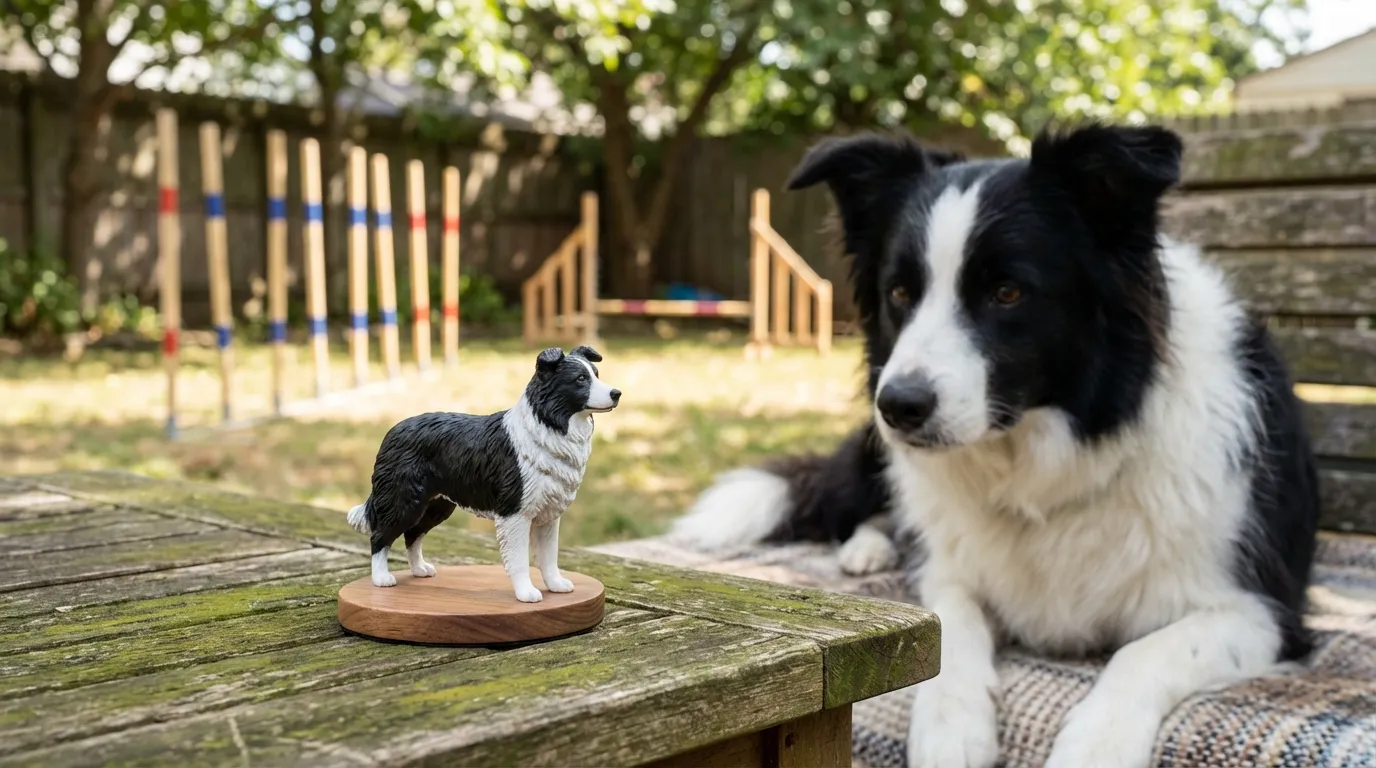
But look at the weave poles in the yard. Look at the ribbons on the wall. Look at the custom figurine on your mantle that catches the light just like his eyes used to.
They didn't quit the team. They just finished the course before you were ready to stop running.
Frequently Asked Questions
How do I deal with the guilt of feeling relieved after my high-energy dog dies?
This is perhaps the most common, yet least discussed, emotion among Border Collie owners. Relief is not a sign of a lack of love; it is a biological reaction to the cessation of stress. Managing a high-drive, intelligent animal is a full-time job. When that job ends, your body naturally exhales. Acknowledge the relief as a testament to how hard you worked to give them a good life, not as a betrayal of their memory.What should I do with my deceased dog's agility equipment?
The backyard course can be a painful daily reminder. However, we recommend waiting at least a month before making decisions. When you are ready, consider donating the equipment to a 4-H club or a young handler just starting out. Knowing your dog's equipment is helping a new team build their bond can be incredibly healing.Is it normal to feel like I've lost a hobby, not just a pet?
Yes. For sport dog owners, the dog is the conduit for your social life, your exercise, and your competitive outlet. You are grieving a "lifestyle loss" alongside the loss of the animal. It is important to find ways to stay connected to your community, perhaps by volunteering at trials, even if you aren't ready to run a new dog yet.How can I memorialize a dog that was always moving?
Photos often look "flat" for dogs that lived life at full speed. Many owners find comfort in tangible items that represent action—framing their championship ribbons, keeping their collar with the mud still on it, or commissioning a custom sculpture that captures a specific dynamic pose, like the moment before a jump or the intense "eye" they used on sheep.Honor Their Memory Forever
Your pet's story deserves to be preserved in a way that captures their unique spirit. A custom PawSculpt figurine transforms your cherished memories into a timeless keepsake—every whisker, every marking, every detail that made them irreplaceable.
Free instant AI preview • 3D artist preview within 7 days • 5 free revisions