7 Interactive Gifts Under $50 That Celebrate Your Friend's Newly Adopted Scottish Fold — Perfect for Mother's Day
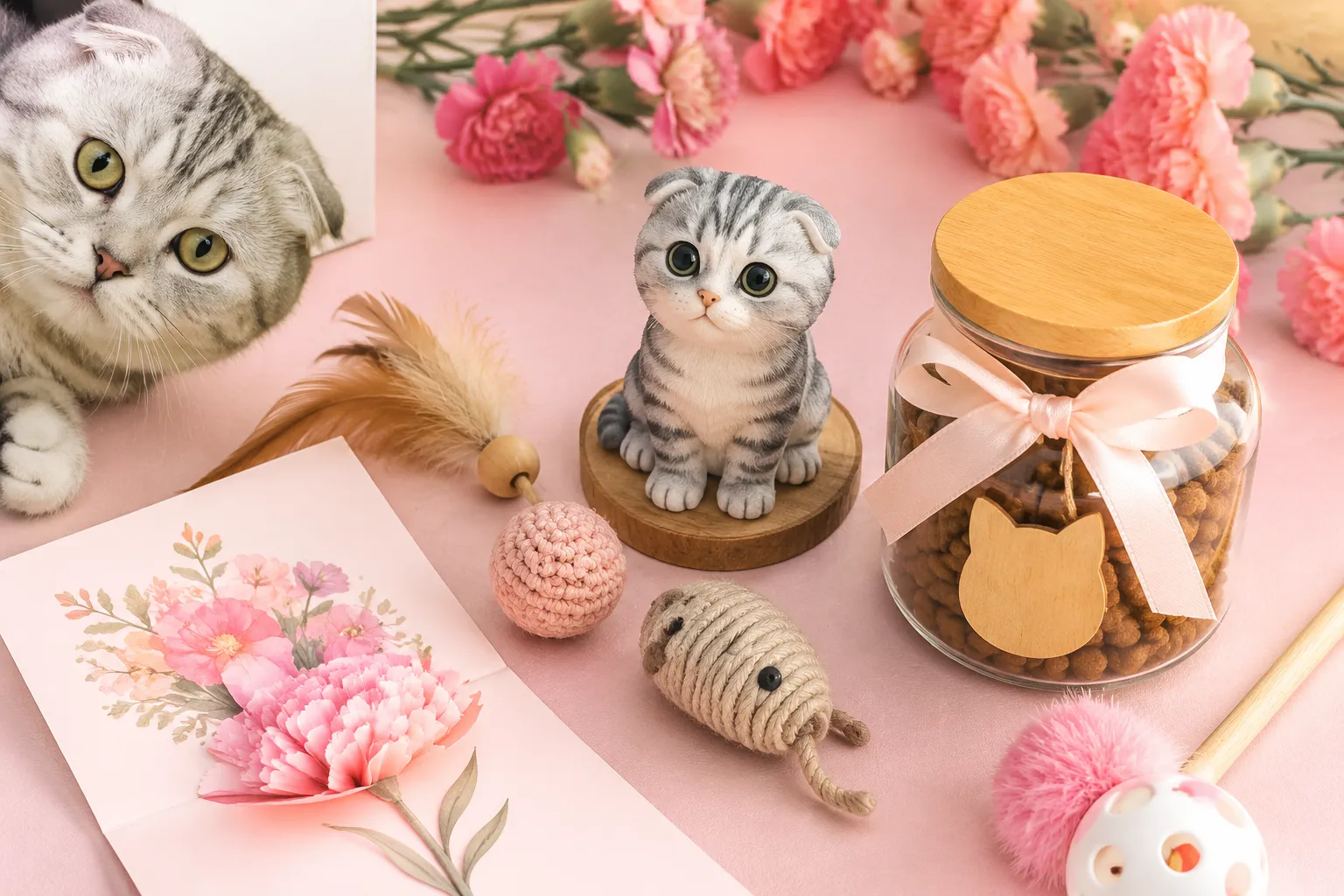
Her Scottish Fold was perched on the back of the couch—ears folded forward, one paw draped over the armrest like a tiny landlord surveying the apartment—when she texted you: "I'm officially a cat mom." And now you're scrolling your phone at 11PM, two weeks before Mother's Day, trying to find a cat gift that doesn't scream "I grabbed this at the airport."
Quick Takeaways
- Scottish Folds need mental stimulation more than most breeds — interactive gifts outperform passive toys by keeping their joints safe
- The $30–$50 range hits the sweet spot — premium enough to feel special, practical enough to actually get used
- Timing matters neurologically — gifts that arrive within the first 8 weeks of adoption reinforce the human-cat bond during peak attachment formation
- A lasting kepsake like a custom 3D-printed figurine pairs perfectly with interactive gifts for a layered present
- Mother's Day framing elevates the gesture — acknowledging someone as a "pet parent" validates an identity they're still growing into
Why Scottish Folds Change the Gift Calculus
Here's what most gift guides won't tell you: Scottish Folds are not standard cats, and standard cat gifts often miss the mark.
The breed's signature folded ears result from a cartilage mutation (osteochondrodysplasia) that affects connective tissue throughout the body. This means their joints are more vulnerable than the average domestic shorthair's. High-impact toys—spring-loaded launchers, aggressive wand attachments that encourage vertical leaping—can actually stress their skeletal system over time.
The ASPCA's breed information resources emphasize that enrichment for cats with joint sensitivities should prioritize mental engagement over physical intensity. Think puzzle-solving, slow tracking, and horizontal play patterns rather than acrobatic jumping.
This is the counterintuitive insight most people miss: the best interactive gift for a Scottish Fold is one that makes them think, not one that makes them leap.
| Factor | Standard Cat | Scottish Fold |
|---|---|---|
| Joint flexibility | Full range | Reduced (cartilage mutation) |
| Ideal play style | Vertical + horizontal | Primarily horizontal |
| Toy risk level | Low for most toys | Moderate for high-impact toys |
| Mental stimulation need | Moderate | High (compensates for limited physical play) |
| Best gift approach | Any interactive toy | Puzzle-focused, low-impact interactive |
So when you're shopping for your friend's newly adopted Fold, you're not just picking something fun. You're picking something that respects the cat's biology. That's a gift that says: I actually thought about this.
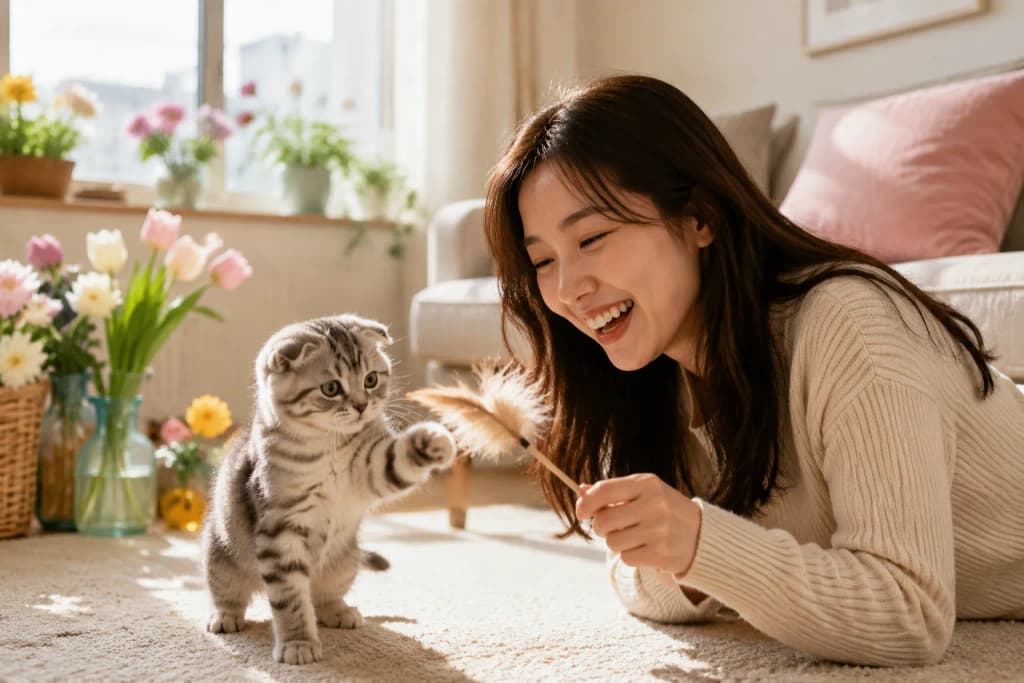
The Psychology of Gifting During Early Adoption
Before we get to the list, let's talk about why the timing of your gift matters more than you might expect.
Behavioral research on human-animal attachment suggests that the first 6–8 weeks of pet ownership represent a critical bonding window. During this period, the owner's brain is forming what attachment theorists call an "internal working model" of the relationship—essentially, their neural pathways are deciding how much emotional weight this bond will carry.
A gift that arrives during this window does something subtle but powerful: it provides social validation of the new identity. Your friend is still figuring out if she's "a cat person" or "a cat mom." When you show up with a thoughtful, specific gift that acknowledges her new role, you're reinforcing that identity at the neurological level.
"The best gifts don't just sit on a shelf—they start conversations and spark memories."
— The PawSculpt Team
This is why generic gifts fall flat. A mug that says "Cat Lady" is fine. But an interactive puzzle feder specifically chosen because you know Scottish Folds need mental stimulation? That communicates a completely different level of care.
And here's the thing about Mother's Day specifically: the holiday already carries identity-validation weight. Extending it to pet parenthood isn't trivializing motherhood—it's recognizing that caregiving is caregiving, and the dopamine-oxytocin feedback loop between a woman and her cat activates many of the same neural circuits as other nurturing relationships.
7 Interactive Gifts Under $50 for a Newly Adopted Scottish Fold
1. Trixie 5-in-1 Activity Center
Best for: The friend who works from home and needs her cat entertained during Zoom calls.
Budget: $25–$35
This isn't your standard ball-in-a-track toy. The Trixie Activity Center combines five different puzzle modules—pegs to bat, tunnels to reach through, slots to fish treats from, and textured surfaces to explore. Each module engages a different cognitive pathway, which is exactly what Scottish Folds thrive on.
Why it stands out: The horizontal design means zero jumping required. Your friend's Fold can sit comfortably (they love sitting in that signature "Buddha pose") and work through each challenge at their own pace. The difficulty is adjustable—start easy during the first week, increase complexity as the cat learns the system.
Pro tip: Suggest your friend pair this with high-value treats (freeze-dried chicken, not standard kible) during the first few sessions. The reward-to-effort ratio needs to feel worth it, or the cat will lose interest within72 hours.
2. PetSafe Automatic Laser Toy (Floor-Mounted Version)
Best for: The friend whose Fold has already claimed the living room floor as sovereign territory.
Budget: $20–$30
Laser toys get a bad reputation because cheap versions create frustration—the cat can never "catch" the prey, which triggers an incomplete predatory sequence and elevates cortisol. But the PetSafe floor-mounted version solves this with randomized patterns that move at ground level, and it auto-shuts off after 15 minutes to prevent obsessive behavior.
Why it stands out: The laser projects across the floor in unpredictable arcs, encouraging low-impact stalking and pouncing rather than vertical jumping. For a Scottish Fold, this mimics natural hunting behavior without stressing joints. The randomization also prevents habituation—the cat can't predict the pattern, so it stays mentally engaging for months.
Pro tip: Tell your friend to always end a laser session by tossing a physical treat to the spot where the laser disappears. This completes the predatory cycle (stalk → chase → catch consume) and prevents the frustration response.
3. LickiMat Casper (Suction-Cup Fish-Shaped Mat)
Best for: The friend who's noticed her Fold eats too fast or seems anxious in the new environment.
Budget: $12–$18
This one surprises people because it doesn't look "interactive" in the traditional sense. But licking is one of the most neurologically calming activities for cats. The textured surface forces slow, deliberate tongue work that activates the parasympathetic nervous system—essentially shifting the cat from "alert mode" to "rest and digest."
Why it stands out: New adoption environments trigger elevated cortisol in cats for an average of 2–4 weeks. A LickiMat spread with wet food or plain yogurt gives the Fold a daily decompression ritual. The suction cup attaches to any smooth surface, creating a designated "calm zone" the cat begins to associate with safety.
Pro tip: The fish shape isn't just cute—it has varied texture zones that prevent the cat from developing a single licking pattern, which would reduce the cognitive engagement over time.
"A gift that reduces a new cat's stress is really a gift for the owner's peace of mind too."
4. Catit Senses 2.0 Diger
Best for: The friend whose Fold is food-motivated and needs portion control built into playtime.
Budget: $15–$22
The Diger is a series of narrow tubes at different heights (all reachable from a seated position—key for Folds) that the cat must reach into with their paws to extract kible or treats. It transforms mealtime from a 30-second inhale into a 15-minute cognitive exercise.
Why it stands out: Scottish Folds have notably dexterous paws—it's one of the breed's charming quirks. The Digger capitalizes on this natural skill while slowing food intake, which reduces the risk of vomiting (common in fast-eating cats adjusting to new environments and new food schedules).
| Gift | Price Range | Play Style | Joint Impact | Cognitive Level |
|---|---|---|---|---|
| Trixie Activity Center | $25–$35 | Puzzle/tactile | None | High |
| PetSafe Laser (floor) | $20–$30 | Chase/stalk | Low | Medium |
| LickiMat Casper | $12–$18 | Licking/calming | None | Medium |
| Catit Diger | $15–$22 | Foraging/reaching | None | High |
| Doc & Phoebe Mice | $20–$28 | Hunting/foraging | Low | |
| Cheerble Mini Ball | $30–$40 | Tracking/batting | Low | |
| PawSculpt Figurine | Varies | Kepsake/display | None | N/A (human gift) |
Pro tip: The tubes are dishwasher-safe. Mention this to your friend—hygiene matters more than people realize with food-dispensing toys, and ease of cleaning determines whether the toy stays in rotation or ends up in a drawer.
5. Doc & Phoebe's Indoor Hunting Feder (3-Mouse Set)
Best for: The friend who wants to honor her Fold's natural instincts without turning the apartment into an obstacle course.
Budget: $20–$28
This system comes with three fabric "mice" that you fill with portioned kibble and hide around the house. The cat hunts for them, "catches" them, and works the food out through a small opening. It replicates the natural feline feeding pattern: hunt, catch, play, eat, groom, sleep.
Why it stands out: Veterinary behaviorists increasingly recommend scatter-feeding over bowl-feeding for indoor cats, and this is the most elegant implementation we've seen. For a newly adopted Fold still mapping their territory, the daily hunt gives them a reason to explore every corner of the space—which accelerates environmental confidence.
Pro tip: Start with easy hiding spots (next to the food bowl, behind a visible chair leg) and gradually increase difficulty over 2–3 weeks. If the cat can't find a mouse within 10 minutes, the frustration outweighs the benefit.
6. Cheerble Mini Ball 2.0 (Interactive Rolling Ball)
Best for: The friend who's out of the house during the day and wories about her Fold being bored alone.
Budget: $30–$40
The Cheerble uses internal sensors to detect when the cat touches it, then rolls away in unpredictable directions. It has three activity modes (gentle, normal, active) and auto-activates when it senses the cat nearby, then goes dormant after the cat walks away.
Why it stands out: The "gentle" mode is specifically what makes this work for Scottish Folds. It rolls slowly enough that the cat can track and bat it without explosive sprinting. The unpredictability keeps the dopamine reward system engaged—each interaction is slightly different, which prevents the habituation that kills interest in static toys within days.
Pro tip: The ball is small enough to roll under furniture, which can frustrate some cats. Suggest your friend block the gaps under couches and beds with pool noodles during the first week until the cat learns the ball's movement patterns.
7. A Custom PawSculpt Figurine — The "Forever" Layer
Best for: The friend who already has the toys covered and needs something that marks this moment in time.
Budget: Visit pawsculpt.com for current options
Here's where we shift from "interactive for the cat" to "interactive for the human." A custom 3D-printed pet figurine captures the Scottish Fold exactly as they look right now—the specific ear fold angle, the coat pattern, that particular way theyuck their paws.
Why it stands out: PawSculpt's process uses full-color resin 3D printing, where color is embedded directly into the material voxel by voxel. This isn't a painted figure that chips over time—the color is literally part of the structure. Master digital sculptors model the figurine from your friend's photos, capturing details like whisker placement and the subtle gradient shifts in a taby's coat.
The emotional logic here is roted in what psychologists call crystallized memory. Photos flatten a3D being into 2D. A figurine preserves spatial presence—the weight of the head tilt, the volume of the folded ears, the specific proportions that make this cat recognizable from across room.
Pro tip: If you're ordering this as a Mother's Day gift, check the website for current turnaround times and plan accordingly. You'll need a few clear photos of the cat—side profile, front face, and any distinctive markings. Ask your friend for "cute pics of the new baby" without revealing why.
Myth vs. Reality: Scottish Fold Gift Misconceptions
Myth #1: "All cats love the same toys, so breed doesn't matter for gift selection."
Reality: Breed-specific physical traits directly influence play preferences and safety. Scottish Folds' cartilage condition means high-impact toys carry genuine risk. A 2019 survey of veterinary orthopedic specialists found that repetitive jumping in affected breeds correlates with earlier onset of joint stiffness. Choosing low-impact interactive toys isn't overthinking—it's informed care.
Myth #2: "Expensive gifts are always better than cheap ones."
Reality: The $12LickiMat may deliver more daily value than a $50 automated toy that the cat ignores after week two. The determining factor isn't price—it's match to the individual cat's current needs. A newly adopted cat in the stress-adjustment phase benefits more from calming enrichment than stimulating enrichment. Read the room (literally—watch how the cat uses the space) before choosing.
Myth #3: "Interactive toys replace human interaction."
Reality: Interactive toys supplement, never replace. The neurochemistry is different. Solo play with a puzzle feeder activates problem-solving circuits. Play with a human activates social bonding circuits and releases oxytocin in both parties. The ideal gift enables both: something the cat can use alone AND something the owner can participate in. The Trixie Activity Center and Doc & Phoebe mice both work in either mode.
The Spatial Psychology of New Cat Ownership
Here's something nobody talks about in gift guides: the way a new cat reshapes the geometry of a home.
Before the adoption, your friend's living room had a couch, a coffee table, a bookshelf. Now it has territories. The corner behind the armchair is a hiding spot. The windowsill is a surveillance post. The space between the couch and the wall is a hunting corridor.
Interactive gifts function as spatial anchors. The puzzle feeder on the kitchen counter becomes a landmark. The LickiMat on the bathroom tile becomes a ritual location. The Cheerble ball's charging station becomes a "toy home base" the cat checks daily.
This matters because newly adopted cats build cognitive maps of their environment during the first month. Each positive association with a specific location accelerates their sense of safety. When you give your friend an interactive gift, you're not just giving her a toy—you're giving her cat a reason to claim another square foot of the apartment as "mine."
And for your friend? She gets to watch that claiming happen. She gets to notice that the cat now sits next to the Diger at 7 AM, waiting. That the cat drags the Doc & Phoebe mouse to the same spot every time. These micro-rituals are the architecture of attachment—observable, repeatable proof that the bond is forming.
"Watching a cat choose a spot in your home is watching them choose you."
The Layered Gift Strategy: Why One Gift Isn't Enough
The most thoughtful approach we've seen—and one that works particularly well for Mother's Day—is what we call the "three-layer" gift:
- Immediate use (interactive toy the cat plays with today)
- Ongoing ritual (food puzzle or enrichment tool that becomes daily routine)
- Lasting keepsake (something that preserves this specific moment)
Layer one satisfies the instant gratification of unboxing. Layer two builds into the daily rhythm of cat parenthood. Layer three becomes meaningful six months, two years, five years from now—when the cat is no longer "new" but the memory of those first weeks still glows.
This is where a custom pet figurine from PawSculpt fits so naturally. It's not competing with the interactive toys for the cat's attention. It's operating on a completely different emotional register—capturing the Scottish Fold as a kitten or young adult, before the face broadens and the coat shifts with age. Years from now, your friend will look at that figurine and remember exactly what her cat looked like during those first magical weeks.
The total budget for all three layers? Easily under $80if you choose strategically:
| Layer | Purpose | Example Gift | Budget |
|---|---|---|---|
| Immediate | Instant engagement | Cheerble Ball or Laser Toy | $20–$40 |
| Ritual | Daily enrichment | Catit Digger or LickiMat | $12–$22 |
| Kepsake | Emotional permanence | PawSculpt figurine | Visit site |
Timing Your Mother's Day Cat Gift for Maximum Impact
The cognitive science of gift-giving suggests that anticipation amplifies perceived value. A gift that arrives exactly on Mother's Day competes with every other gesture that day. A gift that arrives three days early—with a note saying "Couldn't wait for Sunday"—gets its own moment.
For interactive toys, early delivery also serves a practical purpose: it gives your friend time to introduce the toy before the holiday. Then on Mother's Day itself, she can share a video of her Fold solving the puzzle or batting the ball—content she's genuinely excited about, not a staged unboxing.
For the PawSculpt figurine, the timeline works differently. Since the figurine requires photos and digital sculpting, you might give a "preview card" on Mother's Day explaining what's coming. The anticipation becomes part of the gift. Your friend gets to participate in the process—choosing photos, approving the digital preview—which transforms a passive gift into a collaborative experience.
Here's the sequence that works:
- 2–3 weeks before Mother's Day: Order the interactive toy(s). Ship directly to her if you won't see her in person.
- 1 week before: Send photos to PawSculpt (check their site for current process details). Prepare a card explaining the figurine is in progress.
- Mother's Day: Give the card + interactive toy in person (or have them arrive together).
- 2–4 weeks after: The figurine arrives—a second wave of delight when the holiday buzz has faded.
This staggered approach means your gift keeps giving across an entire month. Psychologically, multiple smaller positive events produce more cumulative happiness than one large event of equivalent total value. (This is called the "frequency principle" in hedonic psychology.)
What to Write in the Card
Don't overthink this. But don't underthink it either.
The worst card messages for new pet parents are generic ("Congrats on the new fur baby!"). The best ones are specific and slightly funny. They acknowledge the real experience of early adoption—the 3 AM zoomies, the furniture negotiations, the moment you realize your entire camera roll is now one subject.
A few options that land well:
- "Happy first Mother's Day to someone whose child has better chekbones than any human baby. Enjoy the puzzle feeder—[Cat's name] is going to be smarter than both of us by June."
- "You're officially a mom now. The sleep deprivation is real, the love is ridiculous, and yes, you will become the person who shows cat photos to strangers. Welcome."
- "This gift is technically for [Cat's name], but watching you watch her figure it out is really the gift for both of us."
Notice the pattern: specificity + humor + genuine warmth. No clichés. No "fur baby" without irony. No pretending a cat is literally a human child—just honest acknowledgment that this relationship matters and deserves celebration.
Closing: The Empty Corner That Isn't Empty Anymore
Go back to that text message. "I'm officially a cat mom." Five words that reorganized someone's daily life, sleep schedule, furniture arrangement, and emotional priorities.
The Scottish Fold is probably asleep right now, curled in some improbable position on a surface your friend never expected to share. The apartment that used to have empty corners now has claimed territories. The couch that used to be just a couch is now a perch, a scratching post negotiation zone, a napping throne.
Your gift—whether it's a $15 puzzle feeder or a full-color 3D-printed figurine that captures those folded ears in permanent resin—is really just a way of saying: I see this new shape your life has taken, and I think it's worth celebrating.
That's what makes a Mother's Day cat gift meaningful. Not the price tag. Not the Instagram aesthetic. The recognition.
The best interactive gifts under $50 don't just entertain a Scottish Fold—they give your friend daily proof that she made the right choice. They fill space between "new pet owner" and "this is my family now." And years from now, when the Fold is older and slower the apartment has been rearranged twelve times, the figurine on the shelf will still hold the exact geometry of those first weeks—ears folded forward, one paw draped, surveying the kingdom like a tiny landlord who chose this particular human to live with.
That's worth more than $50. That's worth showing up for.
Frequently Asked Questions
What are the best interactive gifts for a Scottish Fold cat?
Puzzle feeders, floor-mounted laser toys, textured licking mats, and slow-rolling smart balls are ideal. The key principle is mental stimulation with minimal joint impact. Scottish Folds have a cartilage condition that makes high-impact jumping risky, so the best toys engage their intelligence and dexterity rather than their athleticism.
How much should I spend on a Mother's Day gift for a new cat owner?
The $30–$50 range hits the sweet spot for a single meaningful gift. If you want to go the layered route (immediate toy + daily enrichment + kepsake), $50–$80 covers all three layers without feeling excessive. The thought behind the selection matters more than the dollar amount—a $15 LickiMat chosen with breed-specific knowledge outperforms a $50 generic gift basket.
Are Scottish Folds good with interactive toys?
They're excellent with them—often better than average cats. Scottish Folds tend to be patient, observant, and notably dexterous with their paws. They excel at puzzle feeders and foraging toys that reward persistence. Just avoid toys that require explosive jumping or sustained sprinting, which can stress their joints over time.
What is a good keepsake gift for someone who just adopted a cat?
A custom figurine that captures the cat's exact current appearance is one of the most meaningful options. PawSculpt's full-color 3D printing process embeds color directly into resin, preserving details like the specific ear fold angle and coat pattern gradients. Visit pawsculpt.com for details on the process and current options.
When should I order a Mother's Day gift for a cat owner?
For interactive toys, order 2–3 weeks before Mother's Day to allow for shipping. For custom items like figurines, check the maker's website for current production timelines—these require photo submission and digital sculpting. A staggered approach (toy on the day, figurine arriving weeks later) actually creates more total happiness than one big reveal.
Do Scottish Folds need special toys compared to other cats?
Yes, and this is something most gift guides overlook. The same genetic mutation that creates their adorable folded ears affects cartilage throughout their body. Veterinary specialists recommend low-impact enrichment that prioritizes cognitive engagement. This doesn't mean boring—it means smart. Puzzle feeders, foraging systems, and gentle automated toys all work beautifully.
Ready to Celebrate Your Pet?
Every Scottish Fold has details that make them unmistakable—the precise angle of those folded ears, the specific way their coat catches light, the posture they hold when they're watching you from across the room. A custom PawSculpt figurine captures those details in full-color resin, preserving your friend's newly adopted companion exactly as they look right now. It's the perfect Mother's Day cat gift that grows more meaningful with every passing year.
Visit pawsculpt.com to explore the process, see examples, and learn about current options