
Sleeping In: The Pain of Losing Your Morning Alarm Clock Bengal Cat
Six months ago, the kitchen at 5:03 AM was a war zone of calculated chaos. The ceramic "clink" of a treat jar lid hitting the granite counter was the opening bell, followed immediately by the thud of twelve pounds of athletic muscle dropping from the refrigerator top. You didn't need an alarm clock; you had a Bengal. The coffee maker would gurgle against the backdrop of demanding, chirping yowls that sounded more like a jungle bird than a house cat, and you would inevitably trip over a striped tail while reaching for the creamer.
Today, the digital clock on the microwave reads 7:15 AM. The sun is hitting the exact same spot on the linoleum where the food bowl used to slide across the floor. The coffee maker gurgles, but the sound is shockingly loud, echoing off the cabinets without the accompanying symphony of demands. You slept in. You weren't woken by a paw to the face or a scream for breakfast. The kitchen is pristine, the counters are clear of knocked-over mail, and the stillness feels heavy enough to suffocate you.
Quick Takeaways:
- The "Phantom Alarm": Your body's circadian rhythm was likely synced to your pet's routine; waking up at their usual time (even without them) is a biological response, not just emotional.
- The Bengal Void: Unlike quieter breeds, losing a Bengal removes a significant auditory and physical presence from the home, creating a sensory deprivation effect.
- Validating Relief: It is biologically normal to feel physically rested after sleep, even while grieving. This often triggers "survival guilt," but it doesn't diminish your love.
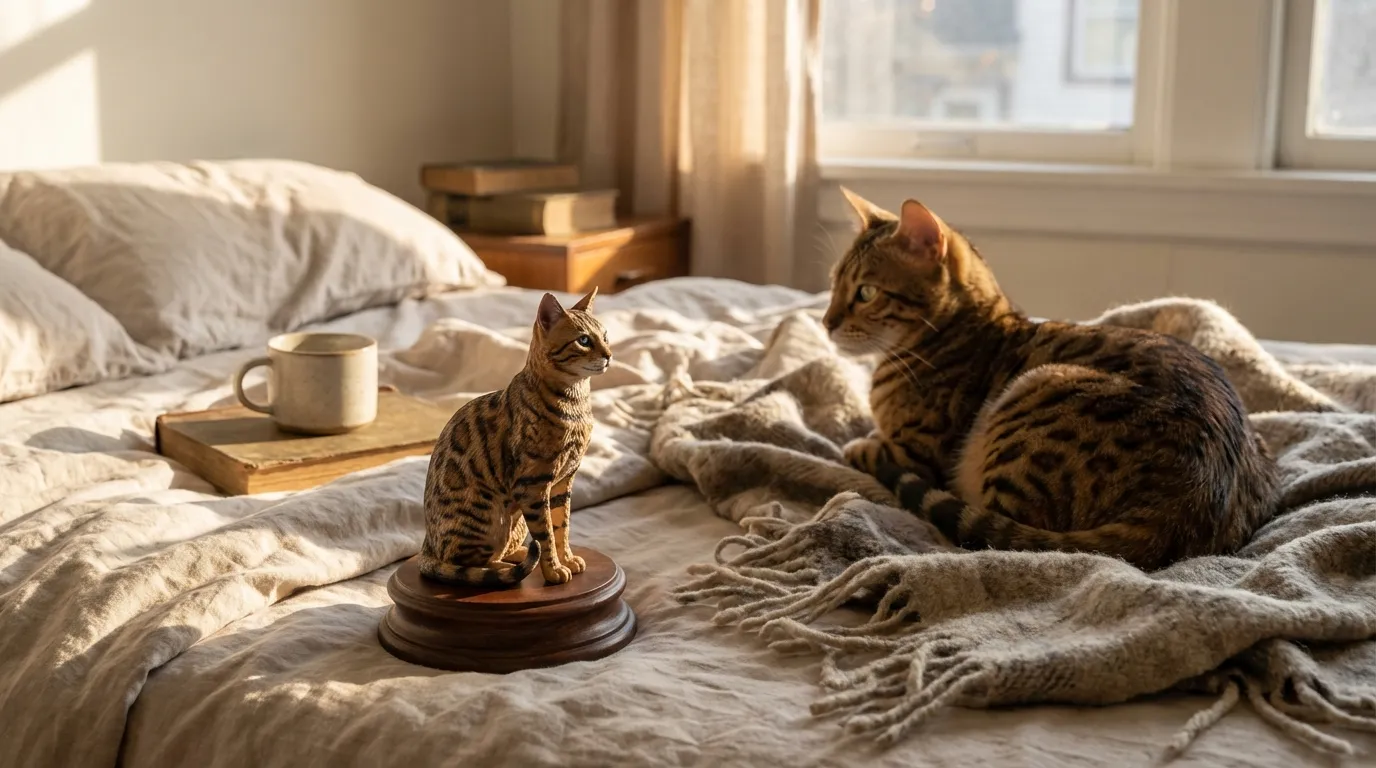
- Tangible Anchors: Because routine is physical, physical memorials often help ground us more than photos. Many Bengal owners find comfort in a custom pet figurine that captures their cat's specific "demanding" posture to keep a piece of that presence in the room.
The Biology of the Phantom Routine
We talk a lot about the heart breaking, but we rarely talk about how the body remembers. When you live with a Bengal—or any high-energy, routine-oriented pet—your physiology actually changes to match theirs. You weren't just waking up early because you had to; your cortisol levels likely began to spike at 4:55 AM in anticipation of the 5:00 AM wake-up call.
This is what we call the "Phantom Routine." It’s why you might find yourself standing in the kitchen, holding a spoon, before realizing there is no wet food to dish out. It’s why your hand automatically guards your water glass so it doesn't get knocked over, even though the threat is gone.
For Bengal owners specifically, this is amplified. Bengals aren't furniture cats. They are kinetic energy. They occupy vertical space, horizontal space, and sonic space. When that energy is suddenly deleted from the environment, your nervous system—which has been keyed up to manage that energy for years—is left spinning its wheels. You have all this alertness with nowhere to direct it.
The silence isn't peaceful. It’s a sensory vacuum.
The Specific Agony of Losing a "Loud" Love
If you’ve never owned a Bengal, you might think a cat is a quiet roommate. We know better. Bengals talk. They chirp, trill, scream, and groan. They narrate their lives and yours. Losing a quiet dog is hard; losing a Bengal is like the soundtrack of your life was suddenly cut, leaving you watching the movie in mute.
We’ve heard from countless families who tell us that the visual absence is painful, but the auditory absence is what breaks them. You find yourself waiting for the "thump-thump-thump" of a sprint down the hallway. You brace for the yowl when you open the pantry.
When that noise stops, the house feels too big. The air feels dead. This is a unique type of grief that relates to sensory processing. You aren't just missing a companion; you are suffering from a lack of sensory input that your brain had labeled as "home."
The "Velcro Cat" Withdrawal
Bengals are often described as "dog-like" or "Velcro cats." They follow you into the bathroom. They supervise your cooking. They sit on your laptop. When they are gone, you lose your shadow. This leads to a profound sense of isolation, even if you live with other humans. You’ll walk into a room and turn to check behind you, a reflex honed over a decade, only to see empty carpet. That micro-moment of disappointment, repeated twenty times a day, is exhausting.The Dirty Secret: Relief, Guilt, and the Morning After
Here is the part of the article where we need to be brutally honest. We need to talk about the feeling that makes you hate yourself, even though it’s entirely natural.
You slept until 7:00 AM.
And you felt... good.
Your body needed the rest. For the first time in years, you weren't woken up by a claw in your scalp or a scream in your ear. You didn't have to clean up a knocked-over plant before having your coffee. For a split second—before the memory rushed back in—you felt a sense of physical relief.
And then, the guilt hit you like a freight train.
This is the "Relief-Guilt Cycle," and it is rampant among owners of high-maintenance pets. You love them ferociously, but caretaking (especially for senior Bengals who may have had health issues) is work. It is physically taxing.
Please hear us on this: Your body’s reaction to rest is not a betrayal of your pet.
You can be devastated by the loss and simultaneously physically relieved to sleep through the night. These two truths can coexist. Biology is not morality. Feeling rested does not mean you loved them less; it just means you are a human being who requires sleep. Forgiving yourself for this biological reaction is the first step in actually processing the grief, rather than just drowning in shame.
Reclaiming the Morning: Breaking the Pattern
So, how do you survive the kitchen? How do you stop the morning from being a daily reminder of what you’ve lost?
The common advice is to "give it time." We disagree. Time by itself just lets the wound fester. You need to actively disrupt the pattern. Your brain has a neural pathway carved deep: Wake up -> Kitchen -> Feed Cat -> Coffee. When you remove the "Feed Cat" step, the brain stumbles.
You need to build a new bridge.
1. Change the sensory input.
If you always drank coffee out of a specific mug while your Bengal yelled at you, put that mug away for a month. Buy a new one. Switch from coffee to tea for two weeks. Listen to a podcast immediately upon waking to fill the auditory void. You need to signal to your brain that this is a different time.
2. The "Memorial Minute."
Instead of wandering aimlessly during the time you used to spend preparing their food, dedicate that specific 5-minute window to a ritual. Light a candle. Write one memory in a journal. Or, simply sit in a different chair than usual and acknowledge the sadness. Give the grief a container so it doesn't spill over into the rest of the day.
3. Physical displacement.
If the kitchen is the trigger zone, don't start your day there. Set up a coffee station in your bedroom or living room. Avoid the scene of the crime (the empty food bowl spot) until you’ve had time to wake up fully.
Anchoring the Memory Without the Pain
One of the hardest parts of losing a pet with such a huge personality is the fear that the "bigness" of them will fade. You worry you'll forget exactly how they arched their back, or the specific way their rosette markings looked in the sunlight.
We see this fear constantly. People keep the food bowls out because putting them away feels like erasing the cat. But keeping the bowls out keeps you stuck in the "Phantom Routine"—it triggers the urge to feed.
This is where shifting from functional objects (bowls, litter boxes) to memorial objects helps. You want something that honors their presence without demanding a task.
We’ve worked with Bengal owners who transition from keeping the litter box (which is just a sad reminder of chores) to creating a dedicated space for a visual anchor. This is often where a custom figurine becomes more than just a statue. When our sculptors work on Bengals, they aren't just looking at the spots; they’re looking at the attitude. The way the head cocks to the side before a chirp. The muscular tension in the shoulders.
Having a tangible representation of them on a shelf—perhaps in the kitchen where they used to supervise—allows you to say "Good morning" to them without the painful trigger of an empty bowl. It acknowledges they are still part of the household's history, but in a new, peaceful form. It’s a static presence to replace the kinetic one, allowing your heart to rest while keeping their memory sharp.
The Long Tail of Grief
The first week is shock. The first month is pain. But the third and fourth months are often the strangest. This is when the world expects you to be "over it," but you're still waking up at 5:03 AM.
It’s okay if the silence still feels loud six months from now. Bengals leave a larger-than-life hole in the universe. But eventually, the morning silence won't feel like an absence. It will start to feel like a pause. A quiet space where you can remember them with a smile instead of a sob.
You will sleep in again. You will drink your coffee without tripping over a tail. And you will look at that spot of sunlight on the floor and remember the beautiful, chaotic, screaming creature that used to dance in it, and you will be grateful that for a little while, you were their person.
Frequently Asked Questions
Why do I still wake up at my cat's feeding time?
This is a biological phenomenon, not just an emotional one. Your circadian rhythm—your body's internal clock—became "entrained" or synced with your pet's routine. If you woke up at 5:00 AM for years, your body learned to spike cortisol (the wake-up hormone) at 4:55 AM. It takes time for your physiology to unlearn this pattern.Is it normal to feel relief after my high-needs pet dies?
Yes, and it is one of the most common, yet least discussed, aspects of grief. If your Bengal was demanding, loud, or required medical care, you were under chronic low-level stress. When that stops, your body physically relaxes. This relief is about the cessation of stress/fatigue, not the cessation of the relationship. Try to separate your physical rest from your emotional love.How do I stop feeling guilty about moving his things?
It helps to distinguish between "functional objects" and "sentimental objects." A litter box or a dirty food bowl is a functional object—it implies a task needs to be done. When the task is gone, the object becomes a painful trigger. Moving these items isn't erasing your pet; it's acknowledging that your role has shifted from caretaker to memory-keeper. Replace the bowl with a photo or a custom figurine to hold the space in a new way.My house feels too quiet without my Bengal. What helps?
The "auditory void" is real with vocal breeds. The silence can actually increase anxiety because your brain is straining to hear sounds that aren't there. Don't force yourself to sit in silence. Fill the space with neutral sound—classical music, a whitenoise machine, or opening a window to let outside sounds in. You are retraining your brain to accept a new baseline volume for "home."How long does the "phantom routine" last?
While everyone grieves differently, the intense physical habit of the phantom routine typically begins to fade after 21 to 40 days—the time it generally takes to break a habit loop. However, emotional triggers associated with the routine may last much longer. Be patient with your body as it recalibrates.Honor Their Memory Forever
Your pet's story deserves to be preserved in a way that captures their unique spirit. A custom PawSculpt figurine transforms your cherished memories into a timeless keepsake—every whisker, every marking, every detail that made them irreplaceable.
Free instant AI preview • 3D artist preview within 7 days • 5 free revisions