
Managing Mobility: Home Hacks for Your Senior German Shepherd
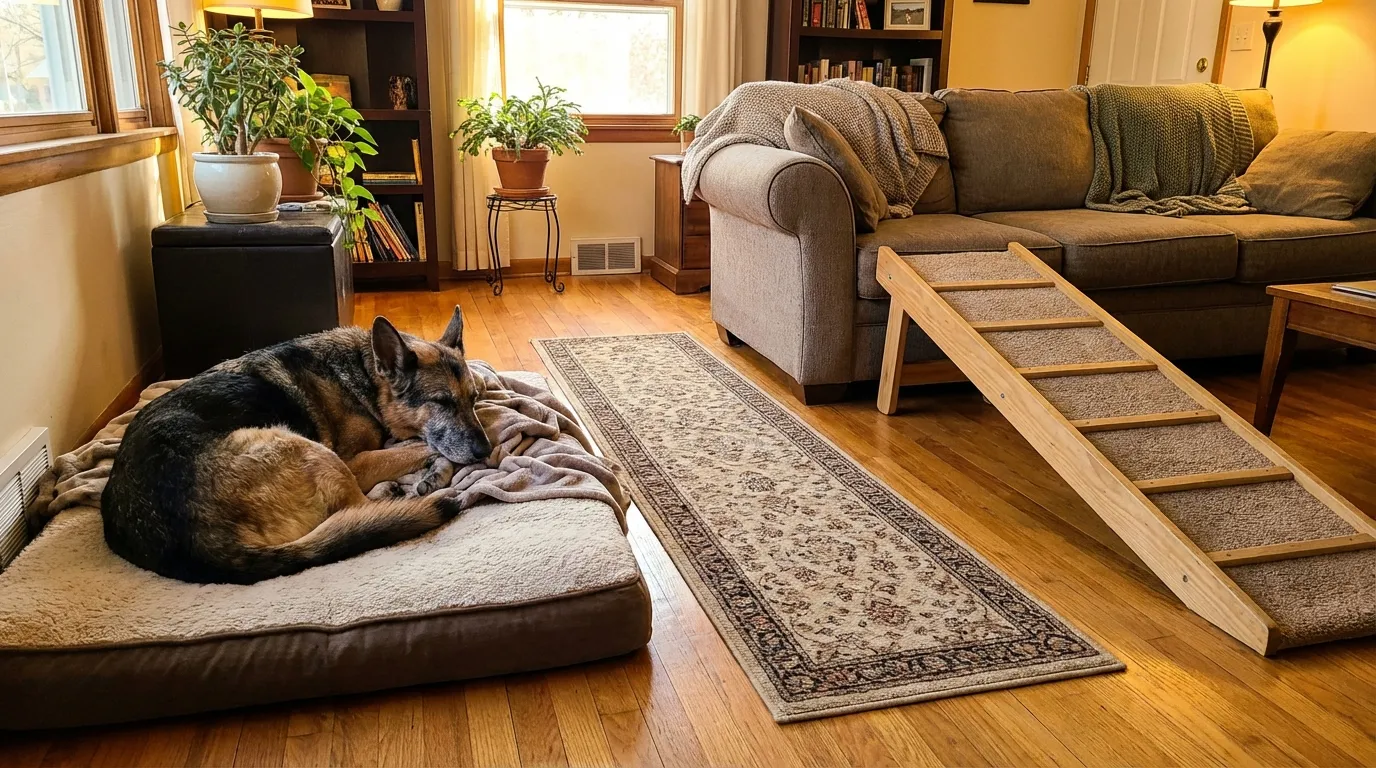
The sound of claws clicking against the laminate floor at 2:00 AM isn't just noise; it’s a specific, rhythmic scraping that signals a struggle. You hear the heavy thud of a hip hitting the ground, then the sharp intake of breath—yours, not theirs. In the dim light of the bedroom, you watch the silhouette of your once-athletic German Shepherd trying to find purchase on a surface that used to be effortless, their back legs betraying a mind that still wants to run. It is a visceral reminder that the geography of your home has shifted. What was once a hallway is now an obstacle course; what was once a cozy corner is now a trap.
Quick Takeaways:
- Traction Mapping: Yoga mats provide better, cheaper stability than area rugs because they don't slide.
- The 15-Degree Rule: Rearrange furniture to eliminate sharp 90-degree turns, which torque arthritic hips.
- The "Towel Test": Before buying expensive harnesses, use a towel under the belly to see if rear-lift assistance helps.
- Elevated Everything: Raise bowls to shoulder height to reduce neck strain and forelimb pressure.
- Mental "Walks": Replace physical distance with nose work to tire out a GSD's active brain without stressing joints.
The Physics of Flooring: Beyond Just "Adding Rugs"
We often hear the generic advice to "put down rugs." But if you’ve ever watched a 90-pound Shepherd accelerate on a runner rug, you know the rug often ends up surfing across the room right along with the dog.
The issue isn't just friction; it's stability.
In our work with pet families, we’ve found that the "Yoga Mat Runway" is the single most effective, low-cost hack for senior German Shepherd care. Unlike standard rugs, yoga mats have a sticky underside that grips the floor. They provide tactile feedback to the dog's pads, signaling "this is safe territory."
The counterintuitive insight: Don't just place mats in high-traffic areas. Place them specifically at transition points—where the carpet meets the hardwood, or right at the threshold of the kitchen. These are the "panic zones" where a dog anticipates a slip and tenses up. That tension alone can cause a fall.
Create a continuous path. We call it "The Green Line" (or whatever color mats you buy). Your dog will learn to navigate the house exclusively via this path. It looks a bit odd to guests, sure. But seeing your old friend walk with confidence? That’s worth the aesthetic compromise.
The Geometry of Dignity: Rethinking Your Furniture Layout
German Shepherds are long dogs. When they were young, they could pivot on a dime. Now, their spine is like a rigid rod, and their hips are rusty hinges.
Most homes are designed with 90-degree angles. We walk around the corner of the sofa. We take a sharp left into the bedroom. For a senior dog with Degenerative Myelopathy (DM) or severe arthritis, a 90-degree turn requires a massive amount of torque on the rear assembly.
This is where the "15-Degree Rule" comes in.
Look at your living room. Can you pull the sofa six inches away from the wall? Can you angle the coffee table? The goal is to turn every sharp corner into a gentle curve.
A specific scenario: We recently spoke with a family whose dog, Kaiser, stopped entering the living room. They thought he was depressed. It turned out the gap between the recliner and the coffee table was narrow enough that he had to make a tight S-curve to get through. Once they moved the table a foot, he was back on the sofa that evening.
It wasn't depression. It was mechanical impossibility. By opening up the "turning radius" of your home, you aren't just helping them move; you're inviting them back into the family circle.
The "Up and Down" Paradox
Getting somewhere is only half the battle. The hardest movement for a senior German Shepherd is the transition from lying down to standing up.
This is simple physics: lifting 80+ pounds from a dead stop requires explosive power in the hindquarters—power they no longer have.
The Bedding Equation
Soft, plush "cloud" beds are actually terrible for senior mobility. Imagine trying to stand up out of a beanbag chair without using your hands. That is what a super-soft bed feels like to a dog with hip dysplasia.You need orthopedic foam that pushes back. There is a "Goldilocks" density—firm enough to support the skeleton, but yielding enough to cushion the joints.
Pro Tip: Look for a bed height of about 4-6 inches. If the bed is too low (flat on the floor), they have to hoist their entire weight up. If it's slightly elevated, they are already 20% of the way to a standing position.
The Feeding Station
We’ve seen debates about bloat and raised feeders, but for a senior GSD with arthritis, an elevated feeder is a quality-of-life non-negotiable.Bending the neck down to floor level shifts weight onto the front shoulders—the very shoulders that are currently overcompensating for the weak back legs. This causes compensatory pain in the triceps and neck. Raising the bowl to shoulder height allows them to eat in a neutral spine position. It’s a small change that saves them a significant amount of daily pain.
Assistive Gear That Doesn't Scream "Invalid"
There is a psychological hurdle for owners when it comes to mobility aids. We hesitate to buy the harness or the wheelchair because it feels like admitting defeat. It feels like the beginning of the end.
But actually, it’s the beginning of freedom.
The "Help 'Em Up Harness" (or similar full-body lifting systems) is standard equipment for aging large breed dogs. Unlike a towel or a standard walking harness, these have a handle specifically over the hips.
The mistake most people make: They wait until the dog can't walk to get one.
The better approach: Put the harness on for 20 minutes a day before the crisis. Use the handle to just take 5% of the weight off their hips while going down the porch steps.
- It preserves their remaining muscle by allowing them to walk longer distances without fatigue.
- It prevents the "fear cycle." If a dog hurts himself on the stairs once, he may refuse to use them forever. If you support him, he maintains the confidence to keep trying.
We often talk about preserving memories of our pets at their peak. At PawSculpt, we create custom figurines that capture that spark in their eyes—the way they looked when they could run for miles. But loving a senior dog means honoring who they are now, too. Using assistive gear isn't hiding their age; it's respecting their changing needs so they can still participate in life.
The Mental Game: Enrichment for the Slow-Moving
A German Shepherd’s brain does not age at the same rate as their hips. You often have a Ferrari engine inside a rusty chassis. This mismatch causes frustration, which can manifest as barking, chewing, or obsessive licking.
If they can’t patrol the perimeter of the yard anymore, you have to bring the world to them.
"TV" for Dogs
If your dog is stuck inside, position their bed near a low window or a glass storm door. We know one owner who set up a bird feeder directly outside the window where her GSD lay all day. It became his "television." He spent hours watching the squirrels and birds, his ears twitching, his mind engaged, even if his body was still.The Nose Knows
Scent work is exhausting. 15 minutes of intensive sniffing is roughly equivalent to an hour of physical walking in terms of caloric burn and mental fatigue.Try this:
Take three cardboard boxes. Hide a high-value treat (freeze-dried liver works well) in one. Shuffle them. Encourage your dog to "find it." They don't have to move much—just shuffle a few feet—but their brain is firing on all cylinders.
This restores their sense of purpose. German Shepherds need a job. In their twilight years, their job can simply be "Find the Treat." They take it just as seriously as they took guarding the house.
Managing the Night: The Sundowning Phenomenon
Senior dogs often experience "sundowning"—restlessness, pacing, or panting as the sun goes down. This is partly due to declining vision (shadows look scary) and partly due to pain (inflammation peaks at night).
Lighting:
Plug-in nightlights in the hallway are crucial. Your dog’s night vision isn't what it used to be, and navigating a dark house can be terrifying if their depth perception is off.
Temperature Control:
Arthritis hates the cold. But heavy blankets can be hard to move under. We recommend a safe, pet-specific heating pad with an auto-shutoff, placed under the cover of their orthopedic bed. The gentle heat keeps the synovial fluid in the joints less viscous, preventing that 3:00 AM stiffness that causes them to cry out.
The Emotional Weight of the "Long Goodbye"
Managing a mobility-impaired dog is heavy work. There is the physical labor of lifting a 90-pound animal, the laundry from incontinence, and the constant, grinding worry.
We need to be real about the caregiver fatigue. It is normal to feel frustrated. It is normal to feel guilty when you lose patience.
But there is a profound intimacy in this stage. When you help them stand, you are repaying the years they spent guarding you. When you adjust their paws for better traction, you are communicating in a language of touch that goes deeper than "sit" or "stay."
One of our customers told us that her favorite memory of her Shepherd, Rex, wasn't his puppy years, but his final months. "We moved slower," she said. "We sat in the grass instead of running through it. I saw things in my backyard I'd never noticed before because I was forced to slow down to his pace."
If you are in the thick of this right now, take a breath. You are doing enough. The ramps, the mats, the supplements—they are all expressions of love.
Look at your dog. Really look at them. The grey muzzle, the cloudy eyes, the worn paws. There is so much history in that face. Whether you choose to immortalize that dignity with a custom pet figurine or simply with a photo on your phone, capture this moment. This version of them—the wise, weathered, enduring version—is just as beautiful as the puppy they once were.
Frequently Asked Questions
How do I know if my German Shepherd is in pain?
Dogs are stoic, especially working breeds like GSDs. They rarely whine unless the pain is acute. Instead, look for "micro-signals": heavy panting when it's not hot, a reluctance to be brushed on the lower back, a "bunny hopping" gait where both back legs move together, or taking a long time to settle down at night. If you notice these, a vet visit for pain management is due.Are stairs bad for senior German Shepherds?
Repetitive stair use is one of the hardest activities for a senior dog. Going up requires rear-end torque; going down puts braking force on the front shoulders. If you can't avoid stairs, use a ramp or a "Help 'Em Up" harness to support their weight. Never let them bolt down the stairs.How much exercise should a senior dog get?
Motion is lotion—stopping exercise completely will make arthritis worse. However, the type of exercise must change. Swap the 45-minute jog for three 10-minute "sniffari" walks. Swimming is the absolute best option if available, as it builds muscle to support the joints without any impact.What is the best flooring for dogs with bad hips?
Wall-to-wall carpet is the gold standard for traction. If you have hardwood, tile, or laminate, you have a "slip zone." You don't need to recarpet your whole house, but you must create "safe lanes" using yoga mats, runners with non-slip backing, or interlocking foam gym tiles. Traction is the single biggest factor in preventing injury in senior dogs.Celebrate Your Pet's Unique Personality
Every pet has quirks and characteristics that make them one-of-a-kind. A custom PawSculpt figurine captures those details—the way they tilt their head, their favorite pose, the spark in their eyes.
Free instant AI preview • 3D artist preview within 7 days • 5 free revisions