
A Memorial Day Gift That Outlasts Flowers: 7 Ways to Honor a Teen's Deployed-Family Feret
Ferrets sleep up to 18 hours a day, which means the loudest sound in many kitchens at 6 a.m. was a set of tiny claws scratching at an empty food bowl. So when a family starts hunting for a Memorial Day pet memorial gift for the teen who did that feeding, the search gets complicated fast — because they aren't just grieving a pet. They're grieving on a schedule no one else is keeping.
Quick Takeaways
- Ferret grief is "disenfranchised" — most people don't take it seriously, so name it out loud first.
- Time the gift to the deployment, not just the holiday — anchor it to when the absent parent can witness it.
- Sound and scent trigger memory faster than photos — preserve the noises before they fade.
- A tangible keepsake gives grief somewhere to live — explore custom pet figurines that hold the small, specific details a teen remembers.
- Involve the teen in choosing — agency reduces the helplessness that compounds loss during deployment.
Why a Deployed-Family Ferret Hits Differently (The Part Nobody Explains)
Here's something the greeting-card aisle will never tell you: the grief a teenager feels for a family ferret during a deployment is rarely just about the ferret.
We've worked with a lot of military families over the years, and a pattern shows up again and again. When one parent ships out, the pet often becomes the emotional stand-in — the warm, breathing thing that's still here when half the household isn't. Psychologists call the absent-parent situation ambiguous loss (a loss with no closure, no body, no funeral, just an empty chair and a countdown). The pet becomes the antidote to that. It's present. It's reliable. It dooks at you when you walk in the door.
So when that pet dies mid-deployment, the teen isn't losing one thing. They're losing the thing that was helping them cope with losing the other thing.
"When a parent ships out, the pet often becomes the heartbeat of the house. Losing it mid-deployment is grief stacked on grief."
And ferrets specifically? They occupy a strange cultural blind spot. Nobody questions crying over a dog. But mention a ferret, and you'll get the head tilt — the "wait, people really love those?" reaction. That dismissal has a clinical name: disenfranchised grief, a term coined by grief researcher Kenneth Doka for mourning that society doesn't recognize as legitimate. The loss is real. The permission to grieve it is not granted.
For a teenager — whose social radar is already cranked to maximum sensitivity — that lack of permission is corrosive. They learn to swallow it. To say "I'm fine." To grieve in the bathroom with the fan on so no one hears.
The best gift you can give, before any object changes hands, is validation. You say the ferret's name out loud. You acknowledge that this animal mattered, that the bond was real, that the timing was brutal. Everything that follows works better once that door is open.
The science of why "small pets" leave big holes
There's a biological reason a 2-pound animal can level a teenager. Attachment isn't proportional to the pet's size — it's proportional to the routine. Ferrets are intensely interactive. They demand play. They hide your socks and do the "weasel war dance" (that frantic, hopping, sideways bounce that means pure joy). That repeated, daily interaction builds neural grooves.
When the animal is gone, the brain keeps firing those grooves anyway. Neuroscientists call this the slow work of neuroplasticity — your brain literally has to rewire the pathways that expected the ferret to be in the laundry basket. That rewiring period is when grief feels physical. It's why a teen will walk into the kitchen, hear nothing, and feel it in their chest.
The gift's real job is to give that rewiring brain something to hold onto while it does the work.
How to Choose the Right Gift (Match It to the Grief Stage)
Before the seven ideas, one frame that'll save you from buying the wrong thing at the wrong time.
A common mistake families make is treating Memorial Day as a hard deadline — "we need the perfect gift by Monday." But grief has its own clock, and a gift handed over too early can feel like pressure to "be okay now," while one timed well can crack a closed kid wide open in the best way.
Here's a rough map of where a teen might be, and what tends to land:
| Grief Stage | Roughly When | What Helps Most | What to Avoid |
|---|---|---|---|
| Acute shock | First 1–2 weeks | Presence, validation, low-effort comfort | Big "permanent" gifts that demand a reaction |
| Searching | Weeks 2–6 | Sensory keepsakes, story-telling rituals | Pushing them to "move on" |
| Reorganizing | 6 weeks–6 months | Lasting memorials, figurines, creative projects | Acting like it's resolved |
| Integration | 6 months+ | Anniversary traditions, shared remembrance | Forgetting the date entirely |
The "So what?" here: if the ferret died two weeks before Memorial Day, a museum-grade keepsake might be exactly right — or it might be two weeks too soon. Read the kid, not the calendar.
7 Memorial Day Gifts That Outlast Flowers
Flowers wilt in four days. That's not a knock on flowers — sometimes you want something that mirrors how fragile the moment feels. But for a grieving teen, the gifts that do the most work are the ones still doing it a year later. Here are seven, ordered loosely from gentlest to most permanent.
1. The Sound-and-Scent Memory Box
Who it's for: A teen in the first raw weeks who isn't ready for anything "displayed."
Budget: $25–$70 (box, audio recorder app is free)
Memory is stored most powerfully through smell and sound, not sight — the olfactory bulb wires directly into the brain's emotional center, which is why a single whiff can flatten you years later. So instead of (or alongside) photos, capture the sensory ferret.
Tuck in the well-worn sleep sack that still smells faintly of them. The favorite stolen sock. A tiny vial of the bedding. And here's the part most people skip — if there's any old phone video, rip the audio of that dooking, that war-dance thump, the rustle through a blanket tunnel. Burn it to a small player or save it as a file the teen controls.
Pro tip: Don't wash anything before it goes in the box. The scent is the point, and it fades faster than you'd think — usually within a few weeks.
2. The Deployment-Connected Remembrance Letter
Who it's for: A teen whose deployed parent hasn't been able to grieve the pet either.
Budget: Free to $40 (stationery or a printed photo book)
This one's specific to military families, and it's the idea outside guides completely miss. The deployed parent is grieving too — often alone, often unable to say so, because they're supposed to be focused on the mission. Meanwhile the teen feels like they're grieving without their other parent.
Bridge it. Have the deployed parent write or record a letter to the teen, about the ferret — a specific memory, the time it stole their watch, the way it slept on the parent's chest before deployment. Time its arrival to Memorial Day.
"Shared grief shrinks. Grief carried alone metastasizes. Get the absent parent into the room, even by mail."
Pro tip: Ask the deployed parent for one concrete sensory detail ("the way her feet sounded on the hardwood"). Specifics heal; generic "I miss her too" doesn't.
3. A Full-Color 3D Printed Figurine
Who it's for: A teen ready for something permanent that captures the ferret exactly — markings, posture, that one ridiculous expression.
Budget: Varies by detail and size — check current options directly.
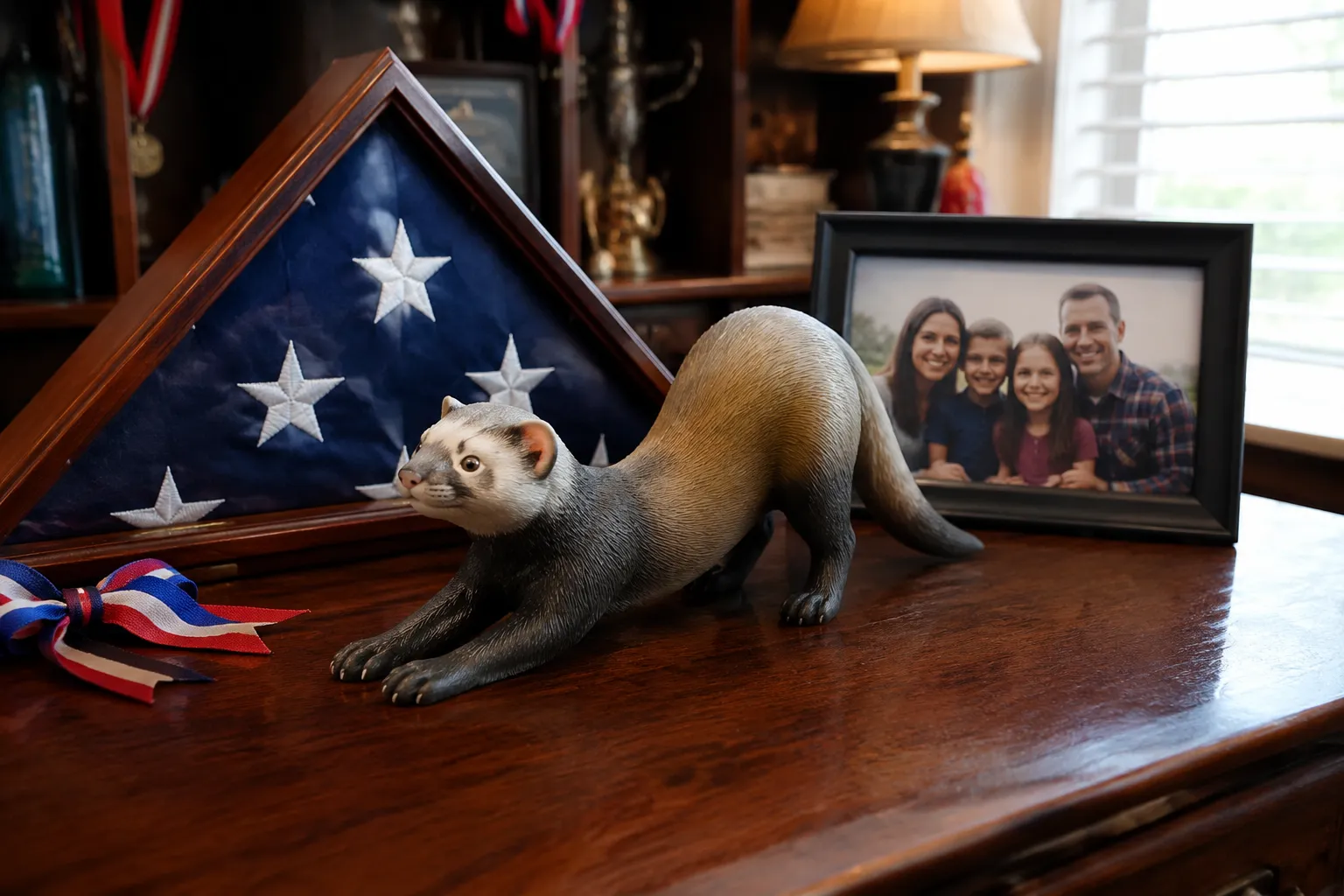
Look, we'll be straight with you about why this one works, since we make them. A figurine succeeds or fails on specificity. A generic "ferret statue" off a shelf does nothing, because the teen didn't love a generic ferret — they loved that mask pattern, that mitt-footed stance, the way one ear sat slightly cockeyed.
At PawSculpt, the piece is digitally sculpted by master 3D artists from your photos, then precision 3D printed in full color, so the markings and coloring are part of the resin itself rather than a coating that chips. The only manual step is a protective clear coat for sheen and durability. The result has a real, faintly textured surface — authentic, not glossy-fake-plastic.
"A figurine isn't about the animal looking 'perfect.' It's about a teen recognizing their friend the second they see it."
— The PawSculpt Team
Why it matters for this reader specifically: a deployed parent can't be at the kitchen table, but a 3D pet sculpture can sit on the teen's desk through the rest of the deployment — a fixed, holdable anchor during the exact months the brain is rewiring. Grief needs somewhere to land. This gives it a landing pad.
Pro tip: Dig for the photo where the ferret is doing something only they did. The funnier and more "them," the better the result. You can see what photos work best and explore the full process over at pawsculpt.com.
4. A Living Memorial — Plant, Stone, or Pocket Garden
Who it's for: A teen who finds comfort in tending something, in having a "place to go."
Budget: $15–$80
There's real psychology here. Caring for a living thing after a loss gives grieving hands a job, and lowers stress hormones — studies on horticultural therapy consistently link gardening to reduced cortisol (the body's primary stress chemical). The teen who lost the thing they cared for gets to care for something again.
A small engraved stone tucked into a pot. A hardy plant chosen in the ferret's "colors." If the family moves often (and military families move a lot), pick something potted and portable so the memorial can deploy with them.
Pro tip: Avoid anything that needs to go in the ground if a PCS move is on the horizon. A memorial you have to abandon at the next base is a second loss.
5. A Custom Star Map of "Their" Night
Who it's for: The more introspective teen who likes meaning baked into objects.
Budget: $30–$90
A printed map of the night sky as it looked on a chosen date — the day the ferret came home, or the day they passed. It's quiet, it's personal, and it reframes the loss in something vast and steady.
For military families, there's a layered meaning that lands hard: the deployed parent is, in a literal sense, under the same sky. Same stars, different ground. A teen staring up at the same constellation their parent might see — with the ferret's date marked underneath — turns a decoration into a thread connecting all three.
Pro tip: Let the teen pick the date. The choosing is part of the grieving, and handing them that decision returns a little control.
6. A Donation or Foster Sponsorship in the Ferret's Name
Who it's for: An older teen whose grief needs an outlet bigger than themselves.
Budget: Any amount
Ferret rescues are chronically underfunded — these animals fall through every crack in the shelter system. A donation in the ferret's name, with a printed certificate, turns private pain into something with a pulse. Adolescent brains are wired to seek meaning and justice; channeling grief into helping another animal satisfies that drive in a way a trinket can't.
This is also a gentle option when you genuinely don't know what the teen wants. It honors the pet without asking the kid to display or perform anything.
Pro tip: Find a ferret-specific rescue, not a general shelter. The specificity signals you got it — that you knew this was a ferret, not just "a pet."
7. A Weighted Comfort Companion
Who it's for: A younger teen, or any kid struggling with the physical absence — the empty arms.
Budget: $20–$50
Here's the counterintuitive one. Some of the families we've talked to resist this, thinking a plush feels like a "replacement" or babyish. It isn't. A small weighted plush (the gentle weight mimics the pressure of a sleeping animal) addresses a real, overlooked symptom: the body misses the weight.
Ferret owners especially. These animals drape over shoulders, burrow into hoodies, fall dead-asleep in a cupped hand. The arms remember the load. A weighted companion at night, in those first weeks, can genuinely lower the nighttime cortisol spike that wrecks a grieving teen's sleep.
Pro tip: Pair it with permission. "This isn't weird, it's not babyish, it's just for the nights that are hard." The framing matters as much as the object.
Gift Comparison at a Glance
If you're juggling all seven, here's the quick-scan version — effort, longevity, and the emotional job each one does:
| Gift | Effort to Make | How Long It Lasts | Best Emotional Job |
|---|---|---|---|
| Sound-and-scent box | Low | Months (scent fades) | Raw early comfort |
| Deployment letter | Low–Medium | Forever (keepsake) | Reconnect absent parent |
| 3D printed figurine | Medium (photos needed) | Decades | Permanent anchor |
| Living memorial | Low | Years (with care) | A "place to go" |
| Star map | Low | Forever | Meaning + connection |
| Donation in their name | Low | One-time + ongoing impact | Outward purpose |
| Weighted companion | Low | Years | Physical comfort at night |
Notice none of these is flowers. Not because flowers are wrong — but because a grieving teen six months from now needs something their hands can find.
Myth vs. Reality: What Families Get Wrong About Pet Grief
We hear the same well-meaning misconceptions constantly. Let's bust three.
Myth #1: "It was just a small pet — they'll bounce back fast."
Reality: Attachment strength tracks with interaction frequency, not body weight. Ferrets are some of the most interactive pets alive. The grief can rival — sometimes exceed — grief for a larger animal, precisely because the daily routine was so dense.
Myth #2: "Getting another ferret right away will fix it."
Reality: A new pet introduced too soon can actually prolong grief, because the brain hasn't finished the rewiring work yet and now has to hold two conflicting attachments. There's no fixed rule, but rushing it usually backfires. Let the teen lead that decision — never surprise them with a replacement.
Myth #3: "Talking about it will just upset them more."
Reality: Avoidance is what festers. Naming the loss, saying the ferret's name, telling the funny stories — this is how the brain integrates a loss instead of burying it. Silence doesn't protect a teen. It isolates them.
"Silence doesn't protect a grieving kid. It just teaches them their love was the wrong size to mention."
What to Capture Before the Memories Soften
This is the part we wish every family knew before they came to us, because some of it can't be recovered later.
Grief researchers describe a model called continuing bonds — the healthiest grieving doesn't sever the relationship with the lost loved one, it transforms it into memory and meaning. But memory is lossy. The specific details — the exact pitch of the dook, the precise pattern of the mask — start softening within months. Capturing them isn't morbid. It's preservation.
If you're going to commission anything custom (a figurine, a portrait, anything), or even just build that memory box, prioritize gathering these while they're still sharp:
- The "signature" photo — the pose or expression that was unmistakably them, not a posed studio shot.
- Multiple angles — for a 3D piece, profile and three-quarter views matter as much as the front.
- Any audio or video — the sounds vanish first and hurt the most to lose.
- The teen's own words — have them describe the ferret in three sentences. That description often reveals what detail actually matters to them.
- Markings, up close — masks, mitts, the white tail-tip. The specifics that make recognition instant.
The American Society for the Prevention of Cruelty to Animals offers solid, calm guidance on coping with pet loss that's worth sharing with a teen who feels alone in it — sometimes hearing it from an outside authority lands better than hearing it from a parent.
"Memory is lossy. The dook fades before the photo does. Capture the sound while you still can."
A note on the photos people overlook
The instinct is to pick the "best" photo — sharp, well-lit, the ferret looking angelic. But the photo that makes the best keepsake is usually the candid one: mid-yawn, mid-steal, caught doing the thing. We've had teens go quiet and then wet-eyed over a slightly blurry shot of their ferret stuffed headfirst in a slipper, because that was the friend they knew. Bring the real ones.
How to Actually Give It (The Handover Matters)
You can pick the perfect gift and still fumble the moment. A few things we've learned watching how these land:
- Don't ambush. Pull the teen aside, not into a group reveal. Grief performed for an audience is grief suppressed.
- Say the name first. "I made something for you, about [ferret's name]." The name does the emotional unlocking.
- Build in the absent parent if you can. A video call timed to the moment, or a note in the parent's handwriting tucked alongside.
- Let them not react. A teen who goes stone-faced isn't ungrateful — they're holding it together. The gift will do its work later, alone, when no one's watching.
- Follow up in a week. "Where'd you end up putting it?" reopens the door gently.
The "So what?" on all of this: the object is only half the gift. The permission to feel you wrap around it is the other half — and honestly, the more important one.
When to Bring in Real Help
We make keepsakes, not diagnoses, so we'll be honest about our lane. If a teen's grief slides into territory that worries you — they stop eating, can't sleep for weeks, withdraw completely, or the loss seems to be triggering something bigger about the deployment — that's beyond what any figurine fixes.
Military families have specific resources for exactly this: Military OneSource and base family-support services offer free, confidential counseling that understands the deployment piece. A gift honors a pet. A counselor helps a kid carry the weight of everything the pet was standing in for.
There's no shame in needing both.
Bringing It Home
That empty food bowl on the kitchen floor — the one no claws scratch at anymore — is going to stay quiet for a while. That's just true. No gift refills it.
But here's what a well-chosen feret memorial for a teen actually does: it gives the silence a shape. A figurine on the desk that catches the morning light. A letter from a parent half a world away who remembered the same crooked ear. A weighted companion for the nights that ambush you. These don't end the grief — they give it dignity, and they give a kid the message that their love wasn't the wrong size to matter.
A deployed parent can't be in the room. The ferret can't come back. But the small, specific things that made that animal theirs can be kept, held, and carried to the next base and the one after that.
This Memorial Day, skip the flowers that brown by Friday. Give the thing that's still doing its job a year from now — the day the parent finally comes home and gets to see, sitting on the shelf, that the family said goodbye well, together, even from apart.
Frequently Asked Questions
Is it normal for a teen to grieve a ferret this hard?
Completely normal. Attachment strength comes from how often you interact with a pet, not how big it is — and ferrets are wildly interactive. Add a deployment, where the pet became an emotional anchor for an absent parent, and the grief makes total sense. The intensity isn't an overreaction. It's proportional to the bond.
What's a good Memorial Day pet memorial gift for a grieving teen?
Choose something that's still doing its job a year later. A sound-and-scent memory box for the raw early weeks, a custom figurine for a permanent anchor, a star map for meaning, or a donation in the ferret's name for an outward outlet. The key is matching the gift to where the teen is in their grief, not just to the calendar.
Should we get a new ferret to help them feel better?
We'd hold off, and definitely never spring one as a surprise. A new pet introduced too early can actually prolong grief, since the brain hasn't finished adjusting to the loss yet. If and when the family is ready, let the teen drive that decision. Replacing a pet and honoring one are two very different things.
How can a deployed parent be part of the memorial?
This is one of the most powerful things you can do. Have the deployed parent write or record a message to the teen about a specific memory — the time the ferret stole their watch, the way it slept on their chest. Time it to land on Memorial Day. It tells the teen they're not grieving alone, and it lets the parent grieve too.
What photos work best for a custom ferret figurine?
Skip the posed "perfect" shots. The candid photo — mid-yawn, mid-mischief, doing the thing only they did — captures the personality a teen actually remembers. Gather multiple angles (profile and three-quarter views help a lot for 3D work) and close-ups of markings like the mask and mitts. You can see more guidance on photo selection at pawsculpt.com.
How long does pet grief usually last for a teenager?
There's no fixed timeline, and anyone who gives you an exact number is guessing. Acute grief often softens over several weeks to a few months, but waves can return on anniversaries or hard deployment days for much longer. What matters is that the grief is moving and being expressed, not buried. If it stalls into withdrawal, sleeplessness, or not eating, reach out to a counselor.
Ready to Celebrate Your Pet?
Every pet has a story worth preserving. Whether you're honoring a beloved companion who's crossed the rainbow bridge or helping a teen in a military family hold onto a ferret who got them through a deployment, a custom PawSculpt figurine captures the small, specific details — the crooked ear, the signature pose — that make your pet one-of-a-kind. The right Memorial Day pet memorial gift doesn't wilt by Friday. It sits on the desk, doing its quiet work, until everyone's home again.
Visit pawsculpt.com to explore our full-color 3D printing process, photo tips, revision options, and quality guarantee.