Minimalism vs. Memory: How to Honor Your Maine Coon Without Cluttering Your Space
The heavy scent of gasoline and old cardboard hits you first, but your eyes go straight to the corner of the garage. There it sits—the six-foot cat tree, carpet shredded by years of enthusiastic claws, now gathering sawdust next to the winter tires. It’s too big to keep, yet the thought of hauling this specific piece of Maine Coon memorial history to the curb feels like a betrayal.
Quick Takeaways
- Size matters in grief — Maine Coons require massive gear, making the physical void they leave behind significantly larger and harder to navigate than with other breeds.
- Curate, don't hoard — Keeping every toy dilutes the memory; selecting one or two "totems" creates a more powerful emotional anchor.
- The "Relief" is normal — It is okay to feel a sense of spatial relief when reclaiming your living room floor; this does not mean you loved them any less.
- Scale down the tribute — Replace furniture-sized memorials with custom figurines that capture your gentle giant's ear tufts and ruff without dominating your square footage.
- Donate with purpose — Passing on expensive XL-sized equipment to shelters helps other large cats and transforms your loss into a legacy.
The "Big Cat" Paradox: When Grief Takes Up Square Footage
We need to talk about the elephant—or rather, the gentle giant—in the room. When you lose a Maine Coon, you aren't just losing a pet; you are losing a physical presence that likely dictated the layout of your entire home.
In our years working with pet families, we’ve noticed a distinct pattern among Maine Coon owners. Your grief has a different spatial footprint. You aren't just putting away a tiny collar. You are staring at an XL litter box that took up half the guest bathroom. You're looking at a scratching post that is literally the size of a tree. You have carriers that look like they could transport a medium-sized dog.
The instinct is to freeze. You leave the giant bed in the center of the living room because moving it feels like erasing them. But here is the counterintuitive truth we've learned: Clutter can actually block healing.
When your home is filled with the "ghosts" of equipment—items that are now empty and gathering dust—your brain triggers a pain response every time you walk by them. You aren't remembering the warm purr or the head-butts; you're remembering the absence.
"Grief isn't a problem to be solved. It's a love story that continues after the last chapter."
The Taboo Emotion: Relief
Let’s be honest about something that almost no one admits. There is a specific type of guilt that comes with reclaiming your space.One of our customers, Sarah, told us about the first time she vacuumed the rug where her 22-pound Maine Coon, Barnaby, used to sleep. She realized she hadn't seen the full pattern of that rug in eight years. Then, she felt a wave of nausea. How could she enjoy seeing the rug? Did that mean she was happy he was gone?
No.
Feeling relief that your home is cleaner, or that you have more space, or that you aren't tripping over a massive water fountain, does not negate your love. It is simply your body acknowledging that the caretaking phase—which was often physically demanding with such a large animal—is over. You can love them fiercely and still appreciate walking through your hallway without turning sideways.
The Psychology of "Stuff" vs. "Spirit"
Why do we keep the fur-covered blanket that smells a little musty? Why do we hesitate to throw away the cardboard box they sat in once three years ago?
We hold onto objects because we are terrified that if we let go of the things, we will lose the memories attached to them. We treat physical objects as hard drives for our emotional data. But the truth is, your memory is resilient.
The "Museum Effect"
When you keep everything, you create a museum of sadness. Your home becomes a shrine to the end of their life, rather than a celebration of the joy they brought.
Minimalism in grief isn't about erasing the pet; it's about distilling the memory down to its purest, most potent form. It’s about choosing "Totems"—objects that spark a specific, happy story—rather than keeping "Artifacts"—objects that just happened to be there.
The Maine Coon "Keep or Toss" Matrix
Deciding what to do with the oversized gear is daunting. We’ve developed this framework to help you make decisions based on emotional value rather than guilt.
| Item Category | Emotional Value | Spatial Impact | Verdict |
|---|---|---|---|
| The Giant Cat Tree | Low (Utility item) | Massive | Donate. Take a photo of it, then let a shelter cat enjoy the vertical space. |
| Favorite Toy | High (Personality) | Tiny | Keep. This is a perfect "Totem" for a memory box or shelf. |
| XL Carrier | Low (Medical/Travel) | High | Donate immediately. It likely triggers memories of vet visits, not cuddles. |
| Shedded Whiskers | High (Physical connection) | Zero | Keep. These are precious and take up no space. |
| The "Main" Bed | Medium | High | Repurpose or Toss. Keep the fabric cover if you want the scent; toss the foam insert. |
Curating a Minimalist Shrine: The "One Shelf" Rule
If you are trying to honor your Maine Coon without turning your home into a mausoleum, we recommend the "One Shelf" rule.
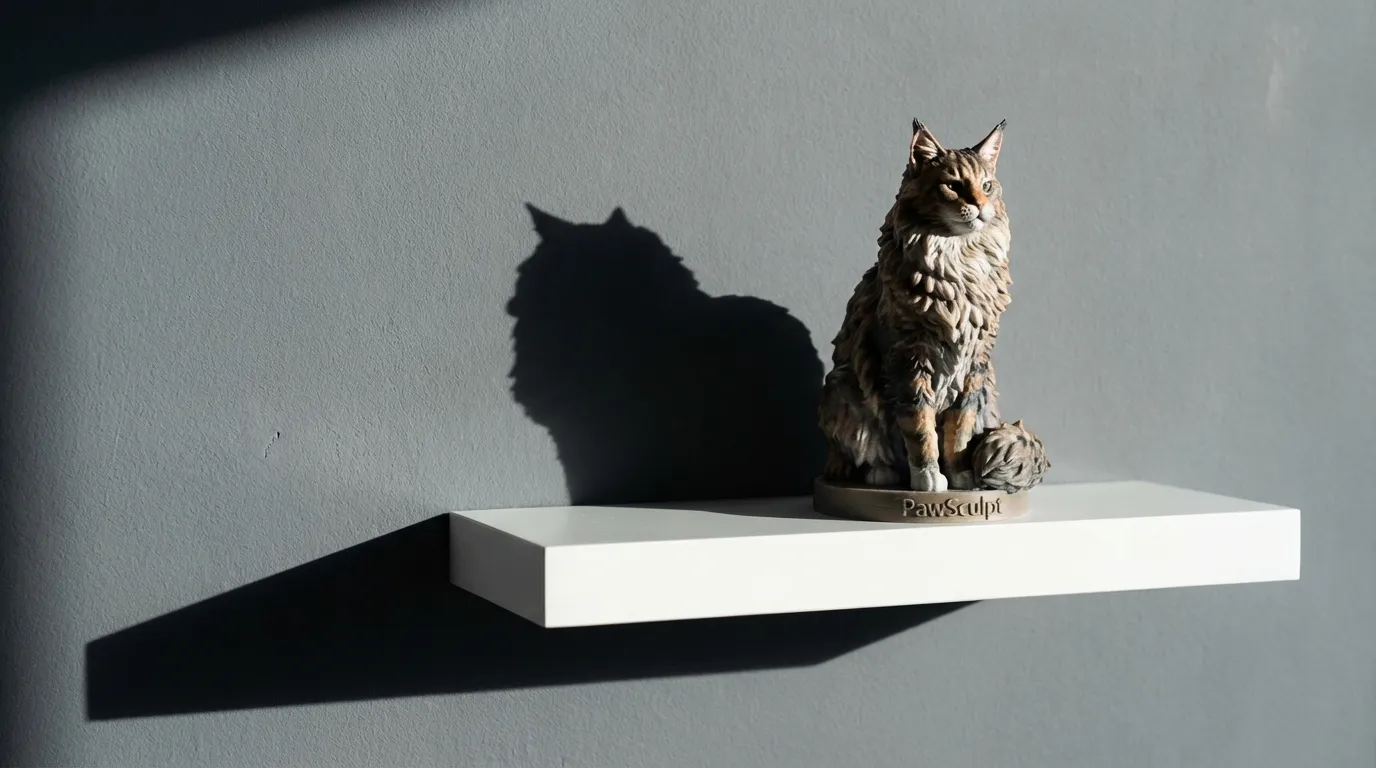
Choose one specific surface—a mantle, a floating shelf, or a specific spot on a bookcase. This is the designated memory zone. By confining the physical memorial to a specific boundary, you give yourself permission to live in the rest of your house without constantly confronting your grief.
What Goes on the Shelf?
Since Maine Coons are visually striking animals—those ear tufts, the heavy paws, the magnificent ruff—you want something that captures that grandeur without the bulk.This is where many families we work with choose to transition from "keeping their stuff" to "creating a likeness."
The Role of Precision Technology
In the past, getting a custom model of a pet meant hiring a painter or sculptor and hoping they captured the likeness. Today, we use full-color 3D printing technology (specifically PolyJet or MJF style processes) to create museum-quality replicas.
At PawSculpt, we don't just "paint a generic cat figurine." Our artists digitally sculpt your Maine Coon based on your photos—capturing the specific asymmetry of their markings, the exact shade of their eyes, and the unique way their fur draped.
Because we use full-color resin, the color isn't a layer of paint that can chip off; the color is built voxel-by-voxel (think 3D pixels) directly into the material. The result is a vibrant, textured, highly detailed physical memory that fits in the palm of your hand, replacing the need for that giant cat bed in the corner.
"We've seen families heal by holding something tangible. Grief needs an anchor, but that anchor doesn't have to be a six-foot scratching post."
— The PawSculpt Team
The Art of the "Soft Purge"
You don't have to do this all at once. In fact, we recommend you don't. Grief messes with your executive functioning. You might throw something away today that you'll desperately want back next week.
The "Purgatory Box" Method
1. Get a large, opaque plastic bin. 2. Put the "maybe" items inside. The toys you aren't sure about, the brushes, the extra bowls. 3. Seal it and put it in the garage or closet. 4. Set a reminder on your phone for 3 months.If you haven't opened that bin in three months to retrieve an item, you have proof that you can live without the object while still keeping the memory. When the reminder goes off, you can donate the contents without the sharp pang of immediate loss.
Repurposing the "Maine Coon Confetti" (Fur)
Maine Coon owners know the struggle of the fur. It’s everywhere. But when they are gone, finding a tumbleweed of fur under the sofa can bring you to your knees.Instead of vacuuming it all away in a panic, consider collecting some. There are artists who spin pet fur into yarn (chiengora) or felt it into beads for jewelry.
We had a customer who took the fur from her cat's favorite brush and had it felted into a small heart, which she placed inside a glass locket. It was a minimalist, elegant way to keep a physical piece of her companion close without keeping the messy, fur-covered furniture.
Digital Preservation: Zero-Footprint Memories
If you are a true minimalist, the best place to store memories is in the cloud. But digital photos can feel ephemeral. You scroll past them too quickly.
The Digital Frame Upgrade
Don't just leave photos on your phone. Invest in a high-quality digital frame. Curate a specific album of "Best Of" moments. Place this frame on your "One Shelf."
The Video Montage
Hire a video editor (or use simple AI tools) to stitch together all those 3-second clips of your Maine Coon "chirping" at birds or kneading dough. Audio is a powerful memory trigger—often more than visuals. Hearing that specific trill-meow can transport you back instantly.
Navigating the Guilt of "Moving On"
As you clear the space, you might feel a heavy weight in your chest. A clean house can feel empty. A spacious floor can feel lonely.
This is where the concept of "Continuing Bonds" comes in. In modern grief psychology, the goal isn't to "move on" or "get over it." The goal is to find a new way to relate to the deceased.
When you donate that massive cat tree to a shelter, you are continuing your bond with your pet by honoring their legacy of love. When you replace the clutter with a singular, beautiful custom figurine, you are continuing your bond by elevating their memory into art.
You aren't erasing them. You are making space for the new shape your love has to take.
"The emptiness of the room is not an absence of love, but a measure of its magnitude."
Frequently Asked Questions
Is it disrespectful to throw away my cat's favorite toys?
Not at all. Your cat's spirit isn't in the toy. Keeping broken, shredded, or dirty toys creates clutter, not connection. We recommend keeping one or two pristine favorites that spark joy and letting go of the rest without guilt.How do I handle the guilt of enjoying a cleaner home after my pet dies?
This is one of the most common, yet unspoken, feelings among pet owners. Acknowledge that two things can be true at once: you miss your pet desperately, and you appreciate the reduced housework. This relief is about the cessation of caretaking duties—which can be intense with large breeds—not the absence of your friend.What is the best way to memorialize a large pet in a small apartment?
Focus on scale. Use vertical wall space for photos, or commission a small, high-detail custom figurine that sits on a desk or shelf. Digital frames are also excellent for cycling through thousands of memories without taking up physical shelf space.How long should I wait before clearing out my Maine Coon's things?
There is no set timeline. Some people need to do it immediately (within 24 hours) to stop the constant visual triggers of pain. Others need months before they can touch the bed. The "Purgatory Box" method we mentioned earlier allows you to clear the space visually without making permanent decisions immediately.Ready to Celebrate Your Pet?
Every pet has a story worth preserving. Whether you're honoring a beloved Maine Coon who has crossed the rainbow bridge or celebrating your furry friend's unique personality, a custom PawSculpt figurine captures those details—from the ear tufts to the paw size—that make your pet one-of-a-kind.
Free instant AI preview • 3D artist preview within 7 days • 5 free revisions