
A Mother's Day Gift That Honors the Cavalier King Charles Spaniel She Still Talks About Every Week
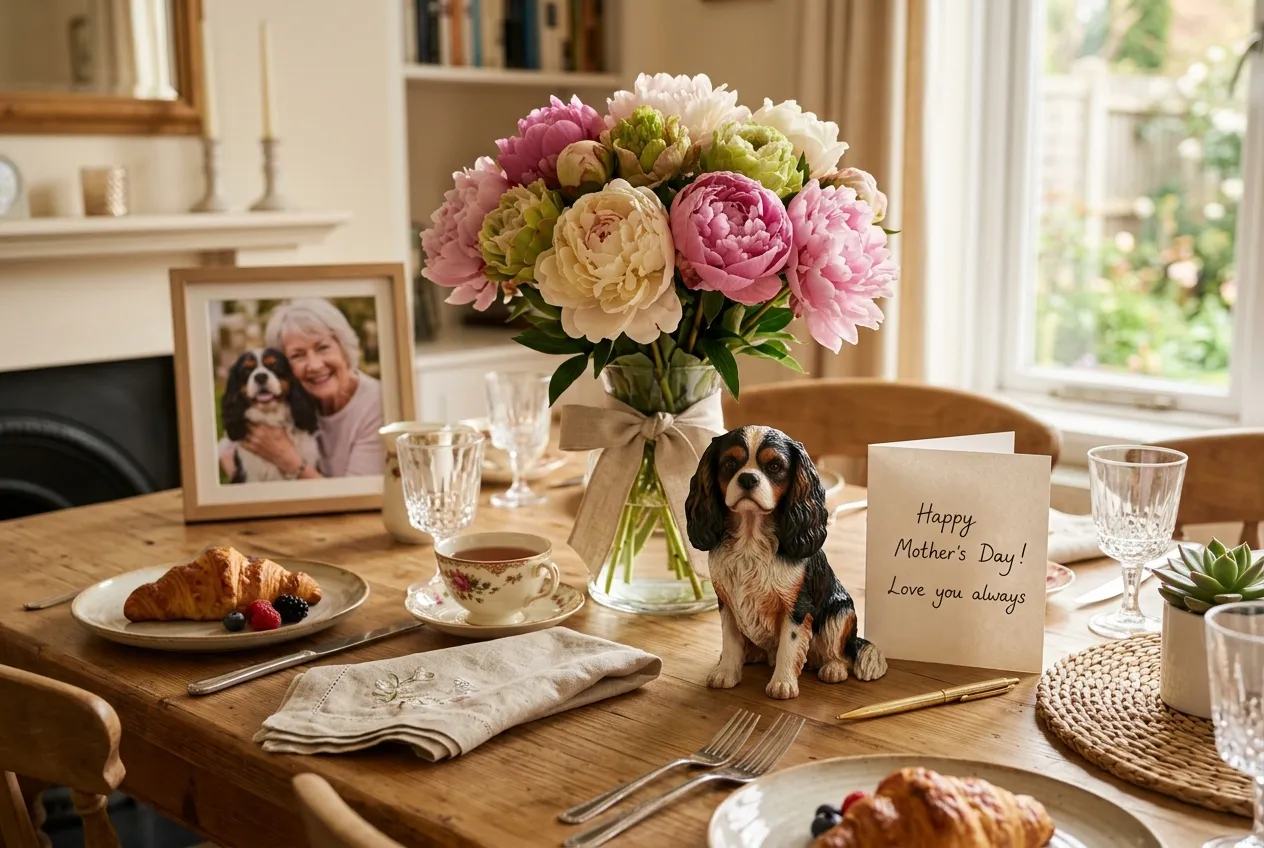
"The bond with a true dog is as lasting as the ties of this earth will ever be." — Konrad Lorenz
Your mother reaches for her phone again. You know what's coming—the same photo of Rosie, her Cavalier King Charles Spaniel, the one with those liquid amber eyes and the perfectly symmetrical blaze down her muzzle. She'll tell you about the morning walks, the way Rosie would press her warm body against her legs during thunderstorms, how she'd tilt her head when your mother sang off-key in the kitchen. It's been three years, and the stories haven't stopped. They shouldn't have to.
Quick Takeaways
- Mother's Day memorial gifts work best when they honor ongoing love — not just past loss, but the relationship that continues in memory
- Cavalier King Charles Spaniels leave distinct sensory memories — their silky ears, the weight of their head on your lap, the specific rhythm of their breathing
- Tangible keepsakes anchor grief in healthy ways — giving mothers something to hold when words aren't enough, like custom pet figurines that capture breed-specific details
- The best memorial gifts spark stories, not tears — they should invite conversation about happy moments, not just sad endings
- Timing matters less than thoughtfulness — a meaningful gift three years after loss can be more powerful than flowers on the first Mother's Day without them
The Cavalier King Charles Spaniel Imprint
There's a specific ache that comes with losing a Cavalier. It's not just the absence of a dog—it's the loss of a shadow that followed from room to room, a warm weight that settled on feet during every phone call, a pair of eyes that watched every bite of food with hopeful devotion. Cavaliers don't just live with you; they attach themselves to your daily rhythm like a second heartbeat.
Your mother probably still catches herself looking down when she stands up from the couch, checking for paws she might step on. She might pause before closing the car door, remembering how Rosie would leap into the passenger seat uninvited, ears flying. The scent memory hits at odd moments—that particular smell of sun-warmed fur after a walk, or the faint sweetness of puppy breath that somehow lingered even into Rosie's senior years.
Cavalier King Charles Spaniels are bred to be companion dogs, descendants of the lap warmers that kept 17th-century nobility company. That genetic imperative to bond runs deep. They're not independent workers or aloof guardians. They're Velcro dogs, and when they're gone, you feel the unsticking in a thousand small moments throughout the day.
The breed's physical characteristics leave their own specific memories. Those long, feathered ears that felt like silk ribbons between your fingers. The compact weight—usually 13 to 18 pounds—that made them the perfect size to scoop up and hold. The way their tail never stopped wagging, a metronome of pure joy. The distinctive coat patterns: Blenheim (chestnut and white), Tricolor (black, white, and tan), Black and Tan, or Ruby. Each marking as unique as a fingerprint.
"Every whisker, every ear tuft, every asymmetrical marking—these details aren't just physical traits. They're the vocabulary of memory."
When you're choosing a Mother's Day gift for someone who lost a Cavalier, you're not just acknowledging a pet's death. You're honoring a relationship that shaped daily life for years, maybe a decade or more. The gift needs to understand that distinction.
Why Traditional Mother's Day Gifts Miss the Mark
The flowers arrive. They're beautiful—roses, probably, or a spring arrangement with tulips and daffodils. Your mother thanks you, puts them in water, and within a week they're wilting. The card says something about love and appreciation. It's nice. It's also completely disconnected from the grief she's still carrying.
Generic Mother's Day gifts operate on the assumption that all mothers want the same things: pampering, flowers, brunch, jewelry. But a mother who's lost her constant companion isn't looking for a spa day. She's looking for acknowledgment that her loss still matters, that the relationship she had with Rosie was significant enough to be remembered and honored.
Here's what happens with most well-intentioned gifts:
Jewelry without meaning sits in a drawer. A generic paw print necklace from a department store doesn't capture anything specific about Rosie. It could represent any dog, any loss. There's no recognition of the Cavalier-specific traits—the ear feathers, the gentle expression, the compact elegance.
Photo frames and albums she already has. Your mother doesn't need another way to display the same photos she's been looking at for three years. She needs something that transforms those images into a new form of presence.
"Pamper yourself" gifts feel tone-deaf. A massage or a gift certificate for a manicure suggests she should be "over it" by now, that self-care will fill the dog-shaped hole in her daily routine. It won't.
Memorial garden stones or wind chimes work for some people, but they're passive. They sit in the yard. They don't invite interaction or conversation. They mark a grave, not a living memory.
The mistake most people make is treating pet loss as something that should be "resolved" by now. Three years feels like enough time to have "moved on." But grief doesn't work on a timeline, especially for a dog who was woven into the fabric of daily life for a decade or more. The American Kennel Club notes that Cavaliers typically live 12-15 years—that's 12-15 years of morning routines, evening walks, shared meals, and constant companionship. That doesn't evaporate on a schedule.
What your mother needs is a gift that says: "I know you still think about her. I know she still matters. Here's something that honors that ongoing relationship."
The Sensory Architecture of Memory
Close your eyes and think about a person you loved who's no longer here. What comes first? Probably not their biographical details or the timeline of your relationship. You remember the sound of their laugh, the texture of their favorite sweater, the way they smelled like coffee and something indefinably them.
Memory is built on sensory scaffolding. The same is true for pets, maybe even more so because our relationships with them are less verbal and more physical. We remember them through touch, smell, sound, and sight.
For a Cavalier King Charles Spaniel, those sensory memories are particularly vivid:
Touch: The silk of those ears, impossibly soft, that you'd stroke while watching TV. The weight of a head resting on your thigh. The warmth of a body curled against your side in bed. The delicate bones you could feel under the fur when you scratched behind the ears. The way their paws felt in your hand when you'd hold them—small, warm, trusting.
Smell: That specific dog scent that wasn't unpleasant, just distinctly Rosie. The way her fur smelled after a bath—clean and slightly sweet. The corn-chip smell of her paws (a phenomenon so common it has a name: "Frito feet"). The way her breath smelled in the morning when she'd wake your mother with gentle nose nudges.
Sound: The click of nails on hardwood floors. The specific rhythm of her breathing when she slept. The little snuffling sounds Cavaliers make—they're brachycephalic enough to have some breathing quirks, but not enough to cause serious problems. The jingle of her collar tags. The way she'd sigh when she finally settled into her favorite spot.
Sight: The way light caught the chestnut patches in her Blenheim coat. The white blaze down her face, slightly asymmetrical if you looked closely. The way her tail never stopped moving, even when she was resting. The expression in those dark eyes—Cavaliers have remarkably expressive faces, capable of conveying hope, contentment, concern, and pure adoration.
When you're choosing a memorial gift, you're trying to trigger these sensory memories in a way that feels comforting rather than painful. The goal isn't to recreate the pet—that's impossible—but to create a physical anchor for the memories that are already there.
This is where most memorial gifts fail. A paw print in clay captures one small detail. A photo captures a moment. But neither engages multiple senses or invites the kind of interaction that keeps memory active and alive.
What We Wish We Knew Sooner
From the PawSculpt Team:
We've worked with thousands of families navigating pet loss, and here's what we wish someone had told us (and them) earlier:
- Grief doesn't decrease; it just becomes more portable. The intensity doesn't fade as much as you learn to carry it differently. A tangible keepsake helps with that portability.
- People want to talk about their pets more than you think. They're not "stuck" in grief—they're keeping a relationship alive through storytelling. Gifts that invite those stories are gifts that get used.
- The details matter more than the gesture. A generic "thinking of you" gift is nice. A gift that shows you remember Rosie's specific markings, her favorite sleeping position, or the way her ears flopped when she ran—that's transformative.
- Timing is arbitrary. We've had customers order memorial pieces five years after a loss, ten years after. The "right time" is whenever the person is ready to have a physical representation of their grief and love.
- Photos are never perfect, and that's okay. Families apologize for blurry photos, bad lighting, or awkward angles. But those imperfect photos often capture personality better than professional portraits. The slightly out-of-focus shot of Rosie mid-zoom in the backyard tells a better story than a posed studio photo.
The Case for Three-Dimensional Memory
Humans are three-dimensional creatures living in a three-dimensional world, yet we try to preserve our most important memories in two dimensions. Photos are beautiful, but they're flat. They capture a moment, not a presence.
A three-dimensional representation changes the relationship with memory. You can walk around it. See it from different angles. Notice how light hits it differently throughout the day. Pick it up and hold it, feeling the weight in your hands—not the same weight as Rosie, but a weight nonetheless, something solid and real.
This is why custom figurines have become increasingly popular as memorial keepsakes. They occupy space in a room the way the pet once did. They're not tucked away in an album or stored in a jewelry box. They sit on a mantel, a bookshelf, a bedside table—places where your mother will see them multiple times a day, in different lighting, from different angles.
The technology behind modern custom pet figurines has evolved significantly. Full-color 3D printing allows for reproduction of specific markings, coat patterns, and breed characteristics that would be impossible to capture through traditional sculpting or painting. For a Cavalier King Charles Spaniel, this means:
- Accurate coat color reproduction: The specific shade of chestnut in a Blenheim coat, the depth of black in a Tricolor, the richness of ruby in a solid-colored Cavalier. These aren't approximations—they're digitally matched to photos.
- Breed-specific features: The distinctive domed skull, the large dark eyes set wide apart, the long feathered ears, the compact body proportions. Cavaliers have a specific look that differentiates them from other toy spaniels, and accurate representation requires understanding those breed standards.
- Individual markings: No two Cavaliers are identical, even within the same color pattern. The exact placement of patches, the shape of the blaze, the distribution of tan points on a Tricolor—these individual variations are what make a figurine feel like Rosie specifically, not just "a Cavalier."
- Personality in posture: The way Rosie held her head, the set of her ears, whether she had a playful stance or a regal sitting position. These postural details communicate personality in ways that static photos sometimes miss.
"We've seen families heal by holding something tangible. Grief needs an anchor, not just an album."
The process of creating a custom figurine also matters. Master 3D sculptors with years of experience in digital modeling work from the photos you provide, building a digital model that captures not just physical accuracy but the essence of the pet's personality. The model is then precision 3D printed in full-color resin, with colors embedded directly into the material rather than painted on afterward. A protective clear coat adds durability and a subtle sheen that brings out the depth of the colors.
This isn't mass production. Each figurine is individually created based on specific photos of a specific pet. The result is a museum-quality piece that feels personal because it is personal.
The Mother's Day Timing Advantage
Mother's Day carries a specific emotional weight that makes it an ideal time for a memorial gift. It's a day dedicated to honoring maternal love—and for many women, the love they had for their pet was deeply maternal.
Dogs don't replace children, but they do fulfill some of the same nurturing instincts. Your mother fed Rosie, cared for her when she was sick, worried about her wellbeing, celebrated her quirks, and structured her days around Rosie's needs. That's maternal love, even if it's directed at a different species.
Mother's Day acknowledges that love. It says: "The care you gave mattered. The relationship you had was real and significant. You were a good mother to Rosie."
For women whose children are grown and gone, or who never had children, or whose children live far away, a pet often becomes the primary recipient of daily nurturing energy. The loss of that relationship can feel like empty nest syndrome, but without the social recognition that comes with children leaving home. A Mother's Day gift that honors the pet relationship validates that the grief is legitimate and the love was real.
Timing also matters because Mother's Day is a day your mother expects to hear from you. She's not surprised by a gift or a gesture. This means you can give something emotionally significant without it feeling like you're bringing up a painful topic out of nowhere. The day itself provides context and permission for a memorial gift.
Choosing the Right Memorial Approach
Not every memorial keepsake works for every person. Your mother's personality, her grieving style, and her relationship with Rosie all influence what kind of gift will resonate.
For the mother who talks about Rosie constantly: She's keeping memory alive through storytelling. She needs a conversation starter, something that invites others to ask questions and gives her permission to share stories. A custom figurine on a prominent shelf does this naturally. Visitors notice it, ask about it, and suddenly she's talking about the time Rosie stole an entire stick of butter off the counter or the way she'd "sing" along to certain songs.
For the mother who's more private about her grief: She might not want something that demands explanation from every visitor. A smaller figurine for her bedroom or home office gives her a private space to remember without feeling like she has to perform her grief for others. The memorial is for her, not for public display.
For the mother who's struggling with guilt: Many pet owners carry guilt about end-of-life decisions, about whether they did enough, about the timing of euthanasia. A memorial gift that focuses on the pet's life rather than their death can help shift the emotional focus. A figurine that captures Rosie in a happy, healthy moment—ears flying, tail wagging—reminds your mother of the years of joy rather than the final difficult days.
For the mother who's ready to remember without crying: Three years is often enough time that memories can be bittersweet rather than purely painful. She can look at photos and smile instead of breaking down. A memorial gift at this stage isn't about processing fresh grief—it's about honoring a relationship that's now part of her personal history.
For the mother who has other pets: A figurine of Rosie doesn't replace the living dogs or cats in her home. It acknowledges that each relationship is unique and irreplaceable. The current pets aren't consolation prizes—they're new relationships. Rosie still deserves her own recognition.
| Memorial Gift Type | Best For | Emotional Impact | Longevity | Conversation Starter |
|---|---|---|---|---|
| Custom 3D Figurine | Mothers who want tangible presence | High - invites interaction | Permanent | Strong - naturally draws questions |
| Memorial Jewelry | Private grievers | Medium - personal reminder | Permanent | Subtle - only if asked |
| Photo Canvas/Print | Those with wall space | Medium - visual reminder | Permanent | Moderate - depends on placement |
| Memorial Garden Stone | Those with outdoor space | Low - passive marker | Permanent | Weak - often goes unnoticed |
| Custom Portrait (painted) | Art lovers | Medium-High - artistic interpretation | Permanent | Strong - art invites discussion |
| Memory Book/Album | Storytellers | Medium - requires active engagement | Permanent | Weak - usually private |
The Photo Selection Process
If you decide to commission a custom figurine, the photos you provide determine the quality and accuracy of the final piece. This is where many people hesitate, worried that their photos aren't "good enough." Here's what actually matters:
Clarity over perfection: A slightly blurry action shot that captures Rosie's personality is more valuable than a perfectly sharp photo where she looks stiff and uncomfortable. The sculptors need to see her natural expression, her typical posture, the way she carried herself.
Multiple angles: Front view, side view, three-quarter view—different angles reveal different details. The shape of the head looks different from the side than from the front. The ear placement, the body proportions, the tail carriage all become clearer with multiple perspectives.
Natural lighting: Outdoor photos or photos near windows show true coat colors better than indoor artificial lighting, which can cast yellow or blue tones that distort the actual color. For a Blenheim Cavalier, this matters—the chestnut patches need to be the right shade, not too orange or too brown.
Close-ups of distinctive features: If Rosie had an asymmetrical blaze, or a specific pattern of freckles on her muzzle, or one ear that flopped differently than the other, close-up photos help capture those individual quirks. These details are what make the figurine feel like Rosie rather than a generic Cavalier.
Photos that show personality: The way she tilted her head when curious. The expression she made when begging for treats. The relaxed, content look when she was curled up in her favorite spot. Personality lives in these small expressions and postures.
Don't apologize for your photos. Professional pet photography is wonderful, but it's not necessary. The photos you took with your phone during ordinary moments—walks, playtime, lazy Sunday afternoons—often capture more authentic personality than posed portraits.
For specific guidance on photo requirements and to see examples of how different photo qualities translate to finished figurines, visit pawsculpt.com where you can explore the process in detail.
Beyond the Physical Gift: The Presentation Matters
How you give the gift shapes its emotional impact. A custom figurine arriving in a plain cardboard box hits differently than one presented with thought and context.
Write a card that acknowledges the ongoing relationship: Don't write "I know you miss Rosie" as if the missing is past tense. Write "I know you still think about Rosie every day" or "I know Rosie is still part of your daily life, even though she's not physically here." This validates that grief doesn't have an expiration date.
Include a specific memory: "I remember how Rosie would press herself against your legs during thunderstorms" or "I can still picture the way she'd tilt her head when you sang in the kitchen." Specific memories show that you paid attention, that Rosie mattered to you too, not just to your mother.
Frame it as celebration, not just memorial: "This is to celebrate the 12 years you had together" rather than "This is to help you remember her." The relationship doesn't need help being remembered—it needs to be honored and celebrated.
Consider the unboxing experience: If you're present when she opens it, give her space to react. Some people cry. Some people laugh. Some people go silent. All of these are valid responses. Don't rush to fill the silence or try to manage her emotions.
Place it somewhere meaningful together: If you're there, ask where she'd like to display it. This gives her agency and creates a small ritual around the gift. Maybe it goes on the mantel where Rosie's collar used to hang. Maybe it goes on the bookshelf near the reading chair where Rosie would curl up at her feet. The placement becomes part of the story.
The Conversation Gift vs. The Private Comfort
Memorial gifts fall into two broad categories: those that invite conversation and those that provide private comfort. Understanding which your mother needs helps you choose the right approach.
Conversation gifts are displayed prominently. They're designed to be noticed, to prompt questions, to give your mother permission to talk about Rosie. For someone who finds comfort in storytelling, who wants to keep Rosie's memory active in her social life, a conversation gift is ideal.
A custom figurine on the living room mantel is a conversation gift. Visitors see it, recognize it as something special, and ask about it. This opens the door for your mother to share stories, to talk about Rosie's personality, to keep the relationship alive through narrative.
The benefit of conversation gifts is that they normalize ongoing grief. When your mother talks about Rosie in response to questions about the figurine, she's not "bringing up" her dead dog inappropriately—she's responding to genuine interest. This can be deeply comforting for people who worry that they talk about their pet too much or that others are tired of hearing about them.
Private comfort gifts are more intimate. They're placed in bedrooms, home offices, or other personal spaces. They're not meant for public display or explanation. They're for the moments when your mother is alone and needs a tangible connection to Rosie.
A smaller figurine on a bedside table is a private comfort gift. It's the last thing she sees before sleep and the first thing she sees when she wakes. It's there for the hard moments—the anniversaries, the random Tuesday when grief hits unexpectedly, the nights when the house feels too quiet.
The benefit of private comfort gifts is that they don't require emotional labor. Your mother doesn't have to explain them, justify them, or perform her grief for others. They're purely for her.
Some people need both. A prominent display piece for the living room and a smaller personal piece for the bedroom. The public and private faces of grief, both honored.
The Cavalier-Specific Details That Matter
Generic pet memorial gifts treat all dogs as interchangeable. But breed-specific characteristics matter, especially for breeds as distinctive as Cavalier King Charles Spaniels.
The ears: This is the most iconic Cavalier feature. Long, feathered, set high on the head, they frame the face and give Cavaliers their characteristic gentle expression. The ear leather should be long enough to reach the nose when pulled forward. The feathering—the long, silky hair—should be abundant. A figurine that gets the ears wrong doesn't look like a Cavalier.
The eyes: Large, round, dark, and set wide apart. Cavalier eyes are remarkably expressive, capable of the "puppy dog eyes" that make the breed so hard to resist. The eye placement and size are crucial to capturing the breed's sweet expression.
The coat: Cavaliers have moderate-length coats with feathering on the ears, chest, legs, and tail. The texture is silky, not curly or wiry. The four color patterns each have specific standards:
- Blenheim: Rich chestnut markings on a pearly white background, with a white blaze between the eyes and ears. Some have a "Blenheim spot" (a chestnut mark on top of the head between the ears).
- Tricolor: Black and white with tan markings over the eyes, on the cheeks, inside the ears, and under the tail.
- Black and Tan: Solid black with tan markings in the same locations as the tricolor.
- Ruby: Solid rich red.
The body proportions: Cavaliers are small but not tiny—they're the largest of the toy spaniels. They should look balanced and elegant, not fragile or exaggerated. The body is slightly longer than tall, with a level topline and a tail that's in constant motion.
The expression: This is the hardest thing to capture and the most important. Cavaliers have a gentle, melting expression that's part of their breed character. They look at you with complete devotion and trust. A figurine that captures the physical details but misses the expression doesn't feel like a Cavalier.
When you're working with a company that creates custom figurines, these breed-specific details should be part of their expertise. Digital sculptors who specialize in pet figurines understand breed standards and can translate photos into three-dimensional representations that honor those standards while capturing individual variations.
The Unexpected Benefits of Tangible Memorials
Research on grief and memory suggests that tangible objects play a specific role in healthy mourning. They provide what psychologists call "continuing bonds"—ways to maintain a connection with the deceased that doesn't require pretending they're still alive or that the loss didn't happen.
A physical memorial object allows for interaction without delusion. Your mother can dust the figurine, move it to different locations, hold it when she's having a hard day. These small interactions acknowledge both the reality of loss and the ongoing importance of the relationship.
Tangible memorials also serve as "permission objects." They give your mother permission to grieve openly, to talk about Rosie, to acknowledge that the loss still affects her. In a culture that often expects people to "move on" quickly from pet loss, a prominent memorial says: "This relationship mattered enough to be honored permanently."
For mothers specifically, memorial objects can help process the particular grief of losing a dependent. The American Veterinary Medical Association notes that the human-animal bond often mirrors parent-child attachment, especially for people whose pets are their primary companions. The loss triggers not just sadness but a loss of purpose—the daily caregiving that structured time and provided meaning.
A memorial figurine doesn't replace that purpose, but it does provide a focal point for the love that no longer has a living recipient. Your mother can't feed Rosie or take her for walks anymore, but she can tend to Rosie's memory, keep her story alive, and maintain the relationship in a new form.
What to Avoid in Memorial Gifts
Some well-intentioned gifts backfire. Here's what to skip:
"Rainbow Bridge" poems and generic sympathy cards: These are so ubiquitous that they've lost meaning. Your mother has probably received a dozen of them. They're not personal, and they don't acknowledge anything specific about Rosie or their relationship.
Gifts that suggest replacement: A gift certificate to a breeder or a "when you're ready for another dog" message implies that pets are interchangeable. They're not. Even if your mother eventually gets another Cavalier, that dog won't be Rosie, and the new relationship won't erase the old one.
Overly sentimental or maudlin items: Gifts covered in angel wings, excessive glitter, or phrases like "Forever in My Heart" can feel cloying rather than comforting. They reduce a complex relationship to a greeting card sentiment.
Anything that requires immediate action: A living plant that needs care, a memorial tree that needs planting, a craft kit that requires assembly—these put pressure on your mother to do something when she might not have the emotional energy. Memorial gifts should provide comfort, not create obligations.
Gifts that focus on the death rather than the life: Items that emphasize "crossing the rainbow bridge" or "gone but not forgotten" keep the focus on loss. Better to choose something that celebrates the years of companionship, the personality quirks, the joy Rosie brought.
Mass-produced items with no personalization: A generic paw print ornament from a big-box store doesn't honor Rosie specifically. It could represent any pet. The lack of personalization suggests you didn't put much thought into it.
The Long-Term Value of Quality Memorials
Cheap memorial items break, fade, or get relegated to storage. Quality pieces become family heirlooms.
A well-made custom figurine lasts indefinitely. Full-color resin 3D prints are UV-resistant and durable. They don't fade in sunlight. They don't chip or crack easily. With basic care—occasional dusting, keeping them away from extreme heat—they'll look the same in twenty years as they do today.
This longevity matters because grief evolves. The figurine that provides comfort in year three might provide different comfort in year ten. It might eventually become a happy reminder rather than a sad one. It might become something your mother shows to grandchildren, telling them stories about the dog who was part of the family before they were born.
Quality memorials also hold their emotional value better than cheap alternatives. A figurine that cost $30 and looks mass-produced might feel disposable. A museum-quality piece that clearly required skill and care to create feels worthy of the relationship it represents. The investment signals that Rosie's memory is worth investing in.
This doesn't mean you need to spend a fortune. It means choosing quality over quantity, permanence over disposability, personalization over generic sentiment.
| Care Aspect | Frequency | What to Do | Why It Matters |
|---|---|---|---|
| Dusting | Weekly | Soft, dry cloth or feather duster | Prevents buildup that dulls colors |
| Deep Cleaning | Monthly | Slightly damp microfiber cloth, air dry | Removes oils and residue |
| Placement | Once | Away from direct sunlight, stable surface | Prevents fading and accidental damage |
| Handling | As needed | Clean, dry hands; support from bottom | Preserves finish and prevents drops |
The Gift That Keeps Giving
The best memorial gifts don't just provide a moment of comfort—they create ongoing opportunities for connection and remembrance.
A custom figurine becomes part of your mother's daily landscape. She sees it every morning. She might touch it in passing. She might talk to it (many people do, and that's healthy). It's a constant, gentle reminder that Rosie's place in her life is permanent, even though Rosie herself is gone.
This ongoing presence serves multiple functions:
Ritual anchor: Your mother might develop small rituals around the figurine—touching it before bed, talking to it when she's having a hard day, including it in holiday decorations. These rituals provide structure for grief and create a sense of ongoing relationship.
Conversation catalyst: When friends visit and ask about the figurine, your mother gets to share stories. This keeps Rosie's memory active and social rather than private and isolated. It also helps friends understand that talking about Rosie is welcome, not taboo.
Grief barometer: How your mother interacts with the figurine can reflect where she is in her grief journey. Early on, she might cry when she looks at it. Later, she might smile. Eventually, it might just be a comfortable presence, like a photo of a loved one that you see every day without strong emotion.
Legacy object: If your mother is older, the figurine might eventually become part of her estate, passed down to you or other family members who also loved Rosie. It becomes a tangible link between generations, a way to keep Rosie's story alive even after your mother is gone.
Making It Personal: Customization Options
The more personalized a memorial gift, the more meaningful it becomes. When exploring custom figurine options, consider these elements:
Pose selection: Was Rosie usually sitting regally, lying down in a relaxed sprawl, or standing alert? The pose should reflect her typical demeanor. A Cavalier who spent most of her time curled up in laps shouldn't be depicted in an alert standing pose—it wouldn't feel like her.
Size considerations: Figurines typically come in multiple sizes. A larger piece (6-8 inches) makes a statement on a mantel or shelf. A smaller piece (3-4 inches) works better for bedside tables or office desks. Think about where your mother will display it and choose accordingly.
Base options: Some figurines come with decorative bases that can be engraved with the pet's name, dates, or a short phrase. This adds another layer of personalization and makes the piece feel more finished and intentional.
Capturing specific moments: Some companies can create figurines based on specific photos that capture a particular moment—Rosie with her favorite toy, Rosie in a characteristic head tilt, Rosie with a specific expression. These moment-based figurines tell a story rather than just depicting a generic pose.
Accessories: If Rosie had a favorite collar, bandana, or toy that was part of her identity, including it in the figurine design adds another layer of recognition and personality.
The goal is to create something that makes your mother think "That's Rosie" rather than "That's a Cavalier King Charles Spaniel." The difference is specificity—the individual details that made Rosie herself and no one else.
The Emotional Journey of Commissioning a Memorial
If you decide to commission a custom figurine, be prepared for the emotional process of selecting photos, reviewing designs, and eventually receiving the finished piece.
Photo selection can be bittersweet. Going through old photos means revisiting memories, some happy and some painful. You'll see Rosie at different ages, in different contexts, and you'll remember the stories behind each image. This can be emotional, but it's also part of the healing process—actively engaging with memory rather than avoiding it.
The preview stage provides anticipation. Most custom figurine companies provide digital previews before creating the physical piece. This gives you a chance to see how the sculptor interpreted the photos, to request adjustments, and to build anticipation for the final product. The waiting period between ordering and receiving can actually be valuable—it gives your mother something to look forward to.
Receiving the finished piece is a significant moment. This isn't like opening a typical gift. It's the first time your mother will see a three-dimensional representation of Rosie since she died. The emotional response can be intense—tears, laughter, silence, or all three. Be prepared for that and give her space to feel whatever she feels.
The first placement is ceremonial. Where the figurine goes in the house matters. This is the spot where Rosie's memory will live physically. Choosing that spot together, if you're present, can be a meaningful ritual.
Why Mother's Day Specifically
You could give a memorial gift on any day, but Mother's Day carries specific significance that makes it particularly appropriate.
It honors the maternal relationship. Your mother cared for Rosie with maternal devotion—feeding, grooming, worrying, celebrating, comforting. Mother's Day acknowledges that this was real maternal love, worthy of recognition.
It provides social permission. On Mother's Day, it's expected that you'll give a meaningful gift and express appreciation for your mother's love and care. This creates a natural opening for a memorial gift without it feeling like you're bringing up a painful topic out of nowhere.
It acknowledges ongoing motherhood. Even though Rosie is gone, your mother's identity as Rosie's caretaker doesn't