
One Year Without Your Corgi and the Grief Still Hits in the Grocery Store Parking Lot
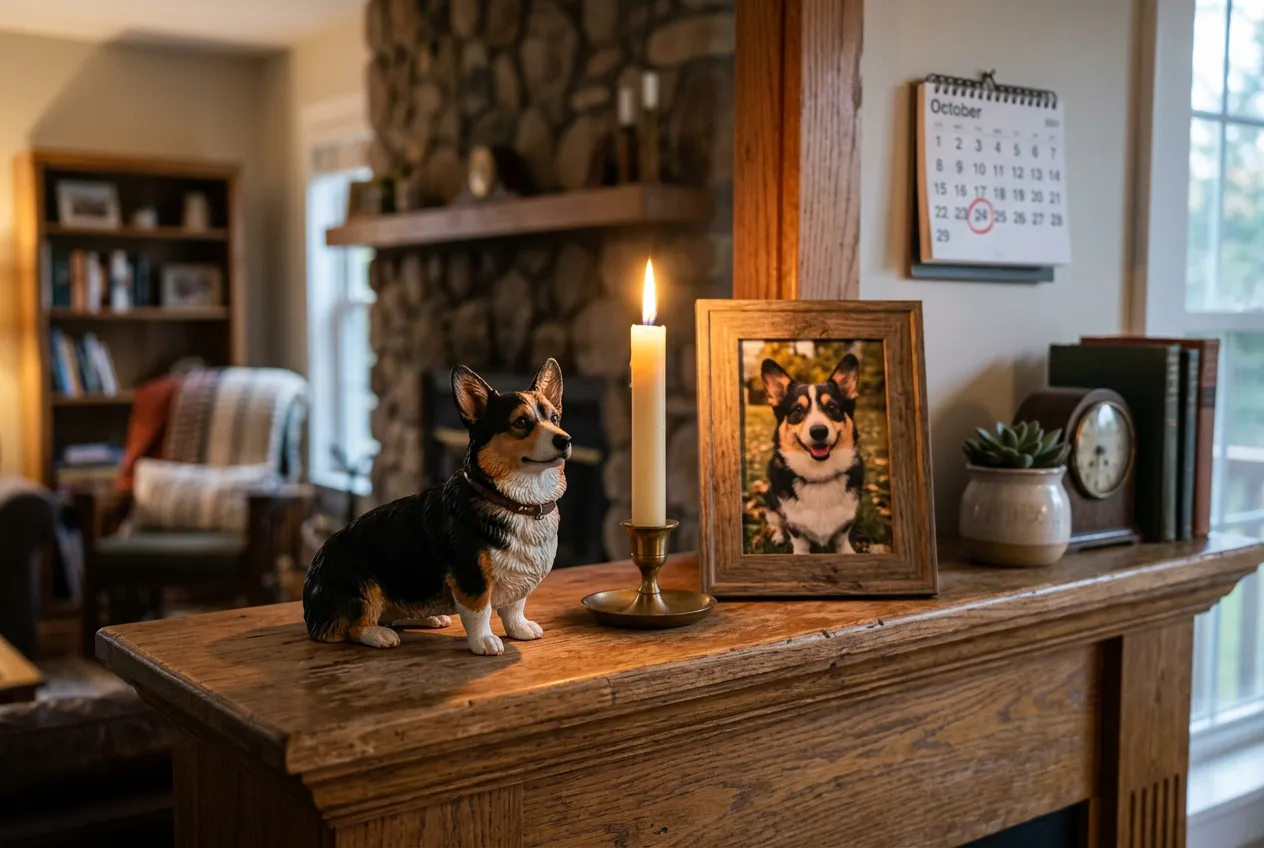
You're sitting in the grocery store parking lot, engine off, staring at a woman loading a Corgi into her SUV two spaces over. The way he hops—that signature bunny-hop—sends your chest into freefall. It's been exactly one year, and grief just walked past your windshield wearing a harness.
Quick Takeaways
- Grief waves at the one-year mark are neurologically predictable — your brain has encoded anniversary triggers into its memory architecture
- The "moving on" timeline is a myth — attachment bonds don't expire on schedule, and expecting them to creates secondary suffering
- Physical reminders serve a psychological function — tangible keepsakes like custom pet figurines help externalize grief so it doesn't live exclusively in your body
- Secondary losses compound the primary one — you're not just grieving your Corgi, but the identity shift of no longer being "their person"
- Anticipatory anxiety about the anniversary often exceeds the day itself — understanding this pattern reduces its power
The one-year anniversary of pet loss occupies a strange psychological space. You've survived 365 days without them. You've proven you can function, work, even laugh. But the calendar doesn't care about your progress. It circles back with surgical precision, and suddenly you're ambushed by the same raw ache you thought you'd metabolized months ago.
This isn't regression. It's neuroscience.
Why the One-Year Mark Hits Different (The Science of Anniversary Reactions)
Your brain is an associative machine. It doesn't just store memories—it indexes them by context, season, smell, and yes, time of year. When the anniversary approaches, your hippocampus (memory center) and amygdala (emotion center) start firing in patterns they haven't accessed in months. You're not imagining the intensity. You're experiencing what psychologists call an anniversary reaction, and it's as real as a broken bone.
Research on complicated grief shows that temporal landmarks—birthdays, adoption days, death anniversaries—trigger measurable increases in cortisol and inflammatory markers. Your body remembers what your conscious mind tried to file away.
But here's what most grief articles won't tell you: the anticipation is often worse than the day itself.
In the two weeks leading up to the anniversary, many pet owners report heightened anxiety, irritability, and intrusive thoughts. They're bracing for impact. The actual day? Sometimes it's quietly sad. Sometimes it's a relief that it's finally here and you can stop dreading it.
The parking lot moment—the one where you see another Corgi and your throat closes—that's your brain's way of saying: I haven't forgotten. I won't let you forget either. It's not cruelty. It's loyalty to the bond you built.
The Cognitive Dissonance of "Doing Better"
You probably told people you were "doing better" around month six. Maybe you adopted another dog. Maybe you rearranged the living room so it didn't feel so empty. Maybe you stopped crying every time you saw a Corgi meme.
And you were doing better. Past tense. Present continuous.
Then the anniversary arrives and you feel like you've been lying to everyone, including yourself. This is the cognitive dissonance that makes year-one so disorienting. You're simultaneously healing and hurting, and our culture doesn't have language for that duality.
Attachment theory explains this beautifully. The bond you formed with your Corgi wasn't a light switch—it was a neural pathway carved over years of co-regulation. When they died, that pathway didn't vanish. It became a phantom limb. Most days you've learned to walk without it. But on the anniversary? You reach for it instinctively, and the absence is fresh all over again.
"Grief isn't linear. It's a spiral. You pass the same pain points at different altitudes."

The Specific Ache of Losing a Corgi (Breed Personality and Grief Intensity)
Not all dog losses are identical, and that's not a hierarchy—it's specificity. Corgis occupy a particular emotional niche. They're not aloof. They're not background pets. They're Velcro dogs with opinions, and their absence leaves a Corgi-shaped hole that a Labrador or a Beagle can't fill.
If you're grieving a Corgi, you're grieving:
- The constant presence. They followed you room to room. The bathroom wasn't private. The kitchen wasn't yours. They were your shadow with a tail, and now the house echoes.
- The personality. Corgis are bossy, stubborn, and convinced they're in charge. You didn't just lose a pet—you lost a roommate with strong preferences about dinner time and who sits where.
- The physical comedy. Those short legs. That wiggle-butt. The way they'd "sploot" on cool tile. Grief for a Corgi includes mourning the daily moments of levity they provided without trying.
- The social identity. Corgi owners are a tribe. You had Instagram followers. Strangers stopped you on walks. You were "the Corgi person." Now you're just... a person who used to have a Corgi.
This last point is what psychologists call a secondary loss—the identity shift that accompanies the primary loss. You're not just grieving your dog. You're grieving the version of yourself that existed in relation to them.
The Guilt That Comes With Relief
Here's the emotional nuance most articles skip: if your Corgi died after a long illness, part of you might have felt relief when it was over. Relief that they weren't suffering. Relief that you could sleep through the night again. Relief that the vet bills stopped.
And then the guilt arrived, because how dare you feel relief?
This is one of grief's cruelest tricks. Relief and love coexist. You can be devastated by their absence and simultaneously grateful that the hardest part is behind you. The guilt doesn't mean you loved them less. It means you loved them enough to prioritize their comfort over your need to keep them close.
If you're carrying this guilt at the one-year mark, name it. Write it down. Say it out loud to someone who won't judge. The relief was compassion. The guilt is proof you cared. Both are true.
What Actually Helps at the One-Year Mark (Evidence-Based Coping)
Most grief advice is vague to the point of uselessness. "Be kind to yourself." "Take it one day at a time." "They'd want you to be happy."
Let's get specific.
Externalize the Grief (Don't Keep It Internal)
Grief that lives exclusively in your head and body becomes toxic. It needs an outlet. At the one-year mark, consider creating a tangible anchor for your grief—something physical that holds the weight so you don't have to carry it alone.
Options include:
- A memory box. Collar, favorite toy, a tuft of fur you saved, their last vet record. Physical objects that you can open when you need to feel close.
- A dedicated photo album. Not just digital—printed. Something you can hold. The tactile experience matters.
- A custom figurine. Families we've worked with often describe their PawSculpt figurine as a "grief anchor"—a three-dimensional representation that captures their pet's unique markings and personality. It's not about replacing them. It's about having a focal point for memory that doesn't live on a screen.
The key is specificity. Generic memorials (a paw print, a rainbow bridge poem) don't carry the same psychological weight as something unmistakably theirs.
Reframe the Anniversary as a Celebration of the Bond
This sounds like toxic positivity, but hear me out. The reason the anniversary hurts is because the bond was real. The depth of your grief is proportional to the depth of your love. That's not a flaw—it's proof of something extraordinary.
Instead of treating the anniversary as a day to "get through," some families reframe it as a bond celebration. Not a celebration that they're gone, but a celebration that they existed at all.
Practical ways to do this:
- Donate to a Corgi rescue in their name
- Volunteer at a shelter for a few hours
- Make their favorite treat (yes, for yourself—they'd approve)
- Spend time with another Corgi owner and swap stories
- Create a small ritual: light a candle, play their favorite squeaky toy sound, sit in their favorite spot
The goal isn't to "move on." It's to integrate their memory into your ongoing life in a way that feels honoring rather than haunting.
Address the Anticipatory Anxiety (The Two-Week Window)
If you're reading this before the anniversary, you're likely in the anticipatory anxiety phase. Your brain is already bracing. Here's what helps:
Name the date. Don't avoid it. Mark it on your calendar. Plan something intentional for that day so you're not just white-knuckling through it.
Lower your expectations. You don't need to have a "meaningful" day. You don't need closure. You need to survive it without judgment.
Warn your people. Tell your partner, your best friend, your therapist: "Next Tuesday is rough. I might be off." Give them permission to check in without you having to ask.
Limit triggers. If you know the grocery store parking lot wrecks you, order delivery that week. If social media Corgi content is too much, mute those accounts temporarily. This isn't avoidance—it's strategic self-protection.
| Coping Strategy | Psychological Function | Best For |
|---|---|---|
| Memory box creation | Externalizes grief, provides tangible anchor | Those who feel "stuck" in their head |
| Ritual/ceremony | Marks transition, honors bond publicly | Those who need closure or community |
| Tangible keepsake (figurine, art) | Creates focal point for memory, reduces intrusive thoughts | Those struggling with "forgetting" fears |
| Volunteer work | Redirects grief into purpose, reduces isolation | Those feeling purposeless post-loss |
| Therapy/support group | Normalizes complex emotions, reduces shame | Those carrying guilt or unresolved feelings |
The Myth of "Moving On" (And What Actually Happens Instead)
Let's dismantle a harmful narrative: the idea that grief has an expiration date, and if you're still sad at one year, you're "not healing properly."
Grief doesn't end. It transforms.
The acute phase—the phase where you can't function, where every song makes you cry, where you forget they're gone and call their name—that phase does ease. For most people, it peaks around 3-6 months and gradually becomes less consuming.
But the bond doesn't dissolve. It becomes part of your psychological architecture. You don't "get over" a Corgi who was your companion for a decade. You learn to carry them differently.
At the one-year mark, what you're experiencing isn't failure to move on. It's your brain renegotiating the relationship from physical presence to internalized memory. That process isn't smooth. It's messy, nonlinear, and occasionally brutal.
The "Continuing Bonds" Model
Modern grief psychology has largely abandoned the old "stages of grief" model (denial, anger, bargaining, depression, acceptance) in favor of the continuing bonds framework. This model recognizes that healthy grieving doesn't mean severing the connection—it means finding new ways to maintain it.
For Corgi owners, this might look like:
- Keeping their collar on your rearview mirror
- Talking to them out loud when you're alone (not pathological—adaptive)
- Maintaining relationships with other Corgi owners who knew them
- Creating annual rituals that honor their memory
- Choosing a new pet when you're ready, without guilt that it's a "replacement"
The goal isn't to "let go." It's to integrate their memory into your ongoing life story in a way that doesn't paralyze you but also doesn't erase them.
"You don't heal by forgetting. You heal by remembering differently."
When Grief Becomes Complicated (Red Flags to Watch For)
Most grief, even intense grief at the one-year mark, is normal. But sometimes grief crosses into complicated grief disorder (now called Prolonged Grief Disorder in the DSM-5-TR). This is a clinical condition that requires professional intervention.
Red flags include:
- Inability to accept the death. If you're still in denial that they're gone after 12 months, that's a concern.
- Pervasive bitterness or anger. Some anger is normal. Consuming rage that affects your relationships isn't.
- Avoidance of all reminders. If you've purged every trace of them and can't tolerate seeing other Corgis, that's avoidance, not healing.
- Suicidal ideation. If you're thinking "I want to die so I can be with them," that's an emergency. Call a crisis line.
- Complete social withdrawal. Grief is isolating, but if you've cut off all relationships for a year, that's complicated grief.
- Inability to find meaning. If life still feels entirely pointless 12 months later, therapy can help.
The difference between normal grief and complicated grief is functionality. Can you work? Can you maintain relationships? Can you experience moments of joy, even if they're brief? If the answer is no across the board, seek help.
Therapies that work for complicated grief include:
- Complicated Grief Treatment (CGT) — a specific protocol developed by Dr. Katherine Shear at Columbia
- EMDR — effective for trauma-related grief
- Acceptance and Commitment Therapy (ACT) — helps with avoidance patterns
- Support groups — the Association for Pet Loss and Bereavement offers resources
The Question No One Asks: "Am I Allowed to Get Another Dog?"
At the one-year mark, this question starts surfacing. Sometimes it's external pressure ("When are you getting another Corgi?"). Sometimes it's internal longing (you miss having a dog). Sometimes it's guilt (feels like betrayal).
Here's the truth: there's no right timeline.
Some people adopt within weeks and find it healing. Others wait years. Both are valid. The question isn't "how long should I wait"—it's "what does my nervous system need right now?"
Signs you might be ready:
- You can think about your Corgi without spiraling into acute grief
- You're excited about the idea of a new dog, not just trying to fill a void
- You've processed the guilt about "replacing" them (you're not—bonds aren't interchangeable)
- You have the emotional bandwidth to train and bond with a new animal
Signs you're not ready:
- You're looking for a dog that's identical to the one you lost (recipe for disappointment)
- You're adopting to avoid grief rather than because you want a dog
- You're still in the acute phase where daily functioning is hard
- You haven't addressed complicated grief symptoms
And here's the permission you might need: getting another dog doesn't mean you loved the first one less. Your heart isn't a pie with finite slices. It's a muscle that expands.
What We Wish We Knew Sooner
From our team's experience working with thousands of grieving pet families:
- The guilt about feeling relief is nearly universal. You're not alone in that.
- Most people underestimate how long the "small triggers" (seeing another Corgi, hearing a similar bark) will affect them. Years, not months.
- Creating a tangible memorial earlier in the grief process helps more than waiting until you "feel ready." You never feel ready.
- The people who judge your grief timeline are usually the ones who've never lost a deeply bonded pet. Their opinions are irrelevant.
- Talking to your deceased pet out loud isn't weird. It's a continuing bond practice that many people find comforting.
Practical Rituals for the Anniversary Day Itself
You've made it to the actual day. Now what?
Here are rituals that families have found meaningful (choose what resonates, ignore the rest):
Morning:
- Light a candle in their favorite spot
- Look through photos without judgment about crying
- Write them a letter (you don't have to send it anywhere—just write)
Midday:
- Visit a place you used to go together (the park, the beach, the trail)
- Donate to a Corgi rescue or shelter
- Order their favorite treat and eat it in their honor (yes, really)
Evening:
- Host a small gathering with people who knew them
- Create or update a memory book
- Sit with a tangible keepsake—a figurine, their collar, a photo—and just be present with the grief
The goal isn't to "do it right." The goal is to mark the day intentionally rather than letting it ambush you.
The Long View: What Year Two and Beyond Look Like
The one-year mark feels monumental because it's the first full cycle without them. But here's what most people don't tell you: year two is often harder in different ways.
Year one, you're still in shock. You're running on adrenaline and the support of people who know you're grieving. Year two, everyone assumes you're "over it," but you're actually just entering a different phase—the phase where the permanence fully sinks in.
By year three, most people report that the grief has become integrated. It's still there, but it's no longer the dominant emotional experience. You can see a Corgi in a parking lot and smile at the memory instead of falling apart. You can talk about them without your voice breaking.
But even at year five, year ten, there will be moments. A song. A smell. A specific angle of afternoon light. Grief doesn't disappear—it becomes part of your emotional landscape.
And that's okay. That's love persisting beyond death.
| Year | Common Experience | What Helps |
|---|---|---|
| Year 1 | Acute grief, shock, "firsts" without them | External support, tangible memorials, therapy if needed |
| Year 2 | Permanence sinks in, support fades, secondary losses surface | Continuing bonds practices, new routines, self-compassion |
| Year 3+ | Integrated grief, occasional waves, ability to remember with joy | Annual rituals, maintaining connection, openness to new pets |
Why Tangible Keepsakes Matter (The Neuroscience of Memory Objects)
There's a reason humans have created memorial objects for millennia. Photographs, urns, jewelry, sculptures—these aren't just sentimental. They serve a cognitive function.
When grief lives exclusively in your mind, it becomes intrusive. You're constantly trying to remember their face, their bark, the exact way they tilted their head. This mental effort is exhausting and often triggers anxiety (what if I forget?).
A tangible keepsake externalizes the memory. It becomes a physical anchor that holds the details so your brain doesn't have to. This is why families who commission custom figurines often report a sense of relief—not because the grief is gone, but because the memory is now safely held in three-dimensional form.
Our team has worked with pet families who describe their figurine as "the version of them I can hold." It's not a replacement. It's a focal point for memory that doesn't require you to keep the grief active in your body 24/7.
For those considering a memorial keepsake, visit pawsculpt.com to explore how full-color 3D printing technology can capture your Corgi's unique markings and personality in lasting form.
The Parking Lot Moment, Revisited
Let's circle back to where we started: you, in a parking lot, watching another Corgi hop into an SUV.
That moment isn't a setback. It's not proof you're "not over it." It's your brain doing exactly what it's designed to do—recognize patterns, activate memories, honor bonds.
The difference between year one and year five isn't that the parking lot moment stops happening. It's that you learn to ride the wave instead of being pulled under by it.
You see the Corgi. Your chest tightens. You take a breath. You remember yours—the way they'd grumble when you stopped petting them, the way they'd steal socks, the way they'd sleep upside down with their legs in the air.
And then you start your car and drive home.
The grief is still there. But so are you.
Frequently Asked Questions
Is it normal to still cry about my dog after a year?
Absolutely. The one-year anniversary triggers what psychologists call an anniversary reaction—your brain's memory centers reactivate patterns they haven't accessed in months. Crying isn't regression. It's your nervous system processing a temporal landmark. Some people cry more at the one-year mark than they did at six months because the permanence finally sinks in. Tears are a healthy emotional release, not a sign you're "not healing properly."
How long does pet grief actually last?
The acute phase—where grief dominates your daily functioning—typically peaks around 3-6 months and gradually becomes less consuming. But the bond doesn't dissolve. By year three, most people report that grief has become integrated rather than overwhelming. You'll still have moments (a song, a smell, seeing another Corgi) that trigger sadness, even years later. That's not pathology—that's love persisting beyond death. The continuing bonds model recognizes that healthy grieving means finding new ways to maintain the connection, not severing it.
When is it okay to get another dog after losing one?
There's no universal timeline. Some people adopt within weeks and find it healing. Others wait years. The question isn't "how long should I wait" but "what does my nervous system need right now?" You're likely ready when you can think about your previous dog without spiraling, when you're excited about a new dog for itself (not just filling a void), and when you've processed the guilt about "replacing" them. You're not ready if you're looking for an identical dog or adopting to avoid grief rather than because you genuinely want a new companion.
What actually helps with anniversary grief?
Tangible memorials (memory boxes, photo albums, custom figurines) help externalize grief so it doesn't live exclusively in your body. Intentional rituals—lighting a candle, visiting a favorite spot, donating to a rescue—mark the day rather than letting it ambush you. Naming the date on your calendar and warning your support system reduces anticipatory anxiety. Most importantly: lower your expectations. You don't need a "meaningful" day. You need to survive it without judgment.
Is it normal to feel relief after my pet died?
Yes, and it's one of grief's most misunderstood emotions. If your Corgi died after a long illness, feeling relief that their suffering ended is compassion, not betrayal. Relief that you can sleep through the night again or that vet bills stopped doesn't mean you loved them less. The guilt that follows relief is common but unwarranted. Relief and devastation coexist. You can be grateful the hardest part is over while simultaneously missing them desperately. Both are true.
What is complicated grief and when should I get help?
Complicated grief (now called Prolonged Grief Disorder) is a clinical condition requiring professional intervention. Red flags include: inability to accept the death after 12 months, pervasive bitterness affecting relationships, complete avoidance of all reminders, suicidal ideation, total social withdrawal, or inability to find any meaning in life. The key difference is functionality—can you work, maintain relationships, and experience brief moments of joy? If the answer is no across the board after a year, therapies like Complicated Grief Treatment (CGT), EMDR, or support groups through organizations like the Association for Pet Loss and Bereavement can help.
Ready to Honor Your Corgi's Memory?
The one-year anniversary of pet loss isn't about closure—it's about finding ways to carry their memory that honor the bond without keeping you stuck in acute grief. For many families, a tangible keepsake becomes that bridge between past and present, a focal point for memory that doesn't require constant mental effort.
Visit pawsculpt.com to see how full-color 3D printing captures your pet's unique personality in lasting form