Forget 'Closure': How to Build a Continuing Bond with Your Departed Maine Coon
"To live in hearts we leave behind is not to die." — Thomas Campbell
The late afternoon sun hits the wooden slats of the front porch, illuminating a specific patch of decking that remains stubbornly empty. For years, that rectangle of light was occupied by a glorious, sprawling architecture of fur and purrs. You catch yourself stepping around that empty space, your muscle memory still respecting the physical volume your Maine Coon once commanded. It is in these quiet, sun-drenched moments that the concept of "moving on" feels not just impossible, but insulting to the masterpiece of personality you lost.
Quick Takeaways
- Reframe your grief — Shift from seeking "closure" (ending the relationship) to "continuing bonds" (evolving the relationship).
- Honor the physical void — Acknowledge that losing a Maine Coon is a massive spatial change in your home due to their sheer size and presence.
- Archive the texture — Preserve sensory details like the feel of their tufted paws or the specific sound of their trill, not just their image.
- Create a tangible anchor — Use physical tributes like custom 3D figurines to maintain a visual presence in your daily life.
The Myth of Closure vs. The Art of Continuing Bonds
In the world of grief psychology, there has been a significant shift in how we view loss—a shift that aligns beautifully with how an artist views a finished canvas. For decades, the prevailing wisdom was "closure." This implies a door shutting, a book ending, a detachment. It suggests that to heal, you must sever the emotional tie to the deceased to make room for new attachments.
But anyone who has shared their life with a Maine Coon knows that love doesn't have an off switch.
The "Continuing Bonds Theory," introduced by classics in the field like Klass, Silverman, and Nickman, offers a more compassionate and realistic framework. It suggests that grief isn't about detaching; it's about restructuring the relationship. The bond continues, but it changes form. It moves from a relationship of presence to a relationship of memory and influence.
Think of it like a sculptor who has finished a piece. The active work of chiseling—the feeding, the grooming, the vet visits—is done. But the art remains in the studio. You still interact with it. You look at it. It defines the space it inhabits. You are building a legacy, not a tomb.
Why "Moving On" Feels Wrong
When well-meaning friends tell you it will "get better" or that you'll "move on," they are unknowingly asking you to forget the texture of your life with your pet. They are asking you to paint over the canvas.Embracing a continuing bond means you give yourself permission to:
- Talk to your Maine Coon (even if they aren't there physically).
- Keep their favorite chair in the sunlight.
- Celebrate their birthday.
- Consult them in your mind ("What would Barnaby do? Probably knock this glass over.").
This isn't denial. It's the preservation of love.
The Specific Weight of a Maine Coon Memorial
We must acknowledge that grieving a Maine Coon comes with a specific set of architectural challenges. We aren't just talking about a pet; we are talking about a creature that likely weighed between 15 and 25 pounds—a being that displaced a significant amount of air and energy in your home.
The Structural Void
When a small cat passes, the silence is subtle. When a Maine Coon passes, the house feels structurally lighter, and not in a good way. You miss the thud of their landing. You miss the "dog-like" greeting at the door. You miss the physical labor of lifting them.This "heavy grief" is literal. Your arms physically remember the weight. This is why standard advice often fails Maine Coon owners; you are grieving a presence that was physically substantial.
The Loss of the "Trill"
Maine Coons are vocal architects. They don't just meow; they chirp, trill, and converse. The acoustic landscape of your home changes drastically when that sound is removed. The silence isn't just a lack of noise; it's a missing frequency that your ears are still tuning in to find."Grief isn't a problem to be solved. It's a love story that continues after the last chapter."
Sensory Archiving: Preserving the Texture of Memory
As craftsmen of memory, we know that high-definition photos are wonderful, but they are flat. They capture light, but they don't capture feeling. To build a continuing bond, you need to engage the senses that are currently starving for input.
1. The Tactile Archive
Your hands are grieving as much as your heart. They miss the oily texture of the guard hairs and the impossible softness of the underbelly.- The Brush Harvest: If you have a grooming brush with fur still in it, do not clean it yet. Place the fur in a glass vial or a small shadow box. It captures the color complexity—the smoke, the silver, the cream—that photos wash out.
- The Fabric Reserve: Did they have a favorite blanket? Don't wash it. Fold it and seal it in a vacuum bag or a cedar chest. Scent is the strongest trigger for memory, and preserving that "earthy, clean fur" smell of a Maine Coon is a gift to your future self.
2. The Auditory Archive
If you have videos on your phone, strip the audio. Create a sound file that is just their trill, their purr, or the sound of them scratching the scratching post.Action: Play this audio on low volume while you are reading or working. It helps retrain the brain that the sound* is still part of your environment, easing the panic of total silence.
3. The Visual Texture
Photos often fail to capture the dimensionality of a Maine Coon's ruff or the lynx tips on their ears. This is where three-dimensional representation becomes vital. We have seen many pet parents struggle with 2D images because they lack the shadow and depth that defined the animal.| Sensory Trigger | The Loss Experience | The Preservation Strategy |
|---|---|---|
| Tactile | "My hands feel empty." | Preserve a lock of fur or a favorite unwashed blanket in a sealed box. |
| Auditory | "The house is too quiet." | Isolate audio clips of their unique chirps/trills; play them during quiet hours. |
| Visual | "I forget their size." | Create a 1:1 scale outline on paper, or commission a scale model/figurine. |
| Spatial | "The room looks wrong." | Keep their favorite perch or bed in its place; don't rearrange immediately. |
The Emotional Landscape: Navigating the "Forbidden" Feelings
In our work helping families design memorials, we hear the things people are afraid to say out loud. Grief is not a linear fade into sadness; it is a jagged, messy mosaic of emotions.
The Relief-Guilt Paradox
This is the counterintuitive insight that few discuss: It is normal to feel relief. Maine Coons are prone to specific health issues like Hip Dysplasia or HCM (Hypertrophic Cardiomyopathy). The end of their lives can involve intensive caregiving—medications, lifting a heavy animal who can no longer walk, managing hygiene for a large cat with long fur.When they pass, the immediate cessation of that labor can bring a wave of physical relief. And immediately following that relief comes a crushing wave of guilt.
The Truth:* Relief is a biological response to the end of stress. It does not mean you didn't love them. It means you were exhausted. Acknowledging this doesn't make you a bad owner; it makes you human.
The Fear of Forgetting
"What if I forget the exact pattern of their tabby markings?" This is a primal fear. We panic that time will erode the details. This anxiety can cause us to obsessively look at photos, trying to memorize every pixel.The Solution:* Externalize the memory. Don't force your brain to hold it all. Trust physical objects to hold the memory for you.
Tangible Tributes: Anchoring the Spirit
To maintain a continuing bond, you need physical touchstones in your environment. These are not shrines to death, but celebrations of life.
The Evolution of the Figurine
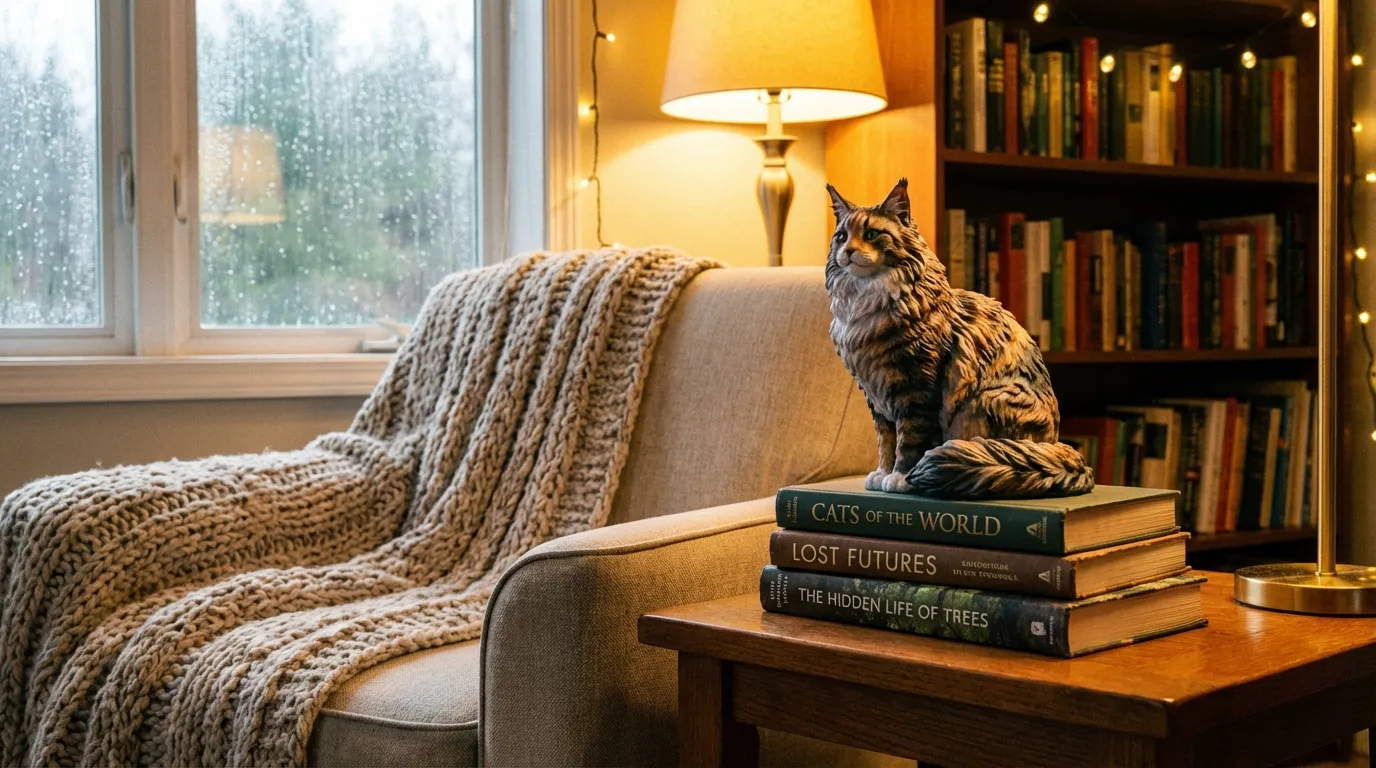
For centuries, humans have created effigies of loved ones. It is an ancient instinct to want to hold the form of the beloved. However, traditional pottery or generic statues often fail to capture the specific "Maine Coon-ness"—the square muzzle, the heavy bone structure, the specific way the tail plumes.This is where modern technology bridges the gap between memory and reality. At PawSculpt, we utilize advanced full-color 3D printing technology to create memorials that are as unique as the pet they honor. Unlike traditional hand-painted statues which can look interpretive or "folksy," our process involves digitally sculpting the pet's likeness based on your photos, and then printing the figurine in full-color resin.
The color isn't painted on top; it is built into the material, voxel by voxel (think of a 3D pixel). This allows for the reproduction of complex tabby patterns, subtle gradients in the ruff, and the specific eye color that a paintbrush simply cannot replicate. It captures the texture of the memory.
"We've seen families heal by holding something tangible. Grief needs an anchor."
— The PawSculpt Team
The "Living" Shelf
Instead of a somber shrine with a candle and an urn, create a "Living Shelf."- Include a custom figurine that represents them in a playful pose (not sleeping).
- Add a small vase where you put fresh flowers weekly (an active ritual).
- Include their collar, but leave it unbuckled, as if they just took it off.
Rituals of Maintenance: Keeping the Connection Alive
A continuing bond requires maintenance, just like a friendship. You must interact with the memory.
The Annual Letter
Write a letter to your Maine Coon on their birthday. Tell them about the year. Tell them about the new cat (if there is one) and how they don't measure up to the Maine Coon standards. This externalizes the internal monologue and validates that they are still a member of the family.The Donation Legacy
Maine Coons are often gentle giants. Honor that spirit by donating specifically to Maine Coon rescues or cardiac research foundations in their name. This turns the passive pain of loss into active hope for others.The "Shadow" Walk
If you used to walk your Maine Coon (as many owners of this dog-like breed do), walk that route alone. Don't avoid it. Notice the things they would have noticed—the birds, the squirrels. See the world through their eyes for twenty minutes. It is a profound way to share space with them again.Frequently Asked Questions
Is it normal to hear my deceased cat in the house?
Absolutely. This is known as "phantom auditory perception." Your brain has spent years filtering for specific frequencies—the heavy thud of paws, the scratch on the litter box, the specific pitch of a trill. When those sounds stop, the brain sometimes "fills in the gaps" from memory. It can be startling, but it is a testament to how deeply attuned you were to them.How long does acute grief for a pet last?
While grief has no expiration date, the "acute" phase—where functionality is difficult—typically lasts a few months. However, because Maine Coons have such distinct personalities and "person-like" presence, we often see owners processing the loss for a year or more. The "firsts" (first Christmas, first birthday without them) are usually the hardest hurdles.Should I get another Maine Coon immediately?
The silence of a home without a Maine Coon can be deafening. However, the danger of getting a new cat too soon is the "replacement trap." You might find yourself resenting the new kitten for not being Him. Wait until you are excited about meeting a new personality, rather than trying to resurrect the old one.How do I help my surviving cats grieve?
If you had a bonded pair, the surviving cat will likely show signs of depression (lethargy, not eating, wandering the house calling). Keep their routine iron-clad—feed them at the exact same time. The predictability offers safety when their social structure has collapsed.Ready to Celebrate Your Pet?
Every pet has a story worth preserving, but a Maine Coon's story is often larger than life. Whether you're honoring a beloved companion who has crossed the rainbow bridge or celebrating your furry friend's unique majesty, a custom PawSculpt figurine captures those structural details—the tufts, the ruff, the intelligent gaze—that make your pet one-of-a-kind.
Free instant AI preview • 3D artist preview within 7 days • 5 free revisions