
The Silence of No Howls: Coping With a Quiet House After Losing a Husky
A Siberian Husky’s howl can register at frequencies capable of traveling up to 10 miles across open tundra, but inside a suburban home, that sound does something more permanent—it rewires the acoustic expectations of your daily life. You are standing at the edge of the local dog park, hands deep in your pockets, watching a young Malamute mix argue vocally with its owner near the benches. The sound is a "woo-woo-woo" cadence that rises in pitch at the end, a defiant question rather than a bark. It hits you in the chest with the force of a physical blow. You realize, with sudden clarity, that your own house isn't just quiet; it is aggressively silent. The specific frequency of your life has been muted, and the brain struggles to process the absence of that opinionated, dramatic, demanding soundtrack.
Quick Takeaways:
- The "Phantom Howl" is real: Your brain is biologically conditioned to expect the noise, and the absence triggers a stress response similar to a phantom limb.
- You aren't just missing a pet; you're missing a roommate: Huskies are conversationalists. The loss involves losing a distinct personality that "talked back" to you.
- Silence amplifies guilt: The sudden drop in household chaos can bring a sense of relief that immediately triggers intense guilt. This is a normal, complex grief response.
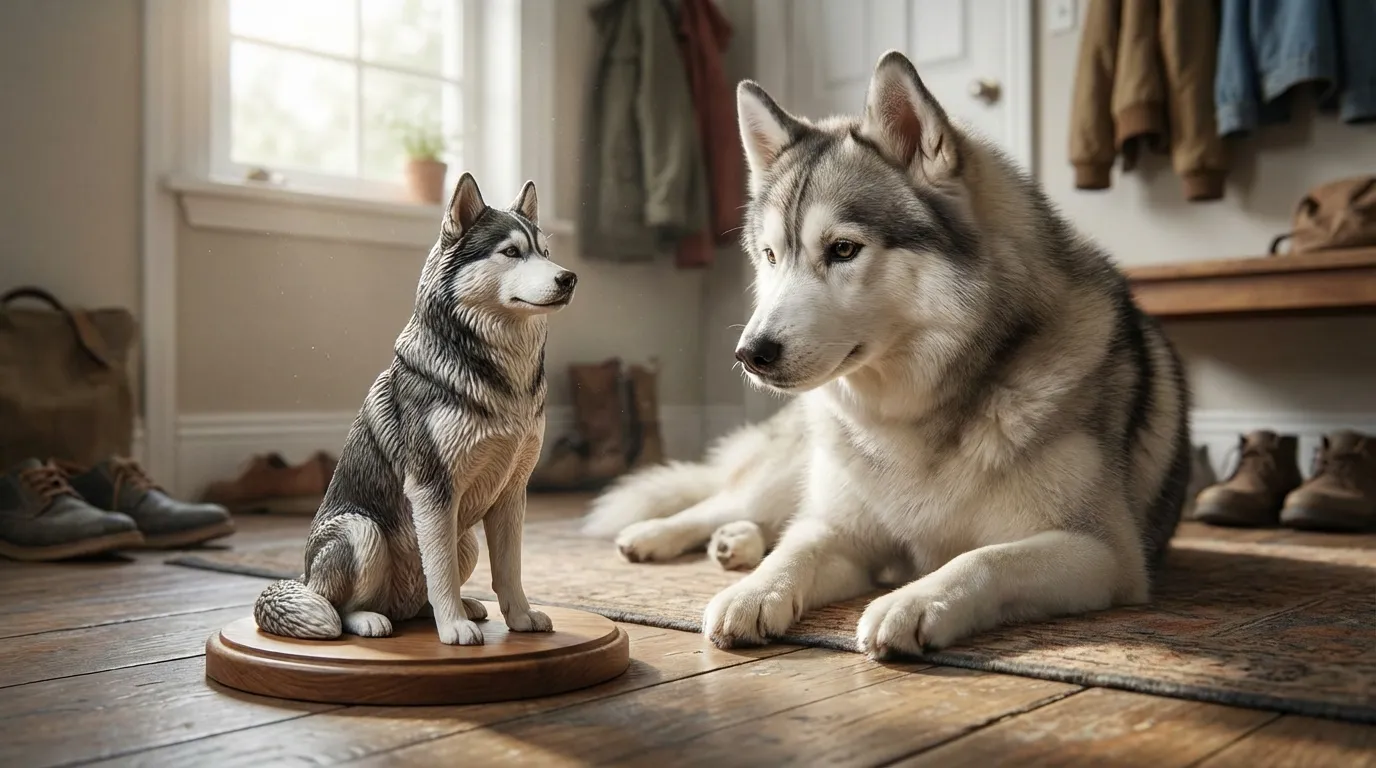
- Visuals trigger audio memory: Many owners find that 3D representations, like a custom figurine capturing their dog’s howling posture, help the brain "hear" the memory more clearly than flat photos.
- Reclaim the soundscape: You need to actively manage the noise levels in your home to help your nervous system downregulate.
The Neurobiology of the Quiet House
We often talk about grief as an emotion, but we rarely discuss it as a sensory processing disorder. When you live with a Husky, you live in a high-decibel environment. You grow accustomed to the click-clack of nails pacing, the heavy sigh of boredom, and the "talking"—that distinct vocalization that lies somewhere between a groan and a scream.
Your brain has spent years predicting these sounds. It anticipates the morning "woo" before the alarm goes off. It braces for the dramatic aria that occurs when you pick up the leash. When that input suddenly stops, your brain’s prediction engine fails. This creates a state of cognitive dissonance. The silence signals "something is wrong" to your primitive brain, keeping you in a state of low-grade fight-or-flight anxiety.
You aren't just sad; your nervous system is confused. You might find yourself startling at the refrigerator ice maker or the settling of the house foundation—sounds that were previously drowned out by the presence of a 50-pound wolf-dog. Acknowledging that your anxiety is partly a biological reaction to a changed sensory environment can be the first step in lowering your shoulders.
The Loss of the Argument
Here is the angle most pet loss guides miss: When you lose a Golden Retriever, you often miss the affection. When you lose a Husky, you miss the conflict.
That sounds counterintuitive, doesn't it? But Huskies are rarely obedient soldiers; they are partners who demand a seat at the negotiating table. They have opinions on when dinner should be served, which direction to walk, and how long you are allowed to be in the bathroom.
We worked with a family recently who told us the hardest part of their day was 6:00 PM. For twelve years, 6:00 PM was "The Argument." Their Husky, Luna, would stand by the back door and verbally berate them until they went outside, regardless of the weather. The father told us, "I used to get so annoyed at her backtalk. Now, I look at the clock at 6:01, and the air feels dead. I miss the fight. I miss having another consciousness in the house that challenged me."
You are grieving a dynamic relationship. You aren't just missing a dog that sat at your feet; you are missing a presence that filled the room with personality and demands. It feels less like losing a pet and more like a roommate moved out without saying goodbye, taking all the energy of the house with them.
The Taboo Emotion: Relief (and the Guilt That Follows)
Let’s be honest about something that few people want to admit in the comment sections of memorial posts. Huskies are a lot of work. They shed enough fur to build a second dog, they escape enclosures, they destroy drywall when bored, and they are loud.
Toward the end, if your Husky was battling illness, the "work" likely shifted from managing their energy to managing their care—medications, mobility assistance, incontinence.
When the end comes, there is often a moment of profound silence where you realize you don't have to rush home. You don't have to vacuum three times a day. You don't have to listen to the howling. And in that split second, you might feel a wave of relief.
Then, immediately, the guilt crashes down. How can I feel relieved? Did I not love them enough?
This cycle is brutal, but it is standard. The relief is your body’s reaction to the cessation of chronic stress and caretaking duties. It has zero correlation with how much you loved your dog. You can be devastated by the loss of your best friend and simultaneously relieved that they are no longer suffering—and that you are no longer in crisis mode. Allow the relief to exist without assigning moral judgment to it. It’s just your body exhaling.
Re-scoring Your Life's Soundtrack
Since the silence is the primary trigger for Husky owners, you cannot simply "wait it out." You have to actively manage the auditory landscape of your home. The goal isn't to erase the memory of their sound, but to stop the silence from feeling like an accusation.
1. The Background Noise Bridge
For the first few weeks, avoid total silence. The contrast is too high. Keep a podcast playing in the kitchen. Use a white noise machine in the bedroom. If you used to leave the TV on for the dog when you left the house, keep doing it for yourself. You are training your brain to stop scanning for the specific frequency of your dog's howl by providing a different baseline of noise.2. The "Talking" Hour
Identify the times of day your Husky was most vocal. Was it the morning greeting? The pre-dinner tantrum? These are your danger zones.- Change the routine: If the 5:00 PM feeding ritual was a scream-fest, do not be in the kitchen at 5:00 PM for the first week. Go for a walk. Run an errand. Break the synaptic association between that time/place and the sound.
- Ritualize the memory: Alternatively, lean into it. One of our clients lights a candle every evening at the time her Husky used to howl for dinner, playing a specific song instead. She replaced the "dog noise" with "memorial noise."
3. Audio Preservation
If you have videos of your Husky howling, back them up immediately. Cloud storage, external hard drive, and a USB stick in a fireproof box. The fear of forgetting the timbre of their voice is real. However, a word of caution: don't loop these videos constantly in the first stages of acute grief. It can keep your brain stuck in the "searching" phase. Save them for moments when you feel strong enough to smile at the memory, rather than break down.Visuals That Trigger the "Inner Ear"
There is a fascinating connection between visual stimuli and auditory memory. When you look at a flat photograph of your dog sleeping, you remember peace. But Huskies are dynamic. Their essence is often captured in motion—mid-howl, head thrown back, mouth forming that perfect "O" shape.
We have learned through our work at PawSculpt that three-dimensional representations trigger different memory centers than two-dimensional photos. When a family commissions a custom figurine of their Husky, they rarely choose a standard "sit-stay" pose. They send us screenshots from videos where the dog is arguing, sassing, or singing the song of their people.
Seeing the physical posture of the howl—the arched neck, the planted feet, the specific way the ears pin back—helps the brain "hear" the sound again. It turns a static memory into a multisensory one. It serves as a tangible anchor in a house that feels too empty, a physical reminder of the big, loud personality that once occupied the space.
When the Silence Finally Breaks
Eventually, the silence changes. It shifts from being a heavy, suffocating weight to a peaceful stillness. You will stop wincing when you drop a spoon in the kitchen. You will stop waking up at 6:00 AM waiting for the "woo-woo" alarm.
This transition can feel like a betrayal, as if you are moving on. You aren't. You are simply integrating the loss. The sharp edges of the grief are wearing down, becoming smooth enough to carry in your pocket.
You might even find yourself laughing again. You’ll see a video of another Husky throwing a tantrum on social media, and instead of crying, you’ll nod and think, “Yeah, I know exactly what that argument is about.”
The house is quiet, yes. But the echoes of their personality—the stubbornness, the drama, the absolute refusal to be ignored—those are loud enough to last a lifetime.
Frequently Asked Questions
Why does my house feel so much emptier after losing a Husky compared to other breeds?
Huskies are what we call "high-presence" dogs. They don't just exist in a room; they occupy it. Between the pacing, the shedding, and the constant vocalizations ("talking," howling, grumbling), they create a high-energy environment. When they pass, you are losing a significant source of auditory and kinetic stimulation. The contrast between a "Husky house" and a quiet house is much sharper than with quieter, more sedentary breeds.Is it normal to hear "phantom howling" after my dog has passed?
Yes, this is a very common phenomenon known as auditory hallucinations during bereavement. Your brain has spent years anticipating specific sounds at specific times. When the sound doesn't occur, your brain sometimes "fills in the gap" with a stored memory. It can be startling, but it is a normal part of the neurological processing of loss and typically fades within a few weeks.I feel guilty for enjoying the quiet. Does this mean I didn't love my dog?
Absolutely not. This is one of the most common, yet least discussed, aspects of pet grief. If your Husky was high-maintenance or ill for a long time, your body has been in a state of chronic stress. The feeling of relief is simply your nervous system downregulating; it is a physiological response, not a measure of your devotion. You can miss them desperately and still appreciate a full night's sleep.How can I memorialize my Husky's voice?
First, ensure all videos are backed up to the cloud—phones can break, but digital files can last forever. Some owners take the audio waveform of their dog's howl and have it tattooed or printed as wall art. Others find that visual cues help trigger the memory of the sound; keeping a custom figurine or a framed photo of them mid-howl can help you recall the specific sound of their voice when memory starts to fade.Honor Their Memory Forever
Your pet's story deserves to be preserved in a way that captures their unique spirit. A custom PawSculpt figurine transforms your cherished memories into a timeless keepsake—every whisker, every marking, every detail that made them irreplaceable.
Free instant AI preview • 3D artist preview within 7 days • 5 free revisions