The Skeptic's Case for a French Bulldog Figurine: When a Gift Outlasts Every Other Gesture
Sarah was merging onto the highway when her hand drifted to the passenger seat—reaching, out of habit, for the warm wrinkled skull that hadn't been there in six weeks. The phantom smell of corn chips and sun-warmed fur hit her before the grief did. That evening, she typed "french bulldog owner gift" into Google, searching for something to give herself permission to remember.
Quick Takeaways
- Most "unique" French Bulldog gifts aren't unique at all — the market is saturated with breed-silhouette mugs and generic prints that miss what makes your Frenchie irreplaceable
- The best gift for a Frenchie owner captures specifics — the exact ear tilt, the brindle pattern, the one crooked tooth
- Physical, three-dimensional keepsakes outperform flat media — they engage touch and spatial memory, which research links to stronger emotional recall
- A custom French Bulldog figurine preserves details photos can't — texture, posture, and personality rendered in full-color resin
- Timing matters more than budget — understanding when someone is ready for a memorial gift prevents well-meaning gestures from landing wrong
The Problem With "Unique French Bulldog Gifts" (And Why Most Aren't)
Type "unique french bulldog gifts" into any search engine and you'll get roughly 47 million results—nearly all of them lying to you. Socks with a cartoon Frenchie face. A doormat that says "A Spoiled French Bulldog Lives Here." Wine glasses etched with a breed silhouette that could be any of the 14 million French Bulldogs registered across the globe.
Here's the counterintuitive insight that most gift guides won't tell you: breed-themed merchandise celebrates the breed, not the dog. And for someone who's lost a Frenchie—or who loves one so fiercely that a gift needs to land with emotional precision—the breed isn't the point. The point is that dog. The specific architecture of those ears. The exact distribution of that brindle. The way that particular animal smelled like Fritos and dryer sheets after a nap on the couch.
Sarah—the woman from the highway—told us something that stuck: "Everyone kept sending me French Bulldog stuff after Hugo died. Pillows, calendars, a little resin statue from Amazon. They were sweet gestures. But none of them looked like Hugo. They looked like a French Bulldog. And honestly, that made me feel worse, because it reminded me that to most people, he was interchangeable."
That observation cuts to the heart of what separates a thoughtful gift from a well-meaning one. And it's the lens through which we're going to evaluate every option in this guide.
The Specificity Spectrum
Not all gifts carry the same emotional weight, and the variable that matters most isn't price—it's specificity. How closely does this object reflect the singular animal the recipient loves?
We think of it as a spectrum:
| Specificity Level | Gift Type | Example | Emotional Impact |
|---|---|---|---|
| Generic | Breed merchandise | French Bulldog socks, mugs | Low — celebrates the breed, not the dog |
| Semi-personal | Photo-based flat items | Photo pillow, canvas print, phone case | Medium — uses the right image but lacks dimension |
| Personalized | Name-engraved items | Collar-tag jewelry, name-embroidered blanket | Medium-high — acknowledges the individual, but visually generic |
| Highly specific | Custom 3D likeness | Full-color figurine, detailed portrait | High — captures posture, markings, expression, personality |
Most gift guides lump everything from "generic" to "highly specific" together and call them all "unique." They're not. And the person receiving the gift can feel the difference immediately.
What French Bulldog Owners Actually Want (Data Over Assumptions)
We've worked with thousands of pet families, and one pattern keeps emerging: the gifts people keep forever are almost never the ones they'd pick from a gift guide. The kept-forever gifts tend to be small, specific, and tied to sensory memory—a clay paw print that still carries the faintest trace of the dog's scent. A collar hung on a hook by the door. A figurine that catches the light at 7 a.m. the same way the dog used to catch it, sleeping in a sunbeam.
The American Kennel Club notes that French Bulldogs consistently rank among the most popular breeds in the United States—number one, in fact, as of their most recent data. That popularity creates a paradox for gift-givers: there's more Frenchie-themed merchandise available than ever, yet most of it feels mass-produced precisely because the breed is so popular. The market is flooded with generic options.
So what do Frenchie owners actually value? Based on patterns we've observed across orders, conversations, and follow-up messages, three factors matter most:
- Recognition of the individual dog's personality. Frenchies are clowns, couch potatoes, stubborn negotiators, anxious snugglers. Owners want a gift that says, "I see your dog, not just a dog."
- Tactile engagement. This surprised us. Flat gifts (prints, photos, digital art) get praised on social media but tend to migrate to drawers within months. Objects you can hold, turn over in your hands, and place in a specific spot in your home have significantly longer display lives.
- Durability that matches the permanence of love. This sounds sentimental, but it's practical: paper fades, fabric stains, and cheaply made resin chips. A gift meant to honor a bond that lasts a lifetime should have a material lifespan that reflects that.
"The best gifts don't just sit on a shelf—they start conversations and spark memories every time someone notices them."
— The PawSculpt Team
The Overlooked Emotional Logic of Three-Dimensional Keepsakes
Here's where it gets interesting. There's a concept in cognitive psychology called haptic memory—the way our brains encode and retrieve information through touch. When you hold a three-dimensional object that resembles your dog, you're activating a different neural pathway than when you look at a photograph. The weight in your hand, the shape under your fingers, the way light falls across a familiar silhouette—these cues access memories that flat images don't.
This isn't pseudoscience. Research from the NIH has explored how multisensory cues strengthen emotional memory retrieval, and the implications for keepsakes are significant. A photograph gives you one sensory channel (visual). A three-dimensional object gives you at least two (visual and tactile), and arguably three if the shape triggers olfactory associations—which, in our experience, it often does.
Sarah mentioned this unprompted. "The first time I held the figurine," she told us, "I swear I could smell Hugo. I know that's not logical. But my hands recognized the shape of his head, and suddenly I could smell his ears." Phantom scent triggered by tactile recognition. It's a phenomenon grief counselors have documented, and it's one reason why three-dimensional memorials carry outsize emotional significance.
A Gift Guide Built on the Specificity Principle
Rather than listing 25 items and calling them all wonderful—which is what you'll find on every other blog post ranking for "best gift for frenchie owner"—we're going to evaluate options through the specificity framework established above. Every item is judged not just on quality and price, but on how closely it captures a specific, individual French Bulldog.
We'll be honest about tradeoffs. Some of these gifts are excellent for what they are. Not every occasion calls for a deeply personal keepsake—sometimes a funny Frenchie mug is exactly right.
Custom French Bulldog Figurine
Who it's for: Someone grieving a lost Frenchie, celebrating a living one, or wanting to give the most emotionally resonant gift possible.
Budget: Varies by provider—visit individual makers for current pricing. For PawSculpt's full-color 3D-printed figurines, check pawsculpt.com for details.
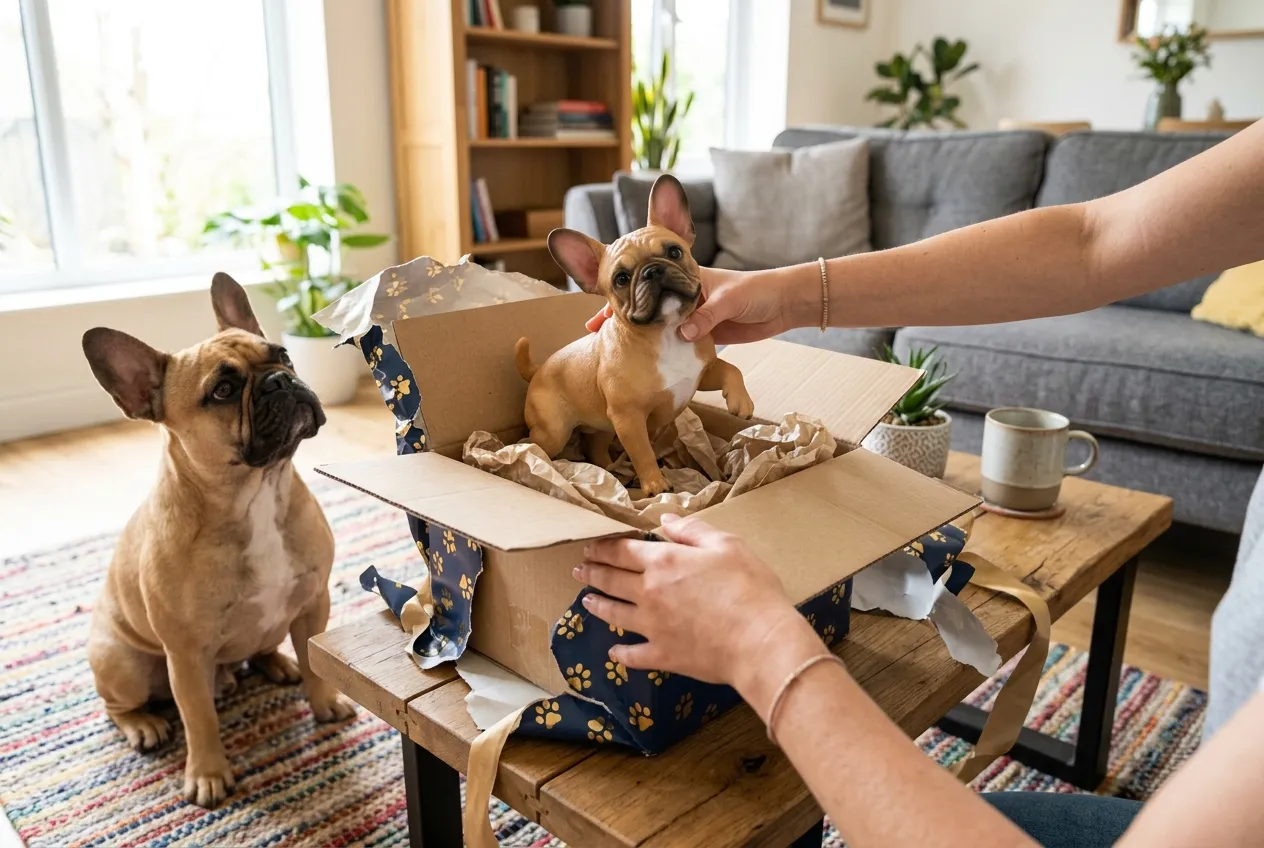
Why it stands out: A custom figurine captures what photos cannot: volume, posture, the specific way a Frenchie's ears fold when relaxed versus alert. PawSculpt's process starts with digital sculpting by master 3D artists who model from your photos, then prints the figurine in full-color resin using advanced 3D printing technology. The color isn't applied after the fact—it's embedded voxel by voxel directly into the material during printing. A clear coat finish adds UV protection and a subtle sheen. The result is a tangible, durable likeness with your dog's exact markings, coloring, and proportions preserved in the material itself.
Pro tip: Submit photos from multiple angles and in natural light. The more reference material the sculptor has, the more accurate the ear set, eye shape, and brindle pattern will be. Visit the PawSculpt website for specific photo guidelines and process details.
Custom Pet Portrait (Painted or Digital)
Who it's for: Someone who values wall art and has a specific aesthetic (watercolor, oil, pop art, etc.).
Budget: $30–$300+ depending on medium and artist.
Why it stands out: A good custom portrait captures expression and mood beautifully. The best portrait artists on platforms like Etsy can translate a photo into a piece of art that emphasizes your Frenchie's personality—the judgmental stare, the goofy tongue-out grin. The weakness is dimensionality: it's flat, it lives on a wall, and it doesn't engage touch or spatial memory the way a three-dimensional object does.
Pro tip: Ask to see the artist's previous French Bulldog work specifically. The breed's facial wrinkles, bat ears, and compact skull require an artist who understands brachycephalic proportions. A lot of pet portrait artists default to golden retriever anatomy and force every breed into that mold.
Personalized French Bulldog Jewelry
Who it's for: Someone who wants to carry their Frenchie's memory with them daily—literally on their person.
Budget: $20–$200+ depending on material (silver, gold, resin-embedded fur).
Why it stands out: Nose-print pendants, silhouette charms with actual ear outlines traced from photos, and lockets with micro-engraved portraits all rank high on the specificity spectrum. The best versions use your dog's actual physical attributes (nose print, ear shape) rather than a generic breed silhouette.
Pro tip: If you're considering a nose-print pendant, you'll need an ink impression or a high-resolution straight-on photo of the nose. Get this while your dog is alive if possible—it's nearly impossible to obtain after the fact, and the regret we hear from owners who didn't is palpable.
Breed-Themed Apparel and Accessories
Who it's for: The proudly obsessed Frenchie parent who wants the world to know it. Also great for casual, fun occasions (birthdays, holidays) where deep emotional resonance isn't the goal.
Budget: $15–$60.
Why it stands out: Honestly? It doesn't, emotionally. But that's okay. A well-designed French Bulldog hoodie or tote bag from a quality brand serves a different purpose: it's a social signal, a conversation starter, an identity marker. It says, "I'm a Frenchie person." For living-dog celebrations—a Gotcha Day, a birthday—this tier is perfectly appropriate and usually well-received.
Pro tip: Skip anything that says "French Bulldog Mom" in that particular font. You know the one. Your recipient almost certainly already has three of them.
Donation in Their Name
Who it's for: The Frenchie owner who already has everything, or who has expressed that they'd rather honor their dog's memory through action.
Budget: Any amount.
Why it stands out: Organizations like the French Bulldog Rescue Network do meaningful work with a breed that faces significant health challenges. A donation in a lost dog's name carries real-world impact. The limitation is that it's intangible—there's nothing to hold, display, or return to when you need a moment of connection.
Pro tip: Pair it with something physical, even something small. A card with a printed photo and a note explaining the donation hits both the emotional and practical marks.
"A gift isn't measured by what it costs. It's measured by how precisely it says, I knew your dog, and your dog mattered."
The Comparison Nobody Makes: Gift Longevity vs. Emotional Half-Life
Here's a framework we've never seen in any gift guide, and it's the one that matters most for memorial and sentimental gifts: emotional half-life.
In physics, half-life describes the time it takes for half of a substance to decay. In gift-giving, emotional half-life is the period after which a gift's emotional impact has diminished by roughly fifty percent. Some gifts spike high and fade fast (think: the thrill of unwrapping a funny mug). Others build slowly and barely diminish at all.
| Gift Type | Initial Emotional Impact | Emotional Half-Life | Display Longevity | Specificity |
|---|---|---|---|---|
| Funny breed socks | High (novelty) | 2–4 weeks | Until they wear out | Generic |
| Photo canvas | Medium-high | 6–12 months (tends to blend into décor) | Years, but often relocated | Semi-personal |
| Custom portrait | High | 1–3 years | Years if prominently placed | Personalized |
| Custom 3D figurine | Very high | 5+ years (often increases) | Indefinite with proper care | Highly specific |
| Nose-print jewelry | High | 3–5 years | Daily wear = constant | Highly specific |
| Memorial donation | Medium (intangible) | Variable | N/A | Personalized |
The insight here is that custom figurines and wearable keepsakes are the only categories where emotional half-life can actually increase over time. A figurine becomes more meaningful as years pass, because it becomes the most accurate remaining representation of an animal whose features are fading in memory. Photographs flatten. Mental images blur. But a three-dimensional object preserves spatial relationships—the ratio of ear height to skull width, the exact curve of a tail, the depth of a chest—that the human brain struggles to retain on its own.
We'll be real: we're biased. We make figurines. But we're presenting this framework because we genuinely believe it's the right way to think about sentimental gifts, and we've watched it play out across enough orders to feel confident in the pattern.
Timing: The Variable Most Gift Guides Ignore Entirely
Most articles about gifts for grieving pet owners focus on what to give. Almost none address when. And timing can be the difference between a gift that brings comfort and one that reopens a wound.
The Three Windows
Based on patterns we've observed working with families in grief, there are three distinct windows for memorial gifts, each with different emotional dynamics:
Window 1: The First Two Weeks (Acute Grief)
During acute grief, most people don't want objects. They want presence. A text that says "I'm thinking about Hugo today" lands better than a package on the doorstep. If you do give a gift in this window, keep it functional and immediate: a meal delivery, a handwritten card, flowers. Anything that requires the recipient to process a representation of their dog (a portrait, a figurine, a custom item) can feel overwhelming.
The exception: if the person explicitly asks for it. Some people cope through action and will commission a memorial piece within days. That's valid. But don't assume it.
Window 2: Weeks 3–12 (The Forgotten Period)
This is the window most people miss entirely, and it's the most important one. The cards have stopped. The texts have slowed. Friends have stopped asking. But the grief hasn't diminished—in many cases it's intensified, because the numbness of acute grief has lifted and the full weight of absence has settled in.
A gift arriving in this window carries a specific message: I haven't forgotten. Your dog still matters. Your grief is still valid. This is, in our experience, the optimal time for a custom figurine or portrait. The recipient has had enough distance to appreciate a likeness without being gutted by it, but not so much distance that the gesture feels belated.
Window 3: The Anniversary (and Beyond)
The first anniversary of a dog's passing is brutal. It's also the moment when most people have zero support, because everyone else in their life has moved on. A gift timed to this date—especially one that shows you remembered the specific date—is profoundly meaningful.
Sarah's figurine arrived on what would have been Hugo's fifth birthday, roughly four months after his passing. "The timing was everything," she told us. "If it had come the week he died, I would have sobbed and put it in a drawer. But by his birthday, I was ready to see him again. I put it on the mantle and I felt something I hadn't felt in months—like he was still here, in some small way."
A Note on Gifts for Living Dogs
Not every custom french bulldog figurine is a memorial. Some of the most joyful orders we process are celebrations of dogs who are very much alive—birthday gifts, adoption anniversary markers, or simply a "because I love this ridiculous creature" gesture. The emotional dynamics are completely different: there's no timing minefield, no risk of reopening wounds. The only consideration is whether the recipient is the type who appreciates sentimental objects or would rather have something practical.
When in doubt, ask. Subtlety is overrated when the goal is making someone happy.
The Skeptic's Objection (And Why It Dissolves)
Let's address the elephant in the room—or, more accurately, the skeptic at the dinner table.
"It's just a figurine." "You're spending money on a statue of your dog." "Isn't that a little... much?"
We've heard every version of this objection. And here's what's interesting: the skeptics are almost always people who haven't lost a pet, or people who haven't yet formed the kind of bond that French Bulldogs, specifically, tend to create.
Frenchies are unusual in the depth of attachment they generate. They're not independent cats who grace you with occasional affection. They're not energetic retrievers who love everyone equally. French Bulldogs are imprinting animals—they choose their person, they attach with velcro-like intensity, and they spend approximately 23.5 hours per day within arm's reach of that person. The bond is almost oppressively close. And when it breaks, the absence is physical. You feel it in the empty weight beside you on the couch. You smell it in the pillow that still carries their particular corn-chip-and-warm-skin scent. You hear it in the missing snore at 3 a.m.
"Grief doesn't need your permission to be enormous. Neither does the love that caused it."
A figurine isn't "just" a figurine for the same reason a wedding ring isn't "just" a ring. The object is a physical anchor for an emotional reality. It gives grief—and love—a place to live outside your head. It converts the abstract ("I miss my dog") into the concrete (a specific shape you can see and touch and place on your desk where it catches the morning light).
The skeptic's objection dissolves the moment they hold one. We've seen it happen dozens of times. Someone picks up a figurine—not even of their own dog—and their face changes. Because the brain recognizes what it's looking at: not a generic object, but a specific animal rendered with enough fidelity to trigger recognition, and with it, emotion.
What Makes a Custom Figurine Worth It: The Technical Details That Matter
If you're considering a custom french bulldog figurine—for yourself or as a gift—there are technical factors that separate excellent keepsakes from mediocre ones. Most gift guides skip this entirely, because it requires understanding the manufacturing process. We won't skip it.
Material Matters More Than You Think
The material a figurine is made from determines three things: color accuracy, durability, and tactile quality.
Full-color resin (the material PawSculpt uses) embeds pigment directly into the substrate during printing. There is no surface coating that can chip, peel, or fade independently of the object itself. The color is the material. This matters enormously for French Bulldogs, whose coats display complex patterns—brindle layering, pied markings with irregular borders, the subtle gradient from fawn to cream on a belly. These patterns require voxel-level color accuracy that surface-applied pigments simply can't match.
Traditional painted resin (what most budget figurines use) starts as a white or gray blank and receives color through manual or spray application. The paint sits on top of the material. Over time—especially with handling—paint layers can separate, chip, or yellow. If someone will be picking up and holding this figurine regularly (and they will, if the likeness is good), surface paint is a liability.
Polymer clay figurines can be beautiful but are inherently fragile. A fall from shelf height onto a hard floor will almost certainly cause damage. For a keepsake intended to last decades, this is a meaningful limitation.
The Digital Sculpting Process
PawSculpt's figurines begin as digital sculptures—3D models built by artists with years of experience in organic form modeling. The sculptor works from your photos, building the dog's likeness polygon by polygon in specialized software. This digital-first approach allows for revisions before any physical material is committed, which means the figurine you receive has already been reviewed and approved in virtual form.
The sculpted model is then sent to a full-color 3D printer, which builds the figurine layer by layer in pigmented resin. The only manual post-processing step is applying a clear protective coat that adds UV resistance and a subtle sheen. That's it. No painting. No airbrushing. The technology reproduces fur patterns, eye color, and marking boundaries with a fidelity that manual processes struggle to achieve at this scale.
For specifics on the process—turnaround time, revision options, pricing—visit pawsculpt.com directly. We'd rather you see the current details than quote something that might be outdated by the time you read this.
What Photos to Submit (And Why It Matters)
The quality of a custom figurine is directly limited by the quality of the reference photos. This is the single most controllable variable in the entire process, and it's where most people underinvest effort.
Here's what makes a reference photo useful versus useless:
- Useful: Natural light. Dog at eye level. Multiple angles (front, both sides, rear, top-down). Relaxed posture. Clear visibility of markings and eye color.
- Useless: Flash photography. Extreme close-ups without context. Single angle only. Dog mid-motion with blurred features. Heavy filters or editing.
For French Bulldogs specifically, three details matter disproportionately: ear position (are they naturally upright or do they flop slightly?), facial wrinkle depth and pattern, and the exact color of the eyes (Frenchie eyes range from dark brown to amber to the occasional blue in merle coats, and getting this wrong ruins the likeness).
If the figurine is a memorial and you're working from existing photos, don't panic if your collection isn't ideal. Experienced sculptors can extrapolate from imperfect references—that's part of the skill. But if your Frenchie is alive, take the reference photos now. Today. In good light, from five angles, with treats for bribery. You'll thank yourself later whether you order a figurine this year or in ten years.
The Gifts That Fail (And What They Tell Us About Intention)
We're going to say something that other gift guides won't: some gifts backfire, and it's worth understanding why.
The most common failure mode isn't poor quality—it's mismatched specificity. A generic breed-themed gift given to someone in deep grief communicates, unintentionally, that the giver didn't understand the depth of the bond. It says "I know you liked French Bulldogs" when the recipient needed to hear "I know you loved Hugo."
The second most common failure is timing (covered above). The third is projection—giving a gift that serves your emotional needs rather than the recipient's. This shows up most often as premature memorial gifts given by people who are uncomfortable with someone else's grief and want to "fix" it with a gesture.
Here's a quick framework for matching gift specificity to the occasion:
| Occasion | Appropriate Specificity Level | Example |
|---|---|---|
| Casual birthday gift | Generic to semi-personal | Breed-themed apparel, funny mug |
| "Just because" for a Frenchie parent | Semi-personal to personalized | Photo-based item, name-engraved piece |
| Adoption anniversary / Gotcha Day | Personalized to highly specific | Custom portrait, custom figurine |
| Pet loss (immediate) | Keep it simple | Card, flowers, meal delivery |
| Pet loss (3–12 weeks) | Highly specific | Custom figurine, nose-print jewelry, commissioned portrait |
| Pet loss anniversary | Highly specific + timed intentionally | Custom figurine with a note acknowledging the date |
The pattern is clear: the deeper the emotional stakes, the higher the specificity needs to be. Generic gifts are fine for casual occasions. But when someone is grieving, or when you're trying to communicate "I see the specific animal you love," generic doesn't cut it.
The Case, Fully Made
We started with a skeptic's framing—"The Skeptic's Case for a French Bulldog Figurine"—because we think the best arguments survive scrutiny.
Here's the case, summarized:
- Most gifts for French Bulldog owners optimize for the wrong variable (price, novelty, or breed recognition) instead of the right one (specificity to the individual dog).
- Three-dimensional keepsakes activate tactile and spatial memory pathways that flat media cannot reach, resulting in stronger and longer-lasting emotional connections.
- The emotional half-life of a custom figurine increases over time, making it one of the only gifts that becomes more meaningful as years pass—precisely because memory fades and the figurine doesn't.
- Timing and specificity matter more than budget. A perfectly timed, highly specific gift at any price point outperforms an expensive but generic one.
- The skeptic's objection ("it's just a figurine") misunderstands the function of physical objects in emotional processing. We anchor love and grief in tangible things because our brains are wired to do so.
Sarah keeps Hugo's figurine on the console table by her front door. Every morning, on her way out, she touches the top of his head. It takes half a second. She's told us the gesture is identical to the one she performed thousands of times when Hugo was alive and sleeping in the hallway—a quick pat, a murmured "bye, buddy," and out the door.
The figurine didn't replace Hugo. Nothing could. But it gave her muscle memory a place to land. And that, for her, was enough.
The faint corn-chip smell she swears she catches sometimes? That's between her and her brain. We just made the shape.
Frequently Asked Questions
What is the best gift for a French Bulldog owner?
It depends entirely on the occasion and the depth of the bond you're honoring. For casual celebrations, breed-themed apparel or accessories work fine. For memorial gifts or deeply sentimental occasions, custom keepsakes that capture the specific dog—figurines, nose-print jewelry, or commissioned portraits—carry significantly more emotional weight. The key variable is specificity, not price.
How much should I spend on a custom French Bulldog figurine?
Pricing varies widely across providers, depending on size, material, and level of customization. Rather than fixating on a dollar amount, focus on what matters: material durability, color accuracy, and the sculptor's ability to capture your dog's individual features. Visit makers' websites directly for current pricing—PawSculpt lists full details at pawsculpt.com.
What photos work best for ordering a custom pet figurine?
Multiple angles in natural light with your dog in a relaxed posture. For French Bulldogs specifically, you'll want clear shots showing ear position (upright vs. slightly folded), facial wrinkle patterns, and eye color. Avoid flash photography, heavy filters, and single-angle submissions. Five good reference photos from different angles will dramatically improve the final result.
When is the right time to give a memorial gift after a pet dies?
The 3-to-12-week window is often the sweet spot. In the first two weeks, grief is typically too raw for objects that represent the lost pet—stick to cards, meals, and simple presence. By weeks three through twelve, the initial support from friends has faded but the grief hasn't, making a thoughtful memorial gift especially meaningful. Anniversary dates are also powerful.
Are custom pet figurines really worth the cost?
From a purely emotional-longevity perspective, they're among the highest-return gifts you can give. Unlike consumable gifts or novelty items that lose impact within weeks, a well-made custom figurine's emotional significance tends to increase over time. As mental images of the pet naturally fade, the figurine becomes the most spatially accurate remaining representation—a physical anchor for memories that would otherwise blur.
What makes PawSculpt figurines different from other pet figurines?
PawSculpt uses full-color 3D printing technology that embeds pigment directly into the resin during fabrication—the color is part of the material, not a coating on top. This means your Frenchie's brindle pattern, pied markings, or fawn coloring won't chip, peel, or separate from the figurine over time. The only manual step is applying a protective clear coat for UV resistance and sheen. For full process details, visit pawsculpt.com.
Ready to Celebrate Your French Bulldog?
Whether you're searching for the perfect french bulldog owner gift, honoring a Frenchie who's crossed the rainbow bridge, or freezing a moment in time for the bat-eared weirdo currently snoring on your lap—a custom PawSculpt figurine captures the details that make your dog irreplaceable. Not a generic breed silhouette. Your dog. Their ears, their markings, their particular brand of dignified absurdity, rendered in full-color resin that lasts.
Visit pawsculpt.com to explore the full process, photo guidelines, and current options